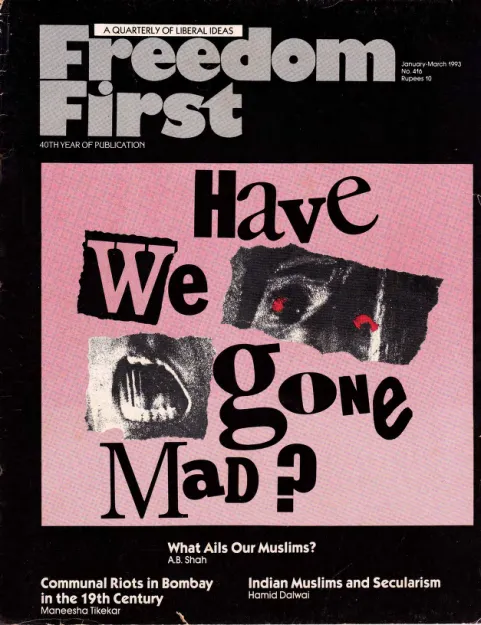
periodical issue
Freedom First
A Quarterly of Liberal Ideas
By S. V. Raju
Democratic Research Service, 4th floor, Maneckji Wadia Bldg., 127, Mahatma Gandhi Road, Bombay 400 023 — Published by J.R. Patel for the Democratic Research Service and printed by him at Parsiana Publications Pvt. Ltd., 300 Perin Nariman Street, Bombay 400 001 · Bombay · 1993
52 pages
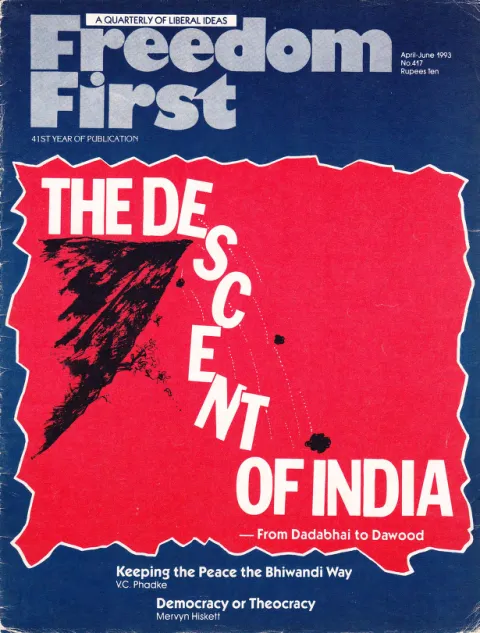
Freedom First
Summary
This April-June 1993 issue of Freedom First (No. 417, 41st year of publication) is organized around a cover package titled “The Descent of India — From Dadabhai to Dawood,” responding to the March 1993 Bombay bomb blasts and the preceding December 1992-January 1993 communal riots following the Babri Masjid demolition. The editorial (“Between Ourselves” by S.V. Raju and R. Srinivasan) frames the issue as a delayed response to the bombings, which forced postponement of a planned seminar on “The Role of the State in a Market Economy.” The lead essays, by R. Srinivasan and S.V. Raju, argue that the bomb blasts exposed a decades-long criminalisation of Indian politics, tracing its roots to the Licence-Permit-Quota Raj of Nehru’s Second Five Year Plan and documenting, through contemporary press reports, the extensive criminal records of sitting municipal corporators and MLAs, including the alleged Dawood Ibrahim-politician nexus in Bombay’s Vasai-Virar belt. In the rendered pages, the volume also carries a tribute to the Sarajevo newspaper Oslobodenje (nominated by the Indian Liberal Group for the Liberal International 1993 Prize for Freedom), a report on how Bhiwandi’s police-community model preserved communal peace during the 1992-93 riots (V.C. Phadke), an essay on the incompatibility of Islamic theocratic instincts with secular pluralist democracy in Britain, India, Pakistan, Sudan and Nigeria (Mervyn Hiskett), and, under the ‘Masani Viewpoint’ feature, a piece by A.G. Philip questioning whether Hindutva and Shiv Sena-style politics can serve national integration.
Key points
-
R. Srinivasan’s “The Criminalisation of Politics in India” argues the March 1993 Bombay bomb blasts confirmed a long-recognised trend, tracing it from election-cost financing through the Emergency-era Youth Congress to today’s criminal-politician nexus.
-
S.V. Raju’s “Criminal Politicians or Political Criminals?” documents corporators and MLAs across Bombay, Aurangabad and Nagpur facing criminal charges, including alleged links between Vasai-Virar politician Hitendra Thakur’s family and Dawood Ibrahim, and favours the 1957 Second Five Year Plan’s licence-permit-quota regime as the root cause.
-
V.C. Phadke’s “Keeping the Peace the Bhiwandi Way” explains why Bhiwandi, despite past riots, stayed peaceful during the December 1992-January 1993 violence, crediting mohalla committees and joint Hindu-Muslim patrols as a replicable “Bhiwandi Model.”
-
Mervyn Hiskett’s “Democracy or Theocracy” argues a recurring Islamic predisposition against secular pluralism has produced conflict from Partition-era India to 1980s Nigeria and Sudan, citing the Indian Muslim League’s rejection of Gandhian secular nationalism.
-
A.G. Philip’s piece under “The Masani Viewpoint” argues Hindutva-style politics is a mobile prejudice that merely finds new targets, comparing the Shiv Sena’s shift from south Indians to Muslims with Pakistan’s turn against Bengalis after Partition.
-
The issue also tributes the Sarajevo newspaper Oslobodenje, nominated by the Indian Liberal Group for the Liberal International 1993 Prize for Freedom.
Essays
The Criminalisation of Politics in India
By R. Srinivasan
R. Srinivasan’s opening essay argues, in the rendered pages, that the March 1993 Bombay bomb blasts confirmed a long-recognised criminalisation of Indian politics. He traces the process from an idealistic post-independence generation of politicians to the corrupting pressures of election financing, which pushed politicians into dependence on ‘vote deliverers’ and musclemen; over time these criminal enforcers stopped working behind the scenes and began winning public office themselves. The essay singles out the Emergency of 1975 and the Youth Congress clique around Sanjay Gandhi as an apogee of this trend, and closes with proposed remedies: state financing of elections, civic education, support for grassroots anti-corruption movements, and public recognition for honest officials.
- Argues the criminalisation of Indian politics is a settled fact, not a matter of dispute, confirmed by the March 12, 1993 Bombay blasts
- Cites Rajni Kothari’s long-standing warnings about this trend as prescient but unheeded
- Identifies election-cost financing as the ‘thin edge’ through which criminal money entered politics, alongside intimidation, booth capturing and kidnapping
- Describes the Emergency-era Youth Congress as a turning point where political criminality became entrenched
- Proposes remedies in the rendered pages, including state-funded elections, civic education campaigns, and public support for anti-corruption grassroots movements
Criminal Politicians or Political Criminals?
By S.V. Raju
S.V. Raju’s essay argues that criminals in India have moved from manipulating politicians behind the scenes to directly winning public office themselves, so that ‘goondas’ now hold elected positions rather than merely controlling those who do. He surveys competing accounts of when this rot began (1947, the 1957 Second Five Year Plan, Indira Gandhi, or Sanjay Gandhi) and personally favours the Second Plan’s licence-permit-quota regime as the root cause, since it created lucrative rents that a new class of smugglers, black-marketeers and ‘dons’ arose to capture. The essay then presents an extensive dossier of press-sourced examples of corporators and MLAs across Bombay, Aurangabad and Nagpur facing criminal charges (from Thane politician Hitendra Thakur’s alleged links to Dawood Ibrahim, to dozens of corporators with pending criminal trials), and closes by citing national crime statistics showing a rising, unpunished tide of crime in India.
- Frames the March 1993 blasts as the moment India’s ‘descent’ became undeniable, with criminals now openly holding elected office rather than working through proxies
- Surveys four competing ‘milestone’ theories for when political criminalisation began, favouring the 1957 Second Five Year Plan’s licence-permit-quota system
- Documents specific cases: Hitendra Thakur (Vasai-Virar), alleged links between his brother ‘Bhai’ and Dawood Ibrahim; Ahmed Ali alias Sher Khan of Agra facing 25+ criminal cases while nominated to a government council
- Cites Aurangabad and Nagpur municipal corporators with dozens of pending criminal cases including murder, dacoity, and kidnapping charges
- Closes with an ‘Mera Bharat Mahan’ sidebar citing national crime-clock statistics: one cognizable crime every seven seconds, rising female criminality (362% increase 1971-1990), and a sharp increase in left-wing extremist and terrorism-related violence
Keeping the Peace the Bhiwandi Way
By V.C. Phadke
V.C. Phadke’s essay explains why Bhiwandi, a powerloom town near Bombay known for prior communal riots, remained peaceful during the December 1992-January 1993 violence that convulsed Bombay after the Babri Masjid demolition. He credits a sustained, decades-long programme of police-community cooperation begun after the 1984 riots: mohalla committees in all 70 municipal wards, joint Hindu-Muslim patrols, advance intelligence-gathering (nakabandis), suspension of cable TV to prevent inflammatory Ayodhya visuals from provoking residents, and confidence-building events such as a mushaira attended by 25,000 people of both communities. Phadke calls this the ‘Bhiwandi Model’ and recommends it be replicated in other communally sensitive parts of India.
- Bhiwandi, despite past riots in 1970 and 1984, stayed largely peaceful through the December 1992-January 1993 communal violence that hit Bombay
- Credits a sustained police-citizen cooperation programme built by successive Deputy Commissioners of Police (K.P. Gaekwad, Suresh Khopde, Gulabrao Pol) since 1984
- Describes mohalla committees of 25 members each across all 70 municipal wards as the backbone of the model
- Cites specific preventive measures around the Babri Masjid demolition: disconnecting cable TV dish antennas, patrolling by political/social leaders and committee members, and rapid police response promises
- Concludes by calling this the ‘Bhiwandi Model,’ worth emulating nationally, while cautioning it depends on mutual trust and both communities shedding prejudice
Democracy or Theocracy
By Mervyn Hiskett
Mervyn Hiskett’s essay, in the pages seen, argues that a recurring Islamic predisposition — an inability to reconcile with secular pluralism, religious diversity and universal adult suffrage — has repeatedly produced conflict wherever Muslim populations have confronted democratic, pluralist states. He traces this from the 1993 proposal for a ‘Muslim Parliament’ in Britain back through the Indian Muslim League’s rejection of Gandhi- and Nehru-style secular pluralism (contrasted with M.A. Ansari’s failed accommodationist stance), Jinnah’s Fourteen Points, and 1906-1929-era Muslim deputations demanding special constitutional status, culminating in Partition. He extends the argument to northern Nigeria’s 1983 coup following anti-secular-democracy protests at Bayero University and to Sudan’s turn toward an anti-democratic Islamist elite corps, situating Sheikh Shabbir Akhtar’s ‘Be Careful with Muhammad’ as a contemporary British instance of the same impulse.
- Opens from a 1991 London Times report on a proposed ‘Muslim Parliament’ in Britain, framed as an early sign of separatist sentiment likely to recur as British Muslims gain confidence
- Argues Islamic dhimma tradition is structurally incompatible with equal-citizenship secular pluralism, tolerating non-Muslims only as tribute-paying subjects, not political equals
- Traces the Indian case from M.A. Ansari’s failed attempt to reconcile Muslim politics with Gandhian secular nationalism, through Jinnah’s Fourteen Points, to the 1947 Partition
- Cites 1906 and 1929-era Muslim deputations to British colonial authorities (to Minto, and around the 1920s) rejecting universal suffrage as alien to Islamic theocratic values
- Extends the argument internationally to Nigeria (1983 Bayero University protests and coup) and Sudan (post-colonial turn to an anti-democratic Islamist elite), and cites Sheikh Shabbir Akhtar’s book as a British parallel
Essay 19
Under the ‘Masani Viewpoint’ feature, A.G. Philip’s piece (courtesy The Sunday Observer) argues that Hindutva, like the intolerance it claims to oppose, is not a genuine force for national integration but a mobile prejudice that finds ever-new targets. Using the Shiv Sena’s shifting targets (south Indians, then Muslims) as the primary example, and drawing a parallel to how West Pakistan’s dominant elite turned on East Pakistan’s Bengalis after Partition, the essay contends that both the Sena and the BJP’s linguistic and religious chauvinism threaten to fragment India’s unity rather than strengthen it, contrasting India’s historical accommodation of linguistic-state demands with Pakistan’s suppression of Bengali demands that led to Bangladesh’s secession.
- Argues intolerance is a state of mind that persists after a theocratic or ethno-nationalist state is established, merely finding new targets (using post-Partition Pakistan’s turn against Bengalis as the model case)
- Traces the Shiv Sena’s shifting targets from south Indians in the 1960s Bombay to Muslims across Maharashtra, arguing the shift was a strategic, marketing-driven choice, not a change in the underlying intolerance
- Compares the BJP’s Jan Sangh-era demand for Hindi imposition to the Sena’s linguistic chauvinism, questioning whether Hindutva politics can accommodate India’s linguistic and ethnic diversity
- Contrasts India’s relatively successful accommodation of linguistic-state demands (e.g., Tamil Nadu, DMK) with Pakistan’s suppression of Bengali demands, crediting this flexibility with keeping India united while Pakistan broke apart
- Concludes that a Hindutva-based unitary government, if the Sena and BJP overcame their rivalry, would risk repeating Pakistan’s mistake of intolerance toward internal diversity
Generated by the v1.5 extraction pipeline. Awaiting editorial review.
Metadata and summary are AI-extracted from the source PDF and reviewed for editorial accuracy. The original work is available via the Read PDF tab above (where present); paragraph-level citation inside the PDF is deferred to a future engagement.