periodical issue
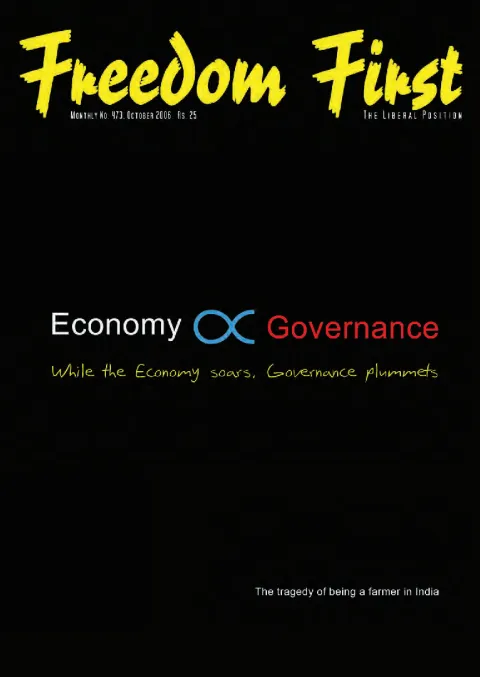
Freedom First
A Quarterly of Liberal Ideas
Published by J. R. Patel for the Democratic Research Service and printed by him at Parsiana Publications Pvt. Ltd., 300 Perin Nariman Street, Bombay 400 001. · Bombay · 1994
52 pages
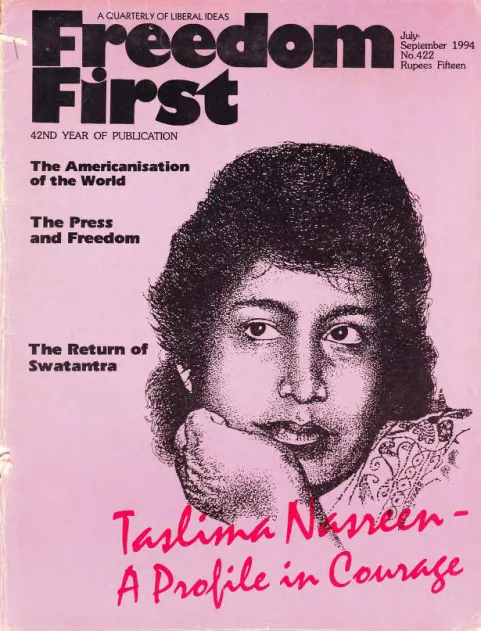
Freedom First
Summary
This July-September 1994 issue of Freedom First (No. 422, 42nd year of publication) opens with editor S. V. Raju and R. Srinivasan praising Bangladeshi writer Taslima Nasreen for confronting religious fundamentalism, and reports on Sharad Joshi’s May 1994 meeting (convened in response to Minoo Masani’s appeal) that led to the founding of a new political party, Swatantra Bharat, with a detailed thirty-point transitional programme for reversing what it calls the damage of the “Nehruvian regime.” The bulk of the rendered pages is given over to Taslima Nasreen: a biographical profile by V. K. Sinha, her own essay and poems, Gwynne Dyer’s piece on “Islamic Feminism,” and a sidebar chronicling worldwide incidents of religious-bigot threats to free speech. Other rendered pieces cover the Shetkari Mahila Aghadi’s Lakshmi-Mukti movement to transfer agricultural land titles to farmers’ wives in Maharashtra, Dilip Thakore’s critique of India’s poor showing in the 1994 Human Development Report, and the opening pages of Rajesh M. Basrur’s essay on Indian national identity, cut off mid-argument.
Key points
-
S. V. Raju’s “The Return of Swatantra” reports on Sharad Joshi’s founding of the new political party Swatantra Bharat, prompted by Minoo Masani’s appeal, with a thirty-point transitional programme covering law and order, pruning the state, and privatisation.
-
V. K. Sinha’s profile of Taslima Nasreen presents her as a Bangladeshi physician and writer facing a fundamentalist fatwa and bounty over her novel Lajja, arguing, via Philip Green, that free speech is constitutive of democracy while religious sentiment is merely incidental to it.
-
Gwynne Dyer’s “Islamic Feminism” contrasts female heads of government in Pakistan, Bangladesh and Turkey with ongoing fundamentalist violence in Algeria, Egypt and Sudan.
-
An unsigned report on the Shetkari Mahila Aghadi’s Lakshmi-Mukti movement describes the transfer of agricultural land titles to rural housewives in Maharashtra, with over a thousand villages qualifying by February 1992.
-
Dilip Thakore’s “A Testimony of Shame” reviews the UNDP’s 1994 Human Development Report ranking India 135th of 173 nations, blaming the “mother of all errors” — the centrally planned socialist model — for entrenching an “amoral” middle class in political power.
-
Rajesh M. Basrur’s essay on Indian national identity, cut off mid-argument, argues the real sources of national unease over Assam, Punjab, Kashmir and Ayodhya lie within Indian society rather than external threats.
-
“Of Cabbages & Kings” recounts the parable of “Sami,” a self-censoring journalist, and the case of Egyptian professor Dr. Nasr Abu-Zaid, blocked from promotion and accused of apostasy.
Essays
Many Voices
A compilation of quoted remarks from public figures and newspapers of mid-1994, ranging from a Swatantra-flavoured jab at INTEL’s Craig Barrett on competitiveness to Kanshi Ram’s advice on defecting legislators, comments on Bombay’s goonda raj, a controversial quote from Kapileshwaranand Saraswati about women reciting the Vedas, and BJP MP Uma Bharati’s remark linking a mosque at Ayodhya to a temple at Mecca.
- A curated “quotes of the quarter” column drawing on Indian and international press
- Includes barbed political commentary on corruption, crime, and party defections in India
- Features a controversial remark on women and the Vedas from a religious figure
- Closes on a note about free trade eclipsing ideology in India and China
Of Cabbages & Kings
An editorial column (byline “RS”) on censorship in the Arab world, opening with the fable of “Sami,” a fictionalised journalist who self-censors until he can no longer distinguish his own opinions from what censors permit, then turning to the case of Egyptian professor Dr. Nasr Abu-Zaid, whose promotion was blocked and marriage annulment sought on charges of apostasy after he published a work of religious semantics.
- Illustrates self-censorship through the parable of “Sami,” a journalist worn down into an unthinking mouthpiece of press censors
- Cites Koestler’s Darkness at Noon as a text worth revisiting now that the communist monolith has crumbled
- Details the case of Dr. Nasr Abu-Zaid, an Egyptian professor of Arabic literature blocked from promotion and accused of apostasy over his book A Critique of Religious Discourse
- Notes a parallel demand to annul Abu-Zaid’s marriage on grounds an apostate cannot be married to a Muslim
The Masani Viewpoint
Minoo Masani’s regular column offers short takes on current affairs: comparing crime-ridden Bombay to Chicago, welcoming a Supreme Court ruling against punishing failed suicide attempts, criticising government commissions as a dodge, and commenting on Nelson Mandela’s election and power-sharing in Sri Lanka, plus a recollection of a conversation with President Jayawardene on including Tamils and Muslims in the Sri Lankan cabinet.
- Criticises the rise in violent crime in Bombay, likening it to Chicago
- Welcomes the Supreme Court’s view that criminalising failed suicide should be removed from the Indian Penal Code
- Argues that in a polyglot society like South Africa a bare majority (the ANC’s win) is not itself democratic consensus, and that power-sharing is required
- Recounts a personal exchange with Sri Lankan President Jayawardene on Tamil and Muslim cabinet representation
- A separate item by K. S. Ramamurthy mocks C. Subramaniam and R. Venkataraman for proposing anti-corruption plans despite their own governmental pasts
The Return of Swatantra
By S. V. Raju
S. V. Raju reports on the founding of a new political party, Swatantra Bharat, prompted by Minoo Masani’s January-March 1994 open letter urging his younger allies to keep economic reform from stalling. Sharad Joshi of the Shetkari Sanghatana convened a meeting at Bharatiya Vidya Bhavan on 28 May 1994, at which he explained his decision to enter party politics after fifteen years of self-professed apolitical public life, and the meeting resolved to form Swatantra Bharat with a Preparatory Committee to draft its constitution. The essay reproduces the party’s transitional thirty-point programme covering law and order, pruning of the state, economic and electoral reforms, and corrective measures, plus a poetic “Statement of Objective.”
- Traces the revival of the Swatantra tradition to Minoo Masani’s January-March 1994 appeal for a freedom movement
- Sharad Joshi, leader of the Shetkari Sanghatana, convened the founding meeting on 28 May 1994 at Bharatiya Vidya Bhavan, Bombay
- Joshi describes abandoning fifteen years of political abstention out of concern that reforms were losing momentum
- The new party’s thirty-point programme calls for abolishing bodies like the Planning Commission, a five-year moratorium on new social legislation, privatisation of state monopolies, proportional representation, and a ‘Zero Regulation Day’
- The programme also proposes joint ownership of private property with spouses and public scrutiny of the wealth of long-serving public officeholders
Taslima Nasreen - A Profile in Courage
By V. K. Sinha
V. K. Sinha’s profile presents Taslima Nasreen as a Bangladeshi physician, poet and columnist who became a global cause celebre after a fundamentalist group issued a fatwa and bounty on her over her novel Lajja and remarks calling for revision of the Koran. The essay traces her family background, her medical career and firsthand encounters with the abuse of rural women, the rise of Islamic fundamentalism in Bangladesh’s fragile democracy, and the argument (via Philip Green) that free speech is constitutive of democracy while religious sentiment is merely incidental to it. It is followed within the same feature by an interview/essay in Nasreen’s own words (“I Am Like the Voice of Women”), two of her poems, Gwynne Dyer’s syndicated piece “Islamic Feminism” contrasting female heads of government in Muslim-majority states with ongoing fundamentalist violence, and a chronological sidebar, “Threats to Free Speech from Religious Bigots,” listing incidents from the 1950s to 1994 including the Rushdie affair and the banned Schindler’s List.
- Nasreen, born in Mymensingh, trained as a physician and began writing poetry at thirteen, well known in Bangladesh and West Bengal before Lajja’s 1993 publication
- As a family planning officer she witnessed widespread abuse of rural women, informing her feminism
- The essay situates her persecution within a fragile Bangladeshi democracy where fundamentalist groups like Jamaat-i-Islami are gaining political ground
- Sinha argues, citing Philip Green, that free speech is constitutive of democracy whereas religious sentiment is only incidental to it, so free expression should take primacy over claims of religious offence
- Nasreen’s own essay describes her motivation as writing ‘for change’ and ‘for women’, stating she hates both the BJP and the Jamaat-e-Islami equally
- Gwynne Dyer’s accompanying piece notes that Pakistan, Bangladesh and Turkey all had female prime ministers in 1994 despite Islam’s reputation for oppressing women, while noting simultaneous fundamentalist violence in Algeria, Egypt and Sudan
- The ‘Threats to Free Speech’ sidebar catalogues decades of fundamentalist and communal attacks on writers and works, from Hindu chauvinist attacks on O Rama in the 1950s to the banning of Schindler’s List in 1994
Lakshmi-Mukti
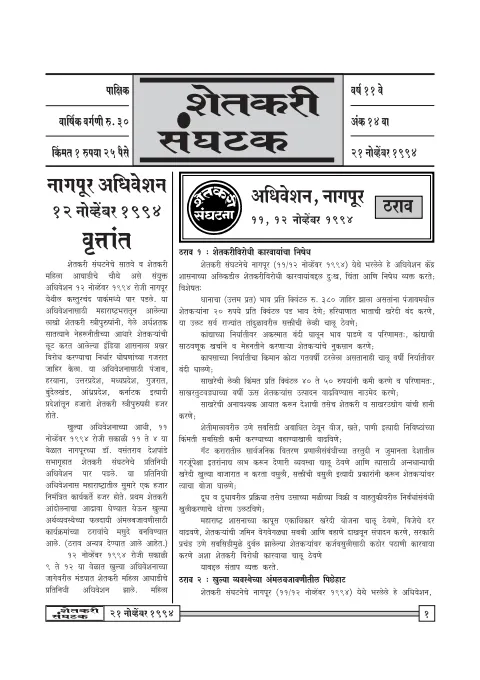
An unsigned report on Lakshmi-Mukti, a movement organised by the Shetkari Mahila Aghadi (the women’s wing of Sharad Joshi’s Shetkari Sanghatana) to transfer ownership of agricultural land to rural housewives in Maharashtra. Launched across the state on 2 October 1990 after a pilot in Vitner village, the movement has seen over a hundred thousand women benefit from land transfers, though the report stresses it is a strictly economic rather than feminist movement, and that securing property rights for women proved far harder than shutting liquor shops or winning panchayat representation.
- Lakshmi-Mukti began with a pilot transfer of land titles to housewives in Vitner village, Jalgaon district, under Vimlatai Patil’s leadership
- The state-wide movement launched on 2 October 1990; villages with at least a hundred qualifying transfers earn the title of Lakshmi-Mukti village
- Yenora in Wardha district was the first village honoured; over a thousand villages had qualified by February 1992
- The SMA’s broader agenda includes drinking-water access, a common civil code, education for girls, and addressing violence against women, alongside its central property-rights push
- The report closes by comparing rural Indian women’s position to Sita’s abandonment in the Ramayana, arguing that what is needed is ‘a temple for Sita’
A Testimony of Shame
By Dilip Thakore
Dilip Thakore reviews the UNDP’s Human Development Report 1994, arguing that despite its diplomatic language the report is a damning indictment of India’s post-independence development record, ranking India 135th of 173 nations. He traces India’s poor showing to the ‘mother of all errors’ — the adoption of a centrally planned socialist model that created a bloated, loss-making public sector and a licence-permit-quota regime, which in turn entrenched an ‘amoral’, quasi-literate mofussil middle class in political power, whose regressive value premises Thakore blames for illiteracy, poor health infrastructure, and communal and caste prejudice.
- HDR 1994, authored under Dr. Mahbub Ul Haq for the UNDP, ranks India 135th of 173 nations despite relatively strong life expectancy at birth (59.7 years)
- Thakore attributes India’s underdevelopment to the post-independence adoption of a centrally planned socialist model and pervasive licence-permit-quota controls on private enterprise
- He argues Indian media commentary on the report has been surprisingly muted, showing ‘resignation tinged with…oriental fatalism’
- The essay blames a newly emergent ‘amoral’ mofussil middle class for capturing political power and imposing shallow, regressive value premises nationally, including communal and caste prejudice
- Less than half of India’s adult population (49.8%) was literate per the report, meaning over 450 million citizens lacked basic literacy
- Thakore credits the Union government’s economic liberalisation and deregulation programme as a belated but necessary corrective, while warning that entrenched interests are fighting back via strikes in PSEs, banks and insurance companies
What Makes for a Nation State / Forging a National Identity
By Rajesh M. Basrur
Rajesh M. Basrur opens an essay questioning what sustains a sense of Indian national identity, pointing to separatist movements in Assam, Punjab and Kashmir, communal violence around Ayodhya, and caste and linguistic conflict as symptoms of fraying national bonds. He argues the real sources of unease lie within Indian society itself rather than in external threats, and that the Nehruvian model of nation-building — secular, liberal-democratic politics combined with planned industrialisation — attempted a transformation of a technologically backward, socially orthodox society at a scale whose difficulty should not be underestimated. The rendered pages break off as Basrur begins evaluating the Nehru model’s outcomes.
- Opens by asking what ‘Indian-ness’ means and whether a fragmented sense of national identity is emerging, citing Assam, Punjab and Kashmir separatism
- Argues Ayodhya-related violence is symbolic of a broader rise in communal, caste and linguistic conflict across India
- Contends that the real sources of national unease lie within Indian society, not from external ‘foreign hand’ threats
- Describes a pervasive ‘moral anarchy’ in which religions preaching humanism are turned into instruments of aggression against the ‘other’
- Introduces the Nehru model of post-independence nation-building — secular liberal democracy plus planned industrialisation — as the essay’s next subject of evaluation, cut off mid-argument
Generated by the v1.5 extraction pipeline. Awaiting editorial review.
Metadata and summary are AI-extracted from the source PDF and reviewed for editorial accuracy. The original work is available via the Read PDF tab above (where present); paragraph-level citation inside the PDF is deferred to a future engagement.