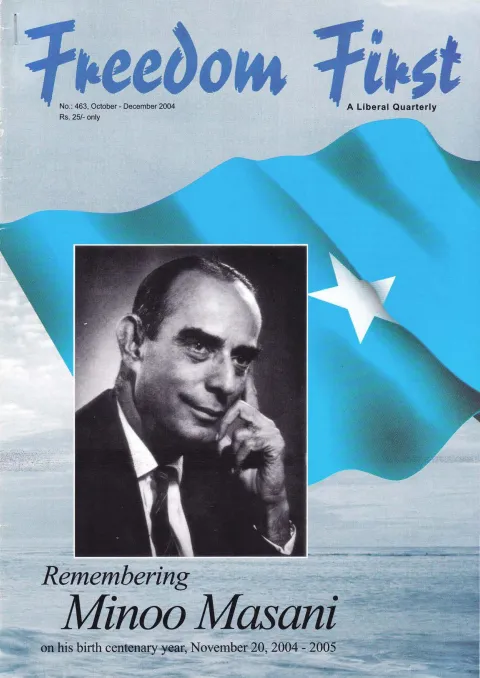
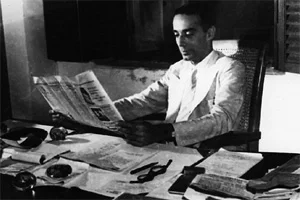
periodical issue
Freedom First
A Quarterly of Liberal Ideas
Edited by S. V. Raju
Freedom First, Army & Navy Building, 3rd floor, 148, Mahatma Gandhi Road, Bombay 400001 · Bombay · 1995
52 pages
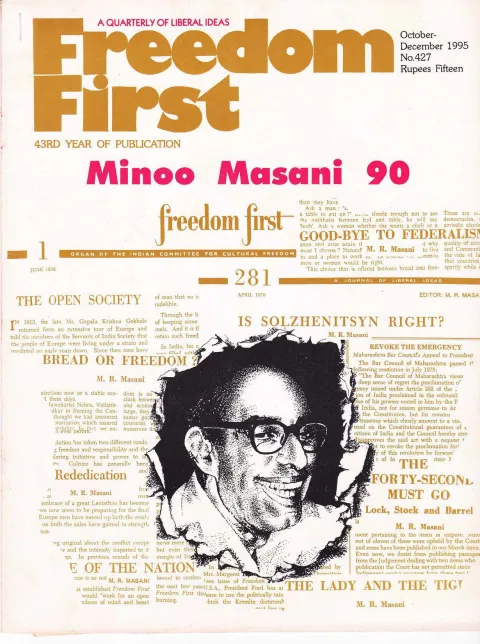
Freedom First
Summary
This is the October-December 1995 issue (No. 427, 43rd year of publication) of Freedom First, the Bombay-based quarterly of liberal ideas. The issue is dominated by a special tribute section, ‘Minoo Masani 90’, marking the 90th birthday of the magazine’s founder, Minoo Masani (1905-), veteran parliamentarian, Constituent Assembly member, and co-founder of the Swatantra Party. In the rendered pages, the tribute section includes a report on the felicitation function held at the Royal Bombay Yacht Club on November 20, 1995 (with speeches by Nani Palkhivala, Sharad Joshi, and others); an essay by Ian Tickle pairing Masani with Swiss anti-communist publisher Peter Sager; a biographical piece, ‘From Marx to Gandhi’, tracing Masani’s political journey from the Congress Socialist Party through his break with Communism to founding the Swatantra Party; ‘The Man Who Saw Tomorrow’, an interview-based profile by Manuwant K. Choudhary reprinted from The Afternoon; ‘Ninety+’, a reminiscence piece drawing on Masani’s own words about jail, Nehru, and public life; and ‘The Last Roman’ by Prakash Arolkar (translated from Marathi), a full biographical sketch spanning Masani’s family background, education, socialist years, and eventual disillusionment with Nehru and the Congress. An advertisement announces a companion tribute volume, also titled Minoo Masani 90, compiling extracts from his writings over 50 years. Beyond the tribute, the rendered pages include the regular ‘With Many Voices’ and ‘Of Cabbages and Kings’ columns (miscellany, quotations, and commentary on topics from the Beijing women’s conference to a WHO financial scandal), an obituary tribute to assassinated Israeli Prime Minister Yitzhak Rabin, an opinion piece by Paresh Vasa criticising the government’s new Employees’ Pension Scheme (‘Robbing the People’), and the opening of an essay by Ranga Kota, ‘The Reforms and the Poor’, defending Narasimha Rao-era economic reforms against the charge that they hurt the poor.
Key points
-
The issue is dominated by a special tribute section, “Minoo Masani 90”, marking the 90th birthday of the magazine’s founder, opening with a report on the felicitation function at the Royal Bombay Yacht Club where Nani Palkhivala called Masani “one of the noblest Indians” and Sharad Joshi credited the Swatantra Party with shaping his own political thinking.
-
Ian Tickle’s “Two Fighters for Freedom” pairs Masani with Swiss anti-communist publisher Peter Sager, tracing their shared Cold War-era anti-communism and arguing new threats such as ethnic cleansing demand the same vigilance.
-
An unsigned biographical piece, “From Marx to Gandhi”, traces Masani’s journey from co-founding the Congress Socialist Party in 1934, through his break with Moscow-directed Communism and his 1942 essay “Socialism Reconsidered”, to co-founding the free-market Swatantra Party with C. Rajagopalachari in 1959.
-
Manuwant K. Choudhary’s interview “The Man Who Saw Tomorrow” covers the Swatantra Party’s years as the largest opposition party in Parliament between 1967-71 and Masani’s resignation from the Minorities Commission chairmanship under the Janata government on principle.
-
Prakash Arolkar’s “The Last Roman”, translated from Marathi, gives a full biographical sketch of Masani from his birth in 1905 through Yerawada Jail, the writing of “Our India”, and his explanation of the Swatantra Party’s eventual decline as stemming from its merger with Charan Singh’s “parochial and casteist” Lok Dal.
-
An unsigned obituary, “Yitzhak Rabin - The Peacemaker”, marks the Israeli Prime Minister’s assassination by a Jewish extremist, drawing an explicit parallel to Gandhi’s killing by a Hindu nationalist and recounting the Oslo peace process and 1994 Nobel Peace Prize.
-
Paresh Vasa’s “Robbing the People” attacks the new Employees’ Pension Scheme, arguing it silently confiscates workers’ provident fund contributions by pooling accounts and reverting unclaimed corpora to government rather than heirs.
-
Ranga Kota’s “The Reforms and the Poor”, opening in the rendered pages, defends the Narasimha Rao government’s economic reforms against the charge that they harm the poor, rebutting arguments based on self-reliance and employment.
Essays
Yitzhak Rabin - The Peacemaker
An unsigned in-house obituary marking the assassination of Israeli Prime Minister Yitzhak Rabin on November 4, 1995. The piece recounts Rabin’s career as a Palmah fighter, his role in the Six-Day War, his terms as Prime Minister, the Oslo peace process, and the 1994 Nobel Peace Prize shared with Arafat and Peres. It draws an explicit parallel between Rabin’s assassination by a religious extremist and Gandhi’s assassination by a Hindu nationalist, and closes with excerpts from Rabin’s final speech at the Tel Aviv peace rally on November 5, 1995, before he was shot.
- Rabin was assassinated on November 4, 1995 by a Jewish university student with extremist views.
- The piece explicitly compares Rabin’s assassination to Gandhi’s, both killed by religious fanatics from within their own community.
- Recounts Rabin’s military career: Palmah fighter, Six-Day War commander, ambassador to the US.
- Covers his political career: Knesset member, labour minister under Golda Meir, Prime Minister from 1974, resignation in 1977, return as defence minister, and second term as Prime Minister from 1992.
- Notes the 1993 Declaration of Principles, 1994 peace treaty with Jordan, and the shared Nobel Peace Prize with Arafat and Peres.
- Quotes Rabin’s final speech at the Tel Aviv peace rally, emphasizing that ‘peace is preferable to war’.
- Freedom First closes by saluting Rabin as ‘a fighter for freedom’ and ‘a true Gandhian’.
With Many Voices
The regular ‘With Many Voices’ column, a page of quotations and epigrams from contemporary press and public figures on topics of the day: Polish privatization, Pakistan’s balancing of Islam and secularism, the Beijing women’s conference and the split between Western feminist priorities and third-world concerns, China’s human rights record on Tibet, India’s judiciary versus executive, and other miscellany from late 1995.
- Compiles quotations from National Review, Time, the Times of India, Indian Express, and other outlets, dated September-December 1995.
- Several quotes address the Beijing UN women’s conference, contrasting Western feminist demands (e.g., abortion rights, lesbian rights) with third-world priorities like clean water and healthcare, per Ela Bhatt and Ayesha Khanam.
- Includes Harrison Ford on Tibet and China, and Barbara Ehrenreich’s criticism of the Beijing conference’s optics.
- Domestic Indian quotes from Nani Palkhivala and Madhu Dandavate note the judiciary’s expanding role as executive authority is seen to abdicate responsibility.
- A quote from Vijay Tendulkar references Bal Thackeray’s Shiv Sena and its attempt to ban Salman Rushdie’s ‘The Moor’s Last Sigh’.
Of Cabbages and Kings (My Friend Madhu; Plain English; The WHO Scam; An Encyclopedia on Democracy)
By SVR / RS
The ‘Of Cabbages and Kings’ column, a miscellany section. In the rendered pages it includes a personal reminiscence titled ‘My Friend Madhu’ about the late Madhu Mehta, a Swatantra Party colleague and trade unionist who died August 27, 1995, and who worked closely with both the author (identified by initials SVR) and Minoo Masani; a piece on ‘Plain English’ discussing a Swiss Press Review editor’s advocacy of simple prose and split infinitives; a note on a ‘WHO Scam’ detailing financial irregularities and mismanagement at the World Health Organisation uncovered in 1993; and a note on a forthcoming four-volume Encyclopedia of Democracy edited by S. M. Lipset.
- Personal tribute to Madhu Mehta, a longtime Swatantra Party colleague of the author (initialed SVR, likely S. V. Raju) and of Minoo Masani, who died August 27, 1995.
- Recounts Mehta’s and the author’s parallel careers in the Bombay Pradesh National Trade Union Congress and the Swatantra Party from 1952 onward, and their eventual falling out over the party’s 1974 split.
- A section on ‘Plain English’ discusses debates over grammar rules, split infinitives, and sentence-initial ‘But’, referencing Minoo Masani, Gandhi, and Rajagopalachari as exemplars of simple English prose.
- The ‘WHO Scam’ item details 1993 revelations of financial irregularities at the World Health Organisation, including questionable contracts and the resignation of Britain’s national auditor Sir John Bourne.
- Notes the publication of a four-volume Encyclopedia of Democracy edited by S. M. Lipset, with contributors including Larry Diamond, covering entries on figures like Gandhi, Nehru, Plato, and Schumpeter.
Minoo Masani 90 (report on 90th-birthday felicitation)
A report on the function held at the Royal Bombay Yacht Club on November 20, 1995 to felicitate Minoo Masani on his 90th birthday, reproduced from Parsiana with permission of its editor Jehangir Patel. It describes speeches by Nani Palkhivala (who called Masani one of the noblest Indians and criticised the country for not recognising his services), Sharad Joshi (founder of the Shetkari Sanghatana, who credited Masani’s Swatantra Party with shaping his own political ideas), and remarks from retired Judge Bakhtavar Lentin. The special Freedom First tribute issue ‘Minoo Masani 90’ was released at the event.
- Function held November 20, 1995 at the Royal Bombay Yacht Club, Bombay, to mark Masani’s 90th birthday.
- Nani Palkhivala called Masani ‘one of the nobliest Indians who ever lived’ and noted the country’s failure to recognise his services; he also called Masani probably the only surviving member of India’s Constituent Assembly.
- A volume of essays in Masani’s honour, ‘In the Vanguard of Freedom’, edited by K. S. Venkateswaran, was mentioned, with contributors including Bernard Levin, Sol Sanders, and Soli Sorabjee.
- Sharad Joshi, founder of the Shetkari Sanghatana, said Masani’s book ‘Our India’ had made him ‘temporarily a socialist’, and described socialism as having ‘been replaced by something worse’ — ‘the madness of communalism’.
- S. V. Raju, editor of Freedom First, introduced speakers and released the special tribute issue ‘Minoo Masani 90’.
- Masani cut his birthday cake alongside his wife Sheela and Palkhivala, and thanked the gathering without making a speech.
Two Fighters for Freedom
By Peter Sager & Minoo Masani
An essay titled ‘Two Fighters for Freedom: Peter Sager & Minoo Masani’ by Ian Tickle, editor of Swiss Press Review and News Report, comparing Masani’s fight against British colonialism and later communism with Swiss anti-communist Peter Sager’s founding of the Swiss Eastern Institute. Tickle recounts how Sager recruited him to edit Swiss Press Review, describes Masani and Sager’s shared Cold War-era anti-communism, quotes from Sager’s 1966 book ‘Moscow’s Hand in India’ (which Tickle translated), and reflects on new threats — ethnic cleansing, the UN’s failures — as the Cold War generation’s fight against communism gives way to newer struggles for human rights.
- Ian Tickle links Masani and Peter Sager as two Cold War-era ‘fighters for freedom’ who both influenced his own career.
- Sager founded the Swiss Eastern Institute and asked Tickle to edit Swiss Press Review and News Report, now in its 36th year.
- Freedom First, founded by Masani in Bombay in 1952, is described as now in its 43rd year, with an editorial tradition of ‘bold and independent thinking’.
- Tickle edited a Festschrift for Sager on his 1991 retirement, titled ‘Freedom First’ in tribute to Masani, calling Masani ‘one of the fathers of modern India’.
- Includes an excerpt from Sager’s 1966 book ‘Moscow’s Hand in India’ on Soviet propaganda aims toward India.
- Nehru’s admiration for Stalin is noted as a source of Masani’s early fears, quoting Masani’s 1944 remarks as Bombay mayor on ‘Socialism Reconsidered’.
- Tickle closes by arguing new threats (ethnic cleansing, UN failures, revival of concentration camps in ex-Yugoslavia) require the same vigilance that defined the Cold War fight, name-checking Freedom First and Swiss Press Review as ongoing efforts.
From Marx to Gandhi
By S. V. Raju
An unsigned essay, ‘From Marx to Gandhi’, tracing Minoo Masani’s ideological journey from co-founding the Congress Socialist Party in February 1934 to co-founding the free-market Swatantra Party with C. Rajagopalachari 25 years later. It covers his resignation from the CSP after concluding Communism was a Moscow-directed international conspiracy, his 1942 essay ‘Socialism Reconsidered’, his embrace of Gandhian Trusteeship as a middle path between statism and unchecked capitalism, and the founding of the Swatantra Party in 1959 as India’s first serious free-market political alternative.
- Masani helped found the Congress Socialist Party in February 1934 alongside Jayaprakash Narayan, Achyut Patwardhan, Ram Manohar Lohia, Asoka Mehta and others.
- He quit the CSP after concluding, contrary to his colleagues, that Indian Communists had to be ‘thrown out’ due to their subservience to Moscow.
- Bertram Wolfe (former Communist and author of ‘Three Who Made a Revolution’) is quoted crediting Masani with recognizing Communist duplicity early via correspondence with Yusuf Meherally.
- Masani’s 1942 essay ‘Socialism Reconsidered’ marked his first questioning of socialist premises, attributing his change of mind to the Soviet Revolution’s failures and the influence of Mahatma Gandhi.
- He embraced the Gandhian concept of Trusteeship as a way to give capitalism ‘a human face’ without abolishing the State.
- In 1959 Masani and C. Rajagopalachari founded the Swatantra Party as an alternative to Nehru’s ‘socialist pattern of society’, with Rajaji coining the phrase ‘Permit-Licence-Quota Raj’.
- The essay quotes Masani’s autobiography ‘Bliss Was It in That Dawn’ on the dangers of combined political and economic power in a nationalised economy.
s signed essay closes the run of pieces on Masani
By S. V. Raju
S. V. Raju’s signed essay closes the run of pieces on Masani’s political philosophy, covering the Swatantra Party’s rise as the largest opposition party in Parliament between 1967-71, Masani’s articulation of a Gandhi-Western-liberal synthesis in his ‘Liberalism’ lecture, his resignation from the Minorities Commission chairmanship under the Janata government, and a personal assessment of Masani as one of the last politicians for whom power was ‘the means to an end — not an end in itself’.
- Between 1967 and 1971, the Swatantra Party was the single largest opposition party in the Lok Sabha (House of the People).
- Masani is credited by Raju with single-handedly putting Liberalism on India’s political map and delegitimising the word ‘Socialism’ in Indian politics.
- Quotes Masani’s ‘Liberalism’ lecture, describing his liberalism as a fusion of Western liberal thought and Gandhian ethics, citing ends-means linkage, minimal government, and Trusteeship.
- Masani resigned the Chairmanship of the Minorities Commission under the Janata government when he felt it was not serious about its work — an act Raju says only Jayaprakash Narayan matched in disinterestedness.
- Masani quit active party politics in 1971 but remained publicly active until nearly 1990, when failing eyesight slowed him.
- Raju’s closing assessment: Masani belonged ‘to a generation of politicians whose passion for integrity and courage of conviction gave politics a meaningful direction’; for such men, ‘politics was public service and not a profession’.
The Man Who Saw Tomorrow
By Manuwant K. Choudhary (interview, reprinted from The Afternoon on Sunday, Nov 26, 1995)
An interview-based profile, ‘The Man Who Saw Tomorrow’, by Manuwant K. Choudhary (Chief Reporter of The Afternoon), reprinted from The Afternoon on Sunday, November 26, 1995. It recounts a personal interview with Masani about Nehru’s economic policies (which Masani calls ‘disastrous’), the Kashmir dispute (on which Masani argues Kashmiris have a right to self-determination), and Masani’s own political evolution, framed by his declaration to a British Tory MP in his youth that he was ‘an ardent socialist’.
- Choudhary describes meeting Masani at the Army & Navy Building office to discuss Nehru’s economic policies, which Masani calls ‘Disastrous’, citing ‘heavy industry first, consumer goods second and agriculture last’.
- Masani says he and Nehru had breakfast every Sunday until 1948, when a disagreement over Stalin ended their close friendship; they did not speak again except in Parliament until Nehru’s death in 1964.
- Masani states Kashmir’s accession to India in 1947 was conditional on a promised plebiscite, and that he is ‘perhaps the only national leader to admit that the Kashmiris have a right to self-determination’.
- He credits Ayub Khan’s planned 1963 visit (cut short by Nehru’s death) as a lost chance to permanently resolve the Kashmir dispute.
- Recalls a Conservative MP in England telling a young Masani that having no heart at 21 (as a non-socialist) or no head at 41 (as a still-committed socialist) were both flaws — foreshadowing Masani’s own later shift.
- Notes that Masani’s 1942 book ‘Socialism Reconsidered’ anticipated arguments Milovan Djilas made in ‘The New Class’ (1956), some 25 years ahead of its time.
Ninety +
By Firdaus Ali (interview, reprinted from Sunday Mid-day, Nov 26, 1995)
A short reminiscence piece, ‘Ninety +’ (drawn from a Sunday Mid-day interview by Firdaus Ali, November 26, 1995), describing Masani at 90 reflecting on his life: his early career as chief of J. R. D. Tata’s office, quitting to join the Quit India movement, his imprisonment at Yerawada Jail, writing ‘Our India’, his parliamentary career and Swatantra Party leadership, and closing reflections on national character and his own physical decline (failing eyesight).
- Masani reminisces about working as Chief of J. R. D. Tata’s office before giving it up when Gandhi launched the Quit India Movement.
- Describes his imprisonment at Yerawada Jail in Pune, including a curt exchange with jail superintendent Barker about bedbugs in his cell.
- After 1957 Masani had ‘a glorious career in Parliament’ opening debates on foreign policy and the Union budget; later elected Swatantra Party general secretary and then president, resigning over 25 years before the interview.
- His only political post afterward was Chairman of the Minorities Commission.
- Names Jayaprakash Narayan, Achyut Patwardhan and Asoka Mehta as some of the outstanding men he ever met, but says Gandhi remains his idol.
- Reflects candidly that Nehru’s ascension to power might not have changed India’s trajectory much regardless, despite his criticisms of Nehru’s Stalin sympathies.
- Closes with Masani’s message to India to ‘be more committed and sincere’ and improve national character, and laments his loss of eyesight preventing him from reading.
Minoo Masani 90
An advertisement for the companion tribute volume ‘Minoo Masani 90’, announcing its release to mark Masani’s 90th birthday on November 20, 1995. The 100-page volume, printed on parchment paper as a collector’s item, compiles extracts from Masani’s writings over 50 years, including from ‘Our India’, his 1940s rejection of socialism, Lok Sabha speeches from the 1960s, and extracts from his last book ‘We Indians’. Price Rs. 150 (Rs. 100 for Freedom First subscribers).
- Volume commemorates Masani’s 90th birthday on November 20, 1995; published by Freedom First.
- Contains extracts from ‘Our India’, his late-1940s rejection of socialism, 1960s Lok Sabha speeches, articles on basic national issues, and extracts from his last book ‘We Indians’ (described as a sequel to ‘Our India’).
- Limited print run of 100 pages on parchment paper, priced at Rs. 150 per copy (Rs. 100 for Freedom First subscribers).
The Last Roman
By Prakash Arolkar (translated by Arvind Deshpande; reprinted from Maharashtra Times, Nov 19, 1995)
A biographical essay, ‘The Last Roman’ by Prakash Arolkar (translated by Arvind Deshpande from the original Marathi article in the Maharashtra Times, November 19, 1995), giving a comprehensive life sketch of Minoo Masani: his birth as Minocher on November 20, 1905 into the family of civil servant Sir Rustom Masani, his education, his early journalism at Janmabhoomi, the writing of ‘Our India’, his time in Yerawada Jail with Jayaprakash Narayan and others, his break with Nehru over communism, and his explanation for the Swatantra Party’s eventual decline.
- Masani was born November 20, 1905 in an illustrious family; his father Sir Rustom Masani was a distinguished civil servant, educationist and intellectual.
- Studied at the Cathedral School, Bharda New School, Elphinstone College, and the London School of Economics; qualified as Bar-at-Law but abandoned legal practice.
- His father disapproved of his politics, so Masani left home and took a low-paying job at the Gujarati daily Janmabhoomi, where he wrote ‘Our India’, which sold over 100,000 copies — a first for an Indian book — and won him a post at Tata Sons.
- Was imprisoned at Yerawada Jail, where he met Jayaprakash Narayan, Achyut Patwardhan, and Asoka Mehta, and became a founder and General Secretary of the Congress Socialist Party.
- Nehru initially praised Masani’s work on the Constituent Assembly’s fundamental rights sub-committee, but the two later became estranged as Masani turned firmly against communism while Nehru drew closer to Krishna Menon.
- Masani explains the Swatantra Party’s decline as stemming from some leaders’ decision to merge with Charan Singh’s Lok Dal, which Masani considered a ‘parochial and casteist’ vehicle rather than a genuinely national party.
- In his later years Masani supported Sharad Joshi and the Swatantra Bharat Party, though it did not succeed.
- The essay frames Masani’s life as ‘swimming against the current’ — literally, as a young man swimming against warned currents near Versova beach, and figuratively, in his political journey from left to right.
Robbing the People
By Paresh Vasa
An opinion piece, ‘Robbing the People’ by Paresh Vasa, criticising the new Employees’ Pension Scheme that came into force November 16, 1995, arguing that it silently confiscates workers’ provident fund contributions by pooling individual accounts and reverting unclaimed corpora to government rather than heirs, unlike the previous system’s clearer inheritance rules. Includes a reprinted list from the Philips Employees’ Union of twelve reasons the scheme harms workers.
- The Employees Pension Scheme, effective November 16, 1995, diverts 8.33% of Provident Fund contributions into a pooled scheme replacing the earlier arrangement.
- Vasa estimated in May 1993 that the corpus subject to forfeiture could reach Rs. 24 lakh crore (twelve zeros), potentially rising to Rs. 1 crore times fourteen zeros as the current generation retires.
- Under the new scheme, pensions are halved on the employee’s death and quartered if the spouse also dies, with no dependent children; the remaining corpus is ‘swallowed’ by the government.
- Vasa contrasts this with the old rules, under which heirs continued to receive PF principal and interest benefits indefinitely.
- Frames the scheme as a ‘family pension scam’ worse than other contemporary scandals — the share scam, the sugar scam, railway scams and the telecom scam.
- Appends a reprinted list from the Philips Employees’ Union citing twelve reasons the scheme is detrimental to workers, including loss of principal, no inflation-linkage, and discriminatory minimum-pension rules.
The Reforms and the Poor
By Ranga Kota
The opening pages of an essay, ‘The Reforms and the Poor’ by Ranga Kota, written in May 1995, which defends the Narasimha Rao government’s economic reforms against opposition claims that they have harmed the poor. In the rendered portion, Kota rebuts arguments based on self-reliance and employment, arguing that opponents of liberalisation — including ‘left-leaning intellectuals and former bureaucrats’ — rely on unproven assumptions about the reforms’ anti-poor effects, and that large industry likely generates more indirect employment than small industry.
- Written in May 1995, defending Narasimha Rao’s reform agenda as its government entered its final year.
- Kota argues that opposition to reforms unites ‘left-leaning intellectuals and former bureaucrats’ whose ideological relevance has waned, alongside opposition parties.
- Identifies three main arguments used against reforms: threats to self-reliance, harm to employment, and inflation; the rendered pages address the first two.
- On self-reliance, Kota argues the rural poor are largely unaffected by competition among goods (e.g., Thums Up vs Pepsi) that do not reach them.
- On employment, Kota contends proponents of anti-reform arguments ignore the indirect employment generated by large industry through trade, transport, advertising, repair and maintenance services.
- The essay is cut off mid-argument, transitioning into a discussion of inflation’s effects on the poor, which is not covered in the rendered pages.
Generated by the v1.5 extraction pipeline. Awaiting editorial review.
Essay 12
No summary was extracted for this article. Listed for completeness.
Essay 13
No summary was extracted for this article. Listed for completeness.
Metadata and summary are AI-extracted from the source PDF and reviewed for editorial accuracy. The original work is available via the Read PDF tab above (where present); paragraph-level citation inside the PDF is deferred to a future engagement.