periodical issue
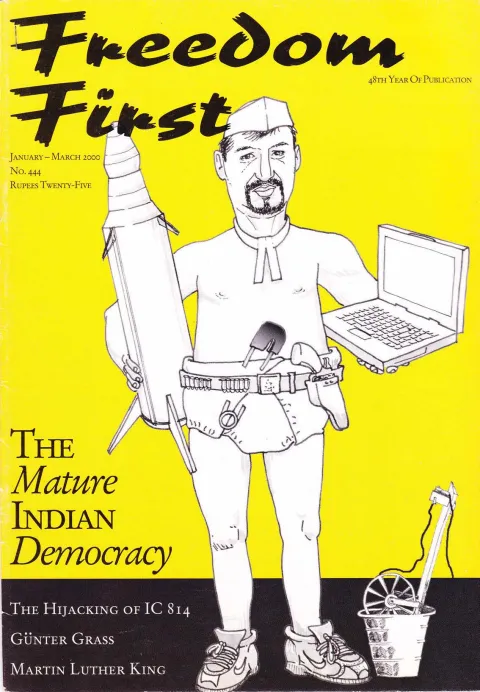
Freedom First
A Quarterly of Liberal Ideas
Edited by S. V. Raju
Published by J. R. Patel for the Indian Committee for Cultural Freedom and printed by him at Kaiser-E-Hind Private Ltd., 300, Perin Nariman Street, Mumbai 400 001. Publishers: Indian Committee for Cultural Freedom, 3rd Floor, Army & Navy Building, 148, Mahatma Gandhi Road, Mumbai 400 001. · Mumbai · 1997
52 pages

Freedom First
Summary
This is issue No. 432 of Freedom First (January–March 1997), the quarterly journal of liberal ideas published from Bombay in its 45th year, edited by S. V. Raju with Associate Editor R. Srinivasan under founder Minoo Masani’s imprint. The rendered pages cover the front matter through the middle of the issue: the editor’s note, the ‘With Many Voices’ page of quotations, the ‘Of Cabbages and Kings’ editorial column, S. S. Bankeshwar’s sketch of Prime Minister Deve Gowda’s evasiveness with the press, a two-part cover package on Anna Hazare’s Maharashtra anti-corruption agitation (a narrative account by Shyam Ashtekar and a companion profile of Hazare’s village-development work at Ralegaon Siddhi by Arun Shourie), and the opening of a symposium on reserved constituencies for women in Parliament, comprising an open letter from women’s-movement signatories opposing the rotational reservation system and an essay tracing the Shetkari Mahila Aghadi’s campaign for women’s political representation. In the rendered pages, the issue’s argumentative center is a classical-liberal skepticism of both populist anti-corruption crusades that lack systemic diagnosis and of quota-based remedies for women’s political representation, favouring structural/institutional fixes (multi-seat constituencies, decentralization, reduced state discretion) over personality-driven or reservation-based approaches.
Key points
-
S. S. Bankeshwar’s “Gowda and the Press” recounts his frustrated attempts to interview then-Chief Minister, later Prime Minister, H. D. Deve Gowda, arguing Gowda mistakes ignorance of national affairs for humility and contrasting him unfavourably with Rajaji and Morarji Desai.
-
Shyam Ashtekar’s account of Anna Hazare’s Maharashtra anti-corruption crusade traces its escalation from complaints against state ministers through a hunger strike and public clashes with Shivsena and BJP figures, criticising the movement for lacking a systemic diagnosis and tacitly endorsing the same statist welfare logic that breeds corruption.
-
Arun Shourie’s companion profile credits Anna Hazare’s Ralegaon Siddhi model village, transformed through water-harvesting, a communal grain bank, and abolition of liquor and tobacco sale, as the product of sustained voluntary community labour rather than government schemes.
-
A two-part symposium on reserved constituencies for women opens with an open letter opposing the rotational reservation system as disenfranchising, proposing permanent three-seat multi-member constituencies instead, followed by an essay tracing the Shetkari Mahila Aghadi’s campaign for full women’s panels in panchayat elections.
-
The “Of Cabbages and Kings” column criticises continuing sati-glorification at Jhunjhunu, a Janata Dal-Sunni political alliance in Kerala, and the government bailout of Indian Bank as socialising losses from politically directed lending.
-
The regular “With Many Voices” column collects press quotations on foreign-investment fatigue, the Deve Gowda coalition’s improvisational style, and Congress’s dependence on the Gandhi family name.
Essays
Many Voices
A page of quoted remarks (‘With Many Voices,’ epigraph from Tennyson) drawn from Indian and international press in late 1996 and early 1997, touching on foreign investment fatigue, the Deve Gowda coalition government’s improvisational style, privatisation of Doordarshan, George Fernandes’s alliance with the BJP, Congress succession politics around Sonia Gandhi, and general disillusionment with the quality of India’s political class.
- Compiles sourced quotations from Indian and international press, December 1996-February 1997
- Union minister C. M. Ibrahim’s comments on privatisation of DD-3 and foreign equity in airlines are featured
- PM Deve Gowda is quoted defending himself against press criticism of his sleepy demeanour
- M. J. Akbar and G. K. Moopanar are quoted on Congress’s dependence on the Gandhi family name
- T. N. Seshan is quoted criticising voter apathy enabling bad candidates
Of Cabbages & Kings
The magazine’s editorial notes column, covering the Amitabh Bachchan Corporation controversy, rising sati-glorification activity at Jhunjhunu, allegations that the Janata Dal is courting Sunni Muslim organisations in Kerala for electoral gain, VIP security disruptions (including incidents involving Deve Gowda’s motorcade and the Mongolian First Lady), a flash strike by BEST bus workers, the Indian Bank bailout controversy, street renaming disputes in Delhi and Bombay, and a report on alleged RAW activity in Kathmandu.
- Criticises continuing sati-glorification practices (Rani Sati temple, Jhunjhunu) and acquittals in the Roop Kanwar case
- Flags a Janata Dal-Sunni political alliance in Kerala as opportunistic ‘secularism’
- Documents VIP security disruptions to ordinary citizens’ movement, citing multiple press reports
- Criticises the Indian Bank government bailout as socialising losses caused by politically-directed lending
- M. R. Pai contributes a piece arguing Indian Bank should be liquidated rather than propped up
Gowda and the Press
By S. S. Bankeshwar
S. S. Bankeshwar recounts his own frustrating attempt, beginning in February 1995, to interview then-Karnataka Chief Minister (later Prime Minister) H. D. Deve Gowda, describing repeated no-shows and unanswered questionnaires. He argues Gowda mistakes ignorance of national affairs for humility, contrasts him with Rajaji and Morarji Desai, and closes with a satirical Q&A about India’s political class (‘Who survived? Our Nation.’).
- Bankeshwar describes multiple broken appointments with Gowda over nearly two years
- Argues Gowda’s self-styled ‘simplicity’ is really ignorance of national issues, workaholism aside
- Contrasts Gowda unfavourably with Morarji Desai’s technique of disarming journalists with counter-questions
- Closes with a mock Q&A naming numerous Indian politicians tainted by scandal (Kesri, Narasimha Rao, Jayalalitha, Sukh Ram, etc.)
Anna Hazare’s Anti-Corruption Crusade
By Shyam Ashtekar
Shyam Ashtekar’s account of Anna Hazare’s 1996 anti-corruption agitation in Maharashtra traces its escalation from Hazare’s complaints against state ministers, through a hunger strike at Ralegaon Siddhi, a public slanging match with Shivsena and BJP figures (Narayan Rane, Bal Thackeray, Gopinath Munde), to the campaign’s eventual loss of momentum. Ashtekar is critical of the movement’s lack of systemic diagnosis, its personalisation of the anti-corruption cause, its ambivalent relationship with political parties, and its tacit support for statist welfare schemes—concluding that Hazare’s own model village depends on the same ‘do-everything’ state logic that breeds corruption elsewhere. A sidebar profiles rival crusader G. R. Khairnar, and a boxed excerpt (‘Quota Raj’) criticizes Deve Gowda’s proposal to extend job reservations to the private sector.
- Hazare, a Padma Shri/Padma Bhushan awardee known for the Adarsha Gaon Yojana model village scheme, escalated his campaign after ministries ignored his corruption complaints
- A three-man committee (Thackeray, Mahajan, Hazare) to investigate corruption quickly collapsed for lack of legal standing
- The agitation triggered a personal and media battle involving named ministers Nitin Gadkari and Gopinath Munde, including an unsubstantiated property/‘tamasha artist’ allegation against Munde
- Rival activist G. R. Khairnar kept his distance from Hazare’s campaign despite his own anti-corruption record as a municipal officer
- Ashtekar argues the movement never articulated a structural critique of the licence-permit-quota raj and continues to endorse pervasive state welfare provision
- A ‘Quota Raj’ sidebar criticises PM Deve Gowda’s promise to extend job reservations to the private sector as economically harmful
The Man and his Work
By Arun Shourie
Arun Shourie’s companion piece profiles Anna Hazare’s personal biography and his transformation of Ralegaon Siddhi village through community effort: from a drought-stricken, debt-ridden, liquor-plagued hamlet twenty years ago to a village with water-harvesting infrastructure, near-universal irrigation, a grain bank, a technical school, mass community weddings, and abolition of liquor and tobacco sale. Shourie frames Hazare’s turn to social work as growing from a personal crisis (depression, a resolve to suicide, then inspiration from Swami Vivekananda) after his military service, and credits the transformation to sustained voluntary community labour rather than government schemes.
- Hazare served in the army as a truck driver from the mid-1960s (including the 1965 war), survived a serious injury, and later underwent a personal crisis before dedicating himself to village service
- Ralegaon Siddhi transformed from a debt-ridden village with 35-40 illicit liquor stills and high child mortality into a largely self-sufficient community
- Water-harvesting (percolation tanks, check dams) raised irrigated acreage from 70-80 to over 1100 acres, enabling three crops a year
- The village runs a communal grain bank, holds low-cost mass weddings across castes, and abolished liquor and tobacco sale by community vow
- Shourie frames the school as aiming to be a ‘Jeevan Shiksha Mandir’ (a temple preparing students for life) rather than a ‘degree factory’
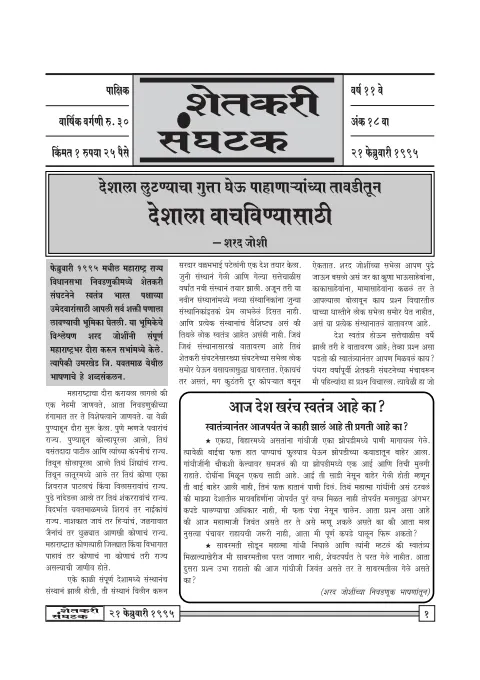
Reserved Seats for Women in Parliament
A two-part symposium on reserved constituencies for women. The first part, an open letter signed by Sanjoo Kashikar and other women’s-movement figures, opposes the rotational system for implementing 33% reservation for women in the Lok Sabha, arguing it disenfranchises repeat candidates and voters and proposes a three-seat multi-member constituency system as an alternative. The second part, unsigned but evidently linked to the Shetkari Mahila Aghadi, traces the history of the rural women’s movement inside the Shetkari Sanghatana since 1986, its push for 100% women’s panels in panchayat elections, and the poor real-world record of panchayat-level reservation, where women’s representation remains largely nominal and dominated by relatives of established male leaders.
- Signatories argue the rotational reservation system produces perverse consequences: meritorious women barred from re-contesting, unequal voter power, and instability tied to by-elections
- They propose replacing rotation with permanent three-seat constituencies where each voter casts three votes and one seat is guaranteed to the top women’s vote-getter
- The companion essay recounts the Shetkari Mahila Aghadi’s founding in 1986 within the Shetkari Sanghatana and its campaign for 100% women’s panels in zilla parishad elections
- Women’s representation in the Lok Sabha is cited as historically low: 4.7% in the first Lok Sabha, falling to 3.5% in 1980, and rising to a peak of 7.9% in 1984
- A sidebar quoting Madhu Kishwar warns that quotas alone are insufficient without genuine inner-party democracy and women’s participation in political parties
Generated by the v1.5 extraction pipeline. Awaiting editorial review.
Metadata and summary are AI-extracted from the source PDF and reviewed for editorial accuracy. The original work is available via the Read PDF tab above (where present); paragraph-level citation inside the PDF is deferred to a future engagement.