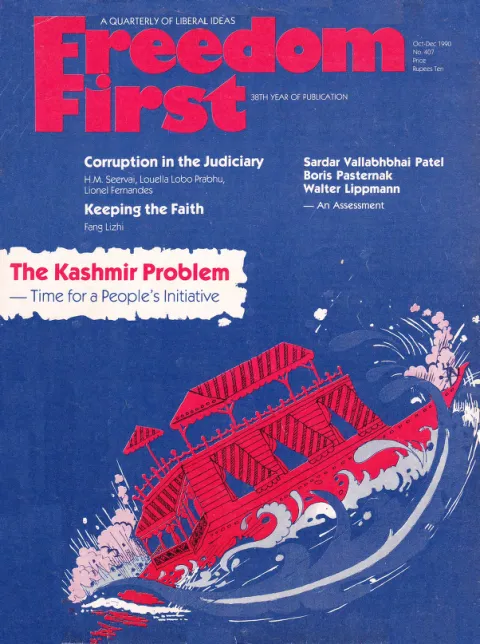
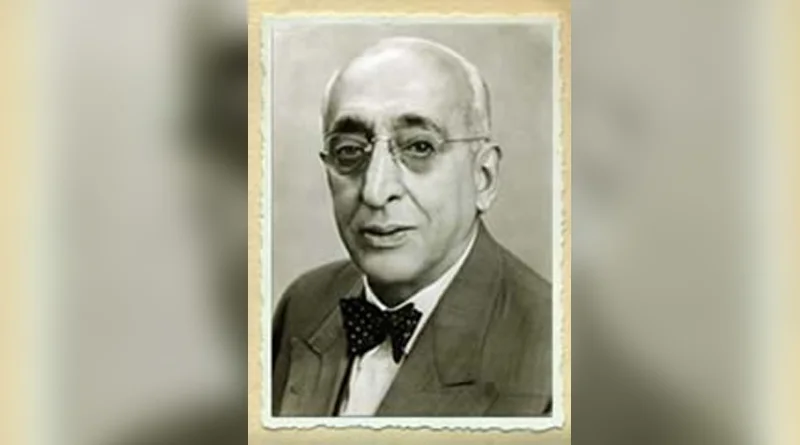
periodical issue
Freedom First
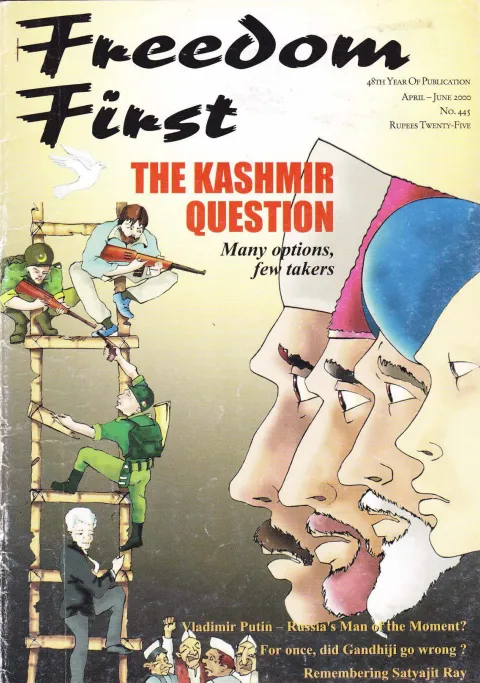
The Kashmir Question: Many Options, Few Takers
By S. V. Raju
Published by J. R. Patel for the Indian Committee for Cultural Freedom, 3rd Floor, Army & Navy Building, 148, Mahatma Gandhi Road, Mumbai 400 001; printed by him at Kaiser-E-Hind Private Ltd., 300, Perin Nariman Street, Mumbai 400 001 · Mumbai · 2000
52 pages
Freedom First
Summary
This is issue No. 445 of Freedom First (April-June 2000, 48th year of publication), the Bombay-based liberal periodical published by the Indian Committee for Cultural Freedom, edited by S. V. Raju with R. Srinivasan as Associate Editor. The cover feature, “The Kashmir Question: Many Options, Few Takers,” is a report on the third in a series of Freedom First-organised discussions on Kashmir (following ones held in July 1990 and July 1995), held on 18 March 2000, blended with written reader contributions. In the rendered pages, the feature surveys the history of the 1947 accession and the unfulfilled plebiscite promise (citing V. P. Menon and quoting Nehru’s 1952 parliamentary pledge), debates whether Kashmiris hate India, weighs the “Punjab model” of normalisation, surveys proposals for de-linking Kashmir from other Indo-Pak issues, warns of Islamic fundamentalism’s regional “grand design,” reviews a Pakistani seminar’s view of Kashmir as a national security “jugular vein” (summarised by Maneesha Tikekar), and closes with a footnoted list of over twenty individual contributors and named discussion participants. The regular front-matter columns in this issue are “With Many Voices” (aggregated press quotations) and “Of Cabbages and Kings” (an editorial notes column covering the 1999-2000 drought, the Sri Lankan civil war, and a Swatantra Party naming dispute), plus a short tribute to the late Bombay High Court judge B. R. Lentin by advocate M. A. Rane. The table of contents (visible on the unnumbered front page) shows further articles beyond the rendered pages: “For Once, Did Gandhiji Go Wrong?” by Eknath Nagarkar, “Restructuring of Public Enterprises in Andhra Pradesh” by P. Prasada Rao, “To Restore Character and Liberal Values in Our Polity” by S. V. Raju, “Remembering Satyajit Ray” by Prem Vaidya, a “Papal Apologies” reflection by Louella Lobo Prabhu, “Vladimir Putin — Russia’s Man of the Moment?” by Perumal Koshy, and book reviews — none of which were seen in this rendered set.
Key points
-
The cover feature “The Kashmir Question: Many Options, Few Takers” reports on Freedom First’s third organised discussion on Kashmir, tracing the 1947 accession and the unfulfilled plebiscite promise via a V. P. Menon extract and Nehru’s 1952 parliamentary pledge, and debating whether Kashmiris resent Indian rule.
-
Maneesha Tikekar’s account of a February 2000 Islamabad seminar presents the Pakistani elite’s framing of Kashmir as “shahrag” (jugular vein) against India’s “atoot ang” (inseparable part), while the feature warns Kashmir has become entangled in a transnational Islamic fundamentalist “grand design” associated with Hasan al-Torabi and Osama bin Laden.
-
The feature surveys proposed solutions including freezing the Line of Control, a phased plebiscite, and Ayesha Jalal’s “Sovereignty Association” idea, closing on the hopeful note of the Indian army’s announced phased troop withdrawal from Kashmir.
-
M. A. Rane’s tribute to Justice B. R. Lentin of the Bombay High Court, who died in April 2000, recalls his 1981 intervention halting the forcible eviction of Bombay pavement-dwellers and his enquiry into the Antulay cement-permit scandal that led to Chief Minister A. R. Antulay’s resignation.
-
The regular “Of Cabbages and Kings” column covers the 1999-2000 drought and the Sri Lankan civil war.
Essays
Many Voices
A tribute to Justice B. R. Lentin of the Bombay High Court (who died 22 April 2000), written by advocate M. A. Rane. In the rendered pages, it recalls Lentin’s fairness and independence, especially his 1981 intervention halting the forcible eviction of Bombay pavement-dwellers ordered by then Chief Minister A. R. Antulay, and his public-interest enquiry into the Antulay cement-permit fund-collection scandal (the “Antulay Case”) that led to Antulay’s resignation. It also mentions Lentin’s enquiry into adulterated-drug deaths at J. J. Hospital. A boxed quotation from Justice Lentin’s own 1990 address to the Leslie Sawhny Programme (“Can Democracy Endure without Character”) on the danger of judicial corruption accompanies the piece.
- Justice B. R. Lentin died on 22 April 2000; the piece is a personal tribute by advocate M. A. Rane.
- Lentin halted the 1981 forcible eviction of Bombay pavement and slum dwellers ordered by CM A. R. Antulay during heavy rain, granting interim stay.
- Lentin heard the Antulay cement-permit/donations scandal PIL, upholding allegations that led to Antulay’s resignation as Chief Minister.
- Lentin also held a public enquiry into deaths of eye patients from adulterated drugs at J. J. Hospital, criticising the Health Minister and hospital officials.
- A boxed quotation from Lentin’s own May 1990 address warns that judicial corruption is more dangerous than political corruption.
The Kashmir Question: Many Options, Few Takers
The cover feature on Kashmir, spanning the report of a 18 March 2000 Freedom First discussion (the third such discussion, after ones in 1990 and 1995) plus written reader contributions, edited together by S. V. Raju. In the rendered pages (5 through 16 printed), the piece moves through the history of the 1947 accession and unfulfilled plebiscite promise (via a V. P. Menon extract and a quoted Nehru pledge to Parliament on 7 August 1952), debates over whether Kashmiris resent Indian rule, a Jayaprakash Narayan quotation on the need for courage in resolving Kashmir, an argument that India’s own actions (Sheikh Abdullah as “Prime Minister,” Article 370, a separate flag/anthem, and taking the issue to the UN) gave Kashmir an anomalous separate identity, calls to talk peace rather than escalate militarily (with boxed comments invoking Nelson Mandela as a possible mediator and drawing lessons from the Soviet failure in Afghanistan and the US in Vietnam), a warning that Kashmir has become a pawn of transnational Islamic fundamentalism led by figures such as Hasan al-Torabi and Osama bin Laden, an account (by Maneesha Tikekar) of a February 2000 Islamabad seminar giving the Pakistani elite’s view of Kashmir as “shahrag” (jugular vein), a survey of proposed solutions including freezing the Line of Control, a phased plebiscite, and Ayesha Jalal’s “Sovereignty Association” idea, and a closing note reporting the army’s phased troop withdrawal from Kashmir as a hopeful sign. The piece ends with 23 numbered footnotes identifying contributors and a full list of participants at the March 18 discussion.
- Report on Freedom First’s third Kashmir discussion (18 March 2000), following earlier ones in July 1990 and July 1995, combined with written reader submissions.
- Traces the 1947 accession, the unfulfilled plebiscite pledge, and the two-nations theory debate via a V. P. Menon extract and a quoted 1952 Nehru statement to Parliament.
- Contributors debate whether Kashmiri Muslims hate India, whether Kashmir was given an artificial ‘separate identity’ by India’s own policies (Article 370, separate flag/anthem, UN referral), and whether a ‘Punjab model’ of normalisation could work.
- Warns Kashmir has become entangled in a transnational Islamic fundamentalist ‘grand design’ associated with Hasan al-Torabi and Osama bin Laden.
- Maneesha Tikekar’s account of a February 2000 Islamabad seminar presents the Pakistani elite’s framing of Kashmir as ‘shahrag’ (jugular vein) versus India’s ‘atoot ang’ (inseparable part).
- Surveys proposed solutions: freezing the LOC as a border, a phased plebiscite/autonomy plan, and Ayesha Jalal’s ‘Sovereignty Association’ between India, Pakistan and Kashmir.
- Closes on a hopeful note citing the Indian army’s announced phased troop withdrawal from Kashmir as a sign of returning normalcy.
- Extensive footnotes credit over twenty named contributors (e.g., Nagindas Sanghvi, M. A. Rane, Nitin G. Raut, Ashok Karnik, Satish Sahney, K. F. Rustomji, Usha Thakkar, N. B. Grant, J. B. D’Souza, S. R. Kelkar, Arvind Deshpande, B. B. Thadani) and list discussion participants.
Generated by the v1.5 extraction pipeline. Awaiting editorial review.
Metadata and summary are AI-extracted from the source PDF and reviewed for editorial accuracy. The original work is available via the Read PDF tab above (where present); paragraph-level citation inside the PDF is deferred to a future engagement.