periodical issue
Freedom First
By S. V. Raju, Arvind Deshpande, M. C. Chagla, M. R. Pai
Published by J. R. Patel for the Indian Committee for Cultural Freedom and printed by him at Kaiser-E-Hind Private Ltd., 300, Perin Nariman Street, Mumbai 400 001. Publishers: Indian Committee for Cultural Freedom, 3rd Floor, Army & Navy Building, 148, Mahatma Gandhi Road, Mumbai 400 001. · Mumbai · 2000
52 pages
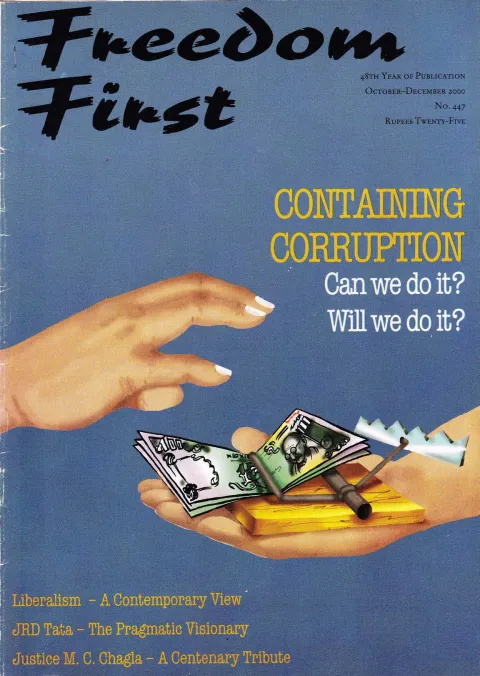
Freedom First
Summary
Freedom First No. 447 (October–December 2000), the classical-liberal quarterly founded by Minoo Masani and edited by S. V. Raju, opens with an obituary for Dr. Usha Mehta, the Gandhian scholar and activist. The masthead and table of contents identify this as a periodical issue produced by the Indian Committee for Cultural Freedom. In the rendered pages the issue runs its regular editorial features (“With Many Voices”, a page of press quotations, and “Of Cabbages and Kings”, a column of editorial-style commentary on current events such as the disputed 2000 US presidential election and Mumbai civic cleanliness drives), followed by S. V. Raju’s essay “Liberalism: A Contemporary View”, which traces the history of the Swatantra Party and the Indian Liberal Group’s evolving stance on freedom, equality, and socialism. The bulk of the rendered pages belong to the issue’s cover symposium, “The Enemy Within – II: Containing Corruption”, a multi-contributor set of short essays and letters on corruption in Indian public life — covering petty and systemic corruption, education, the judiciary, the CVC, banditry (Veerappan), and proposed institutional reforms. The chunk ends partway into Prem Vaidya’s tribute essay “J. R. D. Tata – A Pragmatic Visionary”.
Key points
-
An obituary opens the issue for Dr. Usha Mehta, the Gandhian scholar-activist who ran the Gandhi Smarak Nidhi in Bombay and built one of the city’s best libraries on the Mahatma and the national movement.
-
S. V. Raju’s “Liberalism: A Contemporary View” traces liberalism’s roots in Bentham, Mill and T. H. Green through the Swatantra Party’s founding against Nehruvian statism to Minoo Masani’s 1985 view that socialism’s aims of freedom and equality are good even though its methods produce tyranny.
-
A second-part corruption symposium, “The Enemy Within - II: Containing Corruption”, distinguishes tolerable “petty corruption” from systemic corruption bred by the permit-licence-quota raj, reprinting a Jayaprakash Narayan passage that corruption is a moral, not merely economic, failure.
-
K. K. Pathak’s reprinted 1964 letter to Union Home Minister Gulzari Lal Nanda blames socialist permit-licence-quota policies for debasing society and calls for dedicated corruption courts, open trials, and civic-education reform.
-
J. B. D’Souza’s “Corruption in Education” surveys rampant corruption in schooling, from black-money admissions and leaked exam papers to fake-degree “certificate factories”, citing the Misa Bharati medical-college admission case.
-
Prem Vaidya’s tribute “J. R. D. Tata - A Pragmatic Visionary” recounts filming JRD Tata for a 25th-independence-anniversary documentary, JRD’s insistence on stressing continuing mass poverty over industrial statistics, and his pioneering 1932 airmail flight and long tenure as Air India chairman.
-
M. R. Pai’s “Bandit, not Robin Hood!” argues sandalwood bandit Veerappan’s operation is sustained by corrupt politicians, bureaucrats, police and forest guards profiting as silent partners.
Essays
Dr. Usha Mehta
By R. Srinivasan
An unsigned (byline R. Srinivasan) obituary tribute to Dr. Usha Mehta (1920–2000), the Gandhian scholar-activist who ran the Gandhi Smarak Nidhi in Bombay. It recounts her role as a teacher and researcher who influenced generations of students, her tireless institution-building through the Centre for rural development and civic education programmes, and her personality — described as ascetic yet warm, non-sectarian, and deeply committed to Gandhian and humanist values.
- Usha Mehta (25/08/1920 - 11/8/2000) ran the Gandhi Smarak Nidhi in Bombay as a live centre for Gandhian and humanist values
- She built one of the city’s best libraries on the Mahatma and the national movement
- She was a teacher and research scholar who influenced generations of students
- The Centre under her ran rural development programmes and trained workers academically and in the field
- She was known for an inability to say ‘no’ to requests, sometimes at the cost of her own writing projects
- She is remembered as free of communal prejudice, working with people of all persuasions
Many Voices
The ‘With Many Voices’ column collects short press quotations and one editorial cartoon on current events of late 2000: public-sector losses versus food subsidies, the BMC’s civic performance, Sonia Gandhi’s control of the Congress party, the contested US presidential election, Jyoti Basu’s remark that ‘Marxism alone has a future’, executive overreach into judicial functions, and the state of the Indian economy under Finance Minister Yashwant Singh.
- Tavleen Singh notes a single loss-making public steel plant in Andhra Pradesh cost more than food subsidy spending
- An editorial questions whether the BMC exists to serve citizens or its own 1-1.5 lakh employees
- M. J. Akbar quips that Sonia Gandhi ‘locked up the Congress’ spine in a safe deposit vault’
- Jyoti Basu is quoted saying ‘Marxism alone has a future’
- C. R. Irani criticizes the executive (politician and bureaucrat) for usurping judicial functions
- T. R. Gopalakrishnan notes inverted economic indicators (employment/GDP down, unemployment/inflation up) despite Finance Minister Yashwant Singh’s optimism
- A political cartoon comments on China’s WTO accession alongside jailed dissidents
Of Cabbages & Kings
The editor’s ‘Of Cabbages and Kings’ column comments on the deadlocked 2000 US presidential election, contrasts it approvingly with a BJP-linked politician-training school (the Rambhau Mhalgi Prabhodini Trust, whose ‘School for Caesars’ framing the column notes wryly), praises the Mumbai Mayor’s anti-littering campaign while doubting its enforcement, and profiles Minoo Masani’s founding, over thirty years earlier, of what became the Leslie Sawhny Programme for Training in Democracy — a non-partisan citizenship-training institute at Devlali that trained political workers across parties from the Swatantra Party to the Jan Sangh/BJP.
- The column discusses the disputed US presidential election (Bush v. Gore) and quotes an American academic reassuring the columnist that the US system is stable
- The Rambhau Mhalgi Prabhodini Trust, an RSS-linked training school for politicians, is profiled via an Outlook report
- Freedom First founder Minoo Masani, with Col. Leslie Sawhny, founded a citizenship-training institute (later the Leslie Sawhny Programme for Training in Democracy) at Devlali in Nasik district
- The institute (LSP) trained political workers from the Swatantra Party, Praja Socialist Party, Socialist Party, Congress Party, Jan Sangh, BJP and Janata Party on a non-partisan basis
- Arvind Deshpande, honorary secretary of LSP, is quoted on its cross-party reach
- The column also covers Mumbai civic cleanliness efforts under Mayor Hareshwar Patil and cooperative-sector annual reports (SIES, National Dairy Development Board, Gujarat Cooperative Milk Federation, National Tree Growers’ Cooperative Federation)
Liberalism: A Contemporary View
By S. V. Raju
S. V. Raju’s essay recounts a dispute over whether two earlier Times of India op-eds (‘The Liberal Vision’ and ‘Liberty and Equality – Freedom as the Supreme Value’) represented the Indian Liberal Group’s official views, prompting his rejoinder ‘Liberalism – A Contemporary View’, which the Times of India delayed for two months before returning unpublished. Raju then lays out his own account of liberalism’s evolution in India: its roots in Bentham, J. S. Mill and T. H. Green; the Swatantra Party’s founding as a liberal, anti-socialist opposition to Nehruvian planning; the party’s electoral performance and 1985 manifesto revisions by the Indian Liberal Group; and Minoo Masani’s own 1952 rationale for naming the journal ‘Freedom First’ and his later view that freedom and equality of opportunity are not antithetical to socialism’s goals even as its methods produce tyranny.
- Raju’s rejoinder to the Times of India was delayed two months and then returned unpublished with an unsigned note
- Liberalism is presented as a non-static, evolving philosophy rooted in Bentham, Mill, and T. H. Green, historically anchored in freedom
- The Swatantra Party (founded on liberal principles) opposed Nehru’s Congress-led statist/socialist policies, dubbing them the ‘Licence, Permit, Quota Raj’
- Swatantra won 44 seats in the Fourth Lok Sabha (1967-71), mostly from rural/semi-rural constituencies, driven by realpolitik rather than pure ideological appeal
- The party’s economic policy was influenced by Prof. B. R. Shenoy, advocating floating exchange rates and opposing deficit financing while not opposing all subsidies
- In 1985 the Indian Liberal Group, with Minoo Masani and Count Otto von Lambsdorff present, adopted a manifesto distinguishing liberal equality-of-opportunity from egalitarian equality-of-condition
- Minoo Masani’s 1952 naming rationale for ‘Freedom First’ cited Lord Acton’s view that liberty is the supreme political good, without denying the urgency of also fighting poverty
- Masani’s 1985 article ‘Liberalism’ argued socialism’s aims (freedom and equality) are good but its methods produce tyranny and poverty instead
The Enemy Within - II / Containing Corruption
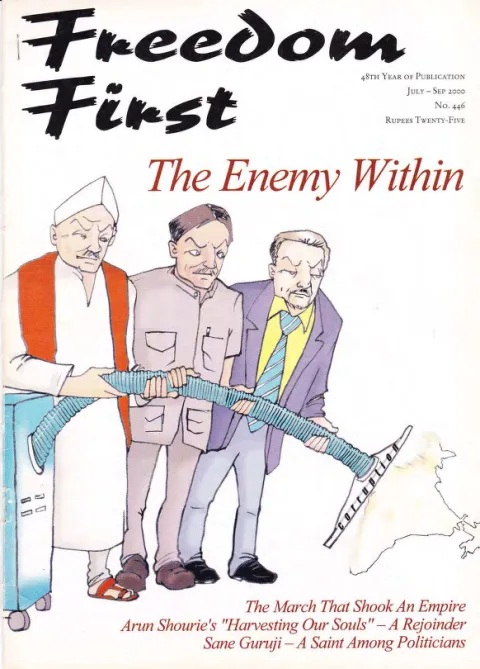
The second installment of the ‘Enemy Within’ corruption symposium opens with an unsigned framing essay distinguishing tolerable ‘petty corruption’ (small bakshish, informal cuts) from the more destructive corruption bred by the permit-licence-quota raj, which the essay argues has now expanded into a nexus of corrupt politicians, bureaucrats, businessmen and trade union ‘leaders’ resisting further economic liberalization. A sidebar reprints a Jayaprakash Narayan passage (‘Corruption Steals the People’s Bread’) arguing that corruption is fundamentally a moral, not merely economic, failure, illustrated with a claim that at least 50% of government spending in Bihar leaks into corrupt pockets.
- Distinguishes small, tolerable ‘petty corruption’ (bakshish, informal cuts) from systemic corruption bred by permit-licence-quota controls
- Argues a New Class of corrupt politicians, bureaucrats and businessmen created under the licence raj is now joined by corrupt trade union ‘leaders’ resisting disinvestment
- Calls for these ‘reactionary’ interests to be fought back as the state loosens economic controls
- Reprinted JP Narayan quote asserts no nation can survive without morality in public life and cites a claim that 50% of government spending in Bihar is siphoned off
Cleansing the Augean Stable
By K. K. Pathak
K. K. Pathak’s piece, ‘Cleansing the Augean Stable’, reprints a 1964 letter to the Hindustan Times addressed to then Union Home Minister Gulzari Lal Nanda, arguing that corruption stems from citizens’ habituated disregard for law under a ‘permit-licence-quota’ socialist framework, and calling for a long-term civic-education reorientation alongside short-term measures: dedicated courts, open trials, and even ‘a reign of terror, with the consent of the people’ against corruption. A sidebar item reports Kargil-fund donations in Sri Ganganagar, Rajasthan going unaccounted for by a district official.
- Reprints a 1964 letter by K. K. Pathak to Gulzari Lal Nanda, then Union Home Minister, on curbing corruption
- Blames socialist/permit-licence-quota policies for debasing society and destroying idealism
- Calls for education reform instilling ‘citizenship’ and civic duty rather than ‘nationalisation of education’ as indoctrination
- Proposes short-term measures: dedicated courts for corruption cases, open trials nationwide, and harsh, swift punishment
- A sidebar documents Kargil War donation funds in Rajasthan (Rs. 1,11,000 collected by a bus operators’ association) going unaccounted for by District Transport Officer Madanlal Meena
A Nation of Self-Seekers
By Ranjit Konkar
Ranjit Konkar’s essay ‘A Nation of Self-Seekers’ is a narrative/allegorical piece arguing that post-independence India replaced foreign colonial oppression with a homegrown bureaucratic tyranny of clerks and officials wielding petty power over ordinary citizens through permits, licences and document gatekeeping. It depicts an everyman’s ordeal navigating bureaucratic obstruction (illustrated through the eyes of a self-satisfied clerk relishing his petty power) and closes by generalizing this into a broader account of India’s post-independence ‘nightmare’ of citizen-on-citizen exploitation and moral decline.
- Argues independence replaced foreign rule with a domestic bureaucratic ‘new social order’ in which citizens humiliate each other
- Details the everyday ordeal of dealing with unaccountable clerks, licences, octroi, and document gatekeepers
- Frames the shift as citizens turning on ‘fellow-countrymen’ out of selfishness rather than colonial-era external oppression
- Portrays a clerk’s internal realization of the power and money-making potential of his petty authority
- Notes the author’s credentials as a Ph.D. in Mechanical Engineering (Stanford) and software professional in robotics
Corruption in Education
By J. B. D’Souza
J. B. D’Souza’s ‘Corruption in Education’, based on a talk at a Nehru Centre/Lok Hith seminar, describes a small civic group (‘Lok Hith’) formed roughly six years earlier by Vinay Toshniwal and N. H. Athreya to combat ethical decline in public life, including efforts around election-candidate vetting, exposing Maharashtra Lok Ayukt ineffectiveness, and petitioning against Medical Council malpractice cover-ups. The essay then surveys corruption across the education system — rural teacher absenteeism, black-money school admissions, paper leaks, fixed examiners, bought educational degrees/certificates from ‘certificate factories’, and coaching-class advertisements promising guaranteed passes — citing the case of Bihar Chief Minister Laloo Prasad Yadav’s daughter Misa Bharati’s medical college admission as symptomatic.
- Lok Hith, a small non-partisan civic group, formed ~1994 to combat ethical decline, tackling election vetting and Lok Ayukt/Medical Council failures
- Describes rampant corruption in education: black-money admissions, paid tuition-for-passing, leaked question papers, bought/fixed exam results
- Cites the case of Misa Bharati (daughter of Bihar CM Laloo Prasad Yadav and Rabri Devi) as an example of examination irregularities benefiting the powerful
- Documents ‘certificate factories’ in Hyderabad and Mumbai’s Dharavi producing fake degrees
- Quotes coaching-class advertisements from a Times of India education supplement promising guaranteed passes/degrees without prior qualification
- Notes a suggestion attributed to Ram Manohar Lohia that every Indian automatically receive a university degree at birth, satirically framed as a solution to graft
- A sidebar profile ‘Enter Mr. N. Vittal’ praises the Central Vigilance Commissioner as a reforming figure amid India’s poor Transparency International corruption ranking
Ungreasing Palms in India
By Monika Halan
Monika Halan’s ‘Ungreasing Palms in India’ (reprinted from Industry Standard) argues corruption and lawlessness — particularly the state’s inability to enforce contracts and property rights — actively deter investment and economic growth, and that the Central Vigilance Commission under N. Vittal cannot alone fix a system lacking accessible, accountable grievance mechanisms at every government office. It is followed by S. S. Bankeshwar’s short piece ‘Travesty of Justice’, which argues it is inconsistent for MPs bribed to survive no-confidence motions (naming former PM Narasimha Rao) to receive parliamentary immunity while ordinary bribe-takers face prosecution.
- Argues corruption and weak contract/property-rights enforcement deter both domestic and foreign investment
- Notes the CVC (under N. Vittal) received 35 years of unread annual reports before Vittal’s 1998 appointment
- Calls for accessible, accountable grievance mechanisms in every government office, department, police station and court, modeled on the US/UK
- Bankeshwar’s piece argues the acquittal of MPs (in the Narasimha Rao bribery-for-no-confidence-vote case) on grounds of parliamentary immunity is a ‘travesty of justice’ inconsistent with equal guilt
Need for Systemic Changes
By F. T. Khorakiwala
F. T. Khorakiwala’s ‘Need for Systemic Changes’ argues corruption in India (government, PSUs, and private sector alike) requires systemic reform rather than mere detection and prosecution — proposing fewer and longer-duration trading licences, faster judicial certified-copy issuance, mandatory prompt payment to government suppliers, and simplified FCRA registration for NGOs. It is paired with a sidebar, ‘The Clout of a BMC Peon’ (reprinted from Times of India, 1998), describing how low-ranking municipal peons profit from selling access to confidential files and documents.
- Argues corruption requires systemic changes, not just detection/prosecution of individuals
- Proposes reducing the number and increasing the duration (3-5 years) of trading licences to cut opportunities for bribe-seeking
- Calls for mandatory fast issuance of certified judicial copies and prompt (within a week) payment to government suppliers, with 15% interest penalties for delay
- Criticizes the FCRA registration process for NGOs seeking foreign charitable donations as itself requiring bribes
- The sidebar reports BMC peons charging Rs. 10 to Rs. 10,000 to leak or ‘disappear’ confidential municipal files
Bandit, not Robin Hood!
By M. R. Pai
M. R. Pai’s ‘Bandit, not Robin Hood!’ criticizes politicians for negotiating with the sandalwood/ivory bandit Veerappan and disputes his popular ‘Robin Hood’ image, arguing his operation functions as an enterprise sustained by corrupt politicians, bureaucrats, police and forest guards profiting as silent partners. It is followed by Savita Karnad’s ‘Cancer of Corruption Needs A Spiritual Cure – Maybe!’, which contrasts swift punishment for petty offenders (a bribe-taking traffic policeman, telephone subscribers) with decades-long impunity for VIP politicians accused of major corruption, wondering half-seriously whether a ‘spiritual cure’, citing Valmiki’s and other dacoits’ redemption, might succeed where legal remedies have failed.
- Pai argues Veerappan’s operation is sustained by corrupt politicians, bureaucrats, police, and forest guards profiting from his activities
- Cites a Kannada weekly (Taranga) photo essay documenting Veerappan’s cruelty, undermining his ‘Robin Hood’ image
- Praises the Supreme Court for asserting rule of law over political appeasement, referencing the Dr. Rajkumar hostage crisis resolution
- Karnad contrasts instant punishment for minor offenses (small bribes, late phone bills) with decades of unresolved cases against VIP politicians and ex-ministers
- Karnad, a microbiologist, frames corruption as a ‘disease’ with no available medical cure, floating the idea of a ‘spiritual cure’ via examples of reformed dacoits
J. R. D. Tata - A Pragmatic Visionary
By Prem Vaidya
Prem Vaidya’s tribute ‘J. R. D. Tata – A Pragmatic Visionary’ recounts the author’s experience filming JRD Tata for a documentary titled ‘25’ marking twenty-five years of Indian independence. It describes JRD’s reluctance and eventual agreement to be interviewed, his choice to shoot at the Tata Engineering and Locomotive Company (TELCO) plant in Chinchwad rather than an air-conditioned office, and his on-camera remarks emphasizing how far India still had to go on poverty and economic growth despite industrial gains. The rendered portion (cut off mid-essay) goes on to describe JRD’s concern about population growth, his UN Population Award, his history in Indian civil aviation (the 1932 Karachi-Bombay mail flight and the 50th-anniversary re-enactment in 1982), and his long tenure as Air India chairman.
- Vaidya was assigned a documentary (‘25’) marking 25 years of independence and sought to interview JRD Tata among other subjects
- JRD initially reluctant, chose TELCO’s Chinchwad plant as filming location over an air-conditioned Tata office
- On camera, JRD downplayed statistical industrial gains (steel, cement, power output multiples) and instead stressed continuing mass poverty
- JRD is described as a committed advocate against excessive population growth, founding chairman of the Family Planning Foundation of India, and 1992 UN Population Award recipient
- The essay covers JRD’s pioneering 1932 Karachi-Ahmedabad-Bombay-Bellary-Madras airmail flight and the 1982 golden-jubilee re-enactment of his first flight
- JRD served as Chairman of Air India (formed 1953 as a joint venture with the Government of India) until 1978
- Essay is cut off mid-narrative (page 19 ends discussing his rented residence ‘The Cairns’ at Altamount Road); remainder of the tribute (further pages) not yet seen
Justice M. C. Chagla - A Centenary Tribute
By Arvind Deshpande
No summary was extracted for this article. Listed for completeness.
In Defence of Democracy
By M. C. Chagla
No summary was extracted for this article. Listed for completeness.
Reflections Serious and Facetious
By Louella Lobo Prabhu
No summary was extracted for this article. Listed for completeness.
Fareed H. Tyabji - A Genuine Gandhian and a True Citizen
By Saad Ali
No summary was extracted for this article. Listed for completeness.
Rural Education: The Need for a New Focus
By Kusum Choppra
No summary was extracted for this article. Listed for completeness.
Contentment, Joy and Living Well
By The Dalai Lama
No summary was extracted for this article. Listed for completeness.
Generated by the v1.5 extraction pipeline. Awaiting editorial review.
Metadata and summary are AI-extracted from the source PDF and reviewed for editorial accuracy. The original work is available via the Read PDF tab above (where present); paragraph-level citation inside the PDF is deferred to a future engagement.