periodical issue
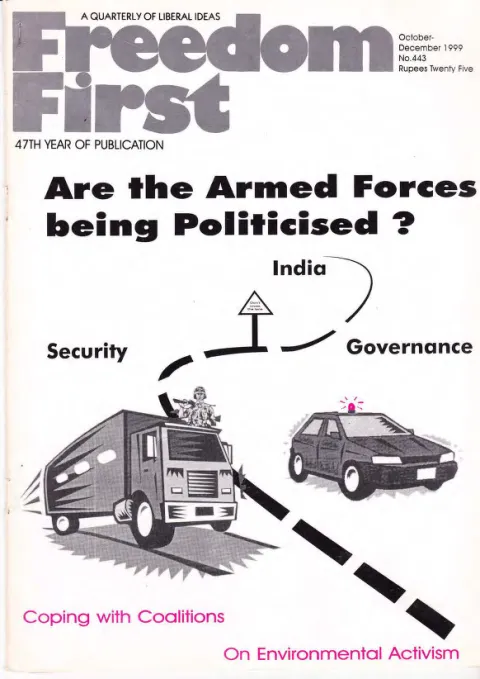
Freedom First
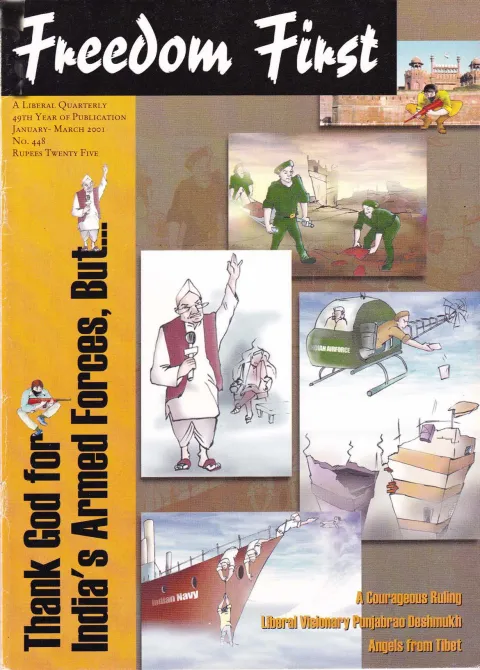
Thank God for India's Armed Forces, But...
By S. V. Raju
Indian Committee for Cultural Freedom, 3rd Floor, Army & Navy Building, 148, Mahatma Gandhi Road, Mumbai 400 001. Published by J. R. Patel for the Indian Committee for Cultural Freedom and printed by him at Kaiser-E-Hind Private Ltd., 300, Perin Nariman Street, Mumbai 400 001. · Mumbai · 2001
72 pages
Freedom First
Summary
This is No. 448 of Freedom First (January-March 2001), the 49th year of publication of the Bombay-based liberal quarterly founded by Minoo Masani, edited by S. V. Raju. In the rendered pages the issue opens with obituary tributes to Professor M. P. Rege and Dr. S. Ambirajan, the editor’s “Between Ourselves” note explaining the issue’s genesis, and the recurring “With Many Voices” (a chorus of quoted press reactions to the Gujarat earthquake) and “Of Cabbages and Kings” editorial-notes columns. The bulk of the rendered material is the cover feature “Thank God for the Armed Forces But…”, built around three news pegs from the preceding months — a terrorist attack on the Red Fort army post, the Gujarat (Bhuj) earthquake, and the International Fleet Review in Mumbai — through which contributors examine the Indian Armed Forces’ expanding, and sometimes politically fraught, role. In the rendered pages this includes Maj. Gen. Eustace D’Souza’s essay warning against politicization of the Army (covering the National Security Council, the stalled Chief of Defence Staff post, the Samba and Kargil cases, and calls to keep the forces free of political interference), R. V. Chari’s account of the Samba Spy Case (the 1975-78 espionage frame-up of army officers, their 2000 exoneration by the Delhi High Court, and its parallels to the Dreyfus affair), and the opening of A. K. R. Hemmady’s essay on the Gujarat earthquake, which was still in progress at the point the rendered pages end.
Key points
-
The cover feature “Thank God for the Armed Forces But…” was built around three news pegs, a terrorist attack on the Red Fort army post, the Gujarat earthquake, and the Mumbai International Fleet Review, to examine the Indian Armed Forces’ expanding and politically fraught role.
-
Maj. Gen. Eustace D’Souza’s “Don’t Politicize the Army - Please!” surveys the forces’ unsustainable range of duties, criticises the National Security Council’s structure and the delayed Chief of Defence Staff post, and reviews historical politicisation episodes from the Krishna Menon era to Operation Blue Star.
-
R. V. Chari’s “The Samba Spy Case” recounts the 1975-1980 espionage frame-up of over fifty army officers, including a soldier’s death in custody, through to their full exoneration and reinstatement by the Delhi High Court in December 2000, drawing an explicit parallel to the Dreyfus Affair.
-
A. K. R. Hemmady’s essay on the Gujarat earthquake surveys the region’s seismic history, reports over 15,000 deaths in Bhuj and Anjar, criticises fatalistic religious explanations for disasters, and details disaster-management failures including absent officials and relief flights turned away from Bhuj airport.
-
The “With Many Voices” column compiles press reactions to the January 26, 2001 earthquake, recording 16,480 deaths and roughly Rs. 3,500 crores in estimated property loss as of early February.
-
The “Of Cabbages and Kings” column opposes a proposed tobacco-advertising ban, criticises both Kerala’s CPM-literature panchayat mandate and Gujarat’s RSS-weekly school circular, and defends the BALCO privatisation against opposition attacks.
Essays
Between Ourselves
By The editor
The editor’s “Between Ourselves” note, in the rendered pages, explains that a planned feature on “Penalising Honesty in the Land of Gandhi” was postponed to the October issue because postal-strike disruption delayed distribution and reader contributions, and that this issue’s cover story on the Armed Forces was substituted after three events — a terrorist strike on an Army post, the Gujarat earthquake, and the Mumbai International Fleet Review — pushed the topic to the fore. It previews the next cover feature on the World Trade Organisation (contribution deadline April 16, 2001) and notes the issue runs 68 pages, 29 of them book reviews, funded partly by an anonymous donor.
- Postal strike disrupted distribution of the previous issue and delayed reader awareness of upcoming features
- The planned ‘Penalising Honesty in the Land of Gandhi’ feature was postponed to October, timed to Gandhi Jayanti
- Three news events — the Red Fort/Army post terrorist attack, the Gujarat earthquake, and the Mumbai Fleet Review — prompted the editors to build this issue’s cover feature around the Armed Forces
- Next cover feature announced: the World Trade Organisation, with a contribution deadline of April 16, 2001
- The issue is 68 pages, of which 29 are book reviews, funded in part by an anonymous donor contribution
Many Voices
“With Many Voices” (in the rendered pages) is a compiled chorus of quoted press reactions to the January 26, 2001 Gujarat earthquake, drawn from The Sunday Times of India, The Week, Outlook, India Today and other outlets — ranging from disaster-response failures, corrupt building practices, and looting, to expressions of resilience. A boxed data table gives casualty and damage figures as of February 7, 2001 (16,480 deaths, 8,792 villages affected, Rs. 3,500 crores estimated property loss).
- Compiles first-person and press quotations reacting to the Gujarat (Bhuj) earthquake of January 26, 2001
- Highlights administrative confusion, corrupt construction practices, and lack of coordination in relief efforts
- Includes praise for citizen and NRI-led rescue improvisation where official response lagged
- A data box records 16,480 human deaths and 2,28,906 collapsed houses as of February 7, 2001
Of Cabbages & Kings
“Of Cabbages and Kings,” the magazine’s recurring editorial-notes column (bylined SVR at the end, in the rendered pages), touches on several unrelated topics: opposition to a proposed ban on tobacco advertising on free-market and free-speech grounds; criticism of both a Kerala government mandate that panchayats buy CPM literature and a Gujarat government circular nudging schools to subscribe to an RSS-affiliated weekly; a cautious welcome to a thaw in India-Myanmar relations while insisting this not mean abandoning pressure over Aung San Suu Kyi’s detention; a defence of the BALCO privatisation against opposition attacks as inconsistent and self-interested; and an open question about the correct liberal position on sanctions versus military action against Saddam Hussein’s Iraq. A boxed reader anecdote, “An Encounter With A Counterfeiter” by Eknaath Nagarkar, recounts a loan appraisal that uncovered a stone-crushing operation supplying material for adulterating food grain.
- Opposes a proposed tobacco-advertising ban as a counterproductive, crony-capitalist-tinted restriction on liberty and free speech
- Criticises both Kerala’s CPM-literature panchayat mandate and Gujarat’s RSS-weekly school circular as improper state promotion of partisan literature
- Welcomes warming India-Myanmar ties cautiously, insisting this should not mean dropping pressure over Aung San Suu Kyi
- Defends the BALCO disinvestment decision and criticises opposition parties (including Congress) for hypocritical, transparency-free objections
- Poses an open question on the proper liberal stance toward Iraq: sanctions relief versus targeted military action against Saddam Hussein
- A separate boxed reader item recounts a bank loan officer’s discovery of a stone-crushing racket used for food-grain adulteration
Thank God for the Armed Forces But … / Don’t Politicize the Army - Please!
By Eustace D’Souza
Maj. Gen. Eustace D’Souza’s “Don’t Politicize the Army — Please!” opens the cover feature (rendered through page 9, where the essay is still continuing). He surveys the many burdens placed on the Indian Armed Forces — four wars, ongoing counter-insurgency in Jammu & Kashmir, 27 UN peacekeeping missions, disaster relief where civil agencies fail, and internal-security duties — and argues the forces are increasingly, and dangerously, drawn into politics. He criticises the National Security Council’s structure (headed by a bureaucrat who also runs the PMO), the prolonged delay in creating a Chief of Defence Staff, procurement stalling (T-90 tanks, LCA, AJT trainer, Arjun tank) that he suggests may hide corruption, and reviews historical episodes of politicization — the Krishna Menon era, General Thimayya’s aborted resignation, Lt. Gen. Thorat’s ignored warnings before the China war, and Lt. Gen. Sundarji’s role in Operation Blue Star under Indira Gandhi. He then turns to the Samba spy case and the Kargil intelligence-failure controversy as contemporary instances of political pressure being placed on the Army.
- Argues the Armed Forces face an ever-widening, unsustainable range of duties: warfighting, UN peacekeeping, disaster relief, and internal security
- Criticises the National Security Council for being headed by a bureaucrat who simultaneously runs the PMO, calling this an inadequate structure for national security
- Blames bureaucratic self-interest for the prolonged delay in creating a Chief of Defence Staff position
- Cites delays in Arjun tank, LCA, and AJT trainer procurement, and a stalled Russian T-90 tank deal, as possibly linked to corruption (‘kickbacks’)
- Recounts historical attempts to politicize the Army, including General Thimayya’s aborted resignation under Nehru and Lt. Gen. Sundarji’s role in Operation Blue Star under Indira Gandhi
- Frames the Samba spy case and the Kargil intelligence-failure inquiry as current examples of political scapegoating of army officers
Preserving the Professionalism of the Armed Forces
By Vishnu Bhagwat
No summary was extracted for this article. Listed for completeness.
The Samba Spy Case
By R. V. Chari
R. V. Chari’s “The Samba Spy Case” recounts the 1975-1980 saga in which army gunners Aya Singh and Sawan Das were arrested on espionage charges, implicating more than 50 army officers who were dismissed in 1980. Intelligence Bureau and RAW findings of innocence were ignored for years; Major R. K. Midha and Havaldar Ram Swaroop suffered torture, with Ram Swaroop dying in custody. After Delhi High Court challenges beginning in 1982, the Supreme Court affirmed judicial review in 1994, and the Delhi High Court fully exonerated the officers on December 21, 2000, ordering reinstatement with back wages. Chari draws an explicit parallel to the Dreyfus Affair in France, and closes by questioning the Directorate of Military Intelligence’s conduct, including its dual role as prosecutor and judge.
- Two army gunners, Aya Singh (Ranbir Singh Rathaur) and Sawan Das, were arrested in 1975 on spying-for-Pakistan charges, with over 50 officers implicated by 1978 interrogation
- All implicated officers were dismissed in January 1980, despite IB and RAW findings later that year that they were innocent
- Havaldar Ram Swaroop died in DMI custody with 39 injuries after arrest; Major R. K. Midha, ordered to cremate the body, refused
- The case dragged through Delhi High Court challenges from 1982, a Supreme Court ruling on judicial review in 1994, ending in full exoneration and reinstatement with back wages on December 21, 2000
- Chari compares the case to the Dreyfus Affair, noting both involved wrongful conviction, torture, and eventual exoneration after prolonged suffering
- Raises questions about the propriety of the DMI acting as both prosecutor and adjudicator in the court-martial process
The Gujarat Earthquake
By A. K. R. Hemmady
A. K. R. Hemmady’s essay on the Gujarat earthquake, seen only through its opening pages (13-20 of 72 rendered), surveys the region’s seismic history (Bhuj’s 1819 ‘Allah Bund’ quake and other Western Gujarat quakes back to 1872), asks whether nuclear testing affects earthquake frequency, and details the January 26, 2001 Bhuj earthquake’s toll (over 15,000 dead in Bhuj and Anjar alone). He criticises Indian fatalism about disasters (contrasting Gandhi’s view of the Bihar earthquake as divine ‘chastisement’ with Tagore’s objection), and moves into an extended critique of disaster management failures during the Gujarat response — absent officials at Krishi Bhavan and the IMD on Republic Day, VIP visits obstructing relief, and shoddy construction enabled by a builder-politician-official nexus in Bhuj. He calls for a professionally staffed, statutorily empowered national Disaster Management Group reporting to Parliament, and closes (in the rendered portion) reflecting on the propriety of the Mumbai International Fleet Review proceeding so soon after the earthquake.
- Surveys the seismic history of Kutch and Western Gujarat, including the 1819 ‘Allah Bund’ earthquake and quakes in 1872, 1903, 1938, 1940, 1956, and 1970
- Raises an open question about whether decades of underground nuclear testing affect earthquake frequency or severity
- Reports over 15,000 deaths in Bhuj and Anjar from the January 26, 2001 earthquake
- Criticises fatalistic religious explanations for disasters (citing Gandhi on the Bihar earthquake and later religious reactions to the Bhuj quake) as an obstacle to a scientific temper
- Details disaster-management failures: no officials present at Krishi Bhavan or the IMD on Republic Day, VIP visits diverting relief efforts, relief flights turned away from Bhuj airport
- Calls for a statutorily empowered, professionally staffed national Disaster Management Group reporting to Parliament, with dedicated equipment and rescue capacity
- Notes builder-official-politician collusion in approving unsafe Bhuj construction, citing an admission from the Bhuj Municipal Corporation president
- Questions (in the essay’s unfinished portion as rendered) whether the Mumbai International Fleet Review should have proceeded so soon after the earthquake
Generated by the v1.5 extraction pipeline. Awaiting editorial review.
Metadata and summary are AI-extracted from the source PDF and reviewed for editorial accuracy. The original work is available via the Read PDF tab above (where present); paragraph-level citation inside the PDF is deferred to a future engagement.