periodical issue
Freedom First
A Liberal Quarterly
By Sharad Joshi
Published by J. R. Patel for the Indian Committee for Cultural Freedom and printed by him at Kaiser-E-Hind Private Ltd., 300, Perin Nariman Street, Mumbai 400 001. · Mumbai · 2004
52 pages
Freedom First
Summary
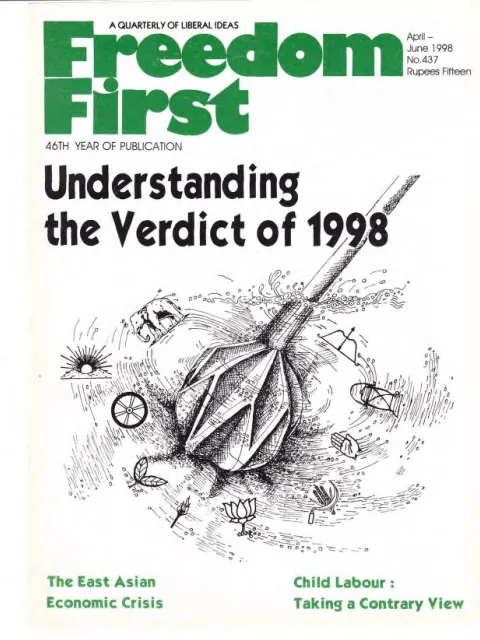
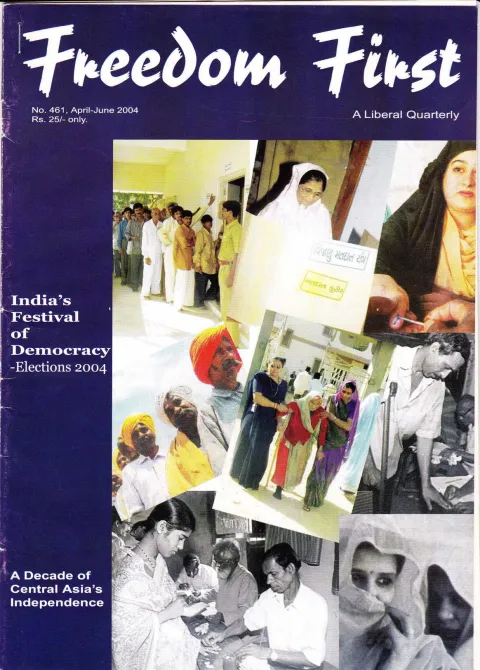
This is Freedom First No. 461 (April-June 2004), the 51st year of publication of the Bombay-based liberal quarterly founded by Minoo Masani, edited by S. V. Raju with R. Srinivasan as Associate Editor. The issue opens with an obituary tribute to Justice V. M. Tarkunde (1909-2004), extracted from an address by Attorney General Soli Sorabjee, followed by the editor’s regular ‘Of Cabbages and Kings’ notes and the ‘With Many Voices’ page of press-quote miscellany. The cover feature, ‘India’s Festival of Democracy - Elections 2004,’ is a summarised report of a discussion meeting held on May 22, 2004 in Mumbai, organised by Freedom First with the Indian Liberal Group and the Project for Economic Education. In the rendered pages, the volume carries presentations by S. V. Raju (on the Election Commission’s autonomy), Nagindas Sanghavi (on the issues dominating the campaign), Ashok Karnik (on what message the voter conveyed), and the opening of Uttara Sahasrabuddhe’s presentation (on the impact of the results on India’s polity), each followed by a summarised floor discussion. The discussion assembled a large panel of Mumbai civil-society figures — activists, retired judges, journalists, academics, and businesspeople — to dissect the Election Commission’s conduct, the BJP’s ‘India Shining’ campaign and its retreat from Hindutva, the Congress’s return under Sonia Gandhi, dynastic politics, and the emerging bipolar Congress-BJP polity.
Key points
-
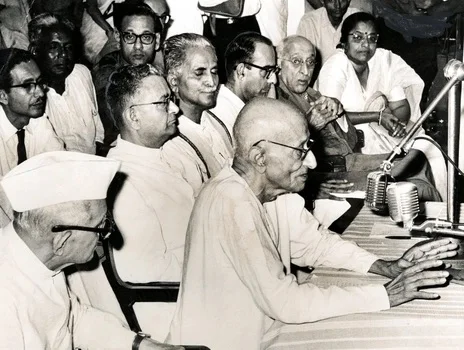
Freedom First No. 461 (April-June 2004) opens with an obituary tribute to Justice V. M. Tarkunde, extracted from an address by Attorney General Soli Sorabjee.
-
The cover feature reports a May 2004 Mumbai discussion on “India’s Festival of Democracy - Elections 2004,” organised with the Indian Liberal Group and the Project for Economic Education.
-
S. V. Raju warns the Election Commission’s autonomy is at risk from government dependence for manpower and funds, citing the 720-fold rise in election costs since 1967 and instances of the EC straying beyond its mandate.
-
Nagindas Sanghavi argues the 2004 campaign again failed to surface substantive issues, framing the BJP’s retreat from militant Hindutva toward “India Shining” and the Congress’s revival as personal validation of Sonia Gandhi’s dynastic leadership.
-
Ashok Karnik argues the narrow BJP-Congress seat gap reflected no decisive ideological verdict, warning that anti-incumbency and demand for “instant delivery” risk pushing governments toward short-termist populism.
-
Uttara Sahasrabuddhe contends only six states effectively determine national power, reframing India’s run of hung parliaments as a reflection of social diversity rather than instability, and identifies an emerging bipolar Congress-BJP polity.
-
Floor discussion at the meeting covered disputes over criminal-record disclosure for candidates, electoral-roll disenfranchisement, and the politicisation of Sonia Gandhi’s foreign origin.
Essays
Many Voices
S. V. Raju’s presentation warns that the Election Commission’s independence is at real risk, citing a former CEC’s claim that the Commission was expanded to three members partly to pack it with government loyalists (a ploy that failed because the appointees proved independent). Raju argues civil society should help ‘tamper-proof’ the EC by reducing its dependence on government-supplied manpower, drawing on corporate and NGO personnel instead, and cites the sharply rising cost of elections (720-fold between 1967 and 2004). He credits IIM professors Chhokar and Sastry’s initiative requiring candidates to declare assets and criminal records, while noting the Patna High Court’s attempt to bar criminal-charge-holders from contesting was defeated on appeal by the EC itself (defending existing law), a position Raju calls regrettable in effect though technically correct. He also flags instances of the EC ‘straying beyond its jurisdiction’ — recommending President’s Rule in Gujarat, asking UP to prosecute a bribery case, policing cash carried through airports, and seeking bans on exit polls and advertisement censorship — arguing these overreach the EC’s core mandate of organising and conducting elections. The floor discussion covers the legal status of the Code of Conduct (a non-statutory convention agreed between the EC and parties), whether false asset declarations can be challenged in court, whether criminal charge disclosure unfairly exposes candidates to flimsy accusations, the propriety of retired CECs entering the Rajya Sabha, and systemic disenfranchisement caused by poor electoral rolls — with suggestions ranging from empowering India Post to maintain rolls to cross-checking against income-tax registers.
- The Election Commission’s autonomy is under strain; a former CEC believed the body was expanded to three members partly to pack it with government appointees, a ploy that failed.
- Government-dependence for manpower and funds leaves the EC vulnerable; Raju proposes drawing on corporate and NGO personnel instead.
- Cost of conducting Indian elections rose 720-fold between 1967 and 2004 (inflation-adjusted roughly 57-fold).
- IIM professors Jagdish Chhokar and Trilochan Sastry’s initiative forced candidates to declare assets and criminal records, though attempts to bar criminal-charge-holders from contesting were struck down.
- The EC arguably overstepped its jurisdiction on several fronts: recommending President’s Rule in Gujarat, ordering prosecution in the Lalji Tandon bribery case, questioning airport cash-carriers, and seeking bans on exit polls/surrogate ads.
- Floor discussion surfaced deep problems with electoral rolls — bogus names, missing genuine voters, ID-card/roll mismatches — and proposed remedies including using the postal system and income-tax data for roll accuracy.
- A West Bengal CPM-EC standoff over election observers, including an FIR filed by the Chief Electoral Officer, illustrated tension between the Commission and state political machinery.
Cabbages and Kings
Nagindas Sanghavi argues the 2004 campaign again failed to throw up substantive issues, with party manifestos reduced to vague development promises. He identifies two real underlying issues that were never squarely debated: first, the BJP’s forced retreat from its ‘militant Hindutva’ platform under the pressures of coalition politics — Vajpayee having discarded the party’s ideological baggage in favour of an economic-growth pitch (‘India Shining’) that nonetheless failed, leaving open whether frustrated hardliners might drag the party back toward the Ram Mandir issue; second, the Congress’s revival, which Sanghavi frames not as an organisational or ideological comeback but purely as a personal validation of Sonia Gandhi’s ‘dynastic leadership,’ a pattern he regards as a ‘blot on democratic norms.’ He surveys state-by-state results (Tamil Nadu anti-Jayalalitha, Karnataka/Andhra Pradesh rural distress and farmer suicides) to argue no single issue dominated nationally, and identifies anti-incumbency and voter fatigue — not ideology — as the one common thread, alongside a debate over whether Sonia Gandhi’s foreign origin was a legitimate campaign issue or a communal dog-whistle by the BJP/RSS.
- The 2004 manifestos offered inanities and generalities rather than substantive policy choices, consistent with past Indian elections.
- The BJP was forced to soften its militant Hindutva platform for coalition politics, pivoting to an economic-growth pitch (‘India Shining’) that nonetheless proved a fifty-year achievement claimed opportunistically.
- Sanghavi frames the Congress’s revival as validation of Sonia Gandhi personally rather than of the party’s organisation or ideology, calling dynastic succession ‘a blot on democratic norms and values.’
- No single issue dominated nationally; different states were driven by different local grievances (anti-Jayalalitha sentiment in Tamil Nadu, farmer suicides and rural neglect in Karnataka/Andhra Pradesh).
- Anti-incumbency and a fatigued, short-termist electorate (‘give them whatever they want and let me win the election’) is identified as the one cross-cutting factor.
- Sonia Gandhi’s foreign origin was pressed by the RSS/BJP/NDA as a citizenship and ‘Bharatiyata’ issue; her camp countered by projecting her as a traditional Indian bahu.
- A recurring debate in the discussion asks why communalism is only ever attributed to the majority community and not to minority-identified parties.
India’s Festival of Democracy – Elections 2004
Ashok Karnik’s presentation argues the 2004 result jolted every camp — pollsters, astrologers, the NDA, and the Congress alike — because the swing between BJP (138 seats) and Congress (145 seats) was too narrow to reflect any decisive ideological verdict. He suggests a mild preference emerged for younger, educated candidates over entrenched incumbents, but insists ideology played essentially no role: results instead reflected local patterns of governance and control — CPM cadre discipline in West Bengal, caste-based manipulation in Bihar — rather than a national mandate for or against any ‘ism.’ Karnik identifies anti-incumbency, voter impatience for ‘instant delivery,’ and short-termist, populist appeals as decisive dynamics, worrying openly that if voters demand only near-term benefits, elected governments will be pushed toward it-doesn’t-matter-what-happens-in-ten-years populism, undermining any capacity for long-term policy planning.
- The 2004 verdict jolted pollsters, astrologers, and all major parties alike; the narrow seat gap between BJP (138) and Congress (145) undercuts any claim of a decisive ideological mandate.
- Karnik suggests voters showed a mild preference for younger, educated candidates over old incumbents.
- Ideology was largely absent from voter calculus; state results instead reflect entrenched local control mechanisms — CPM cadre grip in West Bengal, caste manipulation in Bihar.
- Anti-incumbency and demand for ‘instant delivery’ were the dominant, cross-cutting dynamics rather than any policy debate.
- Karnik warns that a short-termist electorate risks pushing governments toward populist giveaways at the expense of any decade-long planning horizon.
The Election Commission – Is its Autonomy at Risk?
By S. V. Raju
Uttara Sahasrabuddhe’s presentation, as far as rendered, argues that only six states (Uttar Pradesh, Maharashtra, Andhra Pradesh, West Bengal, Bihar, Tamil Nadu) effectively determine national power, and that their fragmented, regionally-contested outcomes explain why India has produced a string of hung parliaments over the past decade and a half. She contends the so-called ‘fractured mandate’ actually reflects India’s underlying social diversity rather than instability, and that no all-India electoral wave has occurred since 1984 (the year of Indira Gandhi’s assassination). She identifies an emerging bipolar Congress-BJP polity in which she sees little substantive difference between the parties beyond opposing assaults on the ‘secular’ and ‘liberal’ ethos respectively, with combined vote share around 50% split evenly between the two and the rest fragmented among smaller parties. The subsequent discussion (following essay 3’s Karnik Q&A, before Sahasrabuddhe’s own floor discussion begins) covers the ‘glamour and glitter’ of Bollywood entrants into the campaign, all of whom lost in Andhra Pradesh and Tamil Nadu, and the politicisation of Sonia Gandhi’s foreign birth as a citizenship issue.
- Only six states — UP, Maharashtra, Andhra Pradesh, West Bengal, Bihar, Tamil Nadu — together hold 291 seats, enough to determine a Lok Sabha majority, and their fragmented state-level politics explains India’s run of hung parliaments.
- Sahasrabuddhe reframes the ‘fractured’/‘fragmented’ mandate label as a positive reflection of India’s social diversity rather than a democratic failure.
- No genuine all-India electoral wave has occurred since 1984 (Indira Gandhi’s assassination); recent elections track state-specific dynamics instead.
- India is moving toward a bipolar Congress-BJP polity with the two parties splitting roughly 50% of the vote between them and little substantive policy difference, differing mainly in which ‘ethos’ (secular vs. liberal) each is seen to have assaulted.
- Floor discussion (carried over from the Karnik session) noted that cinema-star candidates were uniformly rejected by voters in Andhra Pradesh and Tamil Nadu, while flagging Govinda’s win as a possible new Bombay/north-Indian phenomenon.
- Sonia Gandhi’s ‘foreign origin’ was pressed as an issue of Bhartiyata and naturalised citizenship by the RSS/BJP/NDA, met by her camp’s projection of her as a traditional Indian daughter-in-law.
Generated by the v1.5 extraction pipeline. Awaiting editorial review.
Metadata and summary are AI-extracted from the source PDF and reviewed for editorial accuracy. The original work is available via the Read PDF tab above (where present); paragraph-level citation inside the PDF is deferred to a future engagement.