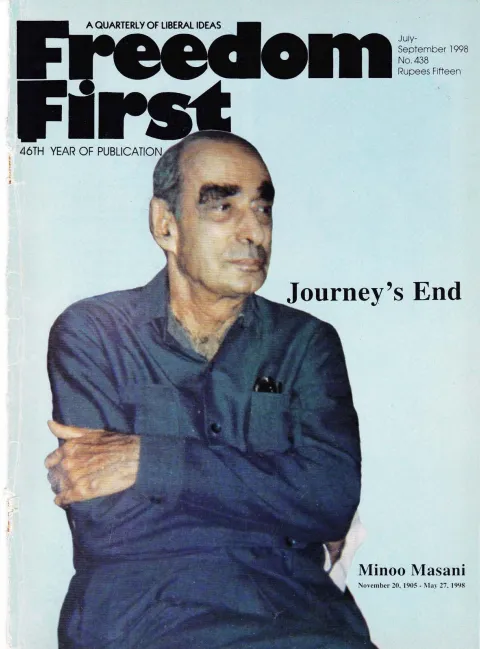
periodical issue
Freedom First
A Liberal Quarterly
Indian Committee for Cultural Freedom, 3rd Floor, Army & Navy Building, 148, Mahatma Gandhi Road, Mumbai 400 001. Published by J. R. Patel for the Indian Committee for Cultural Freedom and printed by him at Kaiser-E-Hind Private Ltd., 300, Perin Nariman Street, Mumbai 400 001. · Mumbai · 2004
52 pages
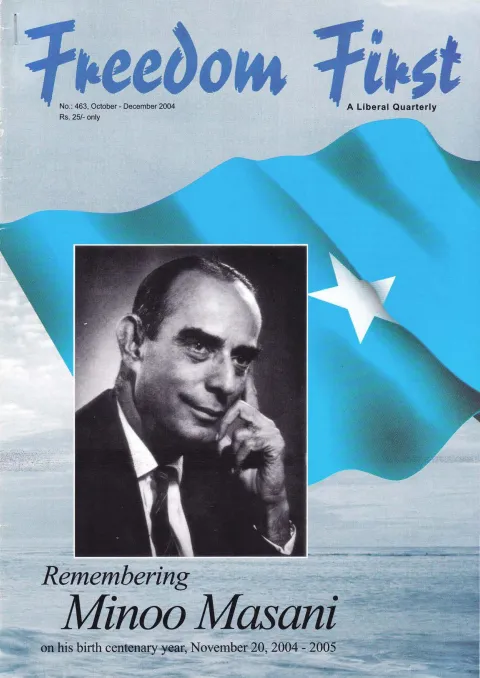
Freedom First
Summary
This is issue No. 463 of Freedom First (October–December 2004), the Bombay-based liberal quarterly founded by Minoo Masani, appearing in the magazine’s 52nd year of publication under editor S. V. Raju. The issue is built around a birth-centenary tribute to Masani (born November 20, 1904), reprinting two of his own essays — “Leadership” and “I Believe” — alongside S. V. Raju’s retrospective assessment “Minoo Masani – The Principled Politician,” which traces Masani’s political journey from a founding member of the Congress Socialist Party to co-founder, with C. Rajagopalachari, of the Swatantra Party in 1959. In the rendered pages, the volume also carries the editor’s “Between Ourselves” note (announcing the postponement of the Indian Liberal Group’s Second National Convention and previewing the centenary commemorations), the recurring satirical column “Of Cabbages and Kings” (commenting on Indira Gandhi hagiography, Yasser Arafat’s death, George W. Bush’s re-election, the killing of the bandit Veerappan, and the arrest of the Kanchi Shankaracharya), the press-clippings digest “With Many Voices,” R. M. Lala’s “Three Great Liberals” (on Dadabhai Naoroji, Pherozeshah Mehta, and Jamsetji Tata), and V. Balachandran’s analysis of the 2004 U.S. presidential election and Electoral College mechanics. The issue also carries a notice protesting the death sentence against the Tibetan lama Tenzin Delek Rinpoche. Further contents listed on the table of contents but not covered in the rendered pages include essays by Amlan Datta (“Reign of Truth”), A. D. Moddie (“Reforming the Neta-Babu Raj”), Kusum Choppra (on water shortage), P. P. Bopanna (on the Supreme Court and Hindutva), N. B. Grant (“The Forgotten Freedom Fighter”), a profile of G. Parameswaran Pillai of Travancore by R. Srinivasan, a tribute to columnist Bernard Levin by “Arianna,” a Debate section, N. Dharmeshwaran’s “D’s Column,” and book reviews.
Key points
-
Freedom First No. 463 (Oct-Dec 2004) is built around a birth-centenary tribute to founder Minoo Masani, reprinting his essays “Leadership” and “I Believe” alongside S. V. Raju’s retrospective “Minoo Masani - The Principled Politician.”
-
Raju traces Masani’s journey from founding the Congress Socialist Party in 1934 through his break with its Moscow-directed wing, his 1944 “Socialism Reconsidered,” and his 1959 co-founding of the Swatantra Party with C. Rajagopalachari.
-
In “Leadership,” Masani argues India suffers a shortage of genuine leadership due to cultural deference and political “tailism,” contrasting Churchill and de Gaulle’s conditional leadership with Indian equivocation and quoting Walter Lippmann’s warning about authoritarian temptation.
-
In “I Believe,” Masani professes a humanist Brotherhood of Man ethic grounded in Stoic philosophy, tracing how contact with Gandhi’s linkage of ends and means led him to renounce State Socialism.
-
“Of Cabbages and Kings” comments on sycophantic press coverage of Indira Gandhi, calls Yasser Arafat “the father of modern terrorism” on his death, and warns of Bush’s re-election implications for civil liberties.
-
R. M. Lala’s “Three Great Liberals” profiles Dadabhai Naoroji, Pherozeshah Mehta, and Jamsetji Tata as London-shaped founders of Indian liberalism, crediting Naoroji as the first Indian elected to the British Parliament.
-
V. Balachandran explains U.S. Electoral College mechanics to rebut Indian media claims that the Supreme Court “elected” Bush in 2000, drawing a parallel to the 1961 Hawaii electors dispute.
-
The editor’s note announces the postponement of the Indian Liberal Group’s Second National Convention to February 2005 and notes the death of Times columnist Bernard Levin.
Essays
Between Ourselves …
By Editor
The editor’s note, in the rendered pages, announces that the Indian Liberal Group’s Second National Convention has been postponed to February 18-20, 2005, pushing back the associated special issue of Freedom First to the same date. It frames this issue as the magazine’s tribute to founder Minoo Masani on his birth centenary (November 20, 2004), to be released at a seminar in Pune organised by the Indian Liberal Group, and invites readers who knew Masani to share reminiscences. It also notes the death of London Times columnist Bernard Levin, a friend of the magazine, and records a reader’s criticism that the journal’s production values feel dated, which the editor promises to address in the February issue.
- Second National Convention of the Indian Liberal Group postponed to February 18-20, 2005
- This issue is dedicated to founder Minoo Masani’s birth centenary (November 20, 1904)
- Tribute issue to be released at a Pune seminar organised by the Indian Liberal Group
- Notes the death of London Times columnist Bernard Levin, a friend of the magazine
- Editor acknowledges reader criticism of the magazine’s dated production and promises a redesign from the February 2005 special issue
Many Voices
No summary was extracted for this article. Listed for completeness.
Of Cabbages And Kings
In the rendered pages, this unsigned editorial column comments on several current events of late 2004: sycophantic press coverage of Indira Gandhi and a defence of criticism of her Emergency-era record; a swipe at Yasser Arafat as “the father of modern terrorism” following his death; a resigned commentary on George W. Bush’s re-election and its implications for civil liberties and gay marriage/stem-cell research; commentary on the killing of bandit Veerappan and media glorification of him; and a call for the law to take its course, without politicisation, following the arrest of the Kanchi Shankaracharya in a murder case.
- Criticises sycophantic press treatment of Indira Gandhi and defends the record of criticising the Emergency
- Cites a Chartered Financial Analyst report that the World Bank was investigating 345 corruption cases, penalising 215 firms/individuals
- Calls Yasser Arafat “the father of modern terrorism” upon his death, criticising retrospective rehabilitation of his image
- Comments on Bush’s re-election, warning of dangers to civil liberties, gay marriage bans, and restricted stem-cell research
- On Veerappan’s killing, criticises media glamorisation encouraging future outlaws
- On the Kanchi Shankaracharya’s arrest, insists the law must apply equally regardless of religious status and warns against politicisation by both DMK and Sangh Parivar groups
Minoo Masani - The Principled Politician
By S. V. Raju
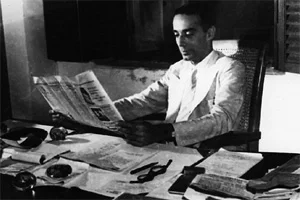
S. V. Raju’s centenary assessment traces Minoo Masani’s evolution from a founding member of the Congress Socialist Party (1934) to his break with it over the CSP’s ties to Moscow-directed Communism, his subsequent “Socialism Reconsidered” (a rethinking of socialist premises), and finally his 1959 co-founding of the Swatantra Party with C. Rajagopalachari to oppose Nehru’s “socialist pattern of society.” Raju frames Masani’s trajectory as a journey “from Marx to Gandhi” and credits him more than anyone with putting liberalism on India’s political map, arguing his warnings against the License-Permit-Quota Raj were vindicated by the 1991 economic reforms. The piece closes by quoting Masani’s own 1994 Freedom First appeal for a movement to defend and complete India’s liberalisation.
- Masani co-founded the Congress Socialist Party in February 1934 alongside Jayaprakash Narayan, Achyut Patwardhan, Yusuf Meherally, Ram Manohar Lohia, Asoka Mehta, and S. M. Joshi
- He quit the CSP five years later over its Communist infiltration and Moscow-directed tactics, then quit politics until 1942 when he rejoined Congress for the Quit India movement
- Published “Socialism Reconsidered” (1944), rejecting Communism and reworking his view of socialism toward a mixed economy and Gandhian trusteeship
- Co-founded the Swatantra Party with C. Rajagopalachari in August 1959 to oppose Nehru’s socialist pattern of society
- The Swatantra Party was the largest single opposition party in the Lok Sabha between 1967 and 1971
- Masani retired from party politics after losing his Lok Sabha seat in 1971 but remained publicly active until near 1990, founding the Democratic Research Service (1954) and the Leslie Sawhny Programme (1968)
- He resigned the Chairmanship of the Minorities Commission under the Janata government rather than compromise on principle
Leadership
By Minoo Masani
A reprinted essay by Minoo Masani arguing that India suffers from a shortage of genuine leadership, which he attributes to cultural deference to authority, a national tendency toward equivocation (‘on the one hand… on the other’), and political ‘tailism’ (following the dominant trend rather than leading). He contrasts Winston Churchill and Charles de Gaulle’s model of conditional leadership with the record of Indian prime ministers, invokes Walter Lippmann’s warning about people choosing authoritarian government over ineffective freedom, and closes by citing Lao Tzu’s criteria for good leadership.
- Argues Indian culture discourages the courage and dissent essential to leadership
- Criticises Nehru-style rhetorical equivocation (‘at the same time… on the other hand’) as symptomatic of a failure to lead
- Praises Churchill and de Gaulle’s model of leading only on one’s own terms
- Quotes Walter Lippmann’s The Public Philosophy on people choosing authoritarian government over ineffective freedom
- Closes with Lao Tzu’s criteria for judging a good leader
I Believe
By Minoo Masani
A reprinted personal credo by Minoo Masani, professing belief in the Brotherhood of Man independent of religious faith, a humanist ethics grounded in the balance of happiness over unhappiness, and a Stoic philosophy drawn from Marcus Aurelius’s Meditations. He describes his lifelong instinct for the underdog, his early attraction to socialism via H. G. Wells and George Bernard Shaw, and how his engagement with Gandhi’s insistence that ends and means are interlinked led him to renounce State Socialism in his 1944 book “Socialism Reconsidered.”
- Professes belief in the Brotherhood of Man without requiring belief in God
- Grounds morality in the overall balance of happiness versus unhappiness an action produces
- Cites Stoic philosophy, especially Marcus Aurelius’s Meditations, as a personal touchstone
- Describes an early instinct for defending the underdog, tracing it to childhood and to reading H. G. Wells and George Bernard Shaw
- Credits contact with Gandhi for the idea that ends and means are interlinked, leading to his 1944 book Socialism Reconsidered and rejection of State Socialism
Three Great Liberals
By R. M. Lala
R. M. Lala’s essay profiles Dadabhai Naoroji, Sir Pherozeshah Mehta, and Jamsetji Tata as three founding figures of Indian liberalism who met regularly in London in the 1860s under the influence of Governor Mountstuart Elphinstone’s liberal administration. It credits Naoroji with giving India political leadership (including winning a British parliamentary seat on a Liberal ticket), Mehta with civic leadership, and Tata with industrial leadership and his campaign against unfair British duties on Indian cloth. Lala argues Nehru’s post-independence turn to state capitalism produced the License-Permit-Quota Raj, but that Rajagopalachari, J. R. D. Tata, and eventually the 1991 reforms vindicated the liberal idea.
- Dadabhai Naoroji, Pherozeshah Mehta, and Jamsetji Tata met regularly in London in the 1860s, shaped by Governor Mountstuart Elphinstone’s liberal vision for India
- Naoroji became the first Indian elected to the British Parliament, on a Liberal ticket from Central Finsbury
- Jamsetji Tata campaigned against British import duties disadvantaging Indian cloth production
- Frames Nehru’s post-independence ‘State Capitalism’ as producing the License-Permit-Quota Raj and decades of thwarted growth
- Credits Rajagopalachari and J. R. D. Tata with keeping the liberal banner alive until the 1991 liberalisation under Manmohan Singh’s budget
U.S. Presidential Elections - An Analysis
By V. Balachandran
V. Balachandran’s analysis (partially seen, ending mid-essay at page 18) explains the mechanics of the U.S. Electoral College system and uses it to rebut claims in the Indian media that the 2000 election was decided by the Supreme Court rather than through constitutional process, drawing a parallel to a 1961 dispute over Hawaii’s electors between Nixon and Kennedy.
- Explains how U.S. voters elect a slate of party-nominated ‘Electors’ rather than the President directly
- Traces the Electoral College’s origins to the Roman ‘Centurial Assembly’ system
- Argues the Indian media’s claim that the Supreme Court ‘elected’ Bush in 2000 is factually incorrect; the Court only ruled on a manual recount dispute
- Draws a parallel to the 1961 Hawaii electors dispute between Nixon and Kennedy, where Nixon as presiding Vice-President certified his rival’s electors
Is there a Water Shortage?
By Kusum Choppra
No summary was extracted for this article. Listed for completeness.
Generated by the v1.5 extraction pipeline. Awaiting editorial review.
Metadata and summary are AI-extracted from the source PDF and reviewed for editorial accuracy. The original work is available via the Read PDF tab above (where present); paragraph-level citation inside the PDF is deferred to a future engagement.