periodical issue
Freedom First
A Liberal Quarterly
By Minoo Masani, S. P. Sathe, Ajit Karnik, R. M. Mohan Rao, S. V. Raju
Indian Committee for Cultural Freedom; Published by J. R. Patel for the Indian Committee for Cultural Freedom and printed by him at Kaiser-E-Hind Private Ltd., 300, Perin Nariman Street, Mumbai 400 001 · Mumbai · 2005
72 pages
Freedom First
Summary
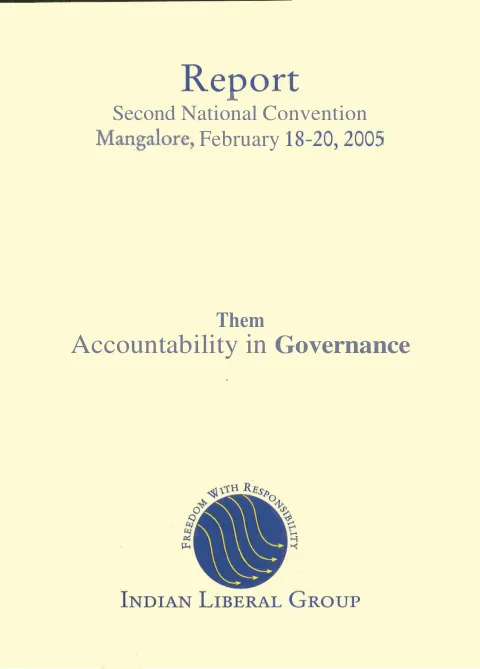
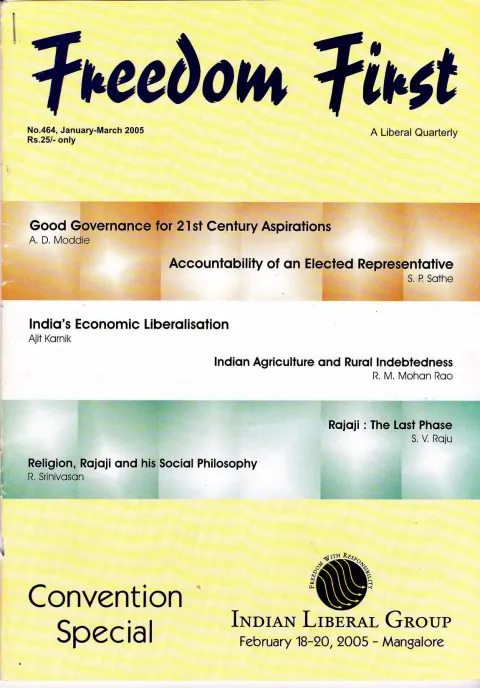
Freedom First No.464 (January-March 2005) is a Convention Special issue, published to coincide with the Indian Liberal Group’s 2nd National Convention held in Mangalore from 18-20 February 2005. The rendered pages open with a tribute to founder Minoo Masani (whose birth centenary the issue marks) in the form of an excerpt from his autobiography ‘Against the Tide’ recounting how the Indian Liberal Group came into being in 1965 out of his engagement with the Liberal International and the Swatantra Party. The issue then carries a set of policy essays addressing the state of Indian governance and economic reform two decades after liberalisation: A. D. Moddie surveys fifty years of failed governance performance (using Bihar and chronic unemployment as case studies) and argues for a shift from personality-driven politics to accountable, skill-based administration, proposing new youth-led committees on family welfare, panchayati raj, and employment. S. P. Sathe examines the constitutional and practical mechanisms of accountability for elected representatives — the President’s discretion, anti-defection law, candidate disclosure of criminal records and assets, the Election Commission’s growing authority, the National Human Rights Commission, and the media — arguing Indian democracy is moving from an obsession with charismatic leadership toward a demand for performance. Ajit Karnik’s essay, in the rendered portion, lays out the liberal position on the state-market relationship, credits India’s post-1991 reforms with strong recovery and poverty reduction, and begins to set out an ‘unfinished liberal agenda’ invoking Hayek’s critique of the planning mindset as a ‘fatal conceit’.
Key points
-
Freedom First No. 464 (Jan-Mar 2005) is a Convention Special issue for the Indian Liberal Group’s Second National Convention in Mangalore, opening with an excerpt from Minoo Masani’s autobiography “Against the Tide” recounting the Indian Liberal Group’s 1965 founding.
-
Masani describes distributing the Swatantra Party’s 21 principles to the Liberal International’s Executive Committee at Gardone in 1959, and names Sophia Wadia, Khushwant Singh, B. R. Shenoy, and H. V. R. Iengar among the ILG’s founding executive committee.
-
A. D. Moddie argues coalition management and accountable governance will define India’s 21st century, using Bihar’s decline and rising unorganised-sector unemployment as case studies, and proposes renaming the Ministry of Labour a Ministry for National Employment and Productivity.
-
Moddie proposes multi-party youth committees, naming figures like Rahul Gandhi, Jyotiraditya Scindia, and Milind Deora, to tackle population planning, panchayati raj reform, and employability training.
-
S. P. Sathe treats accountability as a moral concept, tracing the Supreme Court’s closure of a chief-minister reappointment loophole, its mandated candidate disclosure of assets and criminal records, and the growing institutional legitimacy of the Election Commission under T. N. Seshan.
-
Sathe cites Public Interest Litigation, liberalised after the Emergency, as a key civil-society accountability tool exposing ordinance abuse and corrupt cement-allotment practices, and credits the National Human Rights Commission’s intervention in Gujarat carnage cases.
-
Ajit Karnik surveys India’s post-1991 economic liberalisation, crediting it with a fall in poverty from 37% to about 26% while warning of worsening state government finances, and invokes Hayek’s “Fatal Conceit” to critique the planning-era state.
Essays
How the Indian Liberal Group Came into Existence
By Minoo Masani
In the rendered pages, this is a first-person excerpt from Minoo Masani’s autobiography ‘Against the Tide’ recounting the founding of the Indian Liberal Group. Masani describes being invited in the late 1950s to become a patron of the Liberal International, his role linking Indian liberal elements to that body through the 1960s, praise from Japanese Liberal Democratic Party leaders (including Takeo Miki) for the Swatantra Party’s programme, and his account of debating whether Swatantra should be labelled ‘Conservative’ rather than ‘Liberal’ at a 1959 Liberal International conference in Gardone, Italy. He describes the Indian Liberal Group’s founding on 10 December 1965 as a non-partisan body with an executive committee including Sophia Wadia, Khushwant Singh, B. R. Shenoy, H. V. R. Iengar, and Dr. F. Mehta.
- Masani was invited to become a patron of the Liberal International in the late 1950s, before the Swatantra Party existed.
- He distributed the Swatantra Party’s 21 principles to the Liberal International’s Executive Committee at Gardone, Italy in 1959.
- Japanese Liberal Democratic leaders, including Takeo Miki, admired the ‘courage’ of Rajaji and the Swatantra Party’s programme but Masani read this as diplomatic language for foolhardiness.
- Masani forecasts the ‘Garibi Hatao’ slogan as a natural demagogic response given India’s mass illiteracy and poverty, contrasted with Japan’s more literate electorate.
- The Indian Liberal Group was founded on 10 December 1965 with an executive committee including Sophia Wadia, Khushwant Singh, B. R. Shenoy, H. V. R. Iengar, Dr. F. Mehta, and Masani himself.
- The ILG is described as non-partisan, unconnected to any political party, distinct from the Swatantra Party itself.
Good Governance for 21st Century Aspirations
By A. D. Moddie
A. D. Moddie’s essay argues that managing coalition politics and delivering competent governance will be the central political challenge of India’s 21st century. He revisits a 1964 diagnosis by civil-servant-turned-Congress-minister S. G. Barve on the causes of poor governance and finds that, forty years on, the same failures of accountability and administrative competence persist. Using Bihar as a case study of a mineral- and soil-rich state reduced to what he calls India’s ‘Central Africa’ through decades of political non-performance, Moddie surveys chronic failures across water and hydro-power development in the eastern states, malnutrition despite foodgrain self-sufficiency, and rising unemployment. He then turns to employment policy, arguing the Ministry of Labour’s early-20th-century conceptual framework (protecting existing organized-sector jobs) has become an obstacle to job creation for the much larger unorganized sector, and proposes renaming it a Ministry for National Employment and Productivity tasked with skilling workers for IT, telecom, alternative energy, sanitation, health para-medical work and infrastructure sectors.
- Coalition management will be the defining political challenge of India’s 21st century, per Moddie.
- S. G. Barve’s 1964 diagnosis of governance failure — weak accountability systems and poor administrative capability — remains largely unaddressed 40 years later.
- Bihar, despite rich alluvial and mineral resources, is presented as the starkest case of governmental failure, contrasted with Laloo Prasad Yadav’s RJD government’s fiscal demands.
- Despite grain self-sufficiency, at least 300 million Indians still suffer malnutrition, with India’s HDI standards among the world’s lowest.
- Existing labour law protects roughly 20 million organized-sector jobs at the expense of 37 million in the unorganized sector, which Moddie calls a ‘gross travesty of social justice’.
- Moddie proposes renaming the Ministry of Labour into a Ministry for National Employment and Productivity, and forming multi-party youth committees (naming Rahul Gandhi, Jyotiraditya Scindia, Milind Deora, Naveen Jindal, and others) to tackle population planning, panchayati raj reform, and employability training.
- C. Rajagopalachari’s description of India as a ‘governmentless civilization’ is invoked to frame the historical weakness of centralized governance relative to local customary institutions.
Accountability of an Elected Representative
By S. P. Sathe
S. P. Sathe’s essay treats accountability as a moral concept underlying constitutional democracy, arguing that where written law is not backed by internalised political morality, actors exploit textual gaps — as happened, he says, with an Indian chief minister who resigned and was reappointed within six months to circumvent a constitutional requirement, until the Supreme Court closed the loophole by reading ‘six consecutive months’ strictly. Sathe traces multiple accountability mechanisms: the ambiguity, later resolved by constitutional amendment, over whether the President is bound by cabinet advice; the Supreme Court’s mandate (via the Association for Democratic Reforms litigation) that election candidates disclose criminal records and asset/liability information, and the resulting decline in candidates with criminal records after the ruling, alongside continuing high levels of MPs’ wealth and outstanding debt by party; parliamentary privilege and freedom of speech as accountability tools bounded by the purpose for which they are granted; public interest litigation as a means for civil society to expose politically-protected wrongdoing; and the growing institutional legitimacy of the Election Commission (citing T. N. Seshan and his successor B. B. Lyngdoh, who refused to hold Gujarat elections until post-Godhra tensions subsided) and the National Human Rights Commission. He concludes that Indian democracy needs the rule of law, strong civil liberty guarantees, and a determined move against social injustice, alongside a free media acting as ombudsman.
- Accountability is framed as a moral concept that constitutional law alone cannot sustain without internalised political morality.
- A constitutional loophole allowing a defeated or disqualified candidate to resign and be reappointed chief minister within six months was closed by the Supreme Court’s strict reading of ‘six consecutive months’.
- The Supreme Court mandated candidate disclosure of assets, liabilities, and criminal prosecutions; the share of candidates with criminal records reportedly declined after the ruling in several state elections (from 18% in Gujarat 2002 to 9% in several 2003 state elections), though the 2004 Lok Sabha elections still saw parties like NCP (56%) and RJD (40%) with high shares of such candidates.
- MPs’ declared wealth and debt levels vary sharply by party; total outstanding MP debt was estimated at Rs.413 crores, with Congress owing the largest absolute share.
- Public Interest Litigation, liberalized after the Emergency, is presented as a key civil-society tool for accountability, exposing ordinance abuse, unlawful transfers of judges, and corrupt cement allotment practices.
- The Election Commission’s institutional legitimacy strengthened under T. N. Seshan and was sustained by successor B. B. Lyngdoh’s stand on Gujarat elections after the post-Godhra violence.
- The National Human Rights Commission’s intervention in Gujarat carnage cases, including a Supreme Court appeal for retrial outside the state, is cited as evidence of its growing moral authority.
India’s Economic Liberalisation
By Ajit Karnik
In the rendered pages, Ajit Karnik’s essay on India’s economic liberalisation opens by holding two propositions together: that India has come a long way since 1991 but still has far to go. He contrasts India’s growth trajectory (roughly 6% annually, per-capita GDP doubling every 17 years) with China’s faster growth (per-capita doubling every 9 years) while noting China too remains far from fully developed. Karnik surveys what he considers the clear achievements of India’s post-1991 reforms — a rapid recovery from the 1991 crisis, more stable growth, improved (though still fragile) central government finances, an external-sector turnaround from foreign-exchange scarcity to surplus, and a fall in the poverty ratio to about 26% from 37% in 1993-94 — while warning that state government finances have worsened. He then lays out the core liberal position: the state and market are complementary rather than opposed, each has instrumental rather than intrinsic value, and government’s proper role is ‘governance not business’, avoiding both the pretense of omniscience and omnipotence that (he argues, invoking Hayek’s ‘Fatal Conceit’) characterized India’s planning-era state. The rendered portion ends as Karnik begins to set out what he calls ‘the unfinished liberal agenda’.
- Karnik frames Indian economic development as necessarily slow and holds two claims together: substantial progress since 1991, and a long road still ahead.
- India’s per-capita GDP is estimated to double every 17 years at current growth rates, versus roughly every 9 years for China, though Karnik stresses China too remains far from fully developed.
- Poverty reduction over the last decade is called the most important achievement of India’s reform era, with official estimates of the poverty ratio falling to about 26% from 37% in 1993-94.
- State government fiscal indiscipline is highlighted as a worsening problem even as central government finances have improved since 1991.
- The liberal position, per Karnik, treats state and market as complementary rather than antagonistic, each with only instrumental (not intrinsic) value in promoting the welfare of all.
- Karnik invokes Hayek’s concept of the ‘Fatal Conceit’ to critique the planning-era assumption that government could be omniscient and omnipotent.
Generated by the v1.5 extraction pipeline. Awaiting editorial review.
Metadata and summary are AI-extracted from the source PDF and reviewed for editorial accuracy. The original work is available via the Read PDF tab above (where present); paragraph-level citation inside the PDF is deferred to a future engagement.