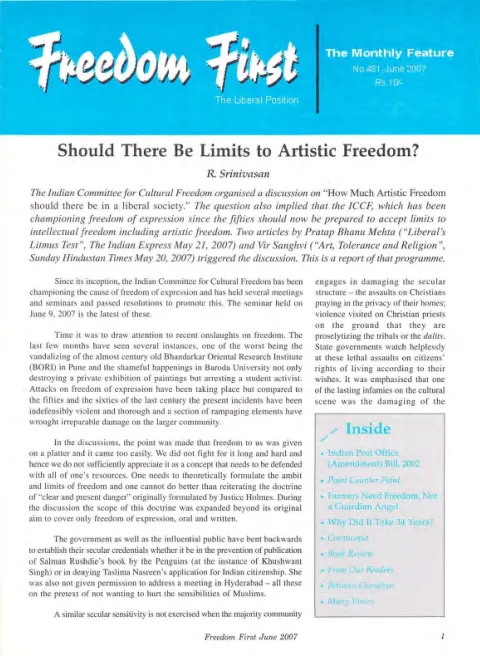
periodical issue
Freedom First
A Liberal Quarterly
Edited by S. V. Raju
Publishers: Indian Committee for Cultural Freedom (ICCF), 3rd Floor, Army & Navy Building, 148, Mahatma Gandhi Road, Mumbai 400 001. Published by J. R. Patel for the Indian Committee for Cultural Freedom (ICCF) and printed by him at Kaiser-E-Hind Private Ltd., Plot No.A-191, Road No.16A, MIDC, Wagle Industrial Estate, Thane (W) - 400 604. · Mumbai · 2005
52 pages
Freedom First
Summary
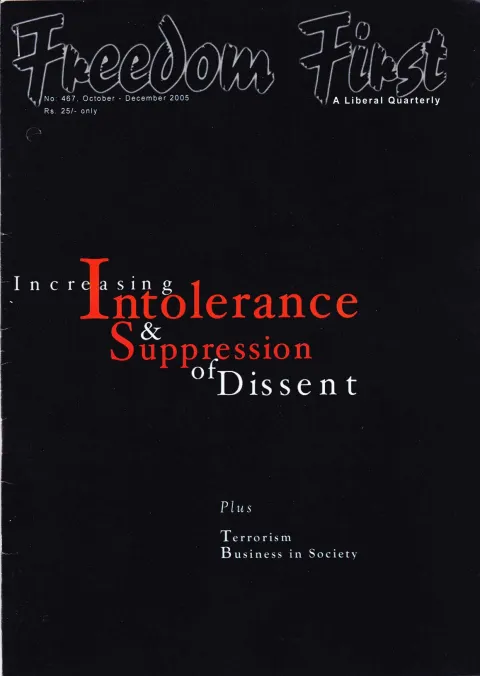
Freedom First No. 467 (October-December 2005), the 53rd year of publication of this Bombay-based liberal quarterly, leads with a cover feature on rising intolerance in Indian public life. The centerpiece is an excerpted lecture by former Attorney General Soli Sorabjee, delivered as part of the Minoo Masani Birth Centenary Lecture series, arguing that tolerance, human rights, democracy and peace are inseparably linked and cataloguing recent Indian and global episodes of censorship and mob intimidation (the Bhandarkar Institute vandalism over James Laine’s Shivaji biography, the banning of the film ‘Ore Oru Gramathil’, the treatment of Jehovah’s Witnesses schoolchildren, and intolerance of dissent within the Congress and Shiv Sena). Geeta Doctor’s companion piece extends the theme through the Tamil Nadu ‘L’Affaire Kushboo’ controversy, reading it and related episodes (a university dress code, the policing of a Chennai hotel) as instances of ‘Tamil Pride’ being weaponised against individual expression, especially women’s. V. Balachandran, a former Special Secretary in the Cabinet Secretariat, contributes a summary of a longer paper on terrorism, surveying definitions of terrorism, the Cold War-era paralysis of international consensus, and the human and financial toll of Pakistan-sponsored terrorism in Jammu & Kashmir. R. Srinivasan writes on the publishing history of Gandhi’s Hind Swaraj in Madras, and Shukla Bose (of the Parikrma Humanity Foundation) opens an essay on corporate social responsibility, arguing business cannot be divorced from society. The issue’s regular features include ‘With Many Voices’ (a page of quotations from the Indian and international press), ‘Of Cabbages and Kings’ (editorial notes on Indian public affairs, including a tribute to Jayaprakash Narayan and criticism of the 104th Constitutional Amendment), and an obituary for D. B. Karnik, a lifelong associate of M. N. Roy’s radical humanist movement. Rendered pages run out partway through the Bose essay and before several later listed pieces (on secularism, the Union budget, the Indian Medical Council, corruption, a 1963 nostalgia piece by Peter Coleman, the Communist Party of China, and privatisation), which per the table of contents follow later in the issue.
Key points
-
Freedom First No. 467 (Oct-Dec 2005) leads on rising intolerance in Indian public life, centred on Soli Sorabjee’s Minoo Masani Birth Centenary Lecture arguing that a free press and independent judiciary are democracy’s two indispensable prerequisites.
-
Sorabjee catalogues Indian and global episodes of censorship and mob intimidation, including the Bhandarkar Institute vandalism over James Laine’s Shivaji biography and the Supreme Court’s Jehovah’s Witnesses ruling protecting students who stayed silent during the anthem.
-
Geeta Doctor’s companion piece reads Tamil Nadu’s “L’Affaire Kushboo” controversy, alongside a university dress code and the arrest of two hotel employees over a party photo, as intolerance weaponised against women and modern lifestyles.
-
V. Balachandran summarises a paper arguing terrorism should be treated as a crime rather than a political grievance, detailing the human and financial toll of Pakistan-sponsored terrorism in Jammu and Kashmir.
-
R. Srinivasan traces the publishing history of Gandhi’s banned Hind Swaraj in Madras, noting the city uniquely had three simultaneous publishers of the work.
-
Shukla Bose of the Parikrma Humanity Foundation opens an essay arguing corporate social responsibility must move beyond philanthropic add-ons to genuine, CEO-led institutional commitment.
-
An obituary tribute by Vilas B. Patankar remembers D. B. Karnik, a humanist journalist devoted to M. N. Roy’s radical humanist movement.
Essays
Essay 1
An in-memoriam tribute to D. B. (Dwarkanath Bhagwant) Karnik, 1908-2005, described as an outspoken, humanist journalist devoted to M. N. Roy’s radical humanist movement and, in his final years, to a home for the physically handicapped at Vikhroli. The piece, by Vilas B. Patankar, recounts Karnik’s frugal, disciplined habits, his role as raconteur of anecdotes about Nehru, M. N. Roy, Ambedkar and Indira Gandhi, and his conviction that ‘ceaseless efforts in the right direction are a reward in itself.’
- D. B. Karnik died on 14 October 2005 at age 96/97 (born 1908).
- He was known as a lively conversationalist with an inexhaustible store of anecdotes about major political figures.
- His journalism and personal devotion were shaped by his lifelong attachment to M. N. Roy.
- He devoted the last 10-15 years of his life to a Vikhroli institution for the physically handicapped.
- The tribute quotes his own philosophy of contentment through noble thought and action rather than complacency or despair.
Many Voices
The ‘With Many Voices’ page collects short quotations from the Indian and international press through October-December 2005 on themes including business ethics, communalism, the Right to Information Act, terrorism, and free expression — functioning as a running commentary on the news cycle behind the issue’s cover theme.
- Quotes range from Subroto Bagchi on Indian MBAs to Thomas Friedman linking terrorism to Islam and Kapil Dev on unequal treatment by cricket administrators.
- Several quotes (Neerja Choudhury, Maja Daruwala) touch on parliamentary corruption and the fragile prospects of the new Right to Information Act.
- The page closes on a Salman Rushdie line about secularising and unifying legal systems, cited in the Imrana case controversy.
Of Cabbages and Kings
The editorial notes column covers the 104th Constitutional Amendment (criticized as a populist imposition of reservation quotas on private unaided educational institutions), the neglected infrastructure at Sir JJ School of Art and Mumbai University’s law department, and laments that Jayaprakash Narayan’s birthday (which falls on the same day as Amitabh Bachchan’s) passes largely unremarked amid consumerist media culture. A second section addresses judicial activism (PILs on Doppler radar siting, train safety, potholes) and closes with the Mumbai Police’s handling of an airport disturbance involving a Sikh religious leader’s kirpan/staff.
- Criticizes the 104th Amendment as a hasty, vote-driven exercise in populism harming educational quality.
- Documents neglect at Sir JJ School of Art and Mumbai University’s law department as examples of state indifference to education.
- Contrasts the popular memory of Amitabh Bachchan’s birthday with the neglect of Jayaprakash Narayan’s, attributing this to consumerist media culture succeeding decades of a ‘socialist pattern of society.’
- Surveys several suo moto and PIL matters before the Bombay High Court, including Doppler radar siting, train security after a rape case, and pothole repairs.
- Praises the Mumbai Police’s handling of a violent crowd at the domestic airport after a Sadhu was barred from carrying his staff onto a flight, quoting the Sikh Association president on equal application of security rules.
Increasing Intolerance and Suppression of Dissent (Cover Feature)
By Soli Sorabjee
Soli Sorabjee’s cover-feature lecture (excerpted from an address delivered 14 October 2005 in Hyderabad as part of the Minoo Masani Birth Centenary programme) argues that a free press and independent judiciary are the two indispensable prerequisites of democracy, and that unshakeable, insecure conviction — not certainty — is what drives intolerant regimes toward censorship. He surveys Indian instances of intolerance (mob action against critics of Sonia Gandhi and Bal Thackeray, the Bhandarkar Institute’s vandalism over James Laine’s book on Shivaji, banning attempts against the film ‘Ore Oru Gramathil’) and international ones (Pakistan’s blasphemy law, the banning of Taslima Nasreen’s ‘Lajja’ in Bangladesh, a Labour Party heckler manhandled at a UK party conference), before turning to Indian judicial precedent — a 1968 Bombay High Court ruling on the right to dissent, and the Supreme Court’s Jehovah’s Witnesses judgment protecting students who remained silent during the national anthem. He closes urging the press to combat prejudice through persuasion, not suppression, as a tribute to Minoo Masani.
- Frames tolerance, human rights, democracy and peace as linked; unchecked intolerance leads to violence which endangers peace.
- Identifies a free press and independent judiciary as democracy’s two indispensable prerequisites.
- Cites Lee C. Bollinger’s The Tolerant Society: intolerance stems from uncertainty and insecurity about a regime’s position, not confidence.
- Surveys Indian cases: threats against critics of Sonia Gandhi and Bal Thackeray; the Bhandarkar Institute vandalism over James Laine’s Shivaji biography; the banning and Supreme Court reversal in the ‘Ore Oru Gramathil’ case.
- Surveys international cases: Pakistan’s Blasphemy Law, the banning of Taslima Nasreen’s Lajja in Bangladesh, and a heckler manhandled at a UK Labour Party conference.
- Discusses the Bombay High Court’s 1968 ruling (during the 1962 Emergency and 1965 war) upholding the right to dissent even regarding Gandhi.
- Details the Supreme Court’s Jehovah’s Witnesses ruling (V. J. Emmanuel v. State of Kerala) protecting students expelled for remaining silent during the national anthem.
- Calls on the press to combat communal prejudice through persuasion and debate rather than suppression, as the best tribute to Minoo Masani.
Women on the Top: Intolerance as a Political Weapon
By Geeta Doctor
Geeta Doctor, a former editor of Freedom First, extends the cover theme through Tamil Nadu’s ‘L’Affaire Kushboo’ — actress Kushboo’s remarks on premarital sex and AIDS, made in the context of a health concern, which were seized upon by political parties (PMK, Dalit Panthers of India) invoking ‘Tamil Pride’ to demand her prosecution. Doctor situates this alongside two other ‘trivial’ but revealing episodes: a Madras University dress code for engineering students, and the arrest of two hotel employees at Chennai’s ‘The Park’ after a party photograph was deemed to breach ‘good behaviour for middle class Tamil values.’ She reads all three as evidence that intolerance is increasingly deployed as a political weapon against women and modern lifestyles, closing with N. Ravi’s Hindu column citing John Stuart Mill on the danger of silencing even a single dissenting opinion.
- Opens with the ‘disrobing of Draupadi’ episode in Tamil street theatre as a cultural frame for public humiliation of women.
- The Kushboo controversy arose from remarks on premarital sex/AIDS taken out of context; PMK and DPI mobilized around ‘Tamil Pride’ rather than the substance of her comments.
- A fellow actress, Suhasini Mani Ratnam, who defended Kushboo’s free speech, also became a target.
- A Madras University dress code for engineering students drew little protest, with most opinion favoring enforced conformity.
- Two young employees of Chennai’s ‘The Park’ hotel were jailed after a private party photo was deemed to breach ‘good behaviour for middle class Tamil values,’ triggering a stalled Citizens Forum debate.
- Concludes that when there is no space for rational dialogue, intolerance becomes a tool for political mobilization, disproportionately targeting women.
Terrorism
By V. Balachandran
No summary was extracted for this article. Listed for completeness.
Gandhi, Hind Swaraj and the City of Madras
By R. Srinivasan
V. Balachandran, former Special Secretary in the Cabinet Secretariat, summarizes a longer paper on terrorism (to be published by the Indian Liberal Group), arguing terrorism should be treated as a crime rather than a political grievance. He surveys competing definitions of terrorism, the Cold War’s paralyzing effect on international consensus-building, case studies suggesting terrorists are often ‘normal’ individuals radicalized for varied reasons, the slow emergence of UN conventions after 9/11, and the devastating human and financial toll of Pakistan-sponsored terrorism in Jammu & Kashmir (94,000 deaths, 36,000 jailed, 20,000 widowed, 40,000 orphaned by December 2002). He closes skeptical that any ‘brute suppression’ path will end terrorism, citing Daniel Benjamin and Steve Simon’s The Next Attack on the post-9/11 war on terror’s failures.
- Opens with the IRA’s line to Margaret Thatcher after a failed assassination attempt to illustrate terrorism’s asymmetric advantage.
- Cold War polemics blurred distinctions between freedom fighters, guerillas and terrorists for over three decades, delaying international consensus.
- Case studies (Raed Abdul Hamid Misk, Wafa Idris, Dhiren Barot) are cited to argue terrorists are often ‘normal’ individuals radicalized for varied personal and ideological reasons.
- Surveys competing US definitions of terrorism (Department of Defense vs. State Department) and their political ambiguities.
- Cites UN Security Council Resolution 1373 (2001) and earlier 1997/1999 conventions as the slow, post-9/11 emergence of international consensus.
- Details the human and economic toll of Pakistan-sponsored terrorism in J&K: 94,000 dead, 36,000 jailed, 20,000 widowed, 40,000 orphaned, Rs. 2,000 crores property damage, Rs. 46,500 crores security expenditure by December 2002.
- Concludes that terrorism should be treated as a crime, not a political problem, since history shows it is unrelated to genuine oppression.
Business in Society
By Shukla Bose
R. Srinivasan, retired professor of Political Science and Associate Editor of Freedom First, traces the publication history of Gandhi’s Hind Swaraj (1909) in Madras, noting that the colonial government banned the Gujarati original but an English version proscribed by Bombay, Madras and Bengal governments continued to circulate via unauthorized printings, and that Madras was uniquely home to three simultaneous publishers of the work (Ganesh & Co., G. A. Natesan, Tagore and Co.), alongside G. Subramania Iyer’s The Hindu’s extensive coverage of the South African satyagraha struggle. The piece reproduces C. Rajagopalachari’s previously unreprinted 1919 note to the Hind Swaraj.
- Hind Swaraj (1909) was banned by the governments of Bombay, Madras and Bengal shortly after publication; the ban on the Gujarati version lasted until 1938.
- An underground English edition, printed on a treadle press by student activist Harisarvottama Rao, sold out entirely with the government unable to trace the printers.
- Madras uniquely had three simultaneous publishers of the work: Ganesh & Co. (with a Tamil version by N. Balaram Iyer), G. A. Natesan, and Tagore and Co.
- The Hindu, founded by G. Subramania Iyer, extensively covered the South African satyagraha struggle (195 letters between 1892-1914, many by Vriddhachalam Pillai under the pseudonym Jnanasambandhan).
- Reproduces C. Rajagopalachari’s 6 June 1919 note to the Hind Swaraj, previously unreprinted, on the doctrine of violence and the necessity of wide distribution of Gandhi’s book.
The Origins of the Secular State
By R. Srinivasan
Shukla Bose, writing for the Parikrma Humanity Foundation, opens an essay arguing that business cannot be divorced from society and that corporate social responsibility (CSR) must move beyond philanthropic add-ons toward genuine, CEO-led institutional commitment. In the rendered pages she describes Parikrma’s ‘Change Your World in Half a Day’ employee-engagement program and poses a series of skeptical questions organisations raise about CSR (that it isn’t a core business requirement, that struggling companies can’t afford it, that it’s government’s job), rebutting each with the argument that reputation, employee retention and long-term viability depend on a company’s relationship with its stakeholders. The essay was not seen through to its end within the rendered pages.
- Argues that shareholder-value thinking is too narrow; businesses must serve a broader set of stakeholders including employees and the communities they operate in.
- Describes Parikrma Humanity Foundation’s ‘Change Your World in Half a Day’ program, which asks corporate employees to donate half a day’s salary.
- Warns that CSR too often becomes ‘jargon,’ with senior managers reluctant to commit to genuine action, especially where an ‘I know all’ mindset prevails.
- Cites intangible reputation value (e.g., 96% of Coca-Cola’s market value held in intangibles) as an argument that CSR has direct business relevance.
- Poses and rebuts several skeptical questions about CSR, including that it’s not business’s job, that struggling companies can’t afford it, and that it’s government’s responsibility.
Generated by the v1.5 extraction pipeline. Awaiting editorial review.
Metadata and summary are AI-extracted from the source PDF and reviewed for editorial accuracy. The original work is available via the Read PDF tab above (where present); paragraph-level citation inside the PDF is deferred to a future engagement.