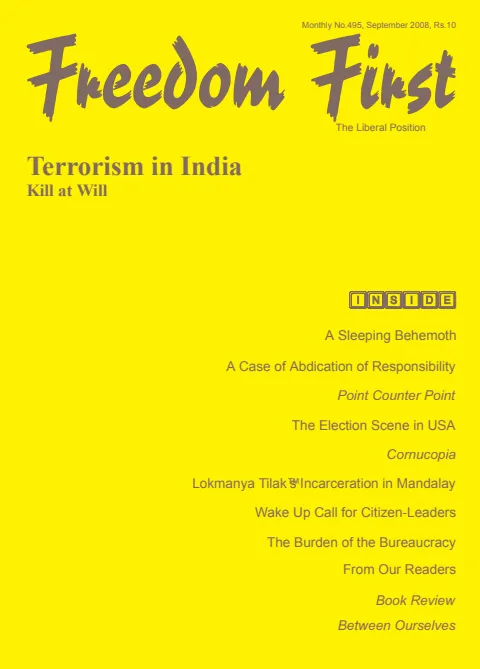
periodical issue
Freedom First
The Liberal Position
Published by J. R. Patel for the Indian Committee for Cultural Freedom (ICCF), 3rd Floor, Army & Navy Building, 148, Mahatma Gandhi Road, Mumbai 400 001, and printed by him at Kaiser-E-Hind Private Ltd., Plot No.A-191, Road No.16A, MIDC, Wagle Industrial Estate, Thane (W) - 400 604. · Mumbai · 2007
12 pages
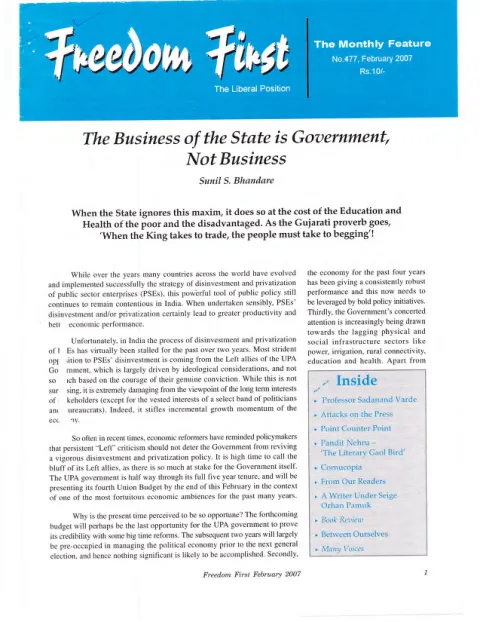
Freedom First
Summary
Freedom First No. 477 (February 2007) is a monthly issue of the Bombay-based liberal magazine, published under the masthead “The Liberal Position” by the Indian Committee for Cultural Freedom. The issue opens with economist Sunil S. Bhandare’s lead essay arguing that the state should exit business and manufacturing and focus on governance, education, and health, timed to the forthcoming Union Budget 2007-08. It carries a tribute to the late socialist leader Professor Sadanand Varde; excerpts from the Committee to Protect Journalists’ 2006 “Attacks on the Press” report introduced by CNN’s Anderson Cooper; Ashok Karnik’s recurring debate column “Point Counter Point” on India-Pakistan relations and reality-TV racism; an essay on Nehru’s prison writings by S. Jagadisan; Firoze Hirjikaka’s “Cornucopia” column on the moral double standards applied to politicians’ private lives; a reader-letters section; an essay on Turkish Nobel laureate Orhan Pamuk’s persecution for discussing the Armenian genocide; two book reviews (on peasant movements in post-colonial India, and a reminiscence of Milton Friedman); the editor’s “Between Ourselves” notes; and a “Many Voices” page of press quotations.
Key points
-
Freedom First No. 477 (February 2007) leads with Sunil S. Bhandare’s essay arguing the state should exit business and manufacturing, recommending the government target at least Rs. 25,000 crores from disinvestment in the 2007-08 budget.
-
G. G. Parikh’s tribute remembers socialist leader Professor Sadanand Varde, who held public office without personal benefit and championed the right to die with dignity.
-
Anderson Cooper’s introduction to the Committee to Protect Journalists’ 2006 report records 55 journalists killed worldwide for their work, 32 in Iraq, and recounts the murder of Russian journalist Anna Politkovskaya.
-
Ashok Karnik’s “Point Counter Point” debates Pranab Mukherjee’s Pakistan visit and the racist treatment of Shilpa Shetty on British reality television.
-
S. Jagadisan’s essay on Nehru as a “literary gaol bird” traces the composition of his prison-written works, including “Glimpses of World History” and “The Discovery of India.”
-
R. Srinivasan profiles Nobel laureate Orhan Pamuk’s prosecution under Turkish law for discussing the Armenian and Kurdish killings, closing on the assassination of fellow journalist Hrant Dink days before Pamuk’s Nobel award.
-
Firoze Hirjikaka’s “Cornucopia” questions the puritanical standard applied to American political leaders’ private morality, contrasting it with French attitudes toward Segolene Royal.
Essays
The Business of the State is Government, Not Business
By Sunil S. Bhandare
Sunil S. Bhandare argues that after a decade and a half of economic reform, the Indian state must finally resolve whether it belongs in business at all, and answers that it does not. He contends that PSE disinvestment and privatization have stalled for two years chiefly because of ideological resistance from the Left allies of the UPA government, and that this stalling damages long-term growth and stakeholders while serving only a narrow band of politicians and bureaucrats. With the UPA government at the midpoint of its term and presenting its fourth Union Budget, he frames the coming budget as a last real opportunity for bold reform before pre-election caution sets in. He lays out four reasons the moment is opportune: the government’s need to manage a high debt-to-GDP ratio (about 68%) and heavy debt-servicing costs; strong equity valuations of already part-divested PSEs; the need to expand the equity culture and capital markets by supplying good stock to investors; and the more fundamental question of redefining the state’s role as the Planning Commission finalizes its 11th Plan Approach Paper. He recommends the government target raising at least Rs. 25,000 crores from disinvestment and strategic sales in 2007-08, with proceeds kept in a dedicated escrow account and split equally between social-sector safety nets, repayment of high-cost government debt, and infrastructure funding via PPPs.
- PSE disinvestment and privatization in India has been stalled for over two years, driven by Left-ally ideological opposition within the UPA coalition.
- India’s debt-to-GDP ratio is about 68%, with annual debt servicing of Rs. 381,929 crores consuming over 38% of Central Budget revenue receipts.
- Market capitalization of 41 listed Central PSEs was around Rs. 646,645 crores, suggesting strong valuations for further disinvestment.
- Since 1991-92, disinvestment has raised Rs. 49,241 crores in total, with the best year (2003-04) raising Rs. 15,547 crores.
- The author recommends targeting at least Rs. 25,000 crores from disinvestment/strategic sales in 2007-08.
- Proceeds should go into an escrow account split equally three ways: social safety nets, high-cost debt repayment, and infrastructure (via PPP/SPV/VGF mechanisms).
- The core argument, from a Gujarati proverb cited in the subtitle: ‘When the King takes to trade, the people must take to begging’ — the state’s proper business is governance, not commerce.
Professor Sadanand Varde
By G. G. Parikh
G. G. Parikh’s tribute, reproduced from the Marathi weekly Janata, memorializes socialist leader Professor Sadanand Varde (1925-2007), who died on January 29. Varde is presented as a man who held public office (corporator, legislator, minister) without ever deriving personal benefit from it, living simply in a rented flat in a Mumbai suburb until his death. The piece traces his formation through the Rashtriya Seva Dal and his commitment to a casteless, egalitarian socialism learned from Sane Guruji, S. M. Joshi, and Nanasaheb Goray, illustrating it with an anecdote about Varde insisting a Dalit woman sit on a chair beside him. It also notes his embrace of Gandhian and nationalist ideals, his advocacy for euthanasia (in the mode of Minoo Masani), and his position as Chairman of the Society for the Right to Die with Dignity at the time of his death. His wife Sudha, also RSD-raised, is described as an equal partner in his socialist and feminist commitments.
- Professor Sadanand (‘Anu’) Varde, 1925-2007, died January 29; the tribute is reproduced from the Marathi weekly Janata.
- He held public office (corporator, legislator, minister) but lived modestly and derived no personal benefit from these posts.
- Formed by the Rashtriya Seva Dal and mentors Sane Guruji, S. M. Joshi, and Nanasaheb Goray, emphasizing a casteless, egalitarian socialism.
- An anecdote: he physically insisted a Dalit woman sit on a chair beside him rather than on the ground.
- He championed euthanasia/right-to-die, like Minoo Masani, and chaired the Society for the Right to Die with Dignity at his death.
- His wife Sudha, also from the RSD tradition, is described as sharing equally in the socialist and women’s movement without holding public office herself.
Attacks on the Press
By Anderson Cooper
This piece introduces excerpts from the Committee to Protect Journalists’ (CPJ) annual report “Attacks on the Press,” noting that 55 journalists were killed worldwide for their work in 2006 (32 in Iraq, the deadliest single-country year on record) and 134 were jailed. It reproduces CNN correspondent Anderson Cooper’s introduction to the report, titled “They Deserved More Than Silence,” which recounts the murder of Russian journalist Anna Politkovskaya and Putin’s dismissive response, the killing of Turkmen reporter Ogulsapar Muradova, the unsolved slaying of Wall Street Journal reporter Daniel Pearl’s Pakistani colleagues, and the dangers faced by local journalists in Iraq, Afghanistan, Pakistan, Ethiopia, China, Cuba, and the Democratic Republic of Congo, contrasting these risks with the comparative safety of American reporters.
- CPJ’s 2006 report recorded 55 journalists killed worldwide for their work, 32 of them in Iraq — the deadliest year in a single country CPJ has recorded.
- 134 journalists were jailed worldwide for their work in 2006.
- Anderson Cooper’s introduction recounts Anna Politkovskaya’s murder in Russia and Putin’s dismissal of her significance.
- Turkmen radio reporter Ogulsapar Muradova was imprisoned and died after a brief trial in 2006.
- Unsolved killings of journalists persist in Pakistan (linked to the Daniel Pearl case), Russia, and elsewhere.
- More than 20 journalists were jailed in Ethiopia; only China and Cuba imprison more journalists worldwide.
Point Counter Point
By Ashok Karnik
In this instalment of his recurring ‘Point Counter Point’ column, Ashok Karnik lays out two-sided debates on current issues. The first concerns Pranab Mukherjee’s January 2007 visit to Pakistan: one view sees it as a goodwill gesture advancing the peace process despite Pakistani rebuffs over the SAARC summit and Kashmir; the other warns that overtures built on trust in Musharraf’s control over jehadi elements are naive, that India should act on its own national interest rather than to please the US, and that lulling the public into complacency about terrorism is dangerous given recent bomb attempts in Delhi, Mumbai, Nagpur, and Bangalore. The second debate concerns the racist remarks directed at Shilpa Shetty on the British reality show ‘Celebrity Big Brother’: one view stresses that the incident exposed real racism in the UK; the counter-view questions why a show built on ‘sleaze’ and abusive behaviour is being rewarded with celebrity and profit at all, regardless of the racism angle.
- Debate one: whether Pranab Mukherjee’s January 2007 Pakistan visit was constructive diplomacy or naive optimism given Pakistan’s rebuffs on SAARC protocol and Kashmir.
- US National Intelligence Chief John Negroponte is cited as saying Al Qaida was spreading from Pakistan to the Middle East, North Africa, and Europe.
- Counter-view warns against complacency about terrorism given recent bomb blasts/attempts in Delhi, Mumbai, Nagpur, and Bangalore.
- Debate two: the racist abuse of Shilpa Shetty on ‘Celebrity Big Brother’ UK sparked debate about whether she deserved sympathy given her large fee for appearing.
- Counter-view argues the format itself, which rewards ‘sleaze’ and abusive behaviour, should be questioned rather than focusing solely on the racism angle.
Pandit Nehru - ‘The Literary Gaol Bird’
By S. Jagadisan
S. Jagadisan’s essay surveys the tradition of prisoners who turned incarceration into literary achievement — Hugo Grotius, Cervantes, John Bunyan, Tilak, and Maulana Azad — before focusing on Jawaharlal Nehru as a ‘literary gaol bird.’ It traces the composition of Nehru’s major prison-written works: Letters from a Father to His Daughter (1928), Glimpses of World History (196 letters to Indira Gandhi written 1930-33 from Naini, Bareilly, and Dehra Dun jails), An Autobiography (1934-35), and The Discovery of India (Ahmednagar Fort, 1944). The essay praises the sweep of Nehru’s historical vision across civilizations, his personal warmth toward Motilal Nehru and Kamala, and quotes Indira Gandhi’s description of her father’s three books as her lifelong companions. It closes (in the continuation on page 10) by praising Nehru’s prose style and quoting Tom Wintringham’s judgment that Indian children would learn better history and better English from Glimpses than from Macaulay or Gibbon.
- Frames Nehru within a tradition of prison-writers including Hugo Grotius, Cervantes, John Bunyan, Bal Gangadhar Tilak (Gita Rahasya, written during Mandalay deportation), and Maulana Azad.
- Nehru’s major prison-written works: Letters from a Father to His Daughter (1928), Glimpses of World History (196 letters, 1930-1933), An Autobiography (1934-35), and The Discovery of India (Ahmednagar Fort, 1944).
- Indira Gandhi is quoted describing her father’s three books as lifelong companions.
- Tom Wintringham’s Nehru Abhinandan Granth (1949) tribute is quoted, judging Glimpses superior to Macaulay or Gibbon for teaching history and English to Indian children.
- The essay emphasizes Nehru’s focus on the inner, cultural life of nations rather than battles and treaties.
Cornucopia: Misplaced Morality?
By Firoze Hirjikaka
In this instalment of his ‘Cornucopia’ column, Firoze Hirjikaka questions the semi-puritanical standard Americans apply to their political leaders’ private morality, contrasting it with more permissive French and European attitudes as illustrated by French Socialist presidential hopeful Segolene Royal, who lives unmarried with the father of her four children. He argues this is not a gender issue (Americans would accept a President Hillary Clinton) but a marital-fidelity issue, and that this standard is hypocritical given US Census data showing married couples are now a minority of American households. He contrasts Bill Clinton (a flawed but effective President whose infidelity nearly sank him) with George W. Bush (personally ‘moral’ but, in the author’s view, lacking intellect and command of world affairs), concluding that America conflates surface family-values virtue with leadership competence and ‘needs to grow up.’
- Segolene Royal, favourite for the French Socialist Party’s presidential nomination, could not run for US President given her unmarried domestic arrangement, the author argues.
- New York Times census data cited: only 49.7% of America’s 111 million households were married couples, meaning divorced/cohabiting couples now outnumber married ones.
- The author calls Michael Dukakis’s downfall over an unproven affair allegation an example of American ‘moral hypocrisy’ in politics.
- Bill and Hillary Clinton are used as a case study: Hillary’s tolerance of Bill’s infidelity is framed as strategic, and Bill’s presidency is judged an overall success despite scandal.
- George W. Bush is criticized as personally ‘moral’ but lacking a ‘razor-sharp intellect’ and grasp of world affairs.
- The essay concludes that France and Europe are more mature in focusing on leadership essentials over personal ‘peripherals.‘
From Our Readers
This reader-letters page opens a new column, ‘Just a Thought,’ suggested by Brigadier R. Lokaranjan (Retd.), who writes in prompted by Saddam Hussein’s execution and reflects on death sentences and mortality among senior citizens. Dr. S. K. Parukh, an educationist, responds to a prior Freedom First article on nanotechnology by Sharad Bailur (issue No. 476, December 2006), arguing that technological breakthroughs are not matched by breakthroughs in values, and invoking J. Krishnamurthy’s dictum ‘the word is not the thing’ against Alfred Korzybski’s Science and Sanity to argue that authentic understanding requires direct perception rather than labels (illustrated with references to understanding ‘Rashid’ or ‘Raju’ beyond the categories of Muslim or Hindutva). Finally, Brig. S. C. Sharma (Retd.) of Pune responds to a prior Cornucopia item on the ‘Foreign Fetish,’ arguing that government recognition of educational institutions matters mainly for regulated professions and government jobs, not for industry employability, and that India’s universities’ broader institutional health (citing Meerut and Bihar) is the more pressing concern.
- Brigadier R. Lokaranjan (Retd.) inaugurates a new ‘Just a Thought’ column, prompted by reflections on Saddam Hussein’s execution and capital punishment.
- Dr. S. K. Parukh responds to Sharad Bailur’s nanotechnology article from Freedom First Issue No. 476 (December 2006).
- Parukh argues values have not kept pace with technological breakthroughs, citing J. Krishnamurthy’s line ‘The word is not the thing’ against Alfred Korzybski’s Science and Sanity.
- Brig. S. C. Sharma (Retd., Pune) responds to a December 2006 Cornucopia item on the ‘Foreign Fetish,’ defending unaccredited institutions whose graduates are absorbed well by industry.
- Sharma argues the more urgent concern is the state of established universities, citing Meerut and Bihar as troubled examples.
A Writer Under Siege: Orhan Pamuk - Nobel Laureate in Literature
By R. Srinivasan
R. Srinivasan profiles Turkish novelist and Nobel laureate Orhan Pamuk as a writer persecuted for confronting his nation’s suppressed history. The essay situates Pamuk’s ordeal within a broader pattern of nations papering over past atrocities, from Holocaust revisionism in Germany to whitewashing of British colonialism, before detailing the Ottoman-era killing of roughly 30,000 Kurds and the Armenian massacres of 1890-1915 that Pamuk referenced in a Swiss newspaper interview. For this, Pamuk was charged under Turkish Penal Code Article 301 with ‘public denigration of Turkish identity,’ facing a trial (begun December 2005) that could have resulted in three years’ imprisonment; the charges, and those against Turkish-Armenian journalist Hrant Dink on the same count, were ultimately dropped, likely because of the case’s damage to Turkey’s EU accession prospects. The essay closes by noting that Dink was assassinated on January 19, 2007, shortly before Pamuk received the Nobel Prize, and reproduces a boxed excerpt from Pamuk’s own 2001 New York Review of Books essay ‘The Anger of the Damned,’ warning that Western nationalist self-righteousness risks driving more of the world toward Turkish-style intolerance and martial law.
- Orhan Pamuk, Turkish Nobel laureate, was tried starting December 2005 under Article 301 of Turkish law for ‘public denigration of Turkish identity’ after discussing Armenian and Kurdish killings in a Swiss newspaper interview.
- The charges against Pamuk (and against Turkish-Armenian journalist Hrant Dink, charged on the same count) were ultimately dropped, partly to protect Turkey’s EU membership bid.
- Hrant Dink was assassinated on January 19, 2007.
- The essay cites nearly 30,000 Kurds killed and Armenian nationalists killed 1890-1915 under Sultan Abdul Hamid II’s plan, while the official Turkish position minimizes the death toll.
- A boxed excerpt from Pamuk’s own essay ‘The Anger of the Damned’ (New York Review of Books, November 15, 2001) is reproduced, warning against Western nationalist self-righteousness fueling global intolerance.
Book Review (Peasant Movements in Post-colonial India; Milton Friedman and the Post Office)
Two book reviews appear on this page. S. Arunajatesan reviews Debal K. Singharoy’s ‘Peasant Movements in Post-Colonial India: Dynamics of Mobilization and Identity’ (Sage Publications), a study covering the Tebhaga (West Bengal) and Telangana (Andhra Pradesh) peasant movements and the Naxalite movement in both states, praising its data-supported case studies while finding the conceptual first chapter less lucid than the rest; the review stresses continuing exploitation of SC/ST and backward-caste peasants by landlords and now by politicians, and recommends the book to NGOs, bank officials, and bureaucrats. The second piece, by Charles Peters (courtesy The Washington Monthly, January/February 2007), recounts a decade-old phone conversation with the recently deceased Milton Friedman, in which Peters challenged Friedman’s anti-government rigidity by pointing to the well-functioning US Post Office of the 1930s-50s; Friedman conceded the point but pressed Peters on why he had to reach so far back for an example of government working well, prompting Peters to reflect that most large government institutions could stand improvement even though essential agencies do important work.
- S. Arunajatesan reviews Debal K. Singharoy’s ‘Peasant Movements in Post-Colonial India’ (Sage Publications, 275 pp., Rs. 295), covering Tebhaga, Telangana, and Naxalite movements.
- The review argues rural exploitation of SC/ST and backward-caste peasants persists in modified form since British rule, now compounded by politicians alongside landlords.
- Charles Peters (Washington Monthly) recalls a phone conversation with Milton Friedman, prompted by Friedman’s recent death.
- Peters cited the well-run US Post Office of the 1930s-50s as a counterexample to Friedman’s anti-government position; Friedman conceded the point.
- Peters concludes that arguing pro- or anti-government in the abstract is less useful than focusing on making essential agencies work better.
Between Ourselves / Many Voices
The editor’s ‘Between Ourselves’ note restates the issue’s core argument that the state’s business is government, not business, invoking Rajaji’s 1962 election-campaign metaphor comparing government preoccupation with industry and trade to a mother busying herself with make-up while feeding her child. It highlights Sunil Bhandare’s essay on disinvestment ahead of the 2007-08 Union Budget, pays tribute to the late Professor Sadanand Varde via G. G. Parikh’s Janata piece, introduces the CPJ ‘Attacks on the Press’ report as the first of a planned series of excerpts, and frames the Orhan Pamuk piece as an extension of the press-freedom theme.
- Restates the issue’s core claim, invoking Rajaji’s 1962 campaign metaphor: government preoccupation with trade compared to a mother applying make-up while feeding her child.
- Highlights Bhandare’s disinvestment essay ahead of the 2007-08 Union Budget.
- Pays tribute to the late Professor Sadanand Varde, referencing G. G. Parikh’s Janata obituary.
- Announces that CPJ ‘Attacks on the Press’ excerpts will continue in upcoming issues.
- Frames the Orhan Pamuk essay as connected to the press-freedom theme of the CPJ report.
Essay 11
The ‘Many Voices’ page compiles brief quotations from the press on current affairs, including comments from Indira Congress member Salman Khurshid on Mulayam Singh Yadav’s stance on Saddam Hussein’s hanging, Shiv Sena chief Bal Thackeray on Lohia’s socialist followers, journalist Swaminathan Anklesaria Aiyar on inflation and political hypocrisy, TV journalist Andy Mukherjee on ambition in Indian business, retired civil servant P. K. Doraiswamy on elected governments’ vote-driven reasoning, Education World’s Dilip Thakore on Indian society’s lack of civility, Newsweek’s Fareed Zakaria on Islam’s overdue ‘Reformation,’ and Hussain Haqqani on Muslim leaders’ selective criticism.
- Salman Khurshid suggests Mulayam Singh Yadav could benefit electorally from openly condemning Saddam Hussein’s hanging.
- Bal Thackeray dismisses Lohia’s socialist followers as easily ‘cracked’ walnuts compared to Lohia himself.
- Swaminathan Anklesaria Aiyar links rising inflation to political complaints.
- P. K. Doraiswamy criticizes elected governments for seeing problems mainly in terms of votes gained or lost rather than public interest.
- Fareed Zakaria argues a reformation-like process may be beginning within Islam, though marked by ‘calumny, hatred and bloody violence.’
- Hussain Haqqani criticizes Muslim leaders and intellectuals for finding it easier to blame outsiders than acknowledge suffering caused within their own communities.
Generated by the v1.5 extraction pipeline. Awaiting editorial review.
Metadata and summary are AI-extracted from the source PDF and reviewed for editorial accuracy. The original work is available via the Read PDF tab above (where present); paragraph-level citation inside the PDF is deferred to a future engagement.