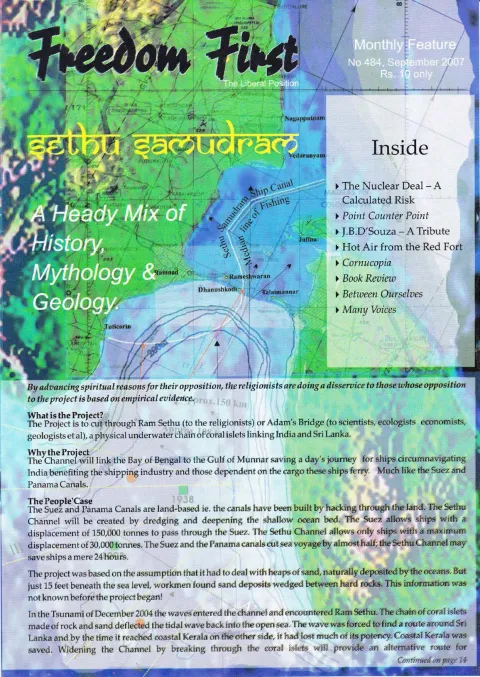
periodical issue
Freedom First
The Liberal Position
By Sharad Joshi
Publishers: Indian Committee for Cultural Freedom (ICCF), 3rd Floor, Army & Navy Building, 148, Mahatma Gandhi Road, Mumbai 400 001. Published by J. R. Patel for the Indian Committee for Cultural Freedom (ICCF) and printed by him at Kaiser-E-Hind Private Ltd., Plot No A-191, Road No.16A, MIDC, Wagle Industrial Estate, Thane (W) - 400 604. · Mumbai · 2007
16 pages
Freedom First
Summary
Freedom First No. 484 (September 2007) is a monthly issue of the Bombay-based liberal magazine, published by the Indian Committee for Cultural Freedom under founder Minoo Masani’s legacy and edited by S. V. Raju. The issue leads with the Sethusamudram Ship Canal controversy, treating the Ram Setu/Adam’s Bridge dispute as a mix of history, mythology, geology, and contested science. Its centerpiece is a three-writer symposium on the India-US civil nuclear deal (the ‘123 Agreement’), offering pro, con, and qualified-pro positions from S. C. Sharma, N. S. Venkataraman, and T. S. Gopi Rethinaraj respectively. Ashok Karnik’s recurring ‘Point Counter Point’ column debates four topical issues (Ram Setu agitation, the ‘Kaoboys of RAW’ memoir controversy, coalition politics, and celebrity criminal prosecutions) by presenting both sides. The issue also carries an extended tribute to the recently deceased civil servant J. B. D’Souza, Sharad Joshi’s column criticizing Manmohan Singh’s Independence Day address as a return to Nehruvian economic thinking, Firoze Hirjikaka’s ‘Cornucopia’ column on unequal justice in India, a short piece on the arrest of terror suspect Abu Hamza and a report on a fundamentalist assault on writer Taslima Nasreen at a Hyderabad book event, A. V. Karnik’s review of B. Raman’s R&AW memoir, a notice pausing the annual ‘Liberal Budget’ exercise, an extract from J. B. D’Souza’s 2006 speech on reservations in education, an editor’s note (‘Between Ourselves’), and the ‘Many Voices’ column of press excerpts.
Key points
-
Freedom First No. 484 (September 2007) leads with the Sethusamudram Ship Canal controversy and centres on a three-writer symposium on the India-US civil nuclear deal, offering pro, con, and qualified-pro positions.
-
S. C. Sharma argues the deal grants India a unique NPT exemption and preserves military reactors from inspection; N. S. Venkataraman counters India has 50 years of low-cost uranium and doesn’t need the deal; T. S. Gopi Rethinaraj frames it as ending India’s “nuclear apartheid.”
-
Ashok Karnik’s “Point Counter Point” debates the Ram Setu agitation, the “Kaoboys of RAW” memoir controversy, coalition politics since 1989, and the Sanjay Dutt and Salman Khan celebrity prosecutions.
-
An extended tribute remembers civil servant J. B. D’Souza, recalling his tip-off to Minoo Masani during a 1975 Emergency arrest threat and his memoir “No Trumpets and Bugles.”
-
Sharad Joshi’s “Hot Air Balloons from the Red Fort” criticises Manmohan Singh’s 2007 Independence Day address as a retreat into Nehruvian urban-industrial development thinking, contrasting it with Japan’s model of deliberately raised agricultural prices funding industrialisation.
-
A. V. Karnik reviews B. Raman’s memoir “The Kaoboys of R&AW,” detailing the agency’s claimed mole in General Yahya Khan’s office ahead of the 1971 war and its simultaneous, sometimes contradictory foreign-intelligence liaisons.
-
An item reports the fundamentalist assault by Majlis legislators on a Hyderabad event releasing Telugu translations of Taslima Nasreen’s books, with legislator Akbaruddin Owaisi reportedly saying he wanted to kill her “without regrets.”
Essays
Essay 1
The cover feature lays out the Sethusamudram Ship Canal project — cutting through Ram Sethu (Adam’s Bridge) to link the Bay of Bengal and Gulf of Munnar — and argues that religionist objections to the project do a disservice to critics who oppose it on empirical/ecological grounds. It compares the proposed channel unfavorably to the Suez and Panama canals (dredging vs. land-cutting, smaller ship displacement, marginal time savings), notes the discovery of unexpectedly hard rock deposits beneath the sea, and credits Ram Sethu’s coral-and-rock structure with deflecting the 2004 tsunami and sparing coastal Kerala. The continuation (p.14) covers the decision to blast through the hard rock despite ecological risk, Dr. Subramanian Swamy’s writ petition against the blasting, the government’s widely criticized affidavit questioning the historicity of the Ramayana, and the escalating project cost (Rs. 2,600 crore to Rs. 3,500 crore), closing by noting the state’s request for three more months to re-examine the matter, with the piece flagged as based on Mint journalist Priyanka P. Narain’s reporting.
- Describes the Sethusamudram project as cutting through Ram Sethu/Adam’s Bridge, a coral-and-rock chain linking India and Sri Lanka
- Argues religious objections undercut the credibility of separate, empirically-grounded objections to the project
- Contrasts the (land-based) Suez/Panama canals with the Sethu channel, which requires dredging a shallow sea bed and saves only about 24 hours of sailing time
- Notes hard rock was found 15 feet below sea level, complicating the original sand-dredging assumption
- Credits Ram Sethu’s coral islet chain with deflecting the December 2004 tsunami and sparing coastal Kerala
- Reports Dr. Subramanian Swamy’s Supreme Court writ petition against blasting the rock
- Notes the government’s affidavit questioning the Ramayana’s historicity backfired, hurting religious sentiment and handing ammunition to Hindutva groups
- States project cost has escalated from Rs. 2,600 crore to Rs. 3,500 crore, with the Supreme Court granting the state three more months to re-examine the matter
The Nuclear Deal - A Calculated Risk (Will Accelerate Economic Growth / It Will Pull India Backward / It is Good For India)
By S. C. Sharma / N. S. Venkataraman / T. S. Gopi Rethinaraj
A three-part symposium on the India-US civil nuclear deal (the ‘123 Agreement’). S. C. Sharma’s ‘Will Accelerate Economic Growth’ argues the deal gives India an unprecedented single-country exemption from NPT-style restrictions, lets India keep 8 of 22 reactors for military use free of IAEA inspection, and will help meet India’s power needs given nuclear’s currently marginal 3% contribution to a 128,435 MW national capacity; he also surveys uranium mining expansion, thorium as an alternative fuel, and renewable/hydro alternatives, concluding India needs to pursue all energy sources rather than rely solely on indigenous slow-paced nuclear technology. N. S. Venkataraman’s ‘It Will Pull India Backward’ contends India does not need the deal at all, citing adequate low-cost uranium reserves for 50 years, the absence of Indian reprocessing capability, and the risk of ceding future pricing/negotiating leverage once bound to a long-term agreement. T. S. Gopi Rethinaraj’s ‘It is Good for India’ frames the deal as ending India’s ‘nuclear apartheid,’ criticizes both Communist and BJP opposition as driven by opportunism (the Communists’ tacit alignment with Chinese interests, the BJP’s inconsistency given its own past testing moratorium), and argues concerns about the Hyde Act’s long-term reliability are speculative given how unpredictable geopolitics will be 20-25 years out.
- Sharma: deal grants India a unique NPT exemption, preserves 8 of 22 reactors for unrestricted military use, and is needed given nuclear’s current 3% share of India’s 128,435 MW capacity
- Sharma surveys alternatives: wind (5,340 MW installed, 45,000 MW potential), hydro (45,000 MW potential in the North-East), thorium-based reactors, and coal, concluding all sources must be pursued together
- Venkataraman: India has ~50 years of low-cost uranium reserves and does not need the deal; the country lacks reprocessing capability and risks being locked into unfavourable terms once committed
- Venkataraman: nuclear supplies only ~3% of India’s and ~17% of the world’s power, undercutting urgency claims
- Gopi Rethinaraj: frames the deal as ending ‘nuclear apartheid’; accuses Left parties of serving Chinese interests and the BJP of opportunistic, self-contradicting opposition
- Gopi Rethinaraj: dismisses long-horizon Hyde Act supply-disruption fears as unpredictable 20-25 years out, arguing India’s growing economic clout is itself a hedge
Point Counter Point (Ramsetu Again / “Kaoboys of RAW” / Coalition Dharma / Celebrity Prosecution)
By Ashok Karnik
Ashok Karnik’s ‘Point Counter Point’ column presents both sides of four topical debates: the renewed Sangh Parivar agitation over the Sethusamudram project and the government’s Ramayana-historicity affidavit; the controversy stirred by B. Raman’s memoir ‘Kaoboys of RAW’ about intelligence-agency disclosures; the merits and failures of coalition (‘dharma’) governments since 1989; and public reaction to the criminal convictions of celebrities Sanjay Dutt and Salman Khan. Karnik concludes on Ram Sethu that both sides overreached — the government’s affidavit needlessly attacked the Ramayana’s historicity, handing Hindutva groups an emotional cause, while religious opposition avoided empirical engagement — and on the RAW memoir that disclosures serve accountability but pose real risks if imitated carelessly by lesser officials.
- On Ram Sethu: notes Subramaniam Swamy’s Supreme Court challenge and the government’s affidavit questioning the Ramayana’s historicity, calling the episode ‘so avoidable’
- On ‘Kaoboys of RAW’: weighs the value of intelligence-agency transparency against operational risk and the motives of insider authors
- On coalition politics: surveys post-1989 coalition failures (Charan Singh, V.P. Singh, Chandra Shekhar, Deve Gowda, Gujral governments) versus the argument that coalitions still allow a ‘working arrangement’
- On celebrity prosecutions: uses the Sanjay Dutt and Salman Khan convictions to ask whether legal outcomes for the rich represent genuine equal justice or selective ‘grandstanding’ by courts
J. B. D’Souza R.I.P. - What Mattered to Him was Public Service
By Dilip D’Souza / Shirish Patel / Naresh Fernandes / S. V. Raju
An extended tribute to J. B. D’Souza (1921-2007), a senior Maharashtra civil servant, following his death, combining reminiscences from his son Dilip D’Souza, structural engineer Shirish Patel, and journalist Naresh Fernandes delivered at his September 2 funeral. The pieces recall D’Souza’s integrity (refusing liquor despite holding a permit others were denied), his willingness to fight government rules he saw as unjust (a Prohibition-era Writ Petition), his humane, informal style (‘Bain’ to friends and family, who called him by his first name), his role heading CIDCO and the New Bombay project, his 1970s support of a colleague under Emergency arrest threat via Minoo Masani, and an anecdote about him rebuking Bandra police for ‘blackmailing’ courting couples. It closes with condolences from Freedom First’s S. V. Raju.
- J. B. D’Souza (1921-2007), known as ‘Bain’ or ‘JB’, was a senior civil servant remembered for prioritizing public service over personal advancement
- Recalled challenging a Prohibition-era rule barring government servants from liquor permits via a Writ Petition, which he won despite a punitive posting
- Shirish Patel recalls D’Souza recruiting him to CIDCO for the New Bombay project and greeting him with ‘Welcome to public service’
- During the 1975 Emergency, D’Souza (then Maharashtra Chief Secretary) tipped off Minoo Masani via phone that his name was on an arrest list, then later confirmed it had been removed
- Recently, before his death, he filed a Writ Petition against the Anti-Corruption Bureau for inaction on MHADA officials accused of issuing false tenancy certificates
- Wrote a memoir titled ‘No Trumpets and Bugles: Recollections of an Unrepentant Babu’
- A companion piece (p.14) reprints an extract of his June 2006 speech at a Freedom First seminar arguing that simply increasing seats in IITs/IIMs by government fiat (for reservations) is not a real solution without matching faculty, labs, and libraries
Hot Air Balloons from the Red Fort / The Rural Perspective
By Sharad Joshi
Sharad Joshi’s ‘Hot Air Balloons from the Red Fort’ criticizes Prime Minister Manmohan Singh’s 15 August 2007 Independence Day address as a retreat into Nehruvian development precepts — prioritizing industry, urban development, and higher-education institutions over rural and agricultural needs. Joshi contrasts this with Mahatma Gandhi’s village-centered vision and argues Singh’s approach (treating agricultural surplus as feeding urban/industrial growth, offering only vague displacement-rehabilitation promises) ignores the Japanese model in which deliberately raised agricultural prices funded early industrialization. He notes a Marathi daily’s comparison of Singh to Nehru and dismisses the speech as bureaucratic and lacking Nehru’s rhetorical brilliance despite echoing his economic mistakes.
- Criticizes Manmohan Singh’s 2007 Independence Day speech for retracing ‘Nehruvian precepts’: industry as vanguard of development, urban and higher-education priority
- Contrasts Gandhi’s village-centered, basic-education-focused vision with Nehru’s and Singh’s urban-industrial bias
- Argues Singh’s model treats agricultural surplus as merely feeding urban industrial growth rather than rural prosperity as an end in itself, unlike Japan’s model of deliberately elevated agricultural prices funding industrialization
- Notes the speech offered no concrete detail on rehabilitating farmers displaced by industrial projects
- Observes a prominent Marathi daily editorially compared Singh to Nehru on grounds of clean image and mannerism, while Joshi finds the comparison favors Nehru rhetorically despite sharing his ‘economic blunders’
Cornucopia: Equal Justice for All?
By Firoze Hirjikaka
Firoze Hirjikaka’s ‘Cornucopia’ column, subtitled ‘Equal Justice for All?’, argues that the jailing of Bollywood actors Sanjay Dutt and Salman Khan does not prove India has equal justice, since their offenses (illegal weapons possession, poaching) involved no serious criminal intent, while far graver, routine abuses by public officials — embezzled disaster-relief funds, adulterated food, corrupt police postings — almost never result in punishment. The column concludes India’s justice system remains fundamentally unequal, with the powerful rarely facing real consequences beyond occasional suspensions or transfers driven by media pressure.
- Argues the Dutt/Khan convictions do not demonstrate equal justice, since public officials commit far more serious, routine harms with near impunity
- Cites examples: officials pocketing disaster relief money, food adulterators causing medical harm, corrupt police postings tied to bribes
- Suggests judges may have engaged in some ‘grandstanding’ to appear unswayed by the celebrities’ star status
- Concludes that in India, culprits ‘rarely see the inside of a jail cell’ and public memory of scandals quickly fades
A Powerless Powerhouse
Two short pieces. ‘A Powerless Powerhouse’ argues that even if suspected terrorist Abu Hamza is arrested in Bangladesh, India should not celebrate prematurely given the difficulty of securing extradition from an uncooperative neighbour, contending that a true regional ‘powerhouse’ would use its economic, military, and geopolitical leverage rather than deferring to diplomatic formalities. A second item, bylined SVR, reports on the assault by Muslim fundamentalists (including Andhra Pradesh Majlis legislators led by Akbaruddin Owasi) on a low-profile Hyderabad function releasing Telugu translations of Taslima Nasreen’s books, praising Dr. N. Innaiah for defending Nasreen during the attack.
- Argues India should press its regional leverage to secure Abu Hamza’s extradition from Bangladesh rather than deferring to extradition-treaty niceties
- Frames diplomatic caution as a luxury India cannot afford given its status as the world’s second-largest victim of terrorist attacks
- Reports Majlis legislators (including Akbaruddin Owasi) and armed supporters disrupted a Center for Inquiry India event releasing Telugu translations of Taslima Nasreen’s ‘Wild Swans’ and ‘Shodh’
- Notes translator Venigalla Komala and Dr. N. Innaiah (a longtime Freedom First supporter) were involved; police arrested and released the attackers on bail
- Owasi reportedly told media he wanted to kill Taslima Nasreen ‘without regrets’
(Lancer Publishers, 2007, Rs. 795). Karnik credits Raman
A. V. Karnik (formerly Deputy Director, Intelligence Bureau) reviews B. Raman’s memoir ‘The Kaoboys of R&AW: Down Memory Lane’ (Lancer Publishers, 2007, Rs. 795). Karnik credits Raman’s authoritative, fluid narrative style and its value in countering the perception that Indian intelligence achieves nothing, while raising the ‘self-centrality’ problem common to insider memoirs. He discusses Raman’s account of R&AW’s role in the 1971 Bangladesh Liberation War, a claimed Indian mole in General Yahya Khan’s office, R&AW’s murky and sometimes contradictory international liaisons (CIA, French SDECE, Soviet KGB, Afghan KHAD, Israeli Mossad, Chinese MSS), unresolved questions about R&AW’s involvement in shielding Rajiv Gandhi during the Bofors cover-up, and Raman’s assessment that R&AW is strong in TECHINT but weak in HUMINT and prevention. Karnik ultimately recommends greater parliamentary or intra-departmental oversight of intelligence agencies’ ‘uncontrolled exhibitionism.’
- Reviews B. Raman’s ‘The Kaoboys of R&AW: Down Memory Lane’ (Lancer Publishers, 2007, 304pp, Rs. 795)
- Praises Raman’s credibility on events he was directly involved in but flags the ‘self-centrality’ bias common to memoirists
- Highlights Raman’s claim of an Indian mole in General Yahya Khan’s office feeding Pak Air Force pre-emptive strike plans ahead of the 1971 war
- Notes R&AW officers were nicknamed ‘Kaoboys’ after founder R. N. Kao
- Details R&AW’s simultaneous, sometimes contradictory liaisons with the CIA, French SDECE, Soviet KGB, Afghan KHAD, Israeli Mossad, and Chinese MSS
- Flags unresolved questions over IB/R&AW’s alleged role advising Rajiv Gandhi on covering up the Bofors deal trail
- Raman assesses R&AW as strong in TECHINT but weak in HUMINT and prevention
- Karnik recommends a Parliamentary Oversight Committee or intra-department review system for intelligence agencies
A Powerless Powerhouse / The Fundamentalists’ Assault on Taslima Nasreen
By SVR
A short boxed notice announcing that after producing four annual ‘Liberal Budget’ critiques (for 2004/05 through 2007/08), the Project for Economic Education and the Indian Liberal Group will pause the exercise for 2008-2009 due to both intellectual (assessing the impact of prior critiques) and material (funding) constraints, planning a detailed retrospective assessment of the four Liberal Budgets to be published as a December Freedom First supplement, with the annual exercise expected to resume in 2009/10.
- Project for Economic Education and Indian Liberal Group jointly announce no Liberal Budget for 2008-2009
- Cite both an intellectual need (to assess impact of the prior four Liberal Budgets) and financial stringency (funds ‘virtually exhausted’)
- Plan to publish a retrospective assessment of the four Liberal Budgets as a December Freedom First supplement
- Expect the Liberal Budget exercise to resume in 2009/10
Book Review: The Kaoboys of R&AW: Down Memory Lane by B. Raman
By A. V. Karnik
An extract from a June 2006 speech J. B. D’Souza gave at a Freedom First seminar on reservations, arguing that government policy on educational reservations is driven by vote-catching slogans and improvised responses rather than planning, and that simply mandating more seats in institutions like the IITs and IIMs is not a real solution unless matched by adequate faculty, laboratories, and libraries — absent which quality will suffer or classes will not run at all.
- D’Souza criticizes reservation policy as driven by vote-catching slogans (citing Karunanidhi’s TV-set promises) and reactive fixes rather than planning
- Argues legislating increased seats in IITs/IIMs without matching faculty, labs, and libraries is not a genuine solution
- Warns that under-resourced expansion will either degrade quality or simply fail to produce functioning classes
Between Ourselves
By Editor
The editor’s ‘Between Ourselves’ note (signed ‘Editor’, i.e., S. V. Raju) explains the issue’s three-article nuclear-deal symposium as an attempt to cut through extraneous, communist-driven distractions clouding public debate on the India-US deal, recommends the new Mint daily to readers, and announces that a planned October discussion (‘India’s Polity Needs a U Turn’) has been postponed to January 2008 because contributors found the October 2 deadline too short, with a revised December 20 deadline.
- Explains the three nuclear-deal articles were commissioned to give readers a clearer picture ‘in layman’s language’ amid extraneous debate
- Accuses communists of trying to delay or scuttle the deal to suit ‘Communist Chinese interests’
- Recommends the new Mint daily newspaper to readers
- Announces the planned October discussion ‘India’s Polity Needs a U Turn’ is postponed to January, with a new December 20 contribution deadline
Many Voices
The ‘Many Voices’ column collects short excerpts from other publications on topics of the day: Left-wing hypocrisy on China policy, Western double standards on China’s human rights record, Indian and global commentary on terrorism, corruption in the police and street-spitting analogized across class lines, and general reflections on state legitimacy, corruption, and former PM Chandrashekhar’s political legacy. Contributors quoted include T. N. Menon, Madhuri Santhanam Sondhi, Dilip Raote, Dipankar Mehta, an Indian Express editorial, James Waters, Pratap Bhanu Mehta, and S. Viswam.
- T. N. Menon (Asian Age) criticizes the Left’s selective national-interest rhetoric given its historical alignment with China
- Madhuri Santhanam Sondhi notes Western democracies overlook Chinese human-rights abuses for trade reasons
- Hindustan Times editorial (Aug 27) observes India both suffers persistent terrorism and fails to prevent it
- Dilip Raote observes spitting is a ‘male-dominated activity’ cutting across class lines
- Pratap Bhanu Mehta (Centre for Policy Research) argues violence erupts when the state offers no outlet for legitimate grievances
- S. Viswam notes a study of former PM Chandrashekhar’s life is useful chiefly for understanding his failures, not his achievements
Generated by the v1.5 extraction pipeline. Awaiting editorial review.
Essay 10
No summary was extracted for this article. Listed for completeness.
Essay 11
No summary was extracted for this article. Listed for completeness.
Essay 12
No summary was extracted for this article. Listed for completeness.
Metadata and summary are AI-extracted from the source PDF and reviewed for editorial accuracy. The original work is available via the Read PDF tab above (where present); paragraph-level citation inside the PDF is deferred to a future engagement.