periodical issue
Freedom First
The Liberal Position
Edited by S. V. Raju
Published by J. R. Patel for the Indian Committee for Cultural Freedom (ICCF), 3rd Floor, Army & Navy Building, 148, Mahatma Gandhi Road, Mumbai 400 001. Printed by him at Kaiser-E-Hind Private Ltd., Plot No.A-191, Road No.16A, MIDC, Wagle Industrial Estate, Thane (W) - 400 604. · Mumbai · 2008
20 pages
Freedom First
Summary
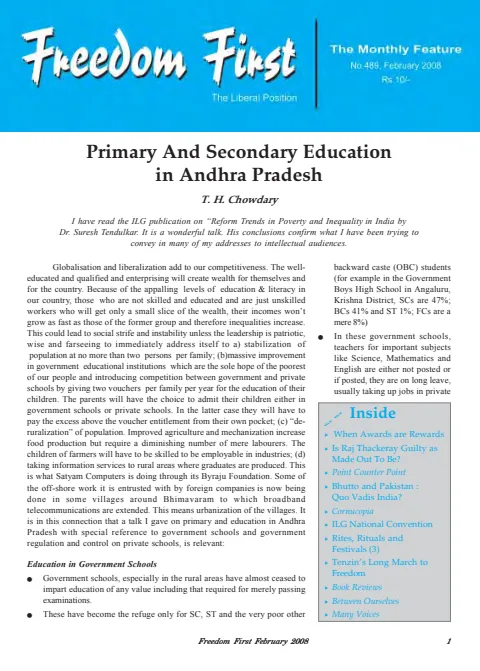
Freedom First No. 489 (February 2008) leads with T. H. Chowdary’s field-level indictment of government primary and secondary education in Andhra Pradesh, proposing school vouchers, deregulation of private schools, and ‘Self Employed Teachers’ as remedies. The issue’s other main pieces cover the politics of state honours (Kuldip Nayar and Kashinath Divecha both arguing that the Bharat Ratna/Padma awards process is arbitrary and should be abolished or left to civil society), H. R. Bapu Satyanarayana’s defence-tinged analysis of the Raj Thackeray/Maharashtra migrant backlash, Arvind A.’s assessment of Pakistan’s instability after Benazir Bhutto’s assassination, and Firoze Hirjikaka’s polemic against Mayawati’s use of state power and against Parsi religious conservatives who tried to block a liberal lecture on conversion. Ashok Karnik’s ‘Point Counter Point’ column debates the Tata Nano, the Sino-Indian ‘Vision Document’, and the Mumbai New Year molestation case from both sides. The issue also carries a report on the Indian Liberal Group’s Fourth National Convention in Chennai (with its four adopted resolutions on economic reforms, national security, coalition governance, and environment/resource conservation), the third instalment of Suman Oak’s series on Hindu rites and festivals (this time Mahashivaraatri), Tibetan activist Tenzin Tsundue’s announcement of a ‘Long March to Freedom’ from Dharamsala toward Tibet, two book reviews (on Nepal’s Maoist-era politics and on the Royal Nepal Army), a notice of a new National Book Trust biography of Minoo Masani, and the editor’s closing notes and quotation roundup.
Key points
-
T. H. Chowdary’s cover feature indicts government primary and secondary education in Andhra Pradesh as collapsed and captured by teacher unions, proposing school vouchers, deregulation of private-school fees, English-medium instruction from Class VI, and a ‘Self Employed Teacher’ scheme paying villagers per pupil who passes exams.
-
Kuldip Nayar’s “When Awards are Rewards” and Kashinath Divecha’s “Dump Devalued Government Awards” both attack the Bharat Ratna/Padma honours system as a politically arbitrary process that violates the Constitution’s spirit, with Divecha calling for the awards to be abolished altogether and merit recognition left to peers and civil society.
-
H. R. Bapu Satyanarayana’s essay on Raj Thackeray situates the anti-North-Indian backlash in Mumbai within a wider pattern of regional chauvinism, arguing Raj is replicating his uncle Bal Thackeray’s earlier tactics against South Indians and suggesting the Congress-led UPA may be tacitly tolerating the affair for electoral advantage.
-
Ashok Karnik’s “Point Counter Point” argues both sides of the Tata Nano’s launch, the Sino-Indian ‘Vision Document’ signed during the Prime Minister’s China visit, and the Mumbai New Year molestation case.
-
Arvind A.’s “Bhutto and Pakistan: Quo Vadis India?” warns that Pakistan’s post-assassination instability, combined with its nuclear and possibly chemical or biological weapons capability, poses a serious risk to India, surveying its history of military rule and US arms sales.
-
Firoze Hirjikaka’s “Cornucopia” criticises Mayawati for suspending IAS officers who praised Rahul Gandhi, comparing her cultivation of blind loyalty to Hitler’s rise, and separately condemns Parsi religious leaders for trying to block a lecture advocating admission of outsiders to Zoroastrianism.
-
An unsigned report covers the Indian Liberal Group’s Fourth National Convention in Chennai, where N. Vittal delivered the inaugural address and delegates adopted resolutions on economic reform, national security, coalition governance, and environmental conservation.
-
Suman Oak’s “Rites, Rituals and Festivals” instalment on Mahashivaraatri traces the festival’s mythological origins and ritual practice, and Tenzin Tsundue announces a six-month ‘Long March to Freedom’ from Dharamsala modelled on Gandhi’s Salt March, timed to draw attention around the Beijing Olympics.
-
Two book reviews cover Mahendra Lawoti’s edited volume on contentious politics and democratisation in Nepal and Ashok K. Mehta’s study of the Royal Nepal Army’s flawed counter-insurgency effort against the Maoists.
Essays
Primary And Secondary Education in Andhra Pradesh
By T. H. Chowdary
T. H. Chowdary’s cover feature argues that government primary and secondary schools in Andhra Pradesh have collapsed in quality, becoming a refuge only for SC/ST and very poor OBC children while teachers, protected by Marxist- and BJP-aligned unions, avoid actually teaching. He opposes mandatory B.Ed/DIET teacher-training requirements, criticises new recognition and registration fees imposed on private schools, and calls for splitting Andhra Pradesh’s single SSC Board into three regional boards. He proposes concrete remedies: two education vouchers per family per year redeemable at government or private schools, English-medium instruction in Mathematics and Science from Class VI, workshops attached to every rural high school, NRI-funded school improvements, and a ‘Self Employed Teacher’ (SET) scheme paying unemployed B.Ed/matriculate villagers per pupil who passes Class V exams.
- Government rural schools have ‘almost ceased to impart education of any value’; in 2006 Krishna district SSC top-20 ranks, 18 went to private-school students and only 2 to government Gurukula students.
- Teachers commute long distances from towns, send their own children to private convent schools, and are organised into unions more focused on service conditions than teaching quality.
- Chowdary opposes mandatory B.Ed/DIET certification for private-school teachers as an unwarranted, costly intervention, arguing ‘teaching is an attitude, a talent.’
- New government-imposed recognition fees (Rs.10,000-20,000 application, Rs.20,000-50,000 endowment) on already-functioning private schools are characterised as bureaucratic overreach.
- Proposes a per-child education voucher (matching government per-pupil expenditure, e.g. Rs.2,000/year) that parents can redeem at any school of choice.
- Proposes ‘Self Employed Teachers’ (SET): unemployed B.Ed/matriculate villagers teach children informally at home up to Class V, paid Rs.1,000 per pupil who passes a government-administered exam.
- Calls for splitting the single Andhra Pradesh SSC Board into three regional boards with non-political advisory councils.
When Awards are Rewards
By Kuldip Nayar
Kuldip Nayar surveys the history of India’s civil honours (Bharat Ratna, Padma awards), arguing that despite the Constitution’s ban on state-conferred titles, successive governments have violated its spirit by using awards as political patronage. He recounts Maulana Azad’s original 1954 objection to Nehru’s government awarding itself honours, describes his own experience preparing shortlists as an information officer in the Home Ministry in the early 1960s (an arbitrary, politically-vetted process with ministers and the PM adding or deleting names), and notes that the Janata government scrapped the awards after the Emergency as feudal anachronisms. He criticises the BJP for ‘saffronising’ the awards and questions why Rabindranath Tagore ever accepted a British knighthood in the first place.
- The Constitution states ‘No title, not being a military or academic distinction, shall be conferred by the state’; Nayar argues this has been violated in spirit since independence.
- Maulana Azad refused the Bharat Ratna in 1954 on the grounds that ruling-party leaders should not be the ones to bestow honours on themselves; he received it posthumously years later.
- As Home Ministry information officer until 1964, Nayar personally helped compile shortlists that were politically vetted by the home minister and Prime Minister.
- Critics and opponents such as Ram Manohar Lohia and E. M. S. Namboodiripad were never considered for awards under any government.
- The Janata government abolished the awards after the Emergency as a ‘feudal’ anachronism; the BJP-led government later gave awards to RSS pracharaks.
- Nayar questions why Tagore accepted a British knighthood at all, given he later returned it after Jallianwala Bagh.
Dump Devalued Government Awards
By Kashinath Divecha
Kashinath Divecha, responding to the controversy L. K. Advani stirred by recommending Atal Bihari Vajpayee for the Bharat Ratna, argues that state-conferred awards are inherently arbitrary since government lacks the competence to judge merit across every field, and that honouring individuals should be left to their peers and to civil society. He calls for abolishing the awards altogether, citing Morarji Desai’s government as a positive precedent for having refused to distribute them in the late 1970s.
- Advani’s letter recommending Vajpayee for the Bharat Ratna triggered an unseemly scramble of competing nominations, showing sponsors do not take the awards’ sanctity seriously.
- Divecha argues any person who reaches the pinnacle of a field is already honoured by peers in that field, without needing government patronage.
- Government ‘gathers recommendations… and then picks and chooses names,’ a system Divecha calls a ‘national… game of non-musical chairs’ that should be abolished.
- Cites Morarji Desai’s government as having made the ‘sagacious decision’ to stop distributing these awards in the late 1970s.
Is Raj Thackeray Guilty as Made Out To Be?
By H. R. Bapu Satyanarayana
H. R. Bapu Satyanarayana examines the furore over Raj Thackeray’s anti-North-Indian rhetoric in Mumbai, situating it within a broader pattern of regional chauvinism across India (Tamil Nadu, Karnataka, West Bengal) and warning that the underlying demographic and political tensions could destabilise the country if exploited by extremists. He suggests Raj is following the same ‘classical model’ his uncle Bal Thackeray used against South Indians decades earlier, driven partly by a need to reassert relevance after splitting from the Shiv Sena, and speculates that the Congress-led UPA government may be tacitly tolerating the affair for electoral reasons ahead of 2009.
- Maharashtrian population share in Mumbai has fallen to 36%, creating an ‘emotive but complex environment’ exploited by regional politicians.
- Compares the situation to Karunanidhi’s championing of Tamilians abroad, the L’affaire Ganguly controversy in West Bengal, and Lalu Prasad Yadav’s remarks against Kannadigas.
- Raj Thackeray is said to be replicating the ‘classical model of political behaviour’ his uncle Bal Thackeray used against South Indians 40 years earlier.
- Speculates the Congress/UPA may be tolerating Raj’s actions for tactical electoral advantage ahead of the 2009 elections.
- A boxed excerpt from Pratap Bhanu Mehta frames the Maharashtra crisis as a failure to make freedom, not diversity, society’s ‘bedrock value.‘
Point Counter Point
By Ashok Karnik
Ashok Karnik’s ‘Point Counter Point’ column presents both sides of three current debates: the Tata Nano’s launch as either an engineering triumph democratising car ownership or a pollution and congestion risk; the Indo-China ‘Vision Document’ signed during the PM’s January 2008 visit as either a genuine diplomatic breakthrough or an over-read agreement papering over an unresolved boundary dispute; and the Mumbai New Year molestation of two women outside a five-star hotel as either a systemic policing and societal failure or a case complicated by the alleged conduct of bystanders and political grandstanding.
- On the Nano: proponents call it a near-miracle of affordable engineering; critics worry it will worsen traffic and pollution by pulling two-wheeler owners into cars.
- On the China visit: one side sees a genuine thaw with progress on trade, aviation, and nuclear cooperation; the other cautions against over-reading the Vision Document’s actual commitments.
- On the Mumbai molestation case: one side blames systemic policing failure (the Commissioner calling it ‘a mountain out of a molehill’); the other notes bystanders’ inaction and political opportunism by Union Minister Renuka Chowdhary.
- The column format explicitly invites readers to submit their own point-counterpoint pieces.
Bhutto and Pakistan: Quo Vadis India?
By Arvind A.
Arvind A. analyses Pakistan’s descent into instability following Benazir Bhutto’s assassination, warning that the country’s nuclear, and possibly chemical and biological, weapons capability makes the spread of extremism and civil unrest a serious risk to India and the world. He surveys Pakistan’s history of military rule, the porousness of its north-western border, and controversial US arms sales (F-16C fighters, AIM-120C missiles), and closes by describing the ‘byzantine power games’ among Musharraf, Nawaz Sharif, and would-be successors to Bhutto as Pakistan spins out of control. A footnote states the piece was written before Pakistan’s elections.
- Pakistan’s military possesses nuclear and probably biological, possibly chemical, weapons, raising fears of WMD proliferation to extremist non-state actors.
- Surveys Pakistan’s history of autocracy under Ayub Khan, Yahya Khan, and Zia-ul-Haq, alternating with tenuous democratic periods.
- Warns of a possible military coup by extremist-sympathising elements that could render ‘mutually assured destruction’ codes meaningless.
- Criticises continued US arms sales to Pakistan (F-16C Block 52+, AIM-120C AMRAAM, M-4 rifles) as strategically risky for India’s west coast.
- Notes Pakistan’s alleged role as an intermediary for arms reaching non-state actors, citing the failed MANPADS attack on an El-Al airliner.
- Describes post-Bhutto Pakistan as a ‘volatile playground’ with Musharraf, Nawaz Sharif, and Bhutto’s would-be successors jockeying for power.
Cornucopia: Mayawati Regina
By Firoze Hirjikaka
Firoze Hirjikaka’s ‘Cornucopia’ column runs two pieces. ‘Mayawati Regina’ criticises Mayawati for suspending four IAS officers who praised Rahul Gandhi in a book, comparing her cultivation of blind loyalty to Adolf Hitler’s rise (while stressing she is not ‘inherently evil’ like Hitler), and warning that caste-based voting could carry her to the Prime Minister’s chair with destabilising consequences for India’s international standing. ‘What Next, Parsi Taliban?’ condemns Parsi religious leaders (including the World Association of Parsi and Irani Zoroastrians) for trying to shut down a talk by Dr. Kersi Antia advocating admission of outsiders to the Zoroastrian faith, calling their intolerance a betrayal of the community’s professed enlightenment.
- Mayawati suspended four IAS officers for praising Rahul Gandhi in a book; Hirjikaka calls this a ‘new high’ in Indian leaders acting like ‘mini-emperors.’
- Draws an explicit but qualified analogy between Mayawati’s and Hitler’s rise to power via oratory and demanded blind obedience from followers.
- Contrasts Mayawati’s professed and calculated ‘humility’ unfavourably with Narendra Modi’s similar tactical use of humility.
- Warns that caste-based voting patterns could realistically put Mayawati in the Prime Minister’s chair, which would be internationally destabilising given her perceived naivety.
- In the companion piece, criticises Parsi religious leaders (Vada Dasturji Kaikhushroo M Jamasp Asa and others, backed by WAPIZ) for trying to block Dr. Kersi Antia’s lecture on admitting outsiders to Zoroastrianism, calling it a betrayal of free expression by a community that considers itself enlightened.
What Next, Parsi Taliban?
No summary was extracted for this article. Listed for completeness.
Fourth National Convention of the Indian Liberal Group
By Indian Liberal Group
An unsigned report on the Indian Liberal Group’s Fourth National Convention, held 3 February 2008 in Chennai with N. Vittal (former Chief Vigilance Commissioner) delivering the inaugural address on ‘An Alternative Strategy for Better Governance.’ The Convention adopted four resolutions: on the status of economic reforms (endorsing the ILG’s ‘Liberal Budget’ series and a six-point reform strategy including an Economic Reforms Implementation Authority and further tax rationalisation, following the Vijay Kelkar Task Force recommendations); on national security imperatives (criticising government inaction on internal security, judicial delay, and policing); on governance and coalition politics (criticising post-1969 coalition politics as opportunistic and detached from national interest); and on resource conservation and environment protection (covering deforestation, water scarcity, and urban planning).
- N. Vittal, former Chief Vigilance Commissioner, delivered the inaugural address on governance reform; excerpts promised in the next issue.
- The economic reforms resolution endorses the ILG/Project for Economic Education’s ‘Liberal Budget’ series (2004-05 to 2007-08) and recommends a six-point strategy: an Economic Reforms Implementation Authority, infrastructure investment acceleration, public-private partnerships via SPVs, tax rationalisation, expenditure management reform, and aggressive PSU disinvestment.
- The national security resolution criticises the government’s ‘lackadaisical attitude,’ citing Maoist ‘Red Corridor’ expansion, Bangladeshi migration into Assam/West Bengal/Tripura, judicial delays, and a politically-compromised police force.
- The governance/coalition politics resolution traces India’s coalition era to the 1969 Congress split and the SVD governments, arguing coalitions have become ‘playthings’ of power brokers rather than instruments of compromise.
- The environment resolution calls for a moratorium on forest diversion, mandatory solar heaters and biogas units, rainwater harvesting, and making environmental protection a compulsory school subject.
Rites, Rituals and Festivals (3): Mahashivaraatri
By Suman Oak
The third instalment of Suman Oak’s series on Hindu rites and festivals covers Mahashivaraatri, observed in 2008 on 6 March. Oak traces the deity Shiva’s origin to primal fear of natural calamities, recounts several mythological explanations for the vrata (Shiva’s confounding of Brahma and Vishnu; the hunter and thief legends), describes the ritual’s fasting, bathing, and night-long vigil practices, and situates the Jotirlinga pilgrimage sites established by Shankaracharya within the historical spread of Shiva worship across castes and regions, including in Dravidian tradition and among Shudra Veda-reciters at Chidambaram.
- Mahashivaraatri, observed by all (not only women), centres on worship of Shiva, whose cult Oak traces to fear of natural calamities rather than love.
- Recounts the mythological origin story of Shiva manifesting as an endless ‘Linga’ to humble Brahma and Vishnu, and the parallel hunter/thief legends explaining the vrata’s fasting and night vigil.
- Describes ritual practice: daylong fasting, evening bathing, wearing Rudraksha, four Pradoshakal poojas through the night with Abhyangasnaan, and a concluding ‘Udyaapan’ ceremony after 12-24 observances.
- Shankaracharya founded 12 Jotirlingas across India to counter the spread of Buddhism and propagate Advaita philosophy.
- Notes that Shiva worship crosses caste lines, including Shudra Veda-reciters at Chidambaram, and that in Dravidian tradition Shiva, Amma (Parvati), and Murugan form a triad predating Aryan-Dravidian cultural fusion.
Tenzin’s Long March To Freedom
By Tenzin Tsundue
Tibetan poet and activist Tenzin Tsundue announces his participation in the ‘Long March to Freedom,’ a six-month, five-NGO-organised walk from Dharamsala toward Tibet beginning 10 March 2008, timed to draw international attention around the Beijing Olympics. Explicitly modelled on Gandhi’s Salt March rather than Mao’s ‘Long March,’ the walk is committed to non-violence; Tsundue recounts his own 1997 arrest and expulsion from Tibet and appeals to readers to volunteer, support, or simply spread the word.
- The march is organised by five Tibetan NGOs as part of the ‘Tibetan People’s Uprising Movement,’ starting 10 March 2008 from Dharamsala.
- Explicitly modelled on Gandhi’s Salt March, and explicitly distinguished from Mao Zedong’s ‘Long March,’ which the piece frames as having led to Tibet’s colonisation.
- Timed to potentially reach the Tibet border around the Beijing Olympics (14-25 August 2008) to maximise international media attention.
- Tsundue describes his own 1997 unauthorised walk into Tibet, resulting in arrest, interrogation, and three months’ imprisonment in Lhasa and Ngari.
- The editor’s introduction frames the march as inspired by Gandhi and explicitly contrasted with Mao’s precedent, and asks readers to convey good wishes to the marchers.
Contentious Politics and Democratization in Nepal,
Two book reviews appear under this heading. Brig. (Retd.) S. C. Sharma reviews ‘Contentious Politics and Democratization in Nepal,’ edited by Mahendra Lawoti (Sage, 2007), a multi-author volume arguing that contentious politics (Maoist insurgency, ethnic minority movements, student protests) had mixed effects on Nepal’s democratization, sometimes advancing and sometimes hindering it. Brig. A. Thyagarajan reviews Ashok K. Mehta’s ‘The Royal Nepal Army: Meeting the Maoist Challenge’ (Rupa, 2005), which portrays the Royal Nepal Army as plagued by poor incentives, weak leadership, and a flawed national security strategy in its belated counter-insurgency effort against the Maoists.
- Lawoti’s edited volume: caste-hill Hindu elites (31% of Nepal’s population) historically dominated state, economy, and society, creating conditions for Maoist insurgency and ethnic-minority mobilisation.
- Contributors covered include Mary Crawford and Kaufman (gender violence and displacement), Bal Gopal Shreshta (ethnic minority language/political rights and the revival of Vihar Buddhism), and Amenda Snellinger (the 2003-2006 student movement that helped bring down the King’s government).
- Lawoti concludes contentious politics affects democratization ‘both positively and negatively,’ depending on whether the underlying activities are coercive or voluntary.
- Mehta’s book on the Royal Nepal Army: the author, a former Gorkha Regiment officer, describes an army plagued by poor incentives, lack of professional leadership, and absence of a coherent national security directive.
- The Royal Nepal Army was slow to engage the Maoist insurgency directly, focusing instead on Kathmandu Valley and national assets, partly due to royal suspicion of India’s intentions.
Book Review: Contentious Politics and Democratization in Nepal by Mahendra Lawoti
By Brig (Retd.) S. C. Sharma
The closing pages carry the editor’s ‘Between Ourselves’ note explaining the choice of primary/secondary education as the issue’s cover feature and previewing the April issue’s focus on Naxal-Maoist security threats, followed by ‘Many Voices,’ a roundup of quotations from contemporary commentary (John DiMarco, Akhtar Mahmood, L. Byrappa, Jyoti Punwani, Pratap Bhanu Mehta, Kuldip Nayar) on themes including jihadism, Pakistan’s legal system, work-week debates, and the Raj Thackeray affair. The masthead lists Minoo Masani as Founder, S. V. Raju as Editor, and R. Srinivasan as Associate Editor, with the Indian Committee for Cultural Freedom (ICCF) as publisher.
- Editor’s note frames education as the deliberate, ‘not exciting’ but foundational cover choice, tied to the view that ‘Liberalism can thrive only in a milieu where a majority has received at least basic primary education.’
- Previews the April 2008 issue’s cover feature on Naxal-Maoist insurgency as a national security threat.
- ‘Many Voices’ quotes include a National Geographic letter distinguishing jihadism from Islam, a rebuttal blaming Pakistan’s problems on departure from Islamic law, and multiple Pratap Bhanu Mehta excerpts on Indian democracy and the Thackeray affair.
- Masthead: Founder Minoo Masani; Editor S. V. Raju; Associate Editor R. Srinivasan; Advisory Board includes Sharad Bailur, R. V. Chari, Firoze Hirjikaka, Ashok Karnik, Nitin Raut, Brig. (Retd.) S. C. Sharma, Sameer Wagle; published by J. R. Patel for the Indian Committee for Cultural Freedom (ICCF), Mumbai.
Generated by the v1.5 extraction pipeline. Awaiting editorial review.
Metadata and summary are AI-extracted from the source PDF and reviewed for editorial accuracy. The original work is available via the Read PDF tab above (where present); paragraph-level citation inside the PDF is deferred to a future engagement.