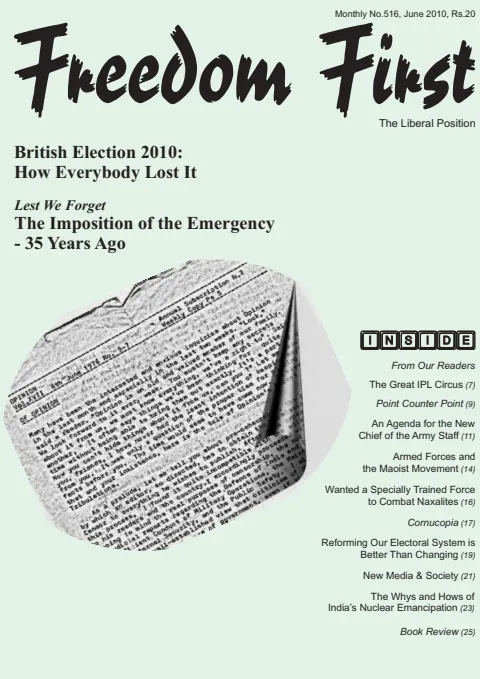
periodical issue
Freedom First
The Liberal Position
Publishers: Indian Committee for Cultural Freedom (ICCF), 3rd Floor, Army & Navy Building, 148, Mahatma Gandhi Road, Mumbai 400 001. Published by J. R. Patel for the Indian Committee for Cultural Freedom (ICCF) and printed by him at Kaiser-E-Hind Private Ltd., Plot No.A-191, Road No.16A, MIDC, Wagle Industrial Estate, Thane (W) - 400 604. · Mumbai · 2008
48 pages
Freedom First
Summary
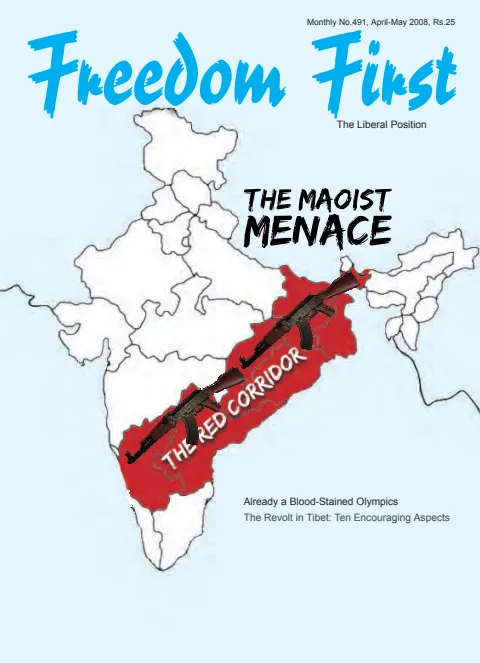
Freedom First No. 491 (April-May 2008), a combined issue marking the magazine’s 55th year of publication, leads with a cover feature on “The Maoist Menace” — a package of six essays on national security that examines the spread of Naxalite/Maoist insurgency across a “Red Corridor”, insurgency in the North East, the erosion of state capacity to respond to internal security threats, the Indian Army’s officer shortage, and the ethics of interrogating terrorist prisoners. The issue opens with an unnumbered front-matter piece by Tibetan activist Tenzin Tsundue on the 2008 Delhi leg of the Olympic torch relay and the security clampdown around Tibetan protesters, followed by the regular “Many Voices” digest of press quotations. In the rendered pages, the volume’s argumentative center is that India’s democratic institutions have so far survived recurring internal-security stress tests (the Emergency, terrorism, insurgency) through a combination of institutional strength and, some contributors argue, luck — but that Maoist expansion, North-East insurgency, and a hollowing-out of the Army’s officer corps now constitute serious and interlinked threats that call for centre-state coordination, reformed policing, and harder policy choices on issues like troop conscription and interrogation methods.
Key points
-
N. Vittal’s “Roots of Indian Democracy” credits India’s 60-year democratic survival to a pluralist constitutional culture and resilient institutions tested by the Emergency, then uses the Nandigram SEZ controversy to warn that short-term political calculation is letting Naxalite ‘revolutionary zones’ expand unchecked.
-
Ashok Sahu traces the Communist Party of India (Maoist)‘s formation from the 2004 merger of the People’s War Group and Maoist Communist Centre back to the 1948 Telangana uprising and 1967 Naxalbari revolt, detailing its roughly 9,000-9,500 cadres across 192 districts and its goal of a contiguous ‘Compact Revolutionary Zone’ from Nepal to Andhra Pradesh.
-
Col. T. S. Tanwar surveys insurgency across the seven North-Eastern states, tracing it to A. Z. Phizo’s Naga National Council and citing 24 active insurgent groups, and attributes the unrest to shared economic backwardness and central neglect.
-
V. Balachandran’s essay rejects the idea that strong armies or policing alone guarantee security, applying a RAND Corporation framework on ‘ungoverned territories’ to India’s Maoist-affected districts and calling for the Centre to assert a clearer legal right to intervene in state security crises.
-
E. D’Souza examines the Indian Army’s shortage of over 11,200 officers, attributing it to private-sector pay competition and quoting senior generals on the unattractiveness of military careers, while flagging conscription as a discussed but rejected remedy.
-
S. C. Sharma argues that coercive interrogation of terrorism suspects, though ethically fraught, has in specific historical cases (Aldo Moro, a 1995 Philippines plot, IRA suspects in Northern Ireland) prevented greater harm, and contends extending POW protections to terrorists is misguided.
-
The issue opens with Tenzin Tsundue’s account of the 2008 Delhi leg of the Olympic torch relay and the security clampdown on Tibetan protesters.
Essays
Roots of Indian Democracy
By N. Vittal
N. Vittal, a former Chief Vigilance Commissioner of India, asks why Indian democracy has survived for 60 years when neighbouring states have not, framing the question in a software/hardware analogy borrowed from information technology. He credits a ‘software’ of pluralist, tolerant sanathana dharma culture and a constitutional framework for open argument (invoking Amartya Sen’s ‘The Argumentative Indian’), contrasted with Pakistan’s religion-centred founding. He credits a ‘hardware’ of resilient institutions — media, parliament, judiciary — that were tested and held during the Emergency, and credits the integrity of founding leaders (Gandhi, Patel, Nehru, Rajaji) for setting standards. The essay then pivots to contemporary threats: jihadi terrorism and Maoist/Naxal terrorism, using the Nandigram SEZ conflict and the contrasting fortunes of Special Economic Zones versus the Naxalites’ ‘Central Revolutionary Zone’ as a case study in how short-term political calculation is allowing the Maoist threat to entrench itself.
- Poses the question of whether India’s democratic survival is luck or the product of durable institutions and cultural pluralism
- Attributes India’s democratic ‘software’ to a tolerant, argumentative Hindu/sanathana dharma tradition, contrasted with Pakistan’s single-book religious politics
- Credits India’s institutional ‘hardware’ — media, judiciary, parliament — with surviving the Emergency and developing safeguards against its repetition (e.g. Bommai judgment restricting Article 356 misuse)
- Credits the personal integrity of independence-era leaders (Gandhi, Patel, Nehru, Rajaji) as a stroke of fortune many post-colonial states lacked
- Identifies jihadi terrorism and Maoist/Naxal terrorism as the two major contemporary threats to India, with Naxalism described via the term ‘Maoist terrorism’
- Uses the Nandigram SEZ controversy to illustrate a ‘tale of two zones’ — Special Economic Zones struggling against red tape while Naxalite ‘revolutionary zones’ expand unchecked
- Concludes that short-term political incentives are weakening the state’s resolve against Naxalism
The Maoist Menace
By Ashok Sahu
Ashok Sahu, a retired Inspector General of Police of Assam, lays out the history, ideology, and operational reach of the Communist Party of India (Maoist), formed by the 2004 merger of the People’s War Group and the Maoist Communist Centre. He traces the movement’s roots to the 1948 Telangana uprising and the 1967 Naxalbari agrarian revolt, describes the ideology of ‘annihilation of class enemies’ and rejection of parliamentary democracy, and details the group’s armed strength (roughly 9,000-9,500 combined cadres across the merged PWG/MCC with an estimated 8,000 firearms), its presence across 192 districts in 16 states, and its stated goal of a contiguous ‘Compact Revolutionary Zone’ from Nepal through Bihar to Andhra Pradesh. He also flags reported Maoist links to the LTTE, Islamist terror groups, Nepali Maoists, and Pakistan’s ISI, and closes (in an editorial excerpt credited to Ashok Karnik) with root causes — poor governance, corruption, unemployment, failed land reform and rehabilitation — and policy recommendations including reorganizing state police, strengthening intelligence, and a centralised armed police force.
- Identifies the CPI (Maoist), formed 21 September 2004 from the merger of the People’s War Group (PWG) and Maoist Communist Centre (MCC), as the country’s most geographically widespread insurgency
- Traces the movement’s origins to the 1948 Telangana uprising under T. Nagi Reddy and T. S. Rao, and the 1967-71 Naxalbari revolt led by Charu Mazumdar and Kanu Sanyal
- Describes the ideology as ‘annihilation of class enemies’ and rejection of parliamentary democracy in favour of protracted armed struggle
- Reports the merged group’s armed strength as roughly 9,000-9,500 cadres and 8,000 firearms, organized under the unified People’s Liberation Guerrilla Army (PLGA) since December 2004
- States Maoist presence spans 192 districts across 16 states, spreading from 165 districts in 14 states between March 2006 and August 2007
- Describes the goal of a contiguous ‘Compact Revolutionary Zone’ (CRZ) running from Nepal through Bihar to the Dandakaranya forests and Andhra Pradesh
- Reports alleged Maoist links to the LTTE, Islamist terror groups, Nepali Maoists, and Pakistan’s ISI
- Attributes Maoist growth to root causes of poor governance, corruption, unemployment, and failed rehabilitation of the displaced (citing an estimate that only 18-20% of displaced tribal people have been properly resettled between 1951-2005)
- Recommends reorganizing state police forces, strengthening intelligence wings, reviving village defence organisations, and raising a centralised armed police force to combat the insurgency
- Notes Andhra Pradesh’s police-led ‘area domination’ strategy (backed by the Greyhounds) as a relative success story against the Naxalites
Insurgency in the North East
By T. S. Tanwar
Col. T. S. Tanwar (Retd.), who served two tenures in the North East and one in Kashmir, surveys the roots and persistence of insurgency across the seven North Eastern states, which share a 4,500 km international border with China, Myanmar, Bangladesh, and Bhutan and are connected to mainland India only by the narrow ‘Chicken’s Neck’ corridor through Siliguri. He traces trans-border linkages back to A. Z. Phizo’s Naga National Council, and notes that the Ministry of Home Affairs’ 2002-03 report already listed 24 active insurgent groups in the region. He argues that all the North-Eastern insurgencies share common causes of economic and infrastructural backwardness, unemployment, and lack of opportunity, and that decades of central neglect have allowed grievances to fester. His recommendations emphasize reforming and depoliticising the police, holding the judiciary accountable, training the army and paramilitary in human-rights-sensitive counter-insurgency conduct, and above all long-term investment in education and economic opportunity across the region.
- Describes the North East as comprising seven states (Assam, Arunachal Pradesh, Mizoram, Nagaland, Manipur, Tripura, Meghalaya) connected to the rest of India only via the narrow Siliguri ‘Chicken’s Neck’ corridor
- Notes the region shares a 4,500 km international border with China, Myanmar, Bangladesh, and Bhutan, fostering trans-border insurgent activity
- Cites the MHA’s 2002-2003 Annual Report listing 24 active insurgent groups in the North East, with Manipur, Nagaland, and Assam as the most seriously affected
- Traces the Naga insurgency to A Z Phizo, founder of the Naga National Council, who left India in 1956 and continued the independence campaign from London until his 1990 death
- Argues rebel groups have neutralised setbacks by forming pacts with other insurgent groups, aided by trans-border movement
- Credits neighbouring states’ cooperation (Bhutan, Myanmar, a ‘reluctant’ Bangladesh) with degrading insurgent training and operating bases
- Identifies common root causes across the region as economic and infrastructural backwardness, unemployment, and lack of opportunity
- Recommends depoliticised, better-resourced state police, judicial accountability, human-rights-sensitive training for army/paramilitary counter-insurgency forces, and educational investment as the way forward
National Security: The Contemporary Paradigm (3)
By V. Balachandran
V. Balachandran, a former Special Secretary in the Cabinet Secretariat of the Government of India, continues (in the third of four planned instalments) excerpts from his October 2007 conference paper ‘A New Paradigm for Indian Internal Security Management’. In the pages seen, he argues against the belief that national security can be assured by strong defence forces or policing alone, pointing to 9/11, repeated Chechen attacks on Russia, and the 2001 Indian Parliament attack as evidence that even heavily armed states remain vulnerable. Drawing on a RAND Corporation study of ‘ungoverned territories,’ he identifies conditions — weak state penetration, absence of a monopoly on force, poor border control, external interference — that map onto India’s Maoist-affected districts. He surveys official reports (the 2001 GOM Report, statements by Home Minister Shivraj Patil) that acknowledge state police failures but have produced little concrete reform, and calls for the Centre to establish a clearer legal right to intervene in state-level security crises, citing precedents like the Special Protection Group and the belated 1999 acceptance of a central force to guard airports after the IC 814 hijacking. The essay is marked as continuing on page 38, beyond the rendered page range.
- Rejects the premise that strong armies or policing alone guarantee national security, citing 9/11, Chechen attacks on Russia, and the 2001 Indian Parliament attack as counterexamples despite those states’ large militaries
- Applies a RAND Corporation framework on ‘ungoverned territories’ (lack of state penetration, lack of monopoly of force, lack of border control, external interference) to India’s Maoist-affected regions
- Cites a Frontline survey (Sept 2007) and D. Bandopadhyay’s Planning Commission expert group blaming administrative failure — especially inadequate rehabilitation of displaced tribal populations — for Maoist growth
- Cites Walter Fernandes’ estimate that 5.5 crore people were displaced by development projects between 1951-2005, with only 28-30% properly resettled (18-20% among tribal people)
- Reviews the 2001 GOM Report’s finding that state police failures have eroded governmental credibility, and notes little concrete follow-through since
- Argues the Centre needs a clearer legal right to selectively intervene in state security crises, especially given weak, heterogeneous coalition governments
- Cites precedents for accepted central intervention: supervision by the Intelligence Bureau/SPG over PM security, and the belated 1999 acceptance of central (CISF) control over airport anti-hijacking security after the IC 814 hijacking
- Notes the irony of state politicians opposing central intervention while in power but demanding it (e.g. CBI probes, central protection) once out of power
Compulsory Military Service in the Army
By E. D’Souza
E. D’Souza examines the Indian Army’s growing shortage of officers — over 11,200 vacancies plus 3,000 mid-level commanders seeking early retirement — attributing it to the private sector’s ability to outbid military pay and career conditions. Drawing on the Army Chief’s Army Day address and international press coverage (Straits Times, India Today), the essay lays out testimony from senior officers (Gen. Deepak Kapoor, Maj. Gen. Afsir Karim, Gen. Ved Prakash Malik) on why young Indians are turning away from military careers — slow promotions, low pay relative to risk, and lifestyle strain — and notes that infantry battalions historically staffed at 20-22 officers now often run at only 12-13. The essay raises conscription as a discussed but currently rejected option and calls for improved pay and conditions to match the private sector; it is marked as continuing on page 38, beyond the rendered range.
- Reports an existing shortage of 11,200 Army officers, worsened by 3,000 mid-level commanders seeking premature retirement
- Cites Straits Times (Jan 2008) and India Today reporting that the Army may need to consider conscription because the private sector is recruiting the best talent
- Quotes Army Chief Gen. Deepak Kapoor ruling out conscription for now but not ruling it out as a future option, while insisting recruitment standards cannot be lowered
- Cites Maj. Gen. Afsir Karim warning that conscription could produce indiscipline, and Gen. Ved Prakash Malik on the unattractiveness of slow promotions and a starting salary that does not exceed Rs 12,000/month even after 10 years to lieutenant-colonel rank
- Notes infantry battalions once authorized 20-22 officers per 1,000 troops now often operate with only 12-13, undermining patrol, ambush, and counter-insurgency capacity
- Recommends improving pay and service conditions to match the private sector, noting there was no senior serving officer on the Sixth Pay Commission
- Notes plans to raise two more Mountain Divisions for Arunachal Pradesh face the same underlying officer-shortage problem
Interrogation of Prisoners
By S. C. Sharma
S. C. Sharma argues that humanitarian objections to the coercive interrogation of terrorism suspects, while well-intentioned, endanger the safety of law-abiding citizens by prioritizing the rights of a violent few over the majority. Drawing on Nelson Rockefeller’s warning against nations getting ‘lost in humanitarian concerns,’ Sharma surveys international cases — the 1978 Aldo Moro kidnapping in Italy, a 1995 Philippines case where torture of a suspect reportedly prevented a plot to assassinate the Pope and bomb Manila airport, and the UK’s 1969 use of harsh interrogation techniques against IRA suspects in Northern Ireland — to argue that coercive interrogation methods have, in specific cases, saved lives, and that extending Geneva Convention protections to terrorists (as opposed to POWs) is ‘fundamentally wrong.’ The essay is marked as continuing on page 38, beyond the rendered page range.
- Argues the rights of the majority to live without fear should take priority over humanitarian consideration for terrorist suspects
- Quotes Nelson Rockefeller warning against a nation getting ‘lost in humanitarian concerns’ to the point of moral and practical paralysis
- Argues extending Geneva Convention POW protections to terrorists is ‘fundamentally wrong’ since standard interrogation methods fail against ideologically hardened terrorist cells
- Cites the 1978 Aldo Moro case in Italy, where a police chief’s refusal to authorize torture of a captured Red Brigade member was followed by Moro’s murder, contrasted with a later successful rescue of NATO Brig-Gen. Dozier after renewed surveillance
- Cites a 1995 Washington Post account of a Philippines terrorist tortured for 67 days who revealed plots to assassinate the Pope and bomb planes at Manila airport
- Cites the UK’s 1969 deployment of the Army to Northern Ireland and its use of interrogation techniques (hooding, wall-standing, noise, sleep deprivation) against IRA suspects, which the EU characterized as torture
- Notes the differing treatment of IRA suspects versus Leila Khalid by the UK, and the US use of Guantanamo to hold terrorism suspects outside domestic court jurisdiction
Generated by the v1.5 extraction pipeline. Awaiting editorial review.
Metadata and summary are AI-extracted from the source PDF and reviewed for editorial accuracy. The original work is available via the Read PDF tab above (where present); paragraph-level citation inside the PDF is deferred to a future engagement.