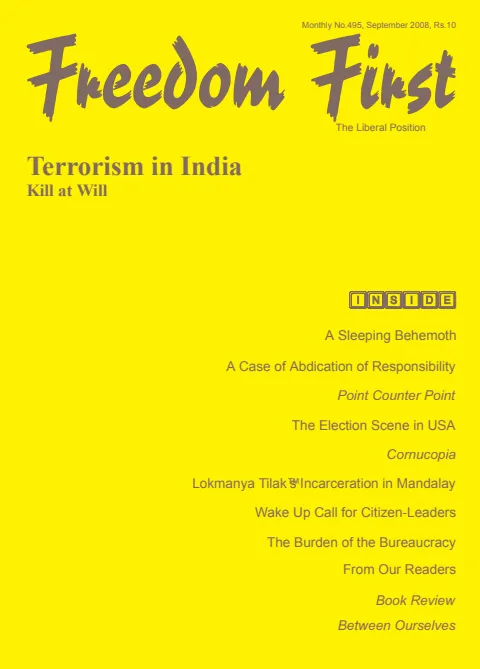
periodical issue
Freedom First
The Nuclear Deal
Published by J. R. Patel for the Indian Committee for Cultural Freedom (ICCF) ... and printed by him at Kaiser-E-Hind Private Ltd. · Mumbai · 2008
20 pages
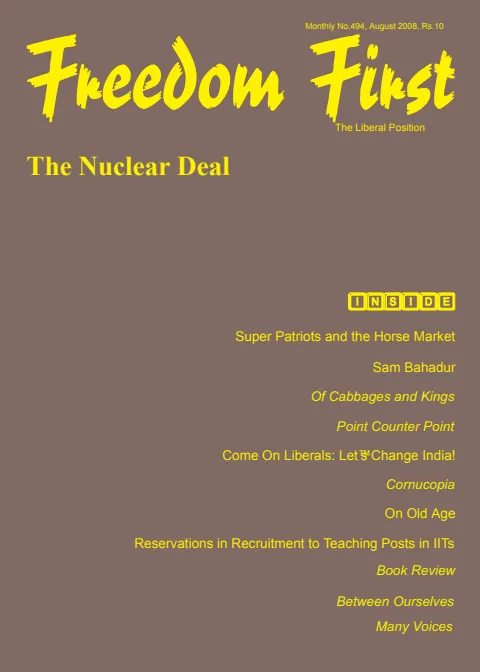
Freedom First
Summary
Freedom First No. 494 (August 2008) is dominated by the India-US civil nuclear deal, which two regular columns tackle from different angles: Sharad Bailur’s ‘Super-Patriots and the Horse Market’ traces the deal’s political lineage from Nehru through Vajpayee to Manmohan Singh and skewers the BJP and Left for opportunistic posturing, while Ashok Karnik’s ‘Point Counter Point’ debates the deal alongside other current controversies (religious misuse of jihad, Congress infighting in Maharashtra) in a for-and-against format. The issue’s other major piece is Major General Eustace D’Souza’s tribute to Field Marshal Sam Manekshaw (‘Sam Bahadur’), who died in June 2008, supplemented by a reprinted Ardeshir Cowasjee column from Dawn. Regular features include Firoze Hirjikaka’s ‘Cornucopia’ column (on Bal Thackeray’s inflammatory rhetoric and illegal schools in Mumbai), a report on new caste-based faculty reservations at the IITs, a book review of Vinay Lal’s ‘Empire of Knowledge’, an excerpt marking Nelson Mandela’s 90th birthday, and the editor’s ‘Between Ourselves’ note introducing new columnist Sanjeev Sabhlok, whose debut piece ‘Come On, Liberals: Let’s Change India!’ calls on liberals to organise politically.
Key points
-
Sharad Bailur’s lead article traces India’s nuclear-policy history from Nehru through Shastri, Indira Gandhi’s Pokhran I, and Vajpayee’s Pokhran II to defend Manmohan Singh’s US nuclear deal as necessary for uranium supply, mocking the opportunistic ‘fishing in a horse trough’ opposition from the BJP, Left, and Mayawati.
-
Major General Eustace D’Souza’s tribute to Field Marshal Sam Manekshaw, who died in June 2008, recounts his wounding at Sittang Bridge, his role planning the 1971 victory over Pakistan, and calls for a posthumous Bharat Ratna while criticising officials for skipping his funeral; a reprinted Ardeshir Cowasjee column from Dawn adds his wartime friendship with Yahya Khan.
-
Ashok Karnik’s “Point Counter Point” debates the nuclear deal and Manmohan Singh’s confidence vote, the Deoband fatwa against jihadist violence, and Congress infighting disrupting a Sonia Gandhi rally in Maharashtra.
-
Sanjeev Sabhlok’s debut column, “Come On Liberals: Let’s Change India!”, announces the Freedom Team of India initiative to recruit about 1,500 citizen-leaders to eventually contest elections on a platform of freedom and anti-corruption.
-
Firoze Hirjikaka’s “Cornucopia” criticises Bal Thackeray’s Saamna editorial calling for Hindu suicide bombers after the Mumbai theatre blasts, and blames poorly run municipal schools for driving Mumbai’s slum families toward illegal unregistered schools.
-
A report covers the June 2008 transfer of Amarnath Shrine land triggering Kashmir Valley protests and the collapse of the Congress-PDP coalition government, and another covers a government order mandating SC/ST/OBC faculty reservations at the IITs over the objections of IIT directors.
-
R. Srinivasan reviews Vinay Lal’s ‘Empire of Knowledge,’ which argues the UN and international financial institutions function as extensions of American power and casts Gandhi as an indigenous alternative to Western development models.
-
An unsigned piece on media trivialisation uses the Aarushi murder coverage to show political news share on Hindi TV channels falling sharply between 2005 and 2007, and a short piece marks Nelson Mandela’s 90th birthday.
Essays
Super Patriots and the Horse Market
By Sharad Bailur
No summary was extracted for this article. Listed for completeness.
Sam Bahadur
By Eustace D’Souza
Major General Eustace D’Souza’s tribute to Field Marshal Sam Hormusji Framji Manekshaw (‘Sam Bahadur’), who died on 27 June 2008 at age 94. The piece recounts his early life, WWI/WWII medical-family background, his commissioning into the Indian Military Academy’s first course, his near-fatal wounding at the Sittang Bridge in Burma, his role in the 1965 and 1971 wars (including the East Pakistan campaign), his sense of humour, leadership philosophy, and idiosyncrasies. It closes by calling for him to be posthumously awarded the Bharat Ratna and criticising the government and service chiefs for not attending his funeral. A boxed sidebar reprints Ardeshir Cowasjee’s tribute from Pakistan’s Dawn, recounting Manekshaw’s friendship with General Yahya Khan and a Rs.1,000 motorbike anecdote.
- Manekshaw died on 27 June 2008 at Military Hospital, Wellington, Nilgiris, aged 94, the world’s oldest living Field Marshal at the time.
- Commissioned in 1932 into the 4/12 Frontier Force Regiment; seriously wounded at the Battle of Sittang Bridge in Burma during WWII.
- As Eastern Army Commander in 1971, oversaw the planning (with Lt. Gen. J.F.R. Jacob and Maj. Gen. Inder Gill) that led to the fall of Dacca and Pakistan’s surrender.
- Known for personal bravery, humour, meticulous appearance, and strict-but-fair man-management style.
- The author faults him for not publicly crediting Jacob and Gill enough, and for favouring Gorkha and Sikh troops.
- The piece closes advocating a posthumous Bharat Ratna and criticises the state/military leadership for skipping his funeral.
- A sidebar reprint from Dawn’s Ardeshir Cowasjee recounts Manekshaw’s wartime friendship with Pakistan’s Yahya Khan.
s lead article on the India-US nuclear deal traces the political history of India
By Sharad Bailur
Sharad Bailur’s lead article on the India-US nuclear deal traces the political history of India’s nuclear programme from Nehru’s dual-use ambitions through Shastri’s no-weapons stance, Indira Gandhi’s Pokhran I, Morarji Desai’s rollback attempt, Vajpayee’s Pokhran II and subsequent CTBT/no-first-use pledges, up to Manmohan Singh’s negotiation of the US deal. Bailur argues the deal is necessary for India’s uranium supply and geopolitical positioning against China, defends it against BJP and Left objections, and mocks the incoherent, self-interested positioning of the BJP, Mayawati, the Left, and various regional parties (‘fishing in a horse trough’).
- Traces nuclear policy history from Nehru’s dual-track ambitions through Pokhran I (Indira Gandhi) and Pokhran II (Vajpayee).
- Argues the BJP would have embraced the same deal if in power, and criticises its opposition as opportunistic.
- Distinguishes the US domestic Hyde Act from the India-US bilateral treaty, arguing no-testing restriction is not actually in the treaty.
- Frames the deal as necessary because IAEA/NSG cooperation is contingent on the US agreement, needed for uranium supply.
- Satirises the ‘fishing in a horse trough’ politics: Left, BJP, Mayawati, SP, and Muslim organisations all triangulating for advantage.
- Cites Jamaat-e-Islami Hind’s condemnation of the deal as ‘anti-India and anti-human.‘
Of Cabbages and Kings
An unsigned piece titled ‘Of Cabbages and Kings’ laments the trivialisation of Indian news media, using the Aarushi murder coverage as its central case study, and cites Centre for Media Studies data showing political news coverage on Hindi TV channels fell from 23.1% (2005) to 10.09% (2007) while crime/entertainment coverage nearly doubled.
- Argues newspapers and TV have shifted from political substance to trivial and crime-focused coverage.
- Uses the Aarushi murder case (39.5 of 92 prime-time hours across six channels) as the key illustration.
- Cites Centre for Media Studies data on the decline of political news share on Hindi channels between 2005 and 2007.
- Raises the normative question of whether media should lead by consumer preference or exercise an educative, guiding role.
Point Counter Point
By Ashok Karnik
Ashok Karnik’s regular ‘Point Counter Point’ feature presents paired for/against arguments on four current issues: the nuclear deal and PM Manmohan Singh’s decision to face a confidence vote; the Deoband fatwa against religious violence and its limited practical effect on jihadist groups; the disruption of Sonia Gandhi’s Maharashtra rally by Congress infighting around minister Rane; and (continued on p.17) further debate on the same topics.
- On the nuclear deal: argues the PM finally showed leadership by staking his government on the deal, while the counter view frames all parties’ positions as tactical, tied to fear of early elections.
- On ‘Religion Misinterpreted’: welcomes the Deoband fatwa (Feb 2008) against violence in Islam’s name, but notes terrorist organisations like Al Qaeda and Lashkar-e-Taiba are unlikely to accept ulema authority.
- On ‘Sonia’s Fiefdom’: examines the disruption of a Congress rally in Maharashtra tied to factional infighting around Chief Minister Deshmukh and minister Rane.
- Concludes state Congress leaders are jockeying for power even as the party’s electoral prospects fade.
Come On Liberals: Let’s Change India!
By Sanjeev Sabhlok
Sanjeev Sabhlok’s debut column for Freedom First is a call to action for Indian liberals to organise politically. He describes his background as a former IAS officer (1982-2001) turned Australian civil servant, his disillusionment with Indian governance’s corruption and waste, his founding of the ‘Freedom Team of India’ initiative, and his plan for a multi-year campaign to recruit ~1500 liberal leaders and eventually contest elections on a platform of freedom, tolerance, and anti-corruption.
- Argues Indian liberal democracy lacks a liberal political voice since the Swatantra Party disbanded in 1973.
- Blames six decades of Nehruvian socialist policy and corruption, alongside rising Hindutva politics represented by the BJP, for India’s governance crisis.
- Describes his own career shift from Indian to Australian bureaucrat and his realisation that political reform must start from the top.
- Announces the ‘Freedom Team of India’ initiative (via a temporary website) aiming to assemble roughly 1500 liberal leaders, one per Lok Sabha constituency.
- Lays out a three-year campaign plan to spread the liberal message before the Team would contest elections.
- States two of his forthcoming books, ‘Breaking Free of Nehru’ and ‘The Discovery of Freedom’.
Cornucopia
By Firoze Hirjikaka
Firoze Hirjikaka’s ‘Cornucopia’ column covers two topics: Bal Thackeray’s inflammatory Saamna editorial calling for Hindu suicide bombers and a ‘Hindu bomb’ in response to Mumbai’s theatre blasts, which the author frames as cynical, effective political provocation exploiting government timidity; and the proliferation of illegal, unregistered schools in Mumbai’s slums, blamed on corrupt, poor-quality municipal (BMC) schools that fail to serve their student population.
- Thackeray’s Saamna editorial after Mumbai theatre blasts calls for Hindu suicide bombers and laments the blasts weren’t more powerful.
- Author argues Thackeray is untouchable due to India’s weak enforcement against powerful political figures, citing Home Minister R.R. Patil’s tepid initial response.
- Frames Thackeray’s provocation as calculated to appeal to a violence-prone electorate rather than the ‘silent majority.’
- On illegal schools: argues BMC municipal schools are so poorly run (bad facilities, indifferent teachers) that slum families turn to unregistered, unqualified alternatives.
- Criticises Maharashtra’s Education Minister Vasant Purke for moralising about ‘illegal’ schools without addressing the root failures of government schools.
Amarnath Shrine – The Land Allotment Controversy
A report titled ‘Amarnath Shrine – The Land Allotment Controversy’ (excerpted and edited from a longer piece by Ram Punyani) covers the June 2008 J&K government decision to transfer land to the Shri Amarnath Shrine Board, the resulting protests and demographic-change fears in the Kashmir Valley, counter-protests in Jammu orchestrated by the BJP, and the eventual collapse of the Congress-PDP coalition government, leaving J&K under President’s Rule.
- The J&K government’s June 2008 diversion of 39.88 hectares to the Amarnath Shrine Board triggered widespread valley protests over perceived demographic change.
- Notes the historical Hindu-Muslim syncretism in managing the yatra, discovered by a Muslim shepherd in the 1850s.
- Both BJP-backed Jammu protests and Kashmiri separatist agitation (including Syed Ali Shah Gilani) escalated the crisis.
- The PDP’s withdrawal from the coalition (under pressure) led to the fall of the state government and imposition of President’s Rule.
On Old Age
‘On Old Age’ presents two circulated internet pieces on aging: ‘Crabby Old Man,’ an anonymous poem said to have been found among a deceased nursing-home patient’s belongings, reflecting on how the elderly are underestimated by caregivers; and ‘Old Age, I Decided, Is A Gift,’ a first-person prose reflection embracing aging with equanimity and gratitude.
- The poem ‘Crabby Old Man’ imagines an elderly patient’s inner monologue, contrasting nurses’ perception of him with his full remembered life.
- Framed as having gone viral after being found among a deceased patient’s possessions in a Tampa, Florida hospital.
- ‘Old Age, I Decided, Is A Gift’ reflects on aging positively, embracing imperfection, broken hearts, and lived experience.
- Both pieces are presented as reader-submitted internet forwards, credited to Priyadarshan Pradhan and B.H. Patankar respectively.
Essay 9
By A news report on the Indian government
A news report on the Indian government’s June 2008 order mandating caste-based (SC/ST/OBC) reservations in teaching faculty recruitment at the IITs, detailing the quota percentages, the strong opposition of IIT directors who fear erosion of merit and institutional quality, and background on the reservation categories and the broader anti-reservation debate in India.
- Government order (dated 9 June 2008, signed by Seema Raj) mandates 15% SC, 7.5% ST, and 27% OBC quotas in IIT faculty recruitment with immediate effect.
- IIT directors, quoted via The Times of India, warn the decision could cause the institutes to ‘crumble’ and undermine their global brand for quality.
- In science/technology departments reservation applies at school/branch level; in humanities/management up to professor level; nearly 49.5% of posts affected overall.
- Background context given on SC (16% of population), ST (7%), and OBC categories, plus reference to the 2006 anti-reservation protests and debates over caste- vs economic-status-based reservation.
- Cites Ambedkar’s observation that social evils in Muslim society were ‘worse than those seen in Hindu society.‘
Reservations in Recruitment to Teaching Posts in IITs
A book review by Professor R. Srinivasan of Vinay Lal’s ‘Empire of Knowledge: Culture and Plurality in the Global Economy’ (Vistaar Publications, 2005), praising the book’s critique of American global dominance, its skepticism toward international institutions (UN, IMF, World Bank, WTO) as extensions of US power, and its argument that concepts like ‘terrorism,’ ‘nation-state,’ and ‘development’ distort social reality and mask coercion and violence, including a discussion of Gandhi as the ‘ultimate dissenter’ from Western nostrums.
- Reviewer finds the book valuable and provocative, skeptical of ‘present-day nostrums’ regarding globalization and international institutions.
- Book argues the UN and bodies like IMF/World Bank/WTO are effectively extensions of American dominance.
- Cites US actions in Iraq, Afghanistan, Laos, Cambodia, El Salvador and Guatemala as evidence of a ‘war machine’ record.
- Discusses selective use of the ‘terrorism’ label, contrasting Irish extremist violence with far larger death tolls attributed to Suharto’s Indonesia never labeled ‘terrorist’.
- Explores how categories like ‘nation-state’ and ‘development’ obscure coercion, citing displacement from dams (Three Gorges, Indian dam projects) and destruction of local languages/cultures.
- Discusses Gandhi as an indigenous alternative to Western social/development models, per the book’s characterisation as the ‘ultimate dissenter.‘
Book Review
By R. Srinivasan
A short excerpted piece marking Nelson Mandela’s 90th birthday (18 July 2008), reflecting on the global celebrations (including a London rock concert) and asking why Mandela commands such widespread admiration compared to other morally comparable public figures, concluding that his ordinary humanity combined with extraordinary courage and generosity explains his singular iconic status.
- Marks Mandela’s 90th birthday with a televised concert in Hyde Park, London, drawing a broad, multi-generational audience.
- Asks why Mandela evokes such widespread global affection compared to other figures of comparable moral standing (Vaclav Havel, Aung San Suu Kyi mentioned).
- Cites Stephen Fry’s explanation that Mandela’s rarity as a genuinely good and great man inspires public optimism and solidarity.
- Concludes Mandela’s iconography as an ‘ordinary man’ capable of extraordinary courage and generosity is central to his appeal, and that his flaws do not diminish this.
Between Ourselves
By Editor
The editor’s ‘Between Ourselves’ note reflects on the political horse-trading around the confidence vote following the nuclear deal, welcomes new columnist Sanjeev Sabhlok, praises Eustace D’Souza’s tribute to Sam Manekshaw while criticising the government for its treatment of Manekshaw’s funeral, and issues a correction crediting a prior article’s original publication in Asian Age. This is followed by ‘Many Voices,’ a compilation of short quoted excerpts from other publications on topics including political extravagance, Pakistani politics, the food crisis, and Indian infrastructure.
- Editor describes the political ‘musical chairs’ around the July 2008 confidence vote as disappointing given widespread public misunderstanding of the nuclear deal’s substance.
- Welcomes Sanjeev Sabhlok’s new column and endorses his call for liberals to seek an electoral mandate.
- Criticises the government and armed forces chiefs for not attending Sam Manekshaw’s funeral.
- Issues a correction: an article on McCain and Obama by V. Balachandran was originally published in Asian Age.
- ‘Many Voices’ compiles short excerpted quotations from Janata, The Week, DNA, Sunday Hindustan Times, The Statesman, Mint, and Indian Express on topics from political lavishness to the global food crisis.
Generated by the v1.5 extraction pipeline. Awaiting editorial review.
Many Voices
No summary was extracted for this article. Listed for completeness.
Essay 12
No summary was extracted for this article. Listed for completeness.
Metadata and summary are AI-extracted from the source PDF and reviewed for editorial accuracy. The original work is available via the Read PDF tab above (where present); paragraph-level citation inside the PDF is deferred to a future engagement.