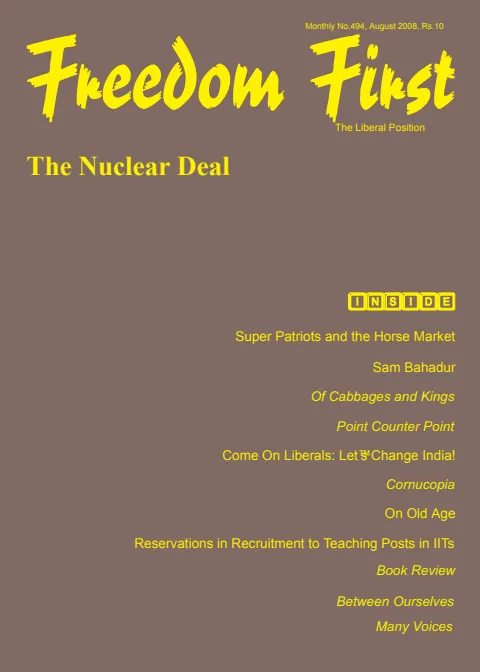
periodical issue
Freedom First
The Liberal Position
By S. V. Raju
Published by J. R. Patel for the Indian Committee for Cultural Freedom (ICCF) and printed by him at Kaiser-E-Hind Private Ltd., Plot No.A-191, Road No.16A, MIDC, Wagle Industrial Estate, Thane (W) - 400 604. · Mumbai · 2008
20 pages
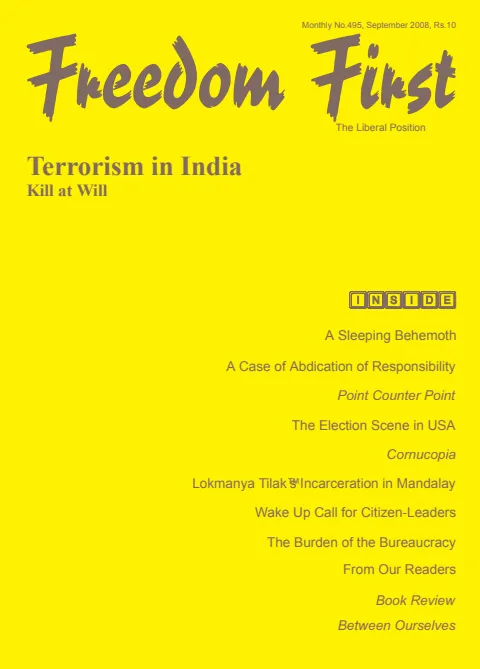
Freedom First
Summary
This September 2008 issue of Freedom First (No. 495) leads with a special section, “Terrorism in India: Kill at Will,” featuring two essays: Ashok Karnik’s “A Sleeping Behemoth,” which surveys three decades of terror attacks across Indian cities and indicts government inertia, poor accountability, and the absence of a coordinated intelligence response; and V. Balachandran’s “A Case of Abdication of Responsibility,” which argues that both the central Ministry of Home Affairs and state governments have failed to act on post-Kargil security reform recommendations and makes the case for a federal anti-terrorism agency, drawing a historical parallel to William Sleeman’s nineteenth-century suppression of Thuggee. Karnik also contributes a recurring “Point Counter Point” feature juxtaposing opposed views on the confidence vote survived by the Manmohan Singh government, the recurring bomb blasts of 2008, and the right to privacy after the Aarushi Talwar case. B. Ramesh Babu reports from Washington on the lull in the 2008 US presidential race between Obama and McCain. Other contributions include Sanjeev Sabhlok’s call for liberal citizen-leaders to organize politically through his Freedom Team of India; Sadanand B. Kumta’s critique of the Sixth Pay Commission’s salary hikes for bureaucrats; R. Srinivasan’s historical piece marking the centenary of Lokmanya Tilak’s 1908 sedition trial and transportation to Mandalay; Firoze Hirjikaka’s “Cornucopia” column questioning whether India’s democracy is mature enough for its own institutions and lamenting the muted public response to Field Marshal Sam Manekshaw’s death; readers’ letters; a book review of Tan Tai Yong’s The Garrison State; and obituary tributes to public-interest litigator M. A. Rane and Alexander Solzhenitsyn.
Key points
-
Ashok Karnik’s “A Sleeping Behemoth” surveys three decades of terrorism in India from the Khalistan insurgency to 2008 jihadi attacks, arguing government inertia and lack of accountability, not resource shortfalls, are to blame, and defends harsher anti-terror laws like TADA and POTA.
-
V. Balachandran’s companion essay, “A Case of Abdication of Responsibility,” argues the Ministry of Home Affairs and state governments have ignored the 2001 post-Kargil Group of Ministers report for seven years, and again invokes William Sleeman’s suppression of Thuggee as a model for a proposed federal anti-terrorism agency.
-
Ashok Karnik’s “Point Counter Point” debates the Manmohan Singh government’s survival of the July 2008 confidence vote, the recurring 2008 bomb blasts in Jaipur, Bangalore, and Ahmedabad, and the right to privacy after the Aarushi Talwar case.
-
B. Ramesh Babu reports from Washington on a lull in the 2008 US presidential race, covering Obama’s foreign tour, the John Edwards scandal, and race as an undercurrent in the campaign.
-
R. Srinivasan marks the centenary of Lokmanya Tilak’s 1908 sedition trial and transportation to Mandalay, detailing the flawed, communally split jury verdict and Chief Justice M. C. Chagla’s 1956 plaque acknowledging the injustice.
-
Sanjeev Sabhlok’s second column promotes the Freedom Team of India, aiming to recruit 1,500 citizen-leaders by 2014, arguing freedom has benefited the poor more than any alternative economic system.
-
Sadanand B. Kumta critiques the Sixth Pay Commission’s 40% salary hike for central government employees as rewarding an unaccountable bureaucracy, while Firoze Hirjikaka’s “Cornucopia” questions whether India’s democracy genuinely serves its people and laments the muted public response to Sam Manekshaw’s funeral.
-
A book review covers Tan Tai Yong’s ‘The Garrison State’ on the militarisation of colonial Punjab under the ‘martial races’ doctrine, and reader letters address the Savitri-Satyavan legend and the fallout of the July 2008 no-confidence motion.
Essays
A Sleeping Behemoth (Terrorism in India: Kill At Will)
By Ashok Karnik
Ashok Karnik, a retired Deputy Director of the Intelligence Bureau, surveys thirty years of terrorism in India, from the Khalistan insurgency of the 1980s to the jihadi violence that struck Delhi, Mumbai, Bangalore, Ahmedabad, Jaipur, and other cities through 2008. He argues the country’s institutional response amounts to indifference: leaders make grandiose statements after each attack but take no serious remedial action, intelligence failures are used as a convenient scapegoat, and no official has ever been held accountable despite two decades of repeated failures. He is skeptical that harsher laws like TADA and POTA were rightly discarded, arguing that laws equip society against crime rather than eliminating it outright, and that misuse by enforcers, not the laws themselves, is the real problem. He welcomes the Deoband seminary’s 2008 fatwa against jihad targeting innocents but notes it has had no visible effect on militants. He closes by warning that India’s habit of absorbing repeated terrorist blows with patience is both a strength and a danger, since if the “sleeping behemoth” is provoked past a threshold it could react in destructive, unfocused ways, and calls for the country to unite past factional and ideological lines to face what he frames as a national crisis.
- Terror attacks have struck India for roughly thirty years, moving from the Khalistan insurgency to jihadi terrorism, with strikes across Delhi, Kolkata, Mumbai, Ayodhya, Malegaon, Varanasi, Bangalore, Hyderabad, Lucknow, Ludhiana, Jaipur, Ahmedabad/Gandhinagar, and Surat between 2001 and 2008.
- The author blames government inertia and lack of accountability rather than resource shortfalls: no official has been held responsible despite repeated intelligence failures over 20 years.
- He defends the value of harsher anti-terror laws (referencing TADA and POTA) as tools that equip society to deal with criminals rather than measures expected to eliminate crime outright.
- The Deoband seminary’s February 2008 fatwa declaring that jihad does not permit killing of innocents is cited as a welcome but so-far ineffective development.
- Cites an estimate that terrorist violence caused 94,000 deaths from the 1980s to 2000, exceeding deaths in all of India’s wars since independence, against Rs. 46,500 crore in security expenditure.
- Frames India’s capitulation at the 1999 Kandahar hijacking as a perception of national weakness that must be reversed.
- Calls for the country to set aside factional and ideological differences to confront terrorism as a unified national crisis.
A Case of Abdication of Responsibility (Terrorism in India: Kill At Will)
By V. Balachandran
V. Balachandran, a former Special Secretary in the Cabinet Secretariat, argues that repeated terrorist attacks expose a systemic “abdication of responsibility” by both the central government and the states. He traces the failure back to the 2001 Group of Ministers report on “Reforming the National Security System,” commissioned after the Kargil War, whose recommendations for a proactive Ministry of Home Affairs and a federal anti-terrorism agency have gone unimplemented for seven years despite being reviewed by officials who remain in office. He contrasts India’s fragmented, politicized, and poorly coordinated state police forces with more centralized counter-terrorism models in the UK (the Metropolitan Police’s Special Branch handling IRA terrorism) and the US (FBI jurisdiction over interstate crimes), and revisits the nineteenth-century suppression of the Thuggee cult by William Sleeman as a historical model of centralized, data-driven law enforcement against a secretive, mobile criminal network. He rejects states’ objections to a federal police force as constitutionally unfounded and calls for the Prime Minister to personally broker a resolution.
- Blames the Ministry of Home Affairs foremost for failing to act on the 2001 Group of Ministers report’s recommendations for a more proactive MHA and a federal anti-terrorism agency.
- Notes states have resisted a federal agency on constitutional grounds (law and order being a state subject), which the author disputes given precedents like the Special Protection Group and CISF taking over security functions.
- Describes state police forces as fragmented, politicized, and poor at inter-state coordination, citing the 2008 Bangalore bombing and Gujarat’s SIMI interrogation-sharing delays as examples.
- Draws an extended historical analogy to William Sleeman’s 1830s campaign against the Thuggee cult, crediting centralized data collection and a single ‘nodal officer’ model with breaking a secretive criminal network operating across princely states.
- Cites the UK’s Metropolitan Police Special Branch (IRA terrorism) and the US FBI (interstate/federal crimes) as models for a functioning centralized counter-terror authority.
- Calls on the Prime Minister to personally mediate a high-level dialogue with the states to allay fears that a federal force would infringe their control over local policing.
Point Counter Point
By Ashok Karnik
Ashok Karnik’s recurring “Point Counter Point” feature presents opposing viewpoints on three topical issues: the July 2008 confidence vote that the Manmohan Singh government narrowly survived (weighing relief at averting instability against condemnation of parliamentary horse-trading and the Left’s loss of leverage), the recurrence of serial bomb blasts in Jaipur, Bangalore, and Ahmedabad in mid-2008 (contrasting weary cynicism about predictable official responses with frustration at the lack of accountability for intelligence failures), and the right to privacy following the intense media scrutiny of the Aarushi Talwar murder case in Noida (debating whether investigative journalism crossed into irresponsible, TRP-driven speculation that damaged innocent reputations).
- On the confidence vote: one side welcomes the government’s survival as enabling the nuclear deal to proceed; the other condemns the horse-trading and calls the BJP’s rush to bring down the government a strategic overreach.
- On bomb blasts: one side describes official responses to Jaipur, Bangalore, and Ahmedabad attacks as a predictable, almost scripted ritual; the other stresses the lack of accountability after nearly 20 years of attacks.
- On the Aarushi Talwar case: one side criticizes media and police for treating theories as facts and sensationalizing a private tragedy; the other (quoting cyber-law advocate Praveen Dalal) situates this within a broader Indian tolerance for privacy violations across regulatory and judicial domains.
- The column format deliberately juxtaposes two unattributed columns of opinion per issue on each topic, inviting readers to weigh both sides.
The Election Scene in USA: Lull Before the Last Lap
By B. Ramesh Babu
Writing from Washington, B. Ramesh Babu describes a lull in the 2008 US presidential campaign between the primaries and the party conventions. He recounts Obama’s foreign tour to the Middle East and Europe, including a large Berlin rally, contrasted with McCain’s diminished visibility and a gaffe comparing Obama to celebrities Paris Hilton and Britney Spears. He covers the John Edwards affair scandal and its lucky timing for Obama’s vice-presidential shortlist, the emerging bipartisan convergence on troop withdrawal from Iraq, and the persistent, complex undertone of race in the campaign despite both candidates publicly avoiding the topic. Babu estimates the race a toss-up tilted toward McCain as of mid-August 2008, citing an undecided older, white electorate, but cautions Indian readers against moral hyperbole about American racism given prejudice’s universality, including within India’s own political history.
- Describes a campaign lull after the primaries, with both parties’ conventions (Denver for Democrats, St. Paul for Republicans) still upcoming as of writing.
- Recounts Obama’s foreign tour (Israel, Palestine, Berlin) boosting his profile, and McCain’s response including a gaffe likening Obama to Paris Hilton and Britney Spears.
- Covers the John Edwards ‘love child’ scandal, noting fortunate timing for Obama since Edwards had been a vice-presidential contender.
- Notes a bipartisan convergence toward Iraq troop withdrawal following a Bush administration policy shift and the Iraqi PM’s endorsement of Obama’s plan.
- Identifies race as an unavoidable undercurrent in the campaign, with older white voters (55+) showing greater reluctance toward Obama.
- Assesses the race as a ‘dead heat’ tilted toward McCain as of 14 August 2008, citing a demographically ‘un-young, un-poor, un-black’ American electoral mainstream.
- Closes with a caution against sanctimony about American racism, citing prejudice as universal and referencing Morarji Desai’s reported reluctance to have Babu Jagjivan Ram succeed him as PM.
Cornucopia (Is India Mature Enough For Democracy? / Who Cares About The Sam Bahadur?)
By Firoze Hirjikaka
Firoze Hirjikaka’s “Cornucopia” column opens by asking whether India is mature enough for democracy, arguing that the reason democracy “does not really work in India” is because it is a system that pays only lip service to the people. He contends that educated, informed citizens who could vote wisely abstain out of disillusionment while the uneducated masses are courted with cash and gifts, allowing party leaders to win nominations through cronyism, purchased loyalty, and corporate financing rather than merit, producing incompetent and sometimes criminal legislators. In the second half (“Who Cares About Sam Bahadur?”), Hirjikaka laments the muted public and media reaction to Field Marshal Sam Manekshaw’s funeral, noting that despite his stature no Commander-in-Chief attended and even a prior political scandal drew a media apology only after backlash, contrasting this with the outsized reaction to celebrity deaths, and concluding that India’s small Parsi community, not being a vote bank, generates no political constituency to honor him.
- Argues India’s democracy ‘pays only lip service’ to the people rather than genuinely serving them.
- Describes disillusioned educated voters abstaining while poorer, less-informed voters are courted through cash and gifts.
- Criticizes the internal party mechanism for selecting candidates as driven by cronyism, corporate funding, and factional loyalty rather than merit, yielding ‘incompetent, corrupt – and even criminal’ legislators.
- Shifts to lament the underwhelming public and official response to Field Marshal Sam Manekshaw’s funeral, noting the Commander-in-Chief of the Armed Forces did not attend.
- Attributes the muted reaction partly to Manekshaw’s belonging to the small Parsi community, which the author says is ‘too insignificant to be considered a vote bank.’
- Closes with the maxim that ‘we get the government we deserve.‘
Lokmanya Tilak’s Incarceration in Mandalay - A Hundred Years Ago
By R. Srinivasan
R. Srinivasan marks the hundredth anniversary of Lokmanya Tilak’s 1908 sedition trial and transportation to Mandalay, situating it within the shift from conciliatory Congress politics to a more assertive nationalism following the 1905 Partition of Bengal. He recounts the Muzzafarpur bombing, the government’s crackdown via the Explosives Bill and Indian Newspapers Bill, and Tilak’s prosecution over two Kesari articles despite them having been written by a sub-editor. He details the flawed trial (a split jury verdict along European/Parsi lines, a mistranslation exposed by Tilak’s cross-examination, and a widely rumored pre-arranged sentence) and Tilak’s defiant courtroom statement. The essay closes on eyewitness accounts from M. R. Jayakar and V. S. Srinivasa Sastri, and (in the continuation) the 1956 unveiling of a commemorative plaque by Chief Justice M. C. Chagla acknowledging the injustice of the conviction.
- Situates Tilak’s 1908 trial within the post-1905 shift toward more assertive Indian nationalism, following the Partition of Bengal and the Muzzafarpur bombing.
- Tilak was prosecuted over two Kesari articles that were in fact written by a sub-editor, though Tilak as editor took full responsibility.
- The trial’s translator broke down under Tilak’s cross-examination and admitted he had not translated the impugned articles, exposing a garbled version presented to the court.
- The jury split along communal/national lines (9 Europeans pronouncing guilty, 2 Parsis not guilty); Tilak was sentenced to six consecutive (not concurrent) years’ transportation.
- M. R. Jayakar’s memoir records that the precise sentence was rumored among the Bar hours before the judge delivered it, suggesting a pre-arranged outcome.
- In 1956, Chief Justice M. C. Chagla unveiled a plaque in the High Court containing Tilak’s words, publicly stating the convictions were a ‘flagrant denial of substantive Justice.‘
Wake-up Call for Citizen-leaders (Come On, Liberals: Let’s Change India!)
By Sanjeev Sabhlok
Sanjeev Sabhlok, introducing his second column for Freedom First, urges liberal-minded citizens to organize politically rather than remain passive, promoting his Freedom Team of India (FTI) platform, which aims to recruit at least 1,500 citizen-leaders willing to contest elections by 2014 and eventually form governments committed to freedom and good governance. He argues freedom has done more for the world’s poor than any other system, citing the historical transformation of England, the US, France, Australia, Japan, Taiwan, and South Korea through free trade and free markets, and contends that capitalist societies are more honest (per Transparency International rankings) than socialist ones. He rejects egalitarian ideologies as unnatural, arguing individual ambition and achievement, not equality, should be society’s aim, and closes with a call to build a grassroots network of local ‘Freedom Families’ to support FTI’s growth.
- Introduces the Freedom Team of India (FTI), aiming to recruit 1,500+ citizen-leaders willing to contest elections by 2014.
- Argues freedom benefits the poor more than any alternative system, citing the historical rise of England, the US, France, Australia, Japan, Taiwan, and South Korea through free trade and markets.
- Cites Transparency International rankings to argue capitalist nations are more honest than socialist ones, naming India and China as comparatively corrupt.
- Rejects egalitarian ideologies as ‘unnatural,’ arguing individuals should aim for personal greatness rather than equality.
- Calls for readers to form local ‘Freedom Family’ groups to build a grassroots network supporting FTI.
The Burden of the Bureaucracy
By Sadanand B. Kumta
Sadanand B. Kumta critiques the Sixth Pay Commission’s recommended 40% salary hike for India’s twenty million central government employees, calculating the additional annual burden at over Rs. 12,561 crore plus Rs. 18,060 crore in arrears, against a backdrop of over a billion citizens including 310 million living below one dollar a day. He argues the raise rewards a bureaucracy without corresponding accountability or performance metrics, contrasting unaccountable babus with corporate executives who answer to shareholders, and cites the Finance Minister’s own criticism of failing government delivery systems (PDS, NREGA, mid-day meals, road development) as evidence that higher pay will not translate into better governance. The piece (continued from p.15) closes by noting defence services feel shortchanged relative to civilian bureaucrats in retirement age, promotion, and educational facilities for children, discouraging recruitment.
- The Sixth Pay Commission’s 40% salary hike raises the Centre’s annual salary bill to Rs. 66,058 crore, with an additional burden of Rs. 12,561 crore plus Rs. 18,060 crore in arrears from January 2006.
- Minimum monthly salaries rise from Rs. 2,550 to Rs. 6,600 at the lowest level and from Rs. 26,000 to Rs. 80,000 (Rs. 96,000 with allowances) at the secretary level.
- Kumta questions whether the raise will improve efficiency, noting the Commission Chairman admitted the recommendations addressed only the ‘carrot,’ not the ‘stick’ of accountability.
- Contrasts unaccountable bureaucrats with corporate executives who must deliver profits to shareholders to keep their jobs.
- Cites the Finance Minister’s own criticism (at the India Today Enclave) of failing government delivery systems including the PDS, NREGA, and mid-day meal scheme as evidence of rank inefficiency and corruption.
- Notes defence services are comparatively disadvantaged in retirement age, promotion opportunities, and children’s education, discouraging recruitment into the armed forces.
From Our Readers
The “From Our Readers” section carries three letters: Prema Nandakumar of Srirangam corrects an earlier Freedom First essay (Suman Oak’s July 2008 piece) on the Savitri-Satyavan legend, arguing it misrepresents Savitri’s agency and Satyavan’s stature; H. R. Bapu Satyanarayana of Mysore raises pointed questions about personal integrity, political morality, and constitutional propriety exposed by the July 2008 no-confidence motion, including cash-for-votes allegations and the Speaker’s conduct; and N. S. Venkataraman of Chennai argues that rampant corruption within government machinery, including police and investigative agencies, has made it easier for terrorists to operate.
- Prema Nandakumar disputes a July 2008 Freedom First essay’s portrayal of Savitri and Satyavan, arguing Savitri actively chose her marriage and that Satyavan was more than ‘just a wood-cutter.’
- H. R. Bapu Satyanarayana frames the July 2008 no-confidence motion’s fallout around three questions: personal integrity of the Prime Minister, political morality (cash-for-votes, party-switching), and constitutional propriety (Speaker’s conduct, CBI independence).
- N. S. Venkataraman argues corruption within government machinery, including police and investigative agencies, has directly facilitated terrorist activity in India.
Book Review: The Garrison State - The Military, Government and Society in Colonial Punjab, 1849-1947 by Tan Tai Yong
By Brigadier Suresh Chandra Sharma (retd.)
Brigadier Suresh Chandra Sharma (retd.) reviews Tan Tai Yong’s The Garrison State: The Military, Government and Society in Colonial Punjab, 1849-1947 (Sage Publications, 2005). The review traces how colonial Punjab was militarized after its 1849 annexation, becoming the empire’s chief recruiting ground under a ‘martial races’ doctrine (Sikhs, Jats, Dogras, Muslims), sustained through land grants, canal colony privileges, and legislation like the Land Alienation Act. It covers Punjab’s massive troop and financial contributions in the First World War, recruitment resistance including opposition from the Ghadar Party, the postwar rise of rural elite-led parties like the Unionist Party under Chhotu Ram and Sikander Hayat Khan, Sikh agitation for gurdwara reform in the 1920s, and the province’s mobilization in World War II, concluding that this militarization set the template for Pakistan’s postcolonial military politics.
- Reviews Tan Tai Yong’s The Garrison State (Sage, 2005, 333 pp., Rs. 640), the seventh volume in Sage’s Modern Indian History series.
- Traces Punjab’s transformation into the British Indian Army’s chief recruiting ground under the ‘martial races’ doctrine after 1849 annexation, restricted to Sikhs, Jats, Dogras, and Muslims from specified districts.
- Describes privileges (land grants, Canal Colonies Bill, Land Alienation Act) used to secure loyalty of recruiting communities, and India’s contribution of 479 million pounds and 1.5 million men in World War I.
- Covers postwar unrest, Jallianwala Bagh’s effect on recruitment, and the rise of the rural elite-led Unionist Party (Chhotu Ram, Sikander Hayat Khan) that dominated Punjab politics until 1946.
- Notes 1920s Sikh gurdwara reform agitation threatened military loyalty, prompting the colonial government to alternate repression with concessions (handing Amritsar’s Golden Temple to the SGPC, then undermining it via anti-Akali associations).
- Concludes the book argues Punjab’s militarization under colonial rule directly informs the continuation of military rule in postcolonial Pakistan.
Between Ourselves … / Many Voices
By Editor
The editor’s “Between Ourselves” column argues the current central government, though headed by a personally honest Prime Minister, presides over a weak center amid an opposition that behaves as though it does not understand the difference between opposing and merely obstructing; the result is a governance logjam even as the economy grows. The editor connects this to the terrorism covered by Karnik and Balachandran in the issue, calling the overall picture ‘far from optimistic,’ and closes by inviting readers’ views. The adjoining “Many Voices” digest reprints short press quotations from Shashi Tharoor, Shobhaa De, Saubhik Chakravarti, Andy Mukherjee, and others on themes of authenticity, terrorism, and Indian democracy, drawn from Mint, Hindustan Times, and The Indian Express in July-August 2008. The back page also carries the masthead: founder Minoo Masani, editor S. V. Raju, associate editor R. Srinivasan, published by the Indian Committee for Cultural Freedom (ICCF), Mumbai.
- The editor characterizes the current Central Government as perhaps the weakest since independence despite an honest Prime Minister, citing a dysfunctional opposition unable to distinguish opposing from obstructing.
- Directly references the issue’s terrorism essays by Ashok Karnik and V. Balachandran as painting a picture ‘far from optimistic.’
- The ‘Many Voices’ digest compiles press quotations from Shashi Tharoor, Shobhaa De, Saubhik Chakravarti, actor Satyaraj, Andy Mukherjee, Vinay Bhagnari, and Salil Tripathi from July-August 2008 publications.
- Masthead confirms: Founder Minoo Masani, Editor S. V. Raju, Associate Editor R. Srinivasan, Advisory Board including Sharad Bailur, R. V. Chari, Firoze Hirjikaka, Ashok Karnik, Nitin Raut, Brig. (Retd.) S. C. Sharma, Sameer Wagle; published by the Indian Committee for Cultural Freedom (ICCF), Mumbai.
Generated by the v1.5 extraction pipeline. Awaiting editorial review.
Metadata and summary are AI-extracted from the source PDF and reviewed for editorial accuracy. The original work is available via the Read PDF tab above (where present); paragraph-level citation inside the PDF is deferred to a future engagement.