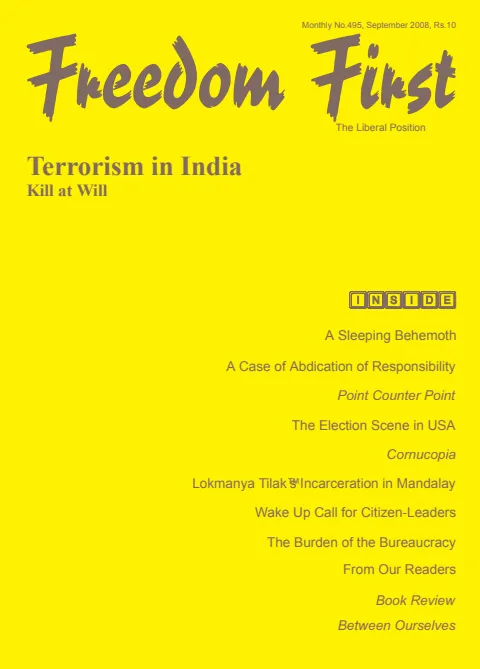
periodical issue
Freedom First
The Liberal Position
Published by J. R. Patel for the Indian Committee for Cultural Freedom (ICCF), and printed by him at Kaiser-E-Hind Private Ltd., Plot No.A-191, Road No.16A, MIDC, Wagle Industrial Estate, Thane (W) - 400 604. Publishers: Indian Committee for Cultural Freedom (ICCF), 3rd Floor, Army & Navy Building, 148, Mahatma Gandhi Road, Mumbai 400 001. · Mumbai · 2008
20 pages
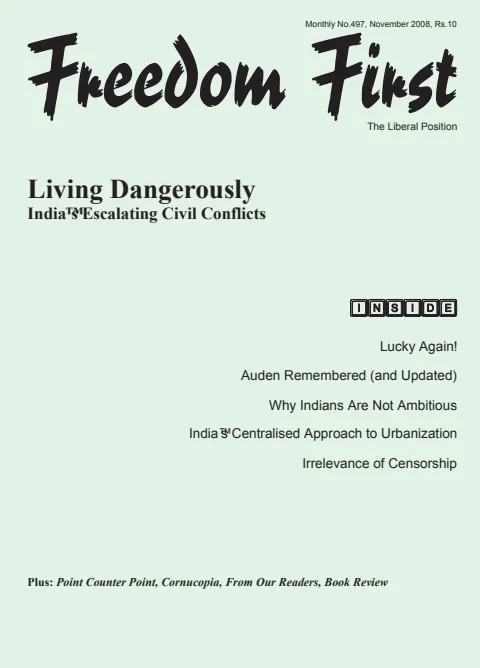
Freedom First
Summary
This is the November 2008 issue (Monthly No. 497) of Freedom First, the Bombay-based liberal monthly published by the Indian Committee for Cultural Freedom. The cover story by R. Srinivasan surveys India’s escalating civil conflicts — Naxalite-controlled territory, anti-Christian violence in Orissa and Karnataka, Bodo-Muslim clashes in Assam — and argues the state is abdicating its basic duty to maintain law and order. The issue’s other pieces range widely: Sharad Bailur’s “Lucky Again!” argues India’s post-Independence survival owes more to fortuitous timing of leaders than to policy wisdom; Sanjeev Sabhlok, writing for the Freedom Team of India, makes the case for radically decentralised, subsidiarity-based urban governance; Prem Vaidya argues for abolishing India’s film censorship regime as a colonial-era relic; M. D. Kini argues India lacks the ambition to pursue energy and water solutions it has the capacity for. Regular features include Ashok Karnik’s “Point Counter Point” (dueling perspectives on the Union Home Minister’s political troubles and zero-tolerance rhetoric on terrorism), Firoze Hirjikaka’s “Cornucopia” column (on internal Parsi community politics), Xerxes Desai’s parody-tribute update of Auden’s “September 1, 1939” applied to the 2008 financial crisis, a book review by Ashok Karnik of Ajay Darshan Behera’s Violence, Terrorism and Human Security in South Asia, reader letters, and the “Many Voices” page of quoted commentary from the month’s press.
Key points
-
R. Srinivasan’s cover essay surveys India’s escalating civil conflicts in late 2008 — Naxalite control over roughly a third of the country’s land mass, anti-Christian violence in Orissa and Karnataka blamed on the VHP and Bajrang Dal, and Bodo-Muslim violence in Assam linked to illegal immigration — and argues the state is abdicating its duty to maintain law and order.
-
Sharad Bailur’s “Lucky Again!” argues India’s post-Independence survival has depended more on fortuitous timing of leaders like Gandhi, Patel, and Nehru than on policy foresight, and warns that reliance on luck cannot continue without institutional reform.
-
Ashok Karnik’s “Point Counter Point” debates whether Union Home Minister Shivraj Patil should be held responsible for a wave of bombings, the government’s contradictory anti-terror messaging, and the Labour Minister’s advisory to industry after the Noida lynching of an Italian CEO.
-
Sanjeev Sabhlok’s column argues for radically decentralised urban governance, proposing small, accountable local councils modelled on New York and Melbourne to replace India’s unaccountable ‘mega-municipalities.’
-
Prem Vaidya argues for abolishing India’s colonial-era film censorship regime, tracing its history and citing the double standard between strict cinema censorship and unregulated television content.
-
M. D. Kini argues India lacks the ambition to pursue available energy and water solutions, citing Anand Mahindra’s critique of India’s timid solar policy and comparing it unfavourably to the ambition behind the Green Revolution and nuclear programme.
-
Firoze Hirjikaka’s “Cornucopia” argues the Parsi community’s scandal-ridden 2008 Panchayat elections and internal infighting, not external conversion pressure, are the real threat to its survival, and a companion piece describes routine diversion of relief and subsidy schemes to politically connected beneficiaries.
-
Xerxes Desai’s parody of Auden’s “September 1, 1939” recasts the poem’s warning about the outbreak of World War II onto the 2008 global financial crisis, and Ashok Karnik reviews Ajay Darshan Behera’s ‘Violence, Terrorism and Human Security in South Asia.‘
Essays
Living Dangerously — India’s Escalating Civil Conflicts
By R. Srinivasan
R. Srinivasan’s cover essay surveys India’s “escalating civil conflicts” in late 2008: Naxalite control over roughly a third of the country’s land mass, anti-Christian violence in Orissa and Karnataka encouraged by lax state governments and blamed on the VHP and Bajrang Dal, apprehensions about foreign-funded missionary conversion activity, and Bodo-Muslim violence in Assam compounded by unchecked illegal immigration. The author faults the Home Minister and Prime Minister for weak, reactive governance, cites a Vatican-World Council of Churches conference’s recommendations on ethical conduct around religious conversion, and closes by invoking constitutional provisions (Articles 256, 257, 355 and Entry 2A of the Union List) that could compel states to act, arguing India’s Constitution, like the American one, should be blind to religious affiliation.
- Frames the contemporary situation using a Hobbesian ‘state of nature’ analogy applied to Naxalite-controlled regions and Orissa.
- Criticizes the Home Minister and Prime Minister for an inadequate, image-conscious response to Orissa and Gujarat-era violence.
- Describes VHP and Bajrang Dal-led anti-Christian violence in Orissa and Karnataka, including desecration of Christian sites.
- Cites a figure of Rs.78.77 crores in foreign donations received by NGOs in 2005-06, especially in Tamil Nadu and Andhra Pradesh, as evidence of suspect missionary funding.
- References a Vatican/World Council of Churches inter-religion conference (Lariano, Italy, May 2006) and its adopted code-of-conduct recommendations on conversion.
- Covers Bodo-Muslim violence in Assam linked to unchecked illegal immigration, warning of a possible future insurgency.
- Argues the Constitution already provides tools (Articles 256, 257, 355, Entry 2A) to compel recalcitrant BJP-led state governments to act.
- Closes with the claim that India’s Constitution, like the U.S. Constitution’s colour-blindness, is meant to be religion-blind.
Lucky Again!
By Sharad Bailur
Sharad Bailur’s essay argues India has survived a string of near-catastrophes since Independence largely through fortuitous timing — the right leader appearing at the right moment — rather than through foresight or sound policy. He runs through Partition-era integration of princely states under Sardar Patel, Mahatma Gandhi’s improbable success against the British, Indira Gandhi’s Emergency and subsequent restoration of democracy, the 1998 nuclear tests, and the 2005 India-U.S. nuclear deal, framing each as a case where India narrowly escaped disaster. He warns that reliance on luck cannot continue indefinitely and calls for the country to build institutional safeguards — in electoral reform, disaster preparedness, and counter-terrorism policy — rather than continuing to gamble on chance.
- Argues India’s survival since 1947 has repeatedly depended on lucky timing of leadership (Gandhi, Patel, Nehru, Narasimha Rao) rather than policy foresight.
- Contrasts India’s relative stability with Pakistan’s and Bangladesh’s turbulent post-independence histories.
- Reviews the 1975 Emergency and its lifting as another instance where ‘better sense prevailed’ just in time.
- Discusses the 2008 Indo-US 123 Agreement and NSG waiver as a case of favourable, possibly lucky, diplomatic outcomes.
- Cites Washington think-tank (Henry L. Stimson Center) opposition to the nuclear deal and quotes co-founder Michael Krepon’s warnings at length.
- Warns that dependence on luck is unsustainable and calls for systemic reform (electoral reform, disaster response, anti-terror law) as a national priority.
- Cites the tsunami, Gujarat earthquake, and Kosi floods in Bihar as instances of natural disaster mismanagement that could presage worse to come.
Point Counter Point
By Ashok Karnik
Ashok Karnik’s recurring “Point Counter Point” column presents opposing takes on two topical issues: the political fate of Union Home Minister Shivraj Patil amid a string of terror attacks, and the government’s rhetorical “zero tolerance” stance on terrorism versus its fractured, contradictory practice across ministries and parties.
- First exchange debates whether Shivraj Patil, though personally decent, should be held responsible for inaction during a wave of bombings (Jaipur, Bangalore, Ahmedabad, Delhi) and unrest in J&K.
- Second viewpoint argues that replacing Patil alone will not fix the problem, given entrenched bureaucratic inertia.
- Second exchange examines contradictions in the UPA government’s anti-terror messaging — disagreements among Rahul Gandhi, Kapil Sibal, the National Security Adviser, and state leaders over harsher laws and the SIMI ban.
- Counter-view frames India as caught in a ‘Catch 22’: feared as soft on terror if it doesn’t act, and accused of persecuting minorities if it does.
- Each exchange closes with a contrasting quotation (Napoleon Bonaparte; Rosalyn Carter) framing the dilemma of political leadership and decisiveness.
A second Karnik “Point Counter Point” installment (continuing on page 8) debates the Union Labour Minister’s controversial advisory to industry to adopt a ‘compassionate attitude’ toward workers in the wake of the lynching of an Italian firm’s CEO by a mob of dismissed employees in Noida, with one side calling it a forgivable if tone-deaf point about labour relations and the other calling it an abdication of the government’s basic responsibility to maintain law and order.
- Centers on the 2008 NOIDA lynching of an Italian firm’s CEO by disgruntled dismissed workers.
- One view holds the minister’s statement was theoretically defensible but badly timed given the victim’s death.
- The counter-view calls the minister’s advice to industry a dereliction of the government’s duty to condemn violence and preserve order for all groups.
- This item is bundled in the same ‘Point Counter Point’ feature and rendered pages continue directly into a reader-letters section titled ‘From Our Readers’.
Auden Remembered (and Updated)
By Xerxes Desai
Xerxes Desai, formerly CEO of Titan Industries, publishes a September 2008 parody-tribute to W. H. Auden’s 1939 poem “September 1, 1939,” transposing its warning about the outbreak of World War II onto the 2008 global financial crisis — relocating the poem from a Fifty-second Street dive to a Wall Street bar and recasting ‘Imperialism’s face’ as ‘Capitalism’s ugly face.’ Auden’s original poem is printed alongside for comparison.
- Desai’s parody updates Auden’s 1939 poem to comment on the September 2008 Wall Street/financial meltdown.
- Substitutions include ‘Wall Street’ for ‘52nd Street,’ ‘corporate death’ for ‘death,’ ‘Adam Smith’ for ‘Luther,’ and ‘Capitalism’s ugly face’ for ‘Imperialism’s face.’
- The two poems are printed side by side, with Desai’s updates shown in bold to highlight the changes.
- A footnote explains Auden’s poem responded to Hitler’s September 1, 1939 invasion of Poland.
Why Indians are Not Ambitious
By M. D. Kini
M. D. Kini’s essay argues that Indians (and the Indian government in particular) are too timid and incremental in pursuing available technological solutions, drawing on industrialist Anand Mahindra’s critique of India’s tepid solar-power policy. Kini surveys the potential of Solar Thermal Electricity Generation, contrasts it with the pollution and proliferation risks of coal and nuclear power, and calls for India to better harness its own innovators (citing IIT/IIM-trained entrepreneurs and grassroots innovation catalogued by the National Innovation Foundation) to address recurring floods, droughts, and energy shortages through bold, ambitious policy rather than imported technology and incremental subsidy schemes.
- Cites Anand Mahindra’s Times of India op-ed arguing India’s solar policy (MNES incentive scheme) is too timid relative to the country’s 250-300 sunny days a year and unused desert land.
- Details STEG (Solar Thermal Electricity Generation) technology, its costs (Rs.7.50-17/kWh) versus coal (Rs.1.40/kWh) and diesel back-up power (Rs.17/kWh).
- Criticizes reliance on nuclear and thermal power given rising uranium prices (from $20 to $85/kg in three years, per Dr. P. K. Iyengar) and pollution/waste concerns.
- Cites Vivek Wadhwa’s research finding Indian immigrant entrepreneurs created 450,000 jobs and $52 billion in US sales, and Anil K. Gupta’s National Innovation Foundation cataloguing 75,000 grassroots innovations.
- Calls for India to apply the same ambition that produced the Green Revolution, satellites, and nuclear weapons to energy, flood, and drought management.
- Proposes repositioning the Planning Commission as a think-tank to build consensus on these persistent economic issues.
Cornucopia: Parsis have Descended from Valhalla
By Firoze Hirjikaka
Firoze Hirjikaka’s “Cornucopia” column argues that the Parsi community’s long-cultivated self-image of superiority has curdled, and that the newly combative, scandal-ridden 2008 Parsi Panchayat elections — marked by rumour-mongering, vote-buying, and public infighting between Liberals and Traditionalists — threaten to accelerate the community’s disappearance rather than preserve its distinct identity.
- Traces the historical roots of Parsi self-perceived exceptionalism to British colonial favoritism and a romanticized Persian heritage.
- Argues Parsis’ former discretion and aloofness from public disputes, including religious ones, has been abandoned.
- Describes the current Parsi Panchayat election cycle as an unprecedented, scandal-driven political campaign with vote-buying and anonymous slander.
- Concludes that public infighting, not external conversion pressure, is the community’s real threat to survival.
Come On, Liberals: Let’s Change India! — India’s Centralised Approach to Urbanization
By Sanjeev Sabhlok
Sanjeev Sabhlok, writing in his recurring ‘Come On, Liberals: Let’s Change India!’ series for the Freedom Team of India, argues for a radical decentralisation of Indian urban governance, proposing that cities be broken into small, accountable local councils (roughly two lakh residents each, chosen on the model of New York or Melbourne) with power to tax, issue bonds, and hire/fire professional chief executives, replacing the current ‘mega-municipalities’ run by unaccountable generalist bureaucrats.
- Frames urbanisation as necessary for productivity gains, citing Adam Smith on division of labour and Alexis de Tocqueville on associational social capital.
- Notes only 28% of Indians live in urban areas, compared with 44% in China, 78% in the US, and 86% in Australia.
- Proposes three governance principles for urban reform: good incentives, accountability, and subsidiarity.
- Argues large cities like Delhi should have dozens of small local councils (drawing comparisons to New York’s 51 and Melbourne’s 28) rather than one unaccountable mega-municipality.
- Recommends councils be empowered to raise land taxes/rates, issue long-term bonds, and hire/fire professional chief executives on performance contracts.
- Frames the essay as part of an ongoing effort to build policy positions for the Freedom Team of India, aiming to field 1,500 liberal candidates from 2014.
Irrelevance of Censorship
By Prem Vaidya
Prem Vaidya’s essay argues that India’s film censorship regime (the Central Board of Film Certification) is an outdated colonial holdover that should have been abolished at Independence. He traces its history from British-era Boards of Film Censors through the 1951 Code of Ethics, notes the double standard by which explicit content passed uncensored in early Indian cinema (including on-screen kissing in the 1933 film Karma) while a film title referencing Gandhi (‘Mahatma’) was forced to change, and calls for the CBFC’s abolition in favour of trusting the film industry and the public.
- Traces the history of Indian film censorship from four colonial-era Boards of Film Censors through the 1951 centralized Board under Sir Clifford Agarwala.
- Cites numerous pre-Independence films (Karma, Zarina, State Express) that included on-screen kissing without censor objection.
- Notes V. Shantaram’s 1935 film had to change its title from MAHATMA to DHARM-ATMA at colonial censors’ insistence to avoid association with Gandhi.
- Describes the informal practice of shooting deliberately provocative ‘Censor’s Cut’ footage purely for censors to excise.
- Quotes Justice M. Hidayatullah’s view that a handful of censors should not judge films alone, and cites Kabir and Tukaram couplets on the value of critics.
- Notes the double standard between strict CBFC/Film Advisory Board oversight of cinema versus the unregulated content on over 105 TV channels.
- Calls for abolition of the CBFC, arguing ‘the people of India’ should be the ‘conscious keepers of the nation.‘
Book Review: Violence, Terrorism and Human Security in South Asia by Ajay Darshan Behera
By Reviewed by Ashok Karnik
Ashok Karnik reviews Ajay Darshan Behera’s Violence, Terrorism and Human Security in South Asia (University Press Ltd. Dhaka, 2008), a comparative academic study of violence and terrorism across India, Pakistan, Sri Lanka, and Nepal. The review highlights the book’s central paradox that development, rather than eliminating grievances, often generates the very conflicts and ‘militarization of the state’ that entrench further violence, and closes by faulting the book (and Kofi Annan’s 2005 five-point UN counter-terrorism strategy that it cites) for offering scholarly analysis but no real solutions.
- The book, by Jamia Millia Islamia University’s Dr. Ajay Darshan Behera, covers India, Pakistan, Sri Lanka, and Nepal but excludes Bangladesh.
- Distinguishes ‘National Security’ from the broader concept of ‘Human Security,’ while conceding human security ultimately depends on the state.
- Argues post-colonial South Asian states’ unfinished nation-building process, not individual leaders’ failures, is the ‘genetic’ root of regional conflict.
- Describes a cycle in which development itself provokes grievances, which lead to ‘militarization of the state,’ perceived by agitators as oppression.
- Notes the book covers Naxalism/North East insurgencies in India, Sindh and Baluchistan in Pakistan, Maoism in Nepal, and the LTTE in Sri Lanka comparably.
- Cites Kofi Annan’s 2005 UN five-point (‘five Ds’) counter-terrorism strategy and dismisses it, along with the book, as offering no practical solution.
Between Ourselves … / Many Voices
By Editor
A short unattributed piece, ‘An Ungrateful Nation?’, criticizes ex-servicemen’s demonstrations and hunger-strike threats over the 6th Pay Commission report as self-diminishing given their otherwise dignified conduct, followed by a boxed extract from Admiral Arun Prakash’s essay ‘Izzat-O-Iqbal?’ lamenting the absence in India of the public honour, memorials, and esteem customarily accorded to servicemen and veterans in other nations.
- Criticizes talk of a hunger strike by ex-servicemen protesting the 6th Pay Commission report as self-diminishing given the dignity of their April/May 2008 demonstrations.
- Extract from Admiral Arun Prakash’s piece contrasts the public honour (monuments, war memorials, named avenues) given to servicemen abroad with its absence in India.
- Notes the extracted piece’s title derives from the Sanskrit-Persian motto of the Regiment of Artillery, meaning ‘Honour and Esteem Everywhere.‘
Essay 11
A reader letter from R. C. Saxena of Baroda responds to an earlier Freedom First article by Sharad Bailur on international law and the nuclear deal, clarifying the constitutional distinction in India between ‘treaty’ and legislative ratification, and arguing that the 123 Agreement did not require formal parliamentary approval because treaty-making falls within the executive’s prerogative under Article 253 and related constitutional provisions.
- Explains that in Indian and international law a treaty is a bilateral or multilateral contract between sovereign states.
- Notes Parliament has no formal constitutional role in treaty-making, only in enacting implementing legislation under Article 253.
- Cites Article 51(c) of the Directive Principles of State Policy on fostering respect for international law and treaty obligations.
- Concludes only the 123 Agreement portion of the broader ‘Nuclear Deal’ qualifies as a true treaty; the NSG waiver was merely a multilateral lifting of a supply ban, not a treaty requiring parliamentary involvement.
Essay 12
A second Hirjikaka piece and further reader letters: ‘Corruption is a Part of Indian Life’ describes the routine diversion of government relief and subsidy schemes (cattle for destitute farmers, PDS foodgrains, disaster relief supplies) to politically connected beneficiaries, citing India’s Transparency International corruption ranking of 85 out of 180 as surprisingly good given the scale of everyday graft. This is followed by reader letters on Major General E. D’Souza’s earlier ‘Kashmir Re-visited’ article and a brief query on the 6th Pay Commission dispute with the Armed Forces.
- Describes politicians diverting a subsidized-cattle scheme meant for destitute Maharashtra farmers to themselves.
- Cites Rajiv Gandhi’s oft-quoted estimate that only 15% of relief funds reach intended beneficiaries.
- Cites Transparency International’s ranking of India at 85 of 180 countries on the corruption index.
- A reader letter from Dr. Ali Khwaja praises Major General E. D’Souza’s account of revisiting his old Kashmir postings at age 87.
- A short letter from a retired Brigadier questions media criticism of the Service Chiefs’ pushback on the 6th Pay Commission award.
Essay 13
By A Ranganathan
No summary was extracted for this article. Listed for completeness.
Generated by the v1.5 extraction pipeline. Awaiting editorial review.
Metadata and summary are AI-extracted from the source PDF and reviewed for editorial accuracy. The original work is available via the Read PDF tab above (where present); paragraph-level citation inside the PDF is deferred to a future engagement.