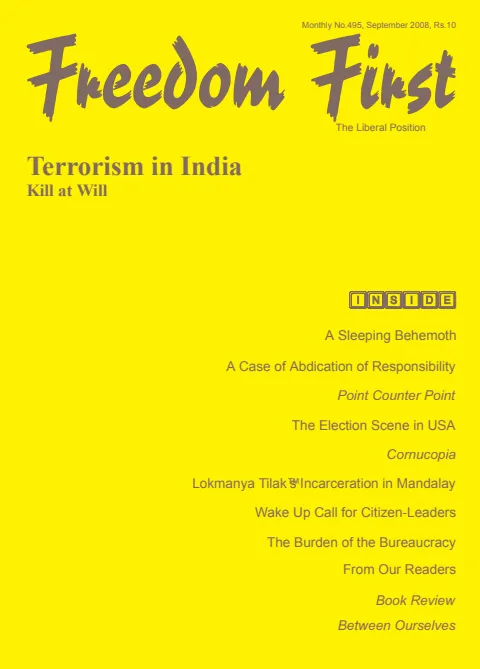
periodical issue
Freedom First
The Liberal Position
Published by J. R. Patel for the Indian Committee for Cultural Freedom (ICCF) and printed by him at Kaiser-E-Hind Private Ltd., Plot No.A-191, Road No.16A, MIDC, Wagle Industrial Estate, Thane (W) - 400 604. Publishers: Indian Committee for Cultural Freedom (ICCF), 3rd Floor, Army & Navy Building, 148, Mahatma Gandhi Road, Mumbai 400 001. · Mumbai · 2009
48 pages
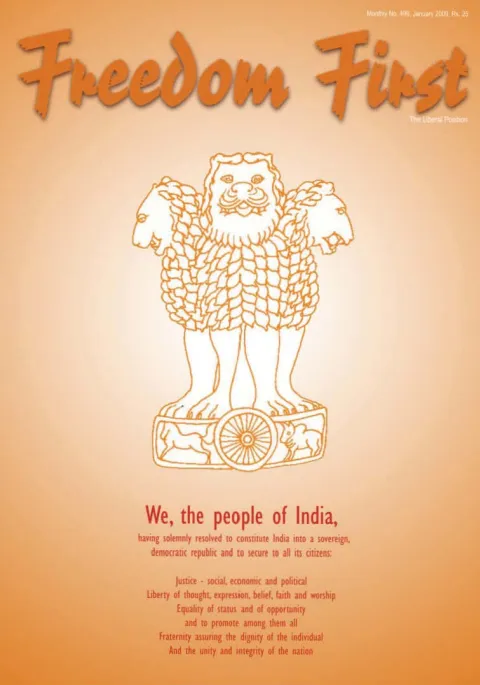
Freedom First
Summary
Freedom First No. 499 (January 2009) is the penultimate issue before the magazine’s 500th-issue commemorative special, and its editorial explains that the planned theme — the forthcoming Lok Sabha elections — was overtaken by the 26/11 Mumbai terror attacks of November 2008, which occurred just as the issue was being planned. The result is an issue split between electoral reform (citizen engagement, the protest vote under Rule 49-O) and a cluster of essays processing the Mumbai attacks: intelligence and policing failures, India’s ‘soft state’ posture, the media’s role, and philosophical reflections on the roots of terrorism and civic response. In the rendered pages the volume opens with its regular ‘Many Voices’ press-quotes digest, an editorial column (‘Of Cabbages and Kings’), reader letters, and then moves into the featured essays by Jagdeep S. Chhokar, A. K. Venkat Subramanian, Ashok Karnik, V. Balachandran, R. C. A. Godbole, and (partially) Vivek Raju.
Key points
-
Jagdeep S. Chhokar argues Indian democracy is at a critical juncture after 26/11, tracing the erosion of political morality since the 1951 H. G. Mudgal case to an estimated 100-120 sitting MPs facing criminal cases, and urges citizens to register, vote informed, and use the Rule 49-O protest vote absent a ‘None of the Above’ option.
-
A. K. Venkat Subramanian details his years-long campaign, via PIL and the Election Commission, to popularise Rule 49-O and add a ‘None of the Above’ button to EVMs, citing rising Tamil Nadu turnout after voter-awareness drives.
-
Ashok Karnik’s post-mortem of the 26/11 attacks describes a ten-man force holding Mumbai hostage for 60 hours despite prior IB and RAW warnings, criticises sensationalist media coverage and Pakistan’s denials, and calls for citizen accountability rather than complacency.
-
V. Balachandran argues India remains a ‘soft state’ that has never substantively reformed its colonial-era intelligence apparatus, contrasting its lack of a codified legal mandate with intelligence services in the US, UK, Canada, Australia, and South Africa.
-
R. C. A. Godbole reflects on the burning of the Taj Palace Hotel, highlighting informal mutual-aid networks among Mumbai commuters during the crisis and proposing a public collection to fund the hotel’s rebuilding as a gesture of civic solidarity.
-
Vivek Raju surveys candidate explanations for the 26/11 attack — incompetent governance, harbouring states, financiers, arms suppliers, religious ideology — and argues ending terrorism would require a near-impossible level of global coordination against the arms trade.
-
The editorial ‘Of Cabbages and Kings’ criticises commuters who vandalised railway property during a Mumbai motormen’s strike and compares Zimbabwe’s cholera crisis and North Korea as examples of governmental failure enabling harm to citizens.
Essays
Many Voices
The regular ‘Many Voices’ column compiles short press quotations on the mood of the country in late 2008: reflections on political hypocrisy, the Mumbai attacks and Pakistan’s denials, communal and religious commentary (including a Gandhi quote on Christian missionary conversion), and remarks on lawyers’ duty to defend the accused.
- A digest of quotations culled from Indian and international press between September and December 2008.
- Several quotes address the 26/11 Mumbai attacks and Pakistan’s response, including President Zardari’s denial of links to the militants.
- Includes commentary on the Zoroastrian/Parsi connection to several of the November terror targets.
- A Mahatma Gandhi quote from Harijan (1935) on missionary conversion is reproduced, cited via Balbir Punj in Outlook.
Of Cabbages and Kings
The editorial column ‘Of Cabbages and Kings’ opens with a comment on Mumbai railway motormen’s flash strike and subsequent commuter vandalism, then moves to the Robert Mugabe/Zimbabwe cholera crisis and North Korea, using both as illustrations of ‘rogue’ failures of governance, before closing with a note recommending the NGO Common Cause and summarizing a Supreme Court judgment protecting senior citizens from punitive mediclaim premium hikes.
- Criticizes commuters who vandalized railway property during a Mumbai motormen’s strike, distinguishing the strike’s causes from the destructive response.
- Compares Robert Mugabe’s Zimbabwe and North Korea’s Kim Jong Il as examples of governments enabling harm to their own people while the world watches passively.
- Argues for a ‘new paradigm’ limiting nationalism and state sovereignty in the face of pandemics.
- Recommends the organisation Common Cause and reports a May 2008 Supreme Court ruling barring insurers from unfairly hiking premiums or excluding coverage for senior citizens.
The Value of the Protest Vote
By A. K. Venkat Subramanian
Jagdeep S. Chhokar argues that India’s democracy is at a critical juncture following 26/11, tracing the erosion of political morality from the 1951 H. G. Mudgal expulsion case through to the present, where an estimated 100-120 sitting MPs face pending criminal cases. He contends that political parties, not voters, are the central actors deciding candidate selection and legislative behavior (via the whip and anti-defection law), and that the Law Commission’s 170th report recommended legally mandated internal democracy for parties. Because the political establishment has no incentive to reform itself, Chhokar argues citizens must take responsibility: registering to vote, making informed choices, and, where no candidate is acceptable, using Rule 49-O (the ‘protest vote’) or, ideally, a ‘None of the Above’ EVM option.
- Traces the decline of political morality from Nehru’s era through Indira Gandhi’s first tenure (1966-77) and the rise of vote-bank politics.
- Uses the 1951 H. G. Mudgal expulsion (for improper dealings with the Bombay Bullion Association) as a benchmark for political morality, contrasted with 18.18% of 14th Lok Sabha (2004-08) MPs having pending criminal cases at election time.
- Cites the Law Commission’s 170th report calling for legally mandated internal democracy, financial transparency, and accountability within political parties.
- Quotes Felix Frankfurter on the responsibility of citizenship as a civic duty.
- Advocates citizen registration, informed voting, and use of Rule 49-O for protest votes, while endorsing a ‘None of the Above’ EVM button as the ideal (though politically unlikely) solution.
- Continues on page 39 (beyond the rendered set).
India Under Attack
By Ashok Karnik
A. K. Venkat Subramanian, IAS (Retd.) and Trustee of the Catalyst Trust, explains the mechanics and history of the ‘protest vote’ under Rule 49-O of the Conduct of Election Rules, 1961, describing his Public Interest Litigation efforts since 2004 (via the Indian Liberal Group, later joined by PUCL) to have the Election Commission and Supreme Court expedite reform, and his campaign to add a ‘None of the Above’ button to EVMs. He reports concrete gains, such as increased Tamil Nadu voter turnout (57% to 70.54% between 2001 and 2006) following voter-awareness campaigns, and presents constituency-level data showing that non-voters often outnumber the winning candidate’s vote share.
- Describes Rule 49-O of the Conduct of Election Rules, 1961, which lets a voter formally decline to cast a vote while still registering at the polling booth.
- Recounts a PIL filed in the Madras High Court (April 2004) and a related PUCL petition in the Supreme Court, both still pending after nearly four years.
- Notes voter fear of retaliation from local parties when exercising Rule 49-O in the absence of ballot secrecy, since it requires an open declaration to the presiding officer.
- Presents Tamil Nadu turnout data: statewide polling rose from 57% (2001) to 70.54% (2006); in Mylapore constituency, ‘non-voters’ at 58.68% (2001) exceeded any single candidate’s share.
- Advocates an EVM ‘None of the Above’ button, with re-election if it receives the most votes, as the ideal long-term reform.
India – A Soft State
By V. Balachandran
Ashok Karnik, formerly Deputy Director of the Intelligence Bureau, gives an angry post-mortem of the 26/11 attacks: a ten-man force held Mumbai hostage for 60 hours, killing over 180 and injuring 350, exposing intelligence and coastal-security failures despite prior warnings (including a specific IB alert about five-star hotel targets and a RAW intercept about a suspect ship from Karachi). He criticizes the media’s sensationalism, mocks Pakistan’s denials (quoting Madeleine Albright’s description of Pakistan as an ‘international migraine’), and calls for citizens to hold elected officials accountable rather than lapsing back into complacency.
- Details intelligence failures: a prior IB warning about five-star hotel targets and a RAW intercept about a suspect ship from Karachi were not acted upon.
- Criticizes the ‘Chalta Hai’ culture of impunity and calls for a culture of accountability with dismissal for failure.
- Criticizes 24/7 media coverage for effectively broadcasting operational details helpful to the terrorists during the siege.
- Notes hopeful signs post-attack: increased Muslim religious leaders condemning the terrorists’ misuse of ‘jihad’, and reduced regionalism after Mumbai was ‘saved by outsiders’ (NSG commandos).
- Calls for a demand for specific action from MPs/MLAs and for citizens to reject complacency (‘let us not go back into slumber’).
War On Mumbai
By R. C. A. Godbole
V. Balachandran argues that India remains a ‘soft state’ that fails to revise its counter-terrorism methodology even after repeated attacks (1993 Bombay blasts, 2001 Parliament attack, 2002 Akshardham, and now 26/11). He traces India’s preventive intelligence apparatus to colonial-era origins (Sleeman’s Thuggee-suppression unit, later the British Intelligence Bureau, rechristened IB after 1947), arguing it has never been substantively reformed or given a codified legal mandate, unlike intelligence services in the US, UK, Canada, Australia, and South Africa, and that this absence of legal codification undermines both operational authority and accountability.
- Cites the 2001 Supreme Court judgment ‘Lal Singh vs. State’ as documenting how easily foreign agents entered and operated within India using bogus visas.
- Notes Parliament’s own 2006 admission that 1.5 lakh foreign nationals (Bangladeshis, Afghans, Pakistanis) who legally entered India between 2003-2006 have since ‘vanished’.
- Argues that IB and RAW’s lack of a codified legal mandate weakens both their institutional authority over state police and their public accountability.
- Contrasts India’s single, undifferentiated police system with the UK’s more distributed model of territorial, national, transport, and specialized policing forces.
- Calls for both a codified law defining intelligence agencies’ powers and duties, and improved inter-state police coordination.
Cornucopia
By Firoze Hirjikaka
R. C. A. Godbole reflects on the burning of the Taj Palace Hotel and argues that Mumbai’s ‘trusting’ civic culture, while it made the city vulnerable, also produced small, organic acts of mutual aid during the crisis (such as regular train commuters checking on each other by phone). He calls for the city’s wealthier residents and institutions to fund the Taj’s rebuilding — not out of necessity for the Tata group, but as a civic gesture of solidarity — and criticizes affluent, insulated citizens for being detached from and biased against the wider population they live among.
- Argues that surveillance relying on technology without human insight has failed everywhere, including in the American oil-zone intelligence effort.
- Highlights informal mutual-aid networks among Mumbai’s train commuters as a model of organic civic resilience.
- Proposes a public collection around the Gateway of India to fund the Taj Hotel’s refurbishment as a symbolic act of civic solidarity.
- Criticizes wealthy, insulated Mumbai residents for a ‘lack of engagement’ with the broader population, arguing true neutrality is impossible and one must be biased in favor of those one lives among.
The World Economic Crisis - An Interpretation
By Sharad Bailur
Vivek Raju reflects on the psychological and structural roots of terrorism following 26/11, criticizing sensationalist media coverage that amplified the attackers’ aim of spreading fear, and surveying candidate explanations for the attack (incompetent governance, states harbouring terrorists, financiers, arms suppliers, religious ideology). In the portion rendered, he argues that ending terrorism requires a near-impossible global coordination to cut off funding, arms, and publicity, and pivots to a broader philosophical claim that terrorism is one expression of a universal human tendency toward tribal, perspective-driven division and violence.
- Criticizes the media’s 24/7 sensationalized coverage of the 60-hour siege for aiding the terrorists’ goal of spreading fear.
- Lists possible culprits for the attack: incompetent governance, harbouring states, financiers (citing Gulf oil money), arms suppliers, and religious ideology.
- Notes the weapons used were ‘next generation’ to the Uzi, and that Pakistan had a license to manufacture them.
- Argues ending terrorism would require unprecedented global coordination against vested interests (notably the arms trade) that is ‘virtually impossible’.
- Frames terrorism as one instance of a broader human pattern of tribal division and violence across 5,000 years of recorded history.
- This essay is cut off mid-argument at the end of the rendered pages (page 20); its continuation was not seen.
Generated by the v1.5 extraction pipeline. Awaiting editorial review.
Metadata and summary are AI-extracted from the source PDF and reviewed for editorial accuracy. The original work is available via the Read PDF tab above (where present); paragraph-level citation inside the PDF is deferred to a future engagement.