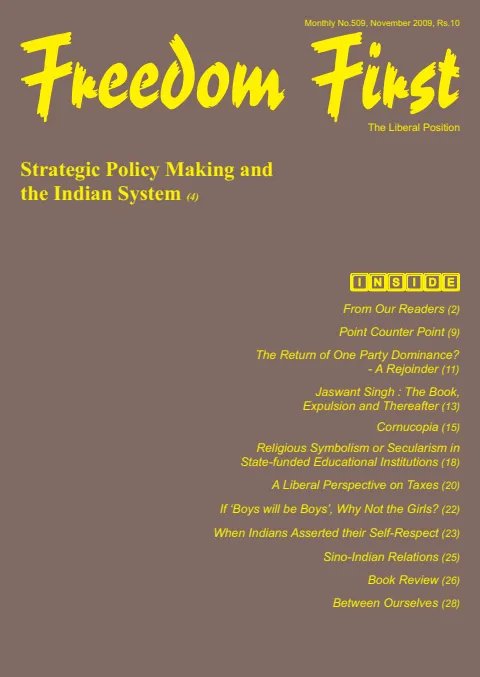
periodical issue
Freedom First
The Liberal Position
Freedom First, 3rd floor, Army & Navy Building, 148, Mahatma Gandhi Road, Mumbai 400 001. · Mumbai · 2009
28 pages
Freedom First
Summary
The rendered pages show the June 2009 issue of Freedom First, a liberal periodical concerned with corruption, political incentives, civil liberties, minority education, informal enterprise, and geopolitics. The issue opens with two articles on tax havens and Indian black money: one urges legal and diplomatic action to recover illicit funds, while the next cautions that campaign claims about forcing Swiss banks to disclose money are electorally attractive but unrealistic. Later articles extend the anti-corruption theme into electoral finance, arguing that expenditure limits, low political salaries, and black money structurally exclude honest candidates.
Key points
-
V. Krishna Moorthy surveys global tax havens and post-2008 pressure on Swiss banking secrecy, linking Indian black money to under-invoicing, kickbacks, hawala, and the licence-permit raj, and urges the new post-2009-election government to pursue illicit funds abroad.
-
Sharad Bailur pushes back against campaign rhetoric promising quick recovery of black money from Swiss banks, arguing Swiss confidentiality and the likely complicity of politicians across parties make such promises implausible.
-
Ashok Karnik’s “Point Counter Point” reads Mumbai’s low post-26/11 voter turnout as civic failure, questions whether coalition parties will prioritise national interest over power, and warns India against letting US-Pakistan dynamics dictate its military strategy toward the Taliban.
-
M. A. Haque argues madrasas proliferate not chiefly from foreign funding or communal politics but from social isolation, poor access to mainstream education, and sustaining religious donation channels like zakat and waqf, and calls for Muslim children to have a genuine choice between madrasa and mainstream schooling.
-
Firoze Hirjikaka’s “Cornucopia” argues Narendra Modi’s national ambitions are premature given his Gujarat-bound charisma and the shadow of Godhra, and separately laments the decline of circulating libraries and serious reading culture in South Mumbai.
-
Sanjeev Sabhlok argues Indian political corruption is structurally produced by election-finance rules that force costly campaigns underground, proposing abolition of expenditure limits, audited accounts, and higher legislator pay as remedies.
-
S. Radhakrishnan and R. Uppili use the Satyam-Maytas scandal to illustrate crony capitalism, contrasting it with small enterprises like Mumbai’s dabbawallahs, arguing the informal sector contributes 30-45% of GDP yet is excluded from formal bank credit.
-
An unsigned article condemns India’s diplomatic silence over Aung San Suu Kyi’s continued detention, and a companion tribute from S. V. Raju remembers Swatantra Party worker J. Ramabhadran, alongside P. L. Dash’s opening piece on post-Soviet Central Asian geopolitics.
Essays
Global Tax Havens and Indian Patronage
By V. Krishna Moorthy
V. Krishna Moorthy surveys tax havens, illicit financial flows, and the post-2008 pressure on Switzerland and other secrecy jurisdictions. He uses Global Financial Integrity figures, the G-20 summit, OECD standards, the UBS case, and the Liechtenstein LGT episode to argue that international pressure has opened a window for India to pursue money stashed abroad. The Indian section links black money to under-invoicing, kickbacks, hawala, defence and civil contracts, and the licence-permit raj, then calls for quick legal and diplomatic action by the new government after the 2009 election.
- Tax havens are presented as legal shelters for tax-evaded and questionable funds on a very large global scale.
- The article treats the 2008 financial crisis and London G-20 summit as catalysts for renewed pressure on banking secrecy.
- Switzerland is described as central because of bank secrecy, the tax fraud/tax evasion distinction, and the UBS case.
- Indian black money is linked to trade mispricing, kickbacks, hawala, and historical licence-permit controls.
- The conclusion urges the new Indian government to recover illicit funds while also reducing incentives for future outflows.
The Politics of Black Money in Swiss Banks
By Sharad Bailur
Sharad Bailur challenges campaign rhetoric about retrieving Indian black money from Swiss banks. He accepts that politicians across parties may have hidden money abroad, but argues that Swiss confidentiality, international law, and the likely complicity of many political actors make promises of swift recovery implausible.
- The article is skeptical of election promises that a new government can force Swiss banks to reveal names or return money.
- A personal anecdote about a demanded Swiss-bank deposit illustrates how power can produce offshore corruption.
- Bailur argues that the problem is not confined to one party and that all political colours may be implicated.
- The piece warns voters against treating black-money promises as easy solutions.
Point Counter Point
By Ashok Karnik
Ashok Karnik’s Point Counter Point column offers paired arguments on electoral apathy, coalition rhetoric, and the Taliban. It criticizes low turnout after the 26/11 attacks as a failure of hope, tests whether party promises are national-interest claims or power calculations, and warns India against letting U.S.-Pakistan dynamics dictate its military strategy. The page also includes short boxed excerpts on Ronald Reagan’s view of government, al-Qaeda’s weakening appeal in Muslim societies, and British MPs’ expenses abuses.
- The column reads Mumbai’s low post-26/11 turnout as both civic failure and a symptom of voter disillusionment.
- It questions whether parties will prioritize national interest over coalition power.
- The Taliban discussion rejects wishful distinctions between good and bad Taliban while cautioning India about U.S. pressure.
- The boxed material links the column’s anti-state and anti-political-class themes to international examples.
‘Madrasaas’ : How They Survive and Why These Institutions are Proliferating?
By M. A. Haque
M. A. Haque argues that madrasas proliferate because they are socially isolated yet economically viable, not simply because of foreign funding or communal politics. He criticizes self-seclusion by managers and teachers, notes community mistrust, poor access to mainstream education, employment anxieties, and the attraction of free boarding and religious instruction for poor Muslim families. The article then explains how zakat, fitra, qurbani hides, sadaqa, imdaad, waqf support, and diaspora remittances sustain these institutions.
- The article treats isolation as two-way: outsiders do not understand madrasas, while managers do not make their work transparent.
- It argues that Islam itself does not require withdrawal from worldly education or public affairs.
- Historical distrust, Partition, communal violence, Gujarat, and poor educational access are cited as reasons Muslim families remain outside mainstream institutions.
- Madrasas survive through religious obligations and donation channels rather than primarily through government or foreign funding.
- The conclusion calls for Muslim children to have a real choice between madrasa and mainstream education.
The Thatcher Revolution - Thirty Years On
By Robin Harris
The short excerpt ‘The Thatcher Revolution - Thirty Years On’ praises Margaret Thatcher’s reversal of Britain’s postwar economic assumptions. It credits her governments with defeating inflation without price controls, strengthening the currency, reforming trade-union power, privatizing utilities, restraining spending, reducing borrowing, lowering taxes, and widening home ownership.
- The excerpt frames pre-Thatcher Britain as economically sick and apparently incurable.
- It presents the Thatcher programme as a break with old assumptions about state management.
- Privatization, fiscal restraint, lower taxes, and labour-market change are treated as sources of revived prosperity.
Cornucopia
By Firoze Hirjikaka
Firoze Hirjikaka’s Cornucopia column first argues that Narendra Modi’s national ambitions may be premature because his charisma and political manipulation remain strongest in Gujarat and because Godhra continues to shadow his image outside the state. A second piece laments the decline of circulating libraries and serious reading in South Mumbai, blaming television, games, instant messaging, and rising book prices for weakening the culture of sustained literary conversation.
- The Modi essay sees him as politically astute but overexposed and too closely linked to post-Godhra polarization.
- It predicts that a quieter national consolidation before 2014 would have been wiser than immediate prime-ministerial projection.
- The book-lovers essay treats the closing of a Colaba circulating library as a sign of a shrinking reading culture.
- It contrasts the intellectual depth of books with short attention spans fostered by television, games, and instant media.
J. RAMABHADRAN R.I.P.
By S. V. Raju
S. V. Raju’s obituary for J. Ramabhadran portrays him as a selfless public worker shaped by Rajaji’s liberal-conservative politics and the Swatantra Party. It emphasizes his work as a journalist, writer, founder of the Tamil fortnightly Chanakyan, organizer of the Rajaji Forum, and party worker who asked for nothing in return.
- Ramabhadran is remembered as a dedicated public worker rather than a professional politician.
- The obituary places him in the Rajaji and Swatantra Party tradition.
- It credits him with founding Chanakyan and helping sustain the Rajaji Forum after the party faded.
Our Politicians Have No Option But To Be Corrupt
By Sanjeev Sabhlok
Sanjeev Sabhlok argues that India’s political corruption is structurally produced by election finance rules. Large constituencies require expensive campaigns, citizens do not fund parties transparently, spending caps push money underground, low salaries deter competent entrants, and fraudulent accounts make dishonesty a condition of success. His proposed reforms are to abolish expenditure limits, audit political accounts, reimburse candidates partly by valid votes, raise legislators’ pay, and organize liberals through the Freedom Team of India.
- Black money is described as the fuel of Indian democracy because campaigns cost far more than legal limits allow.
- Election laws are said to filter out the prudent, the competent, and the honest.
- The article attacks expenditure limits on both practical and philosophical liberty grounds.
- Sabhlok proposes transparency, reimbursement, higher political wages, and liberal party-building as remedies.
Small Business, Small Players: Excluded, but Not Extinct
By S. Radhakrishnan and R. Uppili
S. Radhakrishnan and R. Uppili begin an article defending small business and informal-sector enterprise against a public culture that celebrates large industrial houses. The rendered pages use Satyam and Maytas as examples of crony capitalism and corporate governance failure, then contrast them with small entrepreneurs such as Mumbai dabbawallahs and local businesses. The authors argue that the informal sector contributes significantly to GDP and employment, but is excluded from formal bank credit because it lacks collateral and relies on trust-based lending.
- Large corporate houses are criticized for receiving media adulation, political access, awards, and bank finance.
- Satyam and Maytas are used to illustrate crony capitalism and governance failure.
- Small enterprises are presented as unseen but essential contributors to jobs and dispersed distribution.
- The informal sector is said to contribute 30 to 45 percent of GDP and employ 90 percent of the labour force.
- Banks are criticized for preferring collateral-heavy corporate lending over trust-based small-enterprise credit.
Deafening Silence from the Land of Gandhi (Mahatma that is)
The unsigned article on Aung San Suu Kyi recounts her family background, education, leadership of the National League for Democracy, the 1990 election victory ignored by Burma’s military, and renewed detention before a planned show-case election. It then condemns India’s silence, citing Kuldip Nayar’s criticism that New Delhi had abandoned Suu Kyi to court Myanmar’s junta for security reasons, and ends by contrasting that conduct with Gandhi’s moral legacy.
- The article presents Suu Kyi as a democratic prisoner whose party won the 1990 election but was denied power.
- It criticizes Burma’s military junta for keeping her detained before a legitimacy-seeking election.
- India is accused of abandoning a democratic ally in order to win cooperation from Myanmar on northeast insurgency.
- The conclusion frames the issue as a moral failure by the land of Gandhi.
Delineating Geopolitics in Central Asia
By P. L. Dash
P. L. Dash begins an article on Central Asian geopolitics after the 1991 independence of Kyrgyzstan, Uzbekistan, Turkmenistan, Kazakhstan, and Tajikistan. The rendered page emphasizes Russia’s continuing influence, new competition from the United States, China, Japan, and the European Union, Caspian energy reserves, and the post-Soviet search for viable governance models, including Turkish, Russian, Chinese, Western democratic, and Indian secular-democratic examples.
- The article begins with the strategic dilemma created by Central Asia’s independence from the Soviet sphere.
- Russia remains central despite the entry of the United States, China, Japan, and European powers.
- Caspian oil and gas reserves are framed as a major source of Russia-U.S. contention.
- The region’s early state-building is described as confused, pluralizing, and uncertain about models of governance.
Generated by the v1.5 extraction pipeline. Awaiting editorial review.
Metadata and summary are AI-extracted from the source PDF and reviewed for editorial accuracy. The original work is available via the Read PDF tab above (where present); paragraph-level citation inside the PDF is deferred to a future engagement.