Freedom First
Summary
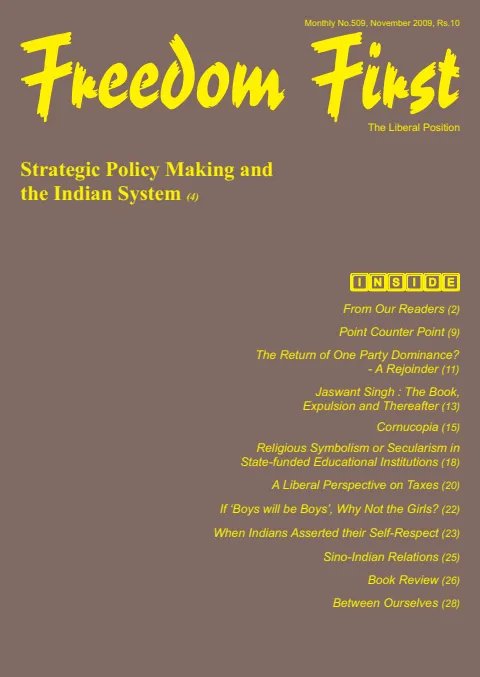
The rendered pages show the November 2009 issue of Freedom First as a policy-and-public-affairs periodical built around liberal concerns about strategic judgment, democratic party conduct, secular governance, civic accountability, and the proper scope of the state. The issue opens with reader letters on religion, Gayatri Devi, electoral malpractice, madrasas, Partition, Gujarat, and education, then moves into Admiral Arun Prakash’s cover feature arguing that India’s nuclear and strategic policy has suffered from weak institutional checks and too little military input.
Key points
-
Admiral Arun Prakash’s cover feature argues India’s nuclear and strategic policy-making suffers from weak institutional checks and insufficient military input, tracing the problem to post-independence idealism and a long-standing separation between scientists and soldiers.
-
Ashok Karnik’s “Point Counter Point” urges India to stand firm against Chinese pressure on Arunachal Pradesh, defends Shashi Tharoor’s ‘cattle class’ remark as harmless banter, and argues Pakistan’s denials over Kargil, 26/11, and proliferation have damaged its credibility.
-
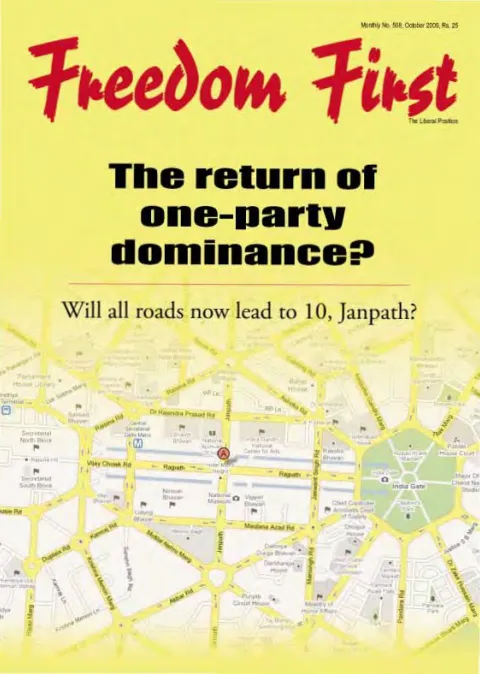
Sharad Bailur rebuts an earlier warning about a “return of one-party dominance,” arguing the 2009 Congress victory does not amount to dictatorship since the UPA remained a coalition dependent on allies, contrasting Congress’s resilience in defeat with BJP triumphalism.
-
Keshav Rau examines Jaswant Singh’s expulsion from the BJP over his Jinnah book, asking why Singh remained in a party whose positions clashed with his stated sympathy for Indian Muslims for decades, and criticises his retention of the Public Accounts Committee chairmanship after expulsion.
-
Firoze Hirjikaka’s “Cornucopia” questions the source of politicians’ disproportionate wealth, argues arresting Hafiz Saeed would not solve the structural threat from Pakistan’s army and ISI, and defends newspapers as an indispensable civic habit.
-
Narendra Nayak discusses the S.V.S. College burkha controversy in Bantwal to examine tensions between individual dress freedom and secular uniformity in state-funded educational institutions.
-
Sanjeev Sabhlok begins a liberal theory of taxation, framing taxes as payment for public goods under a social contract and beginning to justify progressive taxation through price discrimination and unequal consumer surplus.
Essays
From Our Readers
The reader letters section ranges across public reason, political memory, and communal controversy. One letter challenges a previous writer’s theological causation argument by pressing the logic of divine intervention; another recalls Gayatri Devi’s courtesy and simplicity during the Swatantra Party era; another condemns election bribery and argues that literacy and civic service are antidotes to voter manipulation. A longer letter responds to debate on madrasas by defending Jaswant Singh’s historical treatment of Partition, contesting claims about Muslim population growth and cow slaughter, and arguing that Indian madrasas should not be equated with Pakistani militancy.
- Letters debate the limits of religious explanation, public morality, electoral bribery, education, and communal stereotyping.
- Gayatri Devi is remembered through a personal anecdote emphasizing simplicity and humility.
- A letter argues that vote-buying during the 15th Lok Sabha election showed the need for literacy and social-service-oriented education.
- The madrasa letter disputes broad accusations against Muslims and distinguishes Indian conditions from Pakistan.
Strategic Policy Making and the Indian System
Admiral Arun Prakash argues that India’s nuclear controversies reveal a deeper failure of strategic policy-making. He says India has had political stability, scientific talent, and major nuclear investments, yet has repeatedly lacked institutional coherence, independent advice, and military participation in decisions about deterrence, weapons, and crisis planning. The article criticizes the separation of the armed forces from nuclear doctrine and warns that Prime Ministerial control, scientific-enclave influence, and limited checks have left major decisions vulnerable to overstatement and poor oversight.
- The article frames India’s problem as a leadership and institutional deficit rather than a lack of scientific ability.
- It argues that the armed forces have been kept too distant from nuclear doctrine, deterrence planning, and weapons design requirements.
- It traces Indian strategic hesitation to post-independence idealism, moral discomfort with nuclear weapons, and a long-standing separation between scientists and soldiers.
- It concludes that major technological and nuclear decisions need political guidance, institutional checks, and military advice.
Point Counter Point
Ashok Karnik’s column uses a point-counterpoint format to present firm opinions on three controversies. On China, it rejects wishful thinking and urges India to stand firm on Arunachal Pradesh and border pressure; on Shashi Tharoor, it treats the “cattle class” controversy as evidence of political humourlessness; on Pakistan, it argues that Pakistan’s denials and the logic of continued foreign aid have damaged credibility.
- The China section argues that border talks and diplomatic reassurance have not changed Chinese pressure tactics.
- The Tharoor section defends humour and distinguishes ministerial speech from private banter.
- The Pakistan section treats Kargil, 26/11, and nuclear proliferation as evidence against Pakistani credibility.
The Return of One Party Dominance? - A Rejoinder
Sharad Bailur replies to an earlier article by arguing that Congress dominance after 2009 should not be confused with one-party dictatorship. He is critical of Congress’s Emergency record, but he contrasts Congress’s ability to lose, wait, and return to power with what he describes as BJP disbelief and triumphalism after electoral defeat. His central claim is that the UPA remained a coalition dependent on allies, so warnings about single-party domination were exaggerated.
- The article rejects the idea that Congress’s 2009 victory amounted to a return to dictatorship.
- Bailur contrasts Congress’s handling of defeat with the BJP’s reaction to losing power in 2004 and 2009.
- The article argues that a liberal democracy can legitimately give one party an absolute majority while the opposition still occupies large parliamentary space.
- It stresses that the UPA remained a coalition and still had to listen to allies.
Jaswant Singh : The Book, Expulsion and Thereafter
Keshav Rau’s article examines Jaswant Singh’s book on Jinnah, his expulsion from the BJP, and the contradictions between Singh’s expressed sympathy for Indian Muslims and his long service in a party Rau characterizes as hostile to that position. Rau argues that Singh had the right to hold his views, but asks why he remained in the BJP for decades while it pursued positions on Muslims, temples, and Partition that clashed with those views. The article also criticizes Singh for retaining the Public Accounts Committee chairmanship after expulsion and calls on parties to use moral pressure if formal rules cannot remove him.
- The article separates Jaswant Singh’s right to hold views from the political question of his long BJP membership.
- It highlights Singh’s concern for Muslims left in India after Partition and the psychological effects of Partition.
- Rau argues that Singh’s silence during earlier BJP mobilizations weakens his later claim to conviction.
- The article treats parliamentary convention, not only technical rules, as central to democratic conduct.
Cornucopia
Firoze Hirjikaka’s Cornucopia column moves through several short liberal public-affairs reflections. It questions the source of politicians’ disproportionate wealth, argues that arresting Hafiz Saeed would not solve the structural threat posed by Pakistan’s army and ISI, defends a realist view of Gaddafi’s legal right to attend the UN despite public outrage, and ends with a personal defence of newspapers as intimate, participatory, and still indispensable even in a television-and-internet age.
- The column asks citizens to focus not only on asset declarations but on how political wealth was acquired.
- It treats Hafiz Saeed as a symbol and puppet rather than the root of India’s security problem with Pakistan.
- It argues that legal membership in the United Nations creates practical obligations even toward unpleasant leaders.
- It defends newspapers as a civic habit and a forum where readers feel heard.
Religious Symbolism or Secularism in State-funded Educational Institutions
Narendra Nayak discusses a controversy at S.V.S. College in Bantwal over a Muslim student, Ayesha Yasmin, wearing a burkha after the college had barred religiously identifiable dress. Nayak uses the dispute to examine competing secular instincts: whether liberal rationalists should support individual dress freedom even when the practice seems regressive, whether equal treatment requires allowing all religious markers, and whether a stricter French-style secularism would solve or intensify such conflicts in government-funded institutions.
- The article presents the burkha dispute as a test of secularism in state-aided educational institutions.
- Nayak criticizes the way communal mobilization and media attention displaced academic concerns.
- He acknowledges tension between individual freedom of dress and opposition to community compulsion.
- The conclusion asks whether religious symbols, prayers, and rituals should be excluded from publicly funded institutions.
A Liberal Perspective on Taxes
Only the first rendered page of Sanjeev Sabhlok’s “A Liberal Perspective on Taxes - Part I” is visible. In that page, Sabhlok begins a liberal theory of taxation by treating taxes as fees citizens pay for public goods under a social contract protecting life and liberty. He argues that citizens, not companies, authorize and owe taxes, and he begins to defend progressive taxation through price discrimination, Lindahl pricing, consumer surplus, and the idea that rich and poor should experience equal disutility from taxes.
- The visible page frames taxation as payment for public goods under a liberal social contract.
- Sabhlok distinguishes this view from approaches that treat government activity as waste.
- He argues that citizens are the proper tax-paying units, not companies or other legal entities.
- The page begins an argument that progressive taxation can be justified by price discrimination and unequal consumer surplus.
Generated by the v1.5 extraction pipeline. Awaiting editorial review.
Metadata and summary are AI-extracted from the source PDF and reviewed for editorial accuracy. The original work is available via the Read PDF tab above (where present); paragraph-level citation inside the PDF is deferred to a future engagement.