periodical issue
Freedom First
The Liberal Position
By R. Srinivasan, Aroon Tikekar, P. M. Kamath, Ashok Karnik, Amit Dholakia, R. C. Saxena
Freedom First · 2010
40 pages
Freedom First
Summary
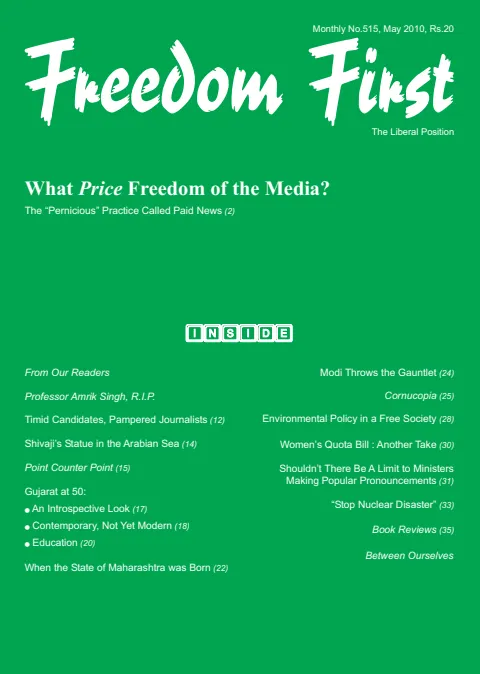
The rendered pages show the May 2010 issue of Freedom First, centered on a cover feature about paid news and the corruption of media credibility in India. The issue opens with reader letters and a memorial note for Professor Amrik Singh, then devotes printed pages 2-11 to a condensed report of a public discussion organized by the Indian Committee for Cultural Freedom on March 6, 2010. The discussion treats paid news as a democratic problem rather than a narrow election-time scandal: speakers argue that the sale of editorial space, private treaties, public-relations capture, weak ethics codes, and owner-editor conflicts blur the line between news and advertising.
Key points
-
The cover feature reports a March 2010 ICCF public discussion on “paid news,” in which speakers including Jehangir Patel and Krishna Prasad argue that the sale of editorial space as advertising, disguised across politics, business, and sport, has become a systemic threat to journalism and democratic accountability.
-
Aroon Tikekar’s “Timid Candidates, Pampered Journalists” narrows the paid-news theme to Marathi journalism, arguing that a proliferation of awards and politician-backed patronage has weakened professional independence, while voicing guarded optimism that credibility may eventually recover.
-
P. M. Kamath defends Maharashtra’s proposed offshore Shivaji statue against criticism that it wastes public resources, reframing it as both a tourism asset and a post-26/11 coastal security and intelligence platform.
-
Amit Dholakia’s “Gujarat at 50: An Introspective Look” presents Gujarat as a paradox of economic dynamism and entrepreneurial energy alongside communal polarisation, weak social indicators, and constricted dissent under Modi-centred politics.
-
R. C. Saxena’s companion piece on Gujarat at fifty distinguishes prosperity from liberal modernity, framing itself as a skeptical response to celebratory development statistics.
-
Ashok Karnik’s “Point Counter Point” withholds judgment on US cooperation in the Headley case, criticises Congress discomfort over Amitabh Bachchan’s appearance with Gujarat’s chief minister, doubts Pakistan’s sincerity in talks, and criticises the state’s confused response to the Dantewada Maoist massacre.
-
R. Srinivasan’s memorial note for Professor Amrik Singh remembers him as a major figure in Indian higher education and a longtime associate of the Indian Committee for Cultural Freedom and Indian Liberal Group.
Essays
What Price Freedom of the Media? The “Pernicious” Practice Called Paid News
The reader letters in the rendered pages respond to earlier Freedom First items on liberalism, intelligence oversight, Naxalite violence, the Pedder Road flyover, and Maharashtra politics. They stress institutional accountability, criticize misplaced public priorities, and accuse Maharashtra’s sugar interests of distorting public policy.
- A subscriber frames Freedom First as a vehicle for liberal argument against religious intolerance.
- A retired officer calls for independent oversight of intelligence agencies and stronger threat analysis.
- Letters criticize political inconsistency in responding to Naxalite violence and infrastructure policy.
- One letter argues that Maharashtra’s sugar barons receive preferential political treatment.
Professor Amrik Singh, R.I.P.
By R. Srinivasan
R. Srinivasan’s memorial note for Professor Amrik Singh presents him as a major figure in Indian higher education: a teacher, vice chancellor, author on university administration, and friend of Freedom First’s liberal institutions. The note emphasizes Singh’s candour about higher education, his faith in its future, and his association with the Indian Committee for Cultural Freedom, the Indian Liberal Group, and the Project for Economic Education.
- Amrik Singh is remembered as an eminent academic and university administrator.
- The note highlights his knowledge of Indian higher education and university officials.
- Freedom First recalls his participation in liberal programmes and regular visits to its office.
What Price Freedom of the Media?,
The cover feature, “What Price Freedom of the Media?,” presents paid news as a systemic threat to journalism, democracy, and public trust. Jehangir Patel introduces the issue by distinguishing ordinary paid web content or advertorials from the Indian practice of selling editorial space in the garb of news. Krishna Prasad argues that paid news is not confined to politics or regional papers but has spread across business, entertainment, sport, interviews, television listings, and election coverage, turning journalism into a purchasable commodity.
- The discussion defines paid news as advertising or influence disguised as editorial content.
- Speakers argue that paid news undermines voters by hiding advertising inside news.
- The feature treats the problem as institutional: owners, editors, PR firms, advertisers, politicians, and readers all appear in the chain of responsibility.
- Several speakers propose remedies, including stronger disclosure, ethics codes, public pressure, SEBI scrutiny of business journalism, global reporting bureaus, private ownership models, and clearer separation of editorial and business functions.
- The discussion also contrasts Indian media’s rising profitability with declining Western newspaper revenue, arguing that Indian paid news is driven by greed and weak norms rather than mere survival.
Timid Candidates, Pampered Journalists
By Aroon Tikekar
Aroon Tikekar’s “Timid Candidates, Pampered Journalists” narrows the paid-news theme to Marathi journalism. He argues that a sudden profusion of awards, new Marathi publications, local press clubs, and politician-backed patronage has weakened professional independence and inflated journalistic self-importance. The essay ends with guarded optimism that credibility may regain value after this cycle of pampering and corruption exhausts itself.
- The essay says contemporary Marathi journalism is unhealthy despite the appearance of growth.
- Tikekar links awards and press-club patronage to paid-news scandals and political fear of media displeasure.
- He argues that many new newspapers function less as democratic institutions than as vehicles for black money, political clout, or blackmail.
- The essay warns that easy honours encourage journalists to see power as privilege rather than duty.
This month in May 1953
The “This month in May 1953” reprint section revisits older Freedom First material. Prabhakar Padhye’s “Common Endeavour” contrasts liberating truth with the false consolations of ideological and religious systems, while the brief “A Fallen Angel” and “Many Voices” items satirize communist reverence for Stalin and the policing of dissent.
- The reprint foregrounds truth-seeking over systems that promise salvation or final certainty.
- The Picasso-Stalin anecdote mocks the politicization of artistic judgment.
- The Budapest anecdote uses humour to show how authoritarian systems make even private criticism dangerous.
Shivaji’s Statue in the Arabian Sea
By P. M. Kamath
P. M. Kamath’s “Shivaji’s Statue in the Arabian Sea” defends Maharashtra’s proposed offshore Shivaji statue against criticism that it wastes public resources. Kamath reframes the project as both a tourism asset and a security platform after the 26/11 Mumbai attacks, arguing that coastal statues of regional heroes could create symbolic unity while functioning as intelligence and defence outposts.
- The essay acknowledges criticism that the statue would cost Rs.350 crores amid drought and other needs.
- Kamath argues that opponents miss the tourism and security potential of a monument in the Arabian Sea.
- The 26/11 sea-route attacks are used to justify coastal intelligence and defence installations.
- The essay proposes a necklace of coastal statues honouring regional historical figures.
Point Counter Point
By Ashok Karnik
Ashok Karnik’s “Point Counter Point” presents paired arguments on Headley, Amitabh Bachchan, Indo-Pak talks, and Maoist violence. The column favors a measured but security-conscious stance: it withholds judgment on U.S. cooperation in the Headley case, rejects political ostracism of Amitabh over Modi, doubts Pakistan’s sincerity in talks, and criticizes the Indian state’s confused response to the Dantewada massacre.
- The Headley section asks whether the United States is cooperating sincerely with India after 26/11.
- The Amitabh section criticizes Congress discomfort over Amitabh Bachchan’s appearance with Gujarat’s chief minister.
- The Indo-Pak section says negotiations are desirable in principle but ineffective when one side treats them as weakness.
- The Maoist violence section argues that debate is no substitute for state action and strategic clarity.
Gujarat at 50: An Introspective Look
By Amit Dholakia
Amit Dholakia’s “Gujarat at 50: An Introspective Look” presents Gujarat as a paradox: economically dynamic, politically stable, entrepreneurial, and development-oriented, yet also marked by communal polarization, charismatic populism, weak social indicators, ecological stress, and constricted dissent. The essay argues that Gujarat’s economic liberalization has not produced a matching political liberalism or moderation.
- Dholakia describes Gujarat as both a development success and a site of pluralism, intolerance, and sub-national identity politics.
- He credits Gujarat with high economic performance, infrastructure, investment, and entrepreneurial energy.
- The essay criticizes the failure to pair market liberalization with non-interfering governance, education autonomy, social justice, and ecological care.
- It warns that state-corporate alliance and Modi-centered politics have narrowed dissent and liberal moderation.
Gujarat at 50: Contemporary, Not Yet Modern
By R. C. Saxena
R. C. Saxena’s “Contemporary Gujarat - Not Yet Modern” begins on the final rendered page and is therefore only partially visible. In the opening, Saxena says that prosperous contemporary Gujarat should not be confused with modern Gujarat in the liberal sense, and frames the article as a skeptical response to celebratory statistics about the state’s development.
- The essay opens by distinguishing prosperity from modernity.
- Saxena says he chose not to write a statistics-heavy celebration of Gujarat at 50.
- The visible portion invokes liberal modernity and a book on modern Gujarat by Achyut Yagnik and Suchitra Sheth.
Generated by the v1.5 extraction pipeline. Awaiting editorial review.
Gujarat at 50: Education
No summary was extracted for this article. Listed for completeness.
When the State of Maharashtra was Born
No summary was extracted for this article. Listed for completeness.
Metadata and summary are AI-extracted from the source PDF and reviewed for editorial accuracy. The original work is available via the Read PDF tab above (where present); paragraph-level citation inside the PDF is deferred to a future engagement.