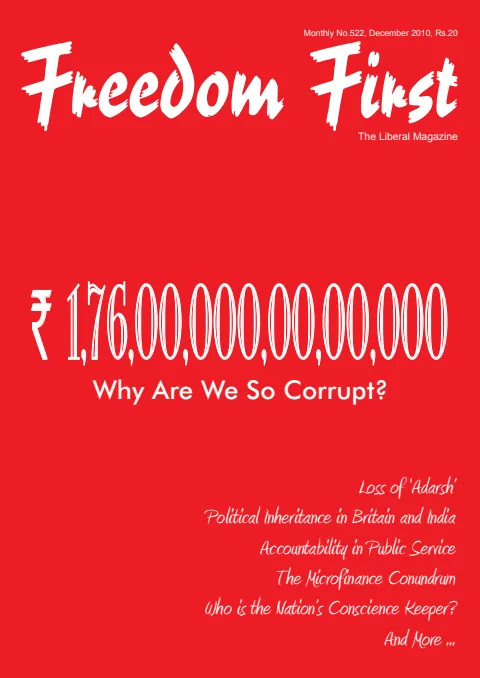
periodical issue
Freedom First
The Liberal Magazine
By N. Vittal
Publishers: Indian Committee for Cultural Freedom (ICCF), 3rd Floor, Army & Navy Building, 148, Mahatma Gandhi Road, Mumbai 400 001. Published by J. R. Patel for the Indian Committee for Cultural Freedom (ICCF) and printed by him at Union Press, 13 Homji Street, Fort, Mumbai 400 001. · Mumbai · 2010
40 pages
Freedom First
Summary
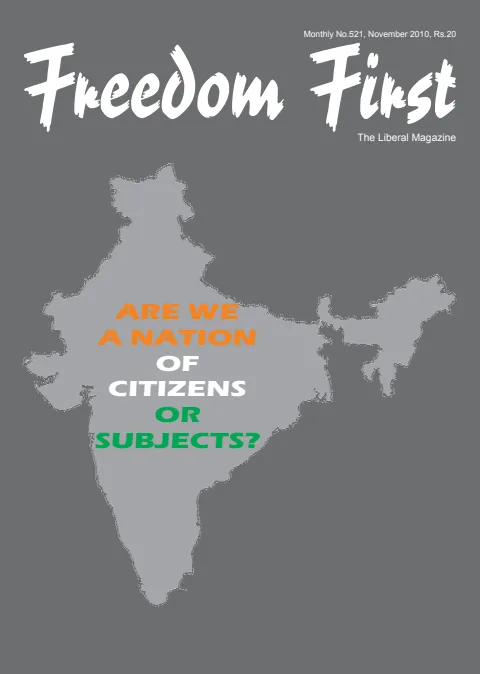
The rendered pages show the November 2010 issue of Freedom First, framed by the cover question, “Are we a nation of citizens or subjects?” The issue opens with an editorial note on Bihar elections, Kashmir, and public debate, then moves into a cover feature on democracy, governance, accountability, civil liberties, public service, media conduct, and agriculture policy. Across the rendered pages, the argumentative center is that formal democracy is not enough unless citizens, officials, politicians, courts, police, and markets are held to standards of responsibility and freedom.
Key points
-
Firoze Hirjikaka’s cover essay “Vandalizing India’s Democracy” argues Indians have let elected representatives behave like rulers rather than servants, tracing municipal corruption and Commonwealth Games mismanagement to citizen apathy and electoral disengagement, and calls for mass political communication rather than elite commentary alone.
-
Ashok Karnik’s “Crisis of Governance” portrays the UPA-II government as trapped in indecision through Groups of Ministers and prime-ministerial hesitation, surveying inflation, Naxalism, Kashmir, China, and the Commonwealth Games as symptoms of an absence of authority and accountability.
-
Furdoon S. B. Mehta, drawing on Maja Daruwala’s police-reform work, argues public order cannot be separated from rights, transparency, and accountable policing, criticising states and the Centre for evading Supreme Court directions on police reform.
-
N. Vittal begins a three-part serial on “Accountability in Public Service,” proposing the equation output equals input times accountability and contrasting citizens in democratic states with subjects in totalitarian regimes.
-
Sanjeev Sabhlok’s “India Needs a Non-Interfering Agriculture Policy” argues food security depends on property rights and open markets, attacking the Essential Commodities Act, procurement, and PDS corruption while calling for people support rather than price support.
-
Ashok Karnik’s “Point Counter Point” criticises Salman Khan for minimising responsibility for 26/11, treats the Jama Masjid attack as evidence terrorism had returned to Delhi, and describes the Ayodhya verdict as legally imperfect but politically useful for settlement.
-
The editor’s note frames the Bihar Assembly election as a possible test of whether Indians behave as assertive citizens or subservient subjects, continuing the magazine’s Kashmir coverage and inviting reader responses.
Essays
Between Ourselves
The editor’s “Between Ourselves” connects the Bihar Assembly election to the issue’s wider concern with whether Indians behave as citizens or subjects. The note hopes that Bihar might show a shift from caste- and religion-based mobilization toward a more assertive electorate, while also flagging the issue’s continuation of discussion on Kashmir and inviting reader responses on Kashmir and Rohinton Mistry’s Such a Long Journey.
- Bihar’s 2010 election is presented as a possible test of democratic change.
- The editor contrasts a subservient electorate with an assertive electorate.
- The issue includes a second-part report on Kashmir and asks whether a plebiscite should cover the whole former princely state.
- Readers are invited to comment on Kashmir and on the Rohinton Mistry controversy.
From Our Readers
“From Our Readers” contains letters on culturally specific mother-in-law jokes, income-tax e-filing problems, and possible interlocutors for Kashmir. The letters move from social observation to administrative grievance: one asks whether British jokes about wives’ mothers translate into Indian family structures, another argues that taxpayers should not be penalized when tax deductors or banks fail to reflect payments in Form 26AS, and a third suggests public figures for Kashmir dialogue.
- Christie Davies asks readers to compare British and Indian mother-in-law jokes.
- V. V. Vijayan criticizes the tax department for denying credit when documentary evidence of payment exists.
- Zafar Futehally proposes B. G. Verghese, A. G. Noorani, and Kuldip Nayar as Kashmir interlocutors.
- The page reflects the magazine’s reader-driven mix of cultural, administrative, and political concerns.
Are We A Nation of Citizens or Subjects? Vandalizing India’s Democracy
By Firoze Hirjikaka
Firoze Hirjikaka’s “Vandalizing India’s Democracy” argues that Indians have allowed elected representatives and officials to behave like rulers rather than servants. He moves from examples of municipal corruption, Commonwealth Games mismanagement, and builder-politician collusion to a broader charge that elite complaint, media exposure, and panel discussion do not matter unless citizens vote, organize, and communicate with the poorer electorate that politicians actually court.
- India is described as a functioning but deeply flawed democracy.
- The article argues that corruption persists because citizens enable it through apathy, bribery, and electoral disengagement.
- Hirjikaka criticizes the intelligentsia for speaking to itself rather than to voters with political power.
- The conclusion is that mass political communication, not elite commentary alone, is needed to check corrupt leaders.
Crisis of Governance
By Ashok Karnik
Ashok Karnik’s “Crisis of Governance” portrays the UPA-II government as trapped in consultations, Groups of Ministers, divided responsibility, and prime-ministerial hesitation. The article surveys inflation, Naxalism, Pakistan, Kashmir, China, the Commonwealth Games, corruption, judicial delay, and administrative malfunction as symptoms of a deeper absence of authority and accountability.
- The essay argues that consensus governance has turned into indecision.
- Karnik criticizes the proliferation of Groups of Ministers as a way to diffuse responsibility.
- Internal security, foreign policy, Kashmir, China, and the Commonwealth Games are treated as examples of weak governance.
- The essay ends by asking whether the government will wake up before losing credibility.
A Lot to be Worried About
By Furdoon S. B. Mehta
Furdoon S. B. Mehta’s “A Lot to be Worried About” excerpts arguments on policing, justice, RTI, and civil liberties. Drawing heavily on Maja Daruwala’s reform work, it argues that public order and security cannot be separated from rights, transparency, and accountable police institutions; attempts to treat human rights as obstacles to security are rejected as dangerous and self-defeating.
- The essay argues for police reform that separates operational policing from political interference.
- It criticizes states and the Centre for evading Supreme Court directions on police reform.
- The RTI Act is praised for moving power from closed administration toward citizens.
- Civil liberties are defended as instruments for securing food, work, water, education, and clean environments.
Accountability in Public Service
By N. Vittal
N. Vittal’s “Accountability in Public Service” begins a three-part serial by defining accountability as the soul of public service. The rendered part develops a simple equation in which output depends on input and accountability, then explains public service through citizens’ satisfaction, democratic dignity, organizational software and hardware, and the need to fix responsibility on individual human beings rather than abstract institutions.
- Public service is defined broadly as both service delivery and governance.
- Vittal proposes the equation I x A = O, linking inputs and accountability to output.
- The essay contrasts citizens in democratic states with subjects in totalitarian regimes.
- It begins an explanation of accountability erosion through Parkinson’s Law and bureaucracy’s tendency to expand.
Ram Narayanan Draws Your Attention to:
By Ram Narayanan
Ram Narayanan’s column points readers to items on India’s Iran dilemma, a University of Iowa winter study program in India, and expectations around President Obama’s forthcoming visit. The column emphasizes how India’s strategic choices are shaped by U.S. policy, Iran sanctions, China, defense agreements, nuclear liability, and Afghanistan.
- A Wall Street Journal article by Harsh V. Pant is cited on India’s dilemma over Iran sanctions.
- The INDIA Winterim program is described as a short study program across several Indian states.
- T. P. Srinivasan’s Wall Street Journal piece is cited for skepticism about the Obama visit.
- The column frames U.S.-India ties through defense, nuclear policy, China, and Afghanistan.
Point Counter Point
By Ashok Karnik
Ashok Karnik’s “Point Counter Point” offers paired comments on current controversies: the Commonwealth Games and a hoax Australian television report, Salman Khan’s remarks about 26/11, the Jama Masjid attack and Indian Mujahideen, and the Ayodhya verdict. The column is sharply polemical, defending factual accountability in media, mocking celebrity commentary on security, warning that terrorism remains a continuing risk, and treating the Ayodhya verdict as a pragmatic chance for settlement.
- The column contrasts international criticism of Commonwealth Games preparations with a later exposure of an Australian TV hoax.
- Karnik criticizes Salman Khan and his defenders for minimizing or confusing responsibility for 26/11.
- The Jama Masjid attack is treated as evidence that terrorism had returned to Delhi after the Pune attack.
- The Ayodhya verdict is described as legally imperfect but politically useful for settlement.
Come on Liberals: Let’s Change India! India Needs a Non-Interfering Agriculture Policy
By Sanjeev Sabhlok
Sanjeev Sabhlok’s “India Needs a Non-Interfering Agriculture Policy” argues that food security depends on freedom, property rights, open markets, private initiative, and poverty elimination rather than state control. He attacks the Essential Commodities Act, subsidies, procurement, PDS corruption, land ceilings, zoning, restrictions on crop insurance and futures, religious interference, and suspicion of biotechnology, then calls for people support rather than price support and invites readers to join the Freedom Team of India.
- The essay argues that government should secure property rights, justice, infrastructure, reserves, research, and worker reskilling, then let markets operate.
- Sabhlok treats the Essential Commodities Act, subsidies, procurement, and PDS as market-distorting controls.
- He calls for absolute property rights subject only to demonstrated public purpose.
- The reform package includes abolishing agricultural trade barriers, land ceilings, zoning restrictions, and religiously motivated agricultural regulation.
- The conclusion links agricultural productivity to freedom and urges political participation through the Freedom Team of India.
Generated by the v1.5 extraction pipeline. Awaiting editorial review.
Metadata and summary are AI-extracted from the source PDF and reviewed for editorial accuracy. The original work is available via the Read PDF tab above (where present); paragraph-level citation inside the PDF is deferred to a future engagement.