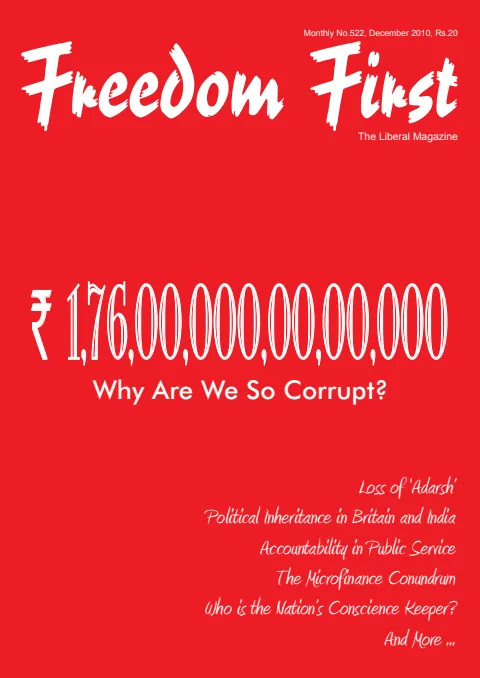
periodical issue
Freedom First
The Liberal Magazine
By Sharad Bailur, N. Vittal, Sunil S. Bhandare
Publishers: Indian Committee for Cultural Freedom (ICCF), 3rd Floor, Army & Navy Building, 148, Mahatma Gandhi Road, Mumbai 400 001. · Mumbai · 2011
44 pages
Freedom First
Summary
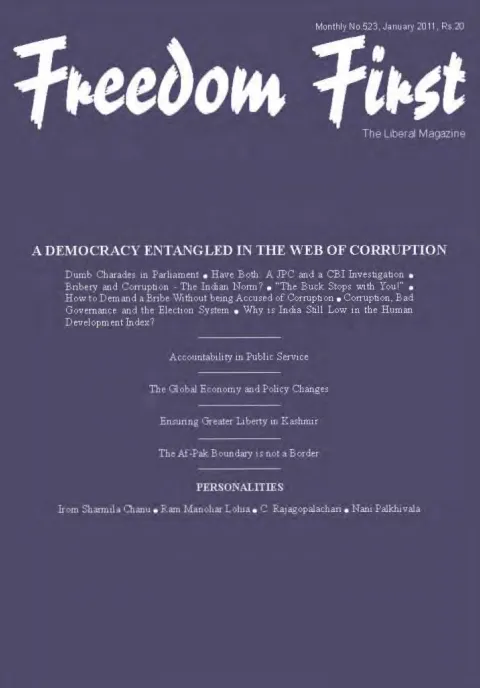
The rendered pages show the January 2011 issue of Freedom First, Monthly No. 523, framed by the editor as a response to a depressing political season of corruption scandals, parliamentary paralysis, and anxieties about democratic accountability. The issue’s opening pages combine reader letters, a corruption-focused cover feature, and early regular columns. Its argumentative center in these pages is that Indian corruption is not merely a set of isolated scandals but a product of incentives: discretionary power, coalition bargaining, opaque elections, weak public-service accountability, and a public culture too resigned to bribery.
Key points
-
The editor’s New Year note frames the issue around the 2G spectrum scandal and parliamentary paralysis, previewing essays on liberal personalities including Ram Manohar Lohia, C. Rajagopalachari, and Nani Palkhivala.
-
Firoze Hirjikaka’s “Dumb Charades In Parliament” argues Congress and BJP theatrics over a Joint Parliamentary Committee are a staged distraction, since genuine anti-corruption reform would require limiting the ministerial and bureaucratic discretion both parties benefit from.
-
Sharad Bailur argues the opposition’s demand for a JPC into the 2G scandal is inadequate unless paired with a Supreme Court-supervised CBI investigation, criticising coalition politics for giving small regional parties disproportionate leverage.
-
A. D. Gorwala’s reprinted essay asks whether bribery has become so normalised in India that it is treated as ordinary social behaviour, arguing corruption grew after Independence as older standards of public service collapsed.
-
Nagesh Kini and M. B. Damania both examine everyday corruption, with Kini calling for civic self-scrutiny against complicity in forged certificates and voter apathy, and Damania describing how officials extract bribes through procedural delay and implied threats without ever naming a sum.
-
Subhash Athale argues India’s first-past-the-post electoral system fosters corruption by making elections prohibitively expensive, proposing proportional and preferential voting along with campaign-finance reform and abolition of high-value cash notes as remedies.
-
Sadanand B. Kumta reads India’s 2010 Human Development Index rank of 119 among 169 countries as evidence growth has not translated into comparable gains in health, education, and nutrition, comparing India unfavourably with China, Sri Lanka, and Bangladesh.
-
Ashok Karnik’s “Point Counter Point” judges President Obama’s India visit a diplomatic success despite criticism over Pakistan and outsourcing, and treats the Adarsh scandal as elite manipulation of land rules while warning that anti-corruption zeal must preserve due process.
-
N. Vittal concludes his three-part “Accountability in Public Service” series by summarising New Public Management proposals such as fixed-term chief executives and professionalised agencies, expressing optimism about Indian democracy’s self-correcting mechanisms.
Essays
Between Ourselves
By Editor
The editor’s opening note, “Between Ourselves…”, introduces the issue as a New Year number overshadowed by corruption scandals and democratic dysfunction. It names recent controversies, including the 2G spectrum affair and parliamentary disruption, and says the issue will focus on what the editor calls the paralysis of parliamentary democracy while also balancing the issue with essays on liberal personalities.
- Frames the issue around corruption, parliamentary paralysis, and the question of accountability.
- Contrasts the negative public mood with planned essays on Shamila Chanu, Ram Manohar Lohia, C. Rajagopalachari, and Nani Palkhivala.
- Invites reader participation through the magazine’s “From our Readers” column.
From Our Readers
“From Our Readers” presents letters responding to earlier Freedom First pieces and current controversies. Readers discuss the magazine’s role, prime-ministerial integrity, the Radia tapes, the Kashmir conundrum, and a proposal to turn the Adarsh housing scam into a public prison site. The section reflects the same mixture of liberal institutional concern and impatience with impunity that dominates the issue’s cover feature.
- Several letters argue that corruption cannot be solved by personal rectitude alone and needs institutional reform.
- The Radia tapes letter stresses the role of media scrutiny while warning against selective television narratives.
- The Kashmir letter criticizes both secessionist politics and inconsistent secular responses to violence.
- The Adarsh letter proposes a symbolic public punishment for corrupt enrichment.
Dumb Charades In Parliament
By Firoze Hirjikaka
Firoze Hirjikaka’s “Dumb Charades In Parliament” argues that Congress and BJP theatrics over a Joint Parliamentary Committee are a staged distraction from the political class’s shared interest in preserving discretionary power. The piece contends that practical anti-corruption reform would require limiting ministerial and bureaucratic discretion, making it politically unattractive to all major parties.
- Treats parliamentary disruption as performative politics rather than genuine anti-corruption action.
- Argues that parties benefit from the same discretion that enables corruption.
- Criticizes the JPC fight as a way to delay action until public anger fades.
Have Both : A JPC and a CBI Investigation
By Sharad Bailur
Sharad Bailur’s “Have Both: A JPC and a CBI Investigation” begins by arguing that the opposition’s demand for a JPC into the 2G scandal is politically inadequate unless paired with a CBI inquiry under Supreme Court supervision. The visible page frames coalition politics as a structural weakness that gives small regional parties disproportionate leverage over national governments.
- Argues that a JPC alone would be unable to investigate criminality or assign punishment.
- Criticizes coalition politics for empowering small parties beyond their electoral scale.
- Presents the 2G controversy as a case where truth-finding and prosecution need separate institutional routes.
Bribery And Corruption – The Indian Norm?
By A. D. Gorwala
A. D. Gorwala’s reprinted “Bribery And Corruption - The Indian Norm?” asks whether bribery has become so common in India that it is now treated as normal social behavior. In the visible pages, Gorwala moves from everyday payments to political influence, police extortion, and the erosion of older standards of public life, arguing that corruption persists because public moral resistance has weakened.
- Frames bribery as a normalized habit cutting across public administration, business, professions, and politics.
- Argues that corruption grew after Independence as old standards of public service collapsed.
- Contrasts legalistic or worldly excuses for corruption with the need to revive public moral sense.
- The article is incomplete in the rendered pages and continues later in the issue.
“The Buck Stops with You!”
By Nagesh Kini
Nagesh Kini’s “The Buck Stops with You!” turns a psychiatrist’s public warning about corruption into a broader call for professional and civic self-scrutiny. The article catalogs scandals and everyday forms of complicity, from forged certificates and medical kickbacks to voter apathy, arguing that corruption persists because citizens repeatedly excuse it as someone else’s problem.
- Uses the language of psychiatric and moral diagnosis to discuss corruption as a social epidemic.
- Links elite scams with everyday compliance in paperwork, elections, business, and professional life.
- Calls for direct civic action rather than only online outrage or symbolic complaint.
- Treats the citizen, not only the politician, as responsible for changing the culture of corruption.
How to Demand a Bribe Without being Accused of Corruption
By M. B. Damania
M. B. Damania’s “How to Demand a Bribe Without being Accused of Corruption” uses anecdote to show how officials can extract money without naming an amount. The visible page describes inspectors and tax officers stretching procedures, querying minutiae, and weaponizing paperwork until the target infers the expected payment.
- Shows how bribery can be communicated through delay, procedural harassment, and implied threats.
- Contrasts the legal definition of corruption with practices that avoid explicit demands.
- Uses sales-tax and labour-inspection examples to show how honest businesses are pressured.
Corruption, Bad Governance and Election System
By Subhash Athale
Subhash Athale’s “Corruption, Bad Governance and Election System” argues that India’s first-past-the-post electoral system fosters corruption by making elections prohibitively expensive and rewarding candidates who can mobilize money, identity blocs, and fragmented vote shares. Athale proposes a party-list proportional and preferential voting system, combined with changes to campaign finance and high-value cash transactions, as a remedy.
- Attributes corruption partly to election costs and the need to recover campaign spending after victory.
- Criticizes first-past-the-post for wasted votes, weak candidate selection, coalition instability, and identity fragmentation.
- Cites Ambedkar’s Republican Party example to illustrate distorted representation under the existing system.
- Calls for proportional and preferential voting, bank-based transactions, abolition of high-value notes, and universal identity numbers.
Why is India Still Low in Human Development Index (HDI)
By Sadanand B. Kumta
Sadanand B. Kumta’s “Why is India Still Low in Human Development Index (HDI)” reads India’s 2010 HDI ranking as evidence that growth has not translated into comparable gains in health, education, sanitation, or nutrition. The article compares India unfavourably with neighbours and poorer countries on indicators such as child mortality, adolescent fertility, and multidimensional poverty, and ends by urging citizens to demand better social services.
- Notes India’s 2010 HDI rank of 119 among 169 countries despite faster growth than many peers.
- Highlights the report’s attention to multidimensional poverty, gender inequality, and inequality-adjusted HDI.
- Compares India unfavourably with China, Sri Lanka, Nepal, Bangladesh, and Pakistan on several human-development indicators.
- Argues that health, sanitation, education, and empowerment have been neglected relative to economic growth.
Point Counter Point
By Ashok Karnik
Ashok Karnik’s “Point Counter Point” examines President Barack Obama’s India visit, the Adarsh housing scam, a broader “Scam Republic,” and the Radia tapes. Karnik tends to weigh competing interpretations: he judges Obama’s visit a success despite critics, treats Adarsh as both a land-allotment and corruption story, and argues that investigations must punish the guilty without abandoning fairness or due process.
- Assesses Obama’s visit as diplomatically successful despite criticism over Pakistan, the UNSC, and outsourcing.
- Treats the Adarsh scandal as a case of elite manipulation of land rules for private gain.
- Warns that anti-corruption zeal must distinguish punishment from mere removal from office.
- Reads the Radia tapes as evidence of influence-peddling in Delhi while warning against selective outrage.
Accountability in Public Service
By N. Vittal
N. Vittal’s “Accountability in Public Service” is introduced as the concluding part of a three-part series. In the visible pages, Vittal summarizes New Public Management proposals, including elected fixed-term chief executives, professionalized executive agencies, competition in services, and electoral reforms requiring majority support. He closes this visible section by saying his optimism rests on democratic self-correction through media, courts, constitutional amendment, and public pressure.
- Connects accountability reform with New Public Management and agency-based delivery models.
- Discusses Professor Pradip Khandwalla’s proposals for fixed-term executives, professional agencies, and electoral reform.
- Uses telecom competition as an example of how public services can improve when monopoly is broken.
- Argues that Indian democracy has self-correcting mechanisms through media, law, elections, and constitutional safeguards.
Generated by the v1.5 extraction pipeline. Awaiting editorial review.
Metadata and summary are AI-extracted from the source PDF and reviewed for editorial accuracy. The original work is available via the Read PDF tab above (where present); paragraph-level citation inside the PDF is deferred to a future engagement.