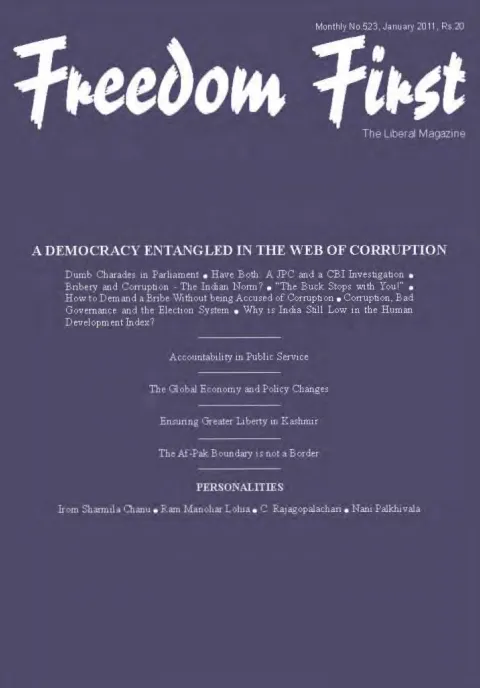
periodical issue
Freedom First
The Liberal Magazine
By Sharad Joshi
Publishers: Indian Committee for Cultural Freedom (ICCF), 3rd Floor, Army & Navy Building, 148, Mahatma Gandhi Road, Mumbai 400 001. · Mumbai · 2011
44 pages
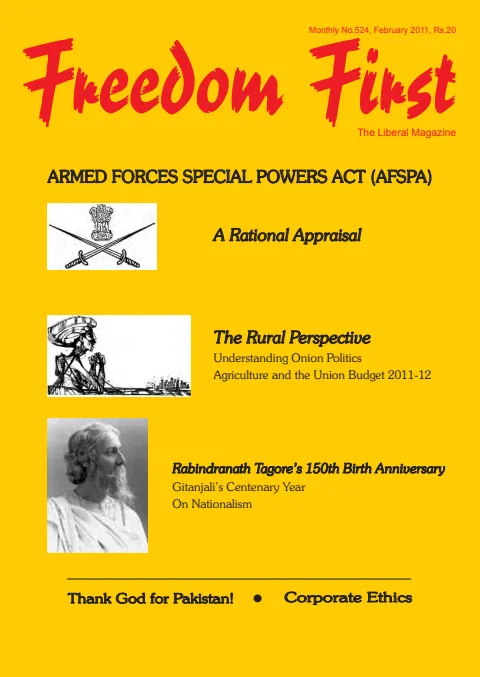
Freedom First
Summary
The rendered pages show the February 2011 issue of Freedom First, a liberal monthly, opening with an editorial note that explains the issue’s unusual sequencing: shorter pieces appear before the cover feature on the Armed Forces Special Powers Act so readers can later weigh that controversy for themselves. The visible issue is organized around public ethics, liberal governance, corruption, civic activism, rural policy, agriculture, and India’s relations with Pakistan and China.
Key points
-
The editor’s “Between Ourselves” explains why the Armed Forces Special Powers Act cover feature is placed later in the issue so readers weigh the civil-liberties question themselves, and introduces Tagore-anniversary material and memorial pieces on M. S. Gore, Shyam Chainani and Kancherla Rama Rao.
-
Reader letters press Freedom First to focus on corruption, police reform and CBI independence, with one correspondent invoking Tunisia’s mass protests and another warning that proposed Direct Tax Code procedures will multiply harassment and corruption at tax offices.
-
Firoze Hirjikaka’s “Thank God for Pakistan!” contrasts India’s corruption and bureaucratic failure with Pakistan’s deeper crisis of religious radicalisation after the murder of Governor Salman Taseer, arguing India’s free press and plural public sphere remain valuable despite its flaws.
-
Ashok Karnik’s “Corporate Ethics” examines the Niira Radia tapes as a study in lobbying and media influence, accepting legitimate policy advocacy as part of democracy while calling for legislation to regulate lobbying and questioning whether enforcement agencies acted coherently.
-
Cyrus Guzder’s tribute “Shyam Chainani - Unflinching Warrior for the Environment” reviews Chainani’s book Heritage and the Environment, presenting him as an incorruptible, persistent campaigner on Bombay planning, coastal regulation and heritage law.
-
J. S. Apte’s biographical tribute to M. S. Gore traces his career at the Tata Institute of Social Sciences and stresses his moderation and independence during the Emergency, including his refusal to sign a statement attacking Jayaprakash Narayan.
-
Sharad Joshi’s “The Rural Perspective: Understanding Onion Politics” argues that export bans and panic responses to onion price rises harm farmers, contrasting the 1980 episode with 2010-11 and opposing blanket bans as damaging to long-term export credibility.
-
In his pre-budget note to the Finance Minister, Joshi cites NCRB data on 17,368 farmer suicides in 2009 and criticises the Debt Relief and Loan Waivers Scheme, weak seed and biofuel policy, and prejudice against futures markets, defending futures as a legitimate marketing channel.
-
Ashok Karnik’s Point Counter Point weighs Wen Jiabao’s India visit, Rahul Gandhi’s leaked remark on Hindu terrorism, and the demand for a Joint Parliamentary Committee on corruption, arguing a JPC may achieve little unless the wider culture of impunity changes.
Essays
Between Ourselves
By Editor
The editor’s note frames the issue as an attempt to balance readable shorter articles with later, more demanding arguments about AFSPA. It also marks Rabindranath Tagore’s 150th birth anniversary and the centenary of Gitanjali, introduces memorial pieces on M. S. Gore, Shyam Chainani, and Kancherla Rama Rao, and asks whether liberal journalism needs a new paradigm after decades of political economy shaped by the Indian republic.
- Explains why the AFSPA cover feature is placed later in the issue.
- Presents AFSPA as a civil-liberties and human-rights question in a context of insurgency and terror.
- Introduces Tagore anniversary material and memorial essays on public-minded liberals and social reformers.
- Connects readership fatigue with corruption coverage to the magazine’s liberal critique of public life.
From Our Readers
The reader letters press Freedom First to take up more contemporary campaigns: corruption, police reform, CBI independence, misuse of AFSPA and secrecy laws, parliamentary obstruction, linguistic discrimination, and administrative accountability. Other letters criticize concessionary land allotments as legalized corruption, urge citizens to organize rather than merely complain, warn that tax compliance rules will multiply harassment, and argue that bank accounts and rural infrastructure can materially empower poor citizens.
- Readers ask the magazine to focus on current corruption, human-rights, and governance failures.
- One correspondent calls for action inspired by Tunisia’s mass protests against a corrupt ruler.
- A tax letter argues that proposed Direct Tax Code procedures will increase visits to tax offices and therefore corruption.
- A banking letter links financial inclusion, Aadhaar-style identity, and rural amenities to empowerment of the poor.
Thank God for Pakistan!
By Firoze Hirjikaka
Firoze Hirjikaka’s article opens by contrasting India’s corruption and bureaucratic failures with Pakistan’s deeper crisis of religious radicalization after the murder of Punjab governor Salman Taseer. The visible portion argues that India’s failings should not obscure the value of its free press, plural public sphere, and relatively restrained democratic life, while warning that Pakistan’s transformation is historically jarring because the two peoples long shared a civilizational and social background.
- Uses Pakistan’s blasphemy-law politics and Salman Taseer’s killing as a foil for India’s democratic weaknesses.
- Argues that India muddles through despite corruption, delayed projects, and poor governance.
- Treats Pakistan’s radicalization as recent, historically startling, and socially tragic.
- The rendered page ends mid-article, with continuation deferred to page 30.
Corporate Ethics
By Ashok Karnik
Ashok Karnik’s essay examines the Niira Radia tapes as a case study in lobbying, corporate influence, media susceptibility, privacy, and public interest. It accepts that lobbying and policy advocacy can be legitimate in a democracy, but argues that manipulation of ministerial appointments, policy outcomes, and journalistic access requires clear legal boundaries, corporate accountability, and careful handling of intercepted private communications.
- Distinguishes legitimate policy advocacy from manipulation of ministers, bureaucrats, and journalists.
- Questions whether intelligence, tax, and enforcement agencies acted coherently in the Radia case.
- Calls for legislation regulating lobbying while warning government not to become a brokerage house.
- Balances Ratan Tata’s privacy claim against the public interest in exposing policy manipulation.
Shyam Chainani - Unflinching Warrior for the Environment
By Cyrus Guzder
Cyrus Guzder’s tribute-review presents Shyam Chainani as a relentless environmental and heritage activist whose diary records campaigns over Bombay’s development plans, coastal regulation, heritage conservation, hill stations, dockyards, open spaces, industrial siting, and public planning law. The essay values Chainani’s methods as much as his victories: persistence, mastery of regulations, moral courage, and a willingness to confront politicians, officials, developers, and public-sector bodies.
- Reviews Chainani’s Heritage and the Environment as a record of long civic campaigns.
- Highlights battles over Bombay planning, RCF relocation, heritage regulations, coastal zones, and public assets.
- Presents Chainani as incorruptible, persistent, and able to translate environmental concerns into legislative language.
- Frames environmental protection as necessary to prevent powerful groups from enclosing the commons.
Kancherla Rama Rao
The editor’s obituary for Kancherla Rama Rao remembers him as a Vijayawada engineer, entrepreneur, liberal citizen, and supporter of education and public causes. It emphasizes his contribution to power generation, employment, school construction, student aid, old-age welfare, Telugu translation of liberal publications, and the Indian Liberal Group.
- Records Rama Rao’s engineering career and power-sector enterprise.
- Emphasizes education, philanthropy, and employment as civic contributions.
- Connects him to the Indian Liberal Group and Freedom First.
- Presents translation into Telugu as part of spreading liberal ideas to decision-makers.
Dr. M. S. Gore - Eminent Social Scientist
By J. S. Apte
J. S. Apte’s article is a biographical tribute to M. S. Gore, tracing his family background, liberal home atmosphere, education, career at the Tata Institute of Social Sciences, public committee work, intellectual output, and later reflections on religion and rationality. It stresses Gore’s moderation, independence during the Emergency, refusal to sign a statement attacking Jayaprakash Narayan, and long contribution to social work and sociology.
- Places Gore within TISS history and Indian social-work education.
- Connects his family background to liberal, tolerant values.
- Describes his reluctance to support Emergency-era political pressure.
- Catalogs his writings, public roles, awards, and late-life reflections.
The Rural Perspective: Understanding Onion Politics
By Sharad Joshi
Sharad Joshi’s onion article argues that export bans and panic responses to price rises damage farmers while doing little to solve supply problems. He contrasts the 1980 onion episode with the 2010-11 situation, emphasizing sharply increased cultivation costs, crop losses from unseasonal rains, the risks of importing from Pakistan, and the long-term harm of undermining Indian traders’ credibility in export markets.
- Explains why onion prices are politically sensitive in India.
- Contrasts varieties, storage characteristics, and regional production in Nashik and Pune.
- Argues that farmer costs rose dramatically between 1980 and 2010-11.
- Opposes blanket export bans as harmful to farmers and long-term market credibility.
Pre-Budget (2011-12) Discussion for the Agricultural Sector
By Sharad Joshi
Joshi’s pre-budget note to the Union Finance Minister lists agricultural policy reforms intended to relieve indebtedness and restore farmer autonomy. It criticizes the Debt Relief and Loan Waivers Scheme, electricity-dues enforcement, ad hoc climate relief, weak biofuel policy, seed and fertilizer supply failures, new land-ceiling reductions, knee-jerk trade bans, edible-oil import dependence, and prejudice against futures markets.
- Cites NCRB data on 17,368 farmer suicides in 2009.
- Argues that debt relief failed to address rural indebtedness, especially among larger surplus-producing farmers.
- Calls for policy that lets farmers manage climate risk, adopt technology, and avoid punitive electricity measures.
- Defends futures markets as a default agricultural marketing channel and criticizes export/import controls.
Point Counter Point
By Ashok Karnik
Ashok Karnik’s Point Counter Point offers paired arguments on Wen Jiabao’s India visit, Rahul Gandhi’s leaked remark on Hindu terrorism, and the demand for a Joint Parliamentary Committee on corruption. The piece presents both conciliatory and skeptical readings of the Wen visit, argues that Rahul Gandhi and Congress leaders should not politicize national security by equating RSS-linked fringe violence with LeT terrorism, and suggests that a JPC may expose little unless the wider culture of impunity changes.
- Contrasts trade-diplomacy optimism with skepticism about unresolved China issues such as stapled visas, Kashmir, Pakistan, and terrorism.
- Treats Rahul Gandhi’s Wikileaks-reported comment as politically damaging and strategically unwise.
- Argues that investigative agencies should establish facts before organizations are blamed for terrorism.
- Sees a JPC as an imperfect response to corruption because deeper political permissiveness is the problem.
Generated by the v1.5 extraction pipeline. Awaiting editorial review.
Metadata and summary are AI-extracted from the source PDF and reviewed for editorial accuracy. The original work is available via the Read PDF tab above (where present); paragraph-level citation inside the PDF is deferred to a future engagement.