
periodical issue
Freedom First
The Liberal Magazine
Published by J. R. Patel for the Indian Committee for Cultural Freedom (ICCF) and printed by him at Union Press, 13 Homji Street, Fort, Mumbai 400001. · Mumbai · 2013
40 pages
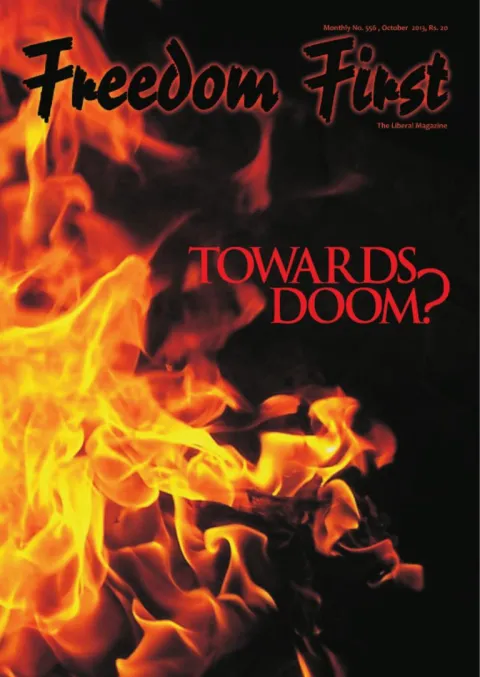
Freedom First
Summary
The October 2013 issue sets its editorial in the magazine’s own lineage. Nehru held that a free economy would take the country to its doom; Rajaji held that too much government would. Two years after the Narasimha Rao reforms, Masani warned in an open letter that they had come by compulsion rather than conviction and would stutter to a stop unless a movement arose to stop statism returning. The editor’s verdict is that they did, and that India is back at the bottom of the heap.
The issue carries the promised tributes to Dr. Narendra Dabholkar, murdered in Pune in August, from three of his fellow rationalists. H. R. Bapu Satyanarayana describes a nation in denial; Brig. S. C. Sharma reports the Shyam Saran findings on Chinese occupation in Depsang, Chumar and Pangong Tso; Nitin G. Raut defends Zubin Mehta’s Shalimar Bagh concert against the protests it drew. Sunil S. Bhandare weighs the exuberance that greeted Raghuram Rajan’s arrival at the Reserve Bank, Ranga Kota asks whether an NDA government would have done differently on subsidies, and B. Ramesh Babu finds the dialogue with Pakistan back at square one. A birth centenary tribute to Avabai Wadia, a review of D. S. Pendse on J. R. D. Tata, and a cluster of pieces on women’s safety close the issue.
Key points
-
The editorial recovers Minoo Masani’s 1993 open letter, written two years after the Narasimha Rao reforms, warning that a change made by compulsion rather than conviction would run out of steam unless a movement arose to keep statism out, and reads the present as the fulfilment of that warning. The Swatantra Party’s twenty-one principles and Rajaji’s 1959 statement “Towards Doom” are noted as available in the magazine’s own archive.
-
Three tributes mark the murder of Dr. Narendra Dabholkar, who led the Andhashraddha Nirmoolan Samiti. The obituary opens with Shaw’s line after Gandhi’s assassination about how dangerous it is to be too good, and records that the movement’s activists come from every class, caste and religion in Maharashtra, work voluntarily, and quarrel with no one’s freedom of worship.
-
Brig. S. C. Sharma reports Shyam Saran’s findings after his August visit to Ladakh: Chinese forces occupying some 640 square kilometres in Depsang, Chumar and Pangong Tso, Indian patrols stopped in the Depsang bulge on 15 April, a shelved border infrastructure plan, and ITBP posts still outside the Army’s operational control.
-
Sunil S. Bhandare examines the “Rajan effect” in the first half of September, when stock and currency markets turned on the change of guard at the Reserve Bank, and warns that a soothing touch should not be mistaken for a change in the fundamentals.
-
Ranga Kota turns the argument on the opposition: the government’s failure to cut subsidies is not in dispute, but whether an NDA government could have overridden its own coalition’s concerns is a question its rhetoric does not answer.
-
B. Ramesh Babu notes what is genuinely new in Pakistan, an elected government succeeding a civilian one that completed its term, and an election campaign without competitive India-baiting, and warns that a summit without preparation on both sides puts the clock back rather than forward.
-
Firoze Hirjikaka’s Cornucopia takes up the parties’ resistance to the Right to Information Act, including the attempt to amend the Constitution to avoid declaring their assets, and notes the irony that the Act was pushed through by the party now most discomfited by it.
-
Suresh C. Sharma’s sixteenth instalment on the Right to Education Act compares government and private schools, noting the finding that the state spends more per child and gets poorer results, and that it has quietly armed itself against the consequences of breaking its own rules.
Essays
A Nation in Denial: A Political Theatre of the Absurd
By H. R. Bapu Satyanarayana
Satyanarayana reads UPA II as an Utter Paralysis of Action: a government that holds office by alliance with allies facing charges of their own, a daily supply of scandal and dismal economic news, and a Supreme Court left helpless for want of proof. The one hopeful sign he allows is the Court’s personal monitoring of the case of the missing coal files, which might yet reach persons however highly placed.
- Describes a quid pro quo government confident it can survive any parliamentary threat.
- Finds no redeeming feature in the economic news accompanying the scandals.
- Places its hope in judicial supervision rather than in political correction.
China’s Intrusion in Ladakh
By Brig. S. C. Sharma
Sharma works from press extracts of the report Shyam Saran, chairman of the National Security Advisory Board, submitted to the Prime Minister’s Office on 10 August after a week in Ladakh. He is as severe on the Indian response as on the intrusion: a Foreign Minister who had not found time to read the report a month later, a fifteen-year border infrastructure plan framed under Indira Gandhi and shelved, forward ITBP posts outside Army control, and two new divisions promised for a decade.
- Reports occupation of about 640 square kilometres across three sectors.
- Notes that Indian patrols were stopped in the Depsang bulge on 15 April.
- Argues that claims can be pressed only from a position of strength, and that the forces lack critical weapons and officers.
Three Cheers for Zubin Mehta
By Nitin G. Raut
Raut defends the Ehsaas-e-Kashmir concert at Shalimar Bagh against those who staged a rival Haqeeqat-e-Kashmir event with the Hurriyat. Music, he argues, has never prevented a war, but opposition to music has never secured a peace either; the rival concert could have complemented rather than contradicted the first.
- Places music in every society, from a Chhattisgarh forest to a Western symphony orchestra.
- Notes the ceremonial place of music in the armed forces themselves.
- Argues that Beethoven and Tchaikovsky in the Shalimar Bagh carried peace further than the protest did.
The Rajan Effect: A Flush of Exuberance!
By Sunil S. Bhandare
After a long stretch of gloom, several key parameters turned in the first half of September 2013, coinciding with the change of guard at the Reserve Bank. Bhandare’s caution is that a market’s relief is not a recovery: he separates what genuinely improved from what merely felt better, and warns that Dr. Rajan’s reassurance should not become complacency among market players.
- Dates the turn precisely and links it to sentiment rather than to fundamentals.
- Holds it premature to judge the new Governor’s effect.
- Sets the exuberance against the imbalances he has documented all year.
Rhetoric and Reality: If Elected to Power, Will the NDA be Any Better?
By Ranga Kota
The steep fall of the rupee since June and sub-five per cent growth in the first quarter have made the government and industry nervous, and the opposition happy. Kota grants that the government failed to cut subsidies decisively, and then asks the question the opposition avoids: how the principal opposition party would suddenly change its own stance on fuel subsidies in office, and whether its government could override its coalition.
- Separates the government’s record from the opposition’s promises.
- Treats subsidy reform as the test case for both.
- Argues that the rhetoric is untested against the arithmetic of coalition.
Talking to Pakistan: Back to Square One
By B. Ramesh Babu
Neighbours cannot be chosen, and the recurring dilemma of whether to talk returns with each new government in Islamabad. Ramesh Babu notes that dialogue or its absence has made little difference to peace, whether the army or a civilian government held power, but allows that this time may be different: a civilian transfer of power, unprecedented in Pakistan’s history, and a campaign without competitive India-baiting.
- Warns that a summit without advance preparation on both sides invites failure.
- Argues that the disillusionment following a failed summit sets relations back further than no summit at all.
- Reads Nawaz Sharif’s campaign conduct as a genuine, if fragile, opening.
Onam: Hope for Good Governance!
By P. Koshy
Koshy reads the festival as a memory of administration rather than of myth. The prosperity of Mahabali’s kingdom, in his telling, was the product of good governance: business conducted without bribes, planning directed at the difficulties of traders and farmers, no favouritism in policy, records so well kept that files never went missing, and a king who acted on the smallest failure.
- Turns a festival into a standard against which present government can be measured.
- Emphasises transparency and record-keeping as the substance of good governance.
- Sets the story’s expectations against the missing files of the present.
Birth Centenary Tribute: Avabai Wadia, Pioneer in Family Planning
By J. S. Apte
Born in Colombo in 1913, Avabai Mehta went to Cambridge on Annie Besant’s advice and became the first woman from Ceylon to pass the Bar examinations. Apte follows her into the All India Women’s Conference in 1944 and to the founding of the Family Planning Association of India in 1949, which she led as president for thirty-four years, holding throughout that family planning must be voluntary and informed if it was to free women from frequent childbearing.
- Sets her work in the tradition of Parsi philanthropy.
- Records her association with Annie Besant, Kamaladevi Chattopadhyay and Dhanwanthi Rama Rao.
- States her conviction that family planning was a means to health, gender equality and choice.
The Right to Education Act (16): Government and Private Schools
By Suresh C. Sharma
The sixteenth part of the series sets the state’s primary responsibility for education against its performance, citing the finding that government spends more per child than private schools and gets worse results, and the quieter fact that government has protected itself from the consequences of breaking the rules it wrote.
- Reaches back to the Bhore Committee for the origins of the obligation.
- Contrasts per-child spending with outcomes in the two systems.
- Argues that rules must bind the state that made them.
Elsewhere in the issue
- Point Counter Point, Ashok Karnik’s column of opposed positions on the month’s controversies.
- An excerpt from Gopalkrishna Gandhi in The Telegraph on what Rajaji and President S. Radhakrishnan each predicted India and Indians would become after independence.
- Suresh C. Sharma’s review of Beyond the Giant: J. R. D. Tata by D. S. Pendse.
- Three short pieces on the Uttarakhand disaster by R. K. Cheema, Rahul Sunilkumar and Fareen Quereshi.
- Four on the safety of women, by Dr. Jyoti Marwah, Dr. Rita Bhambi, Arish Mehta and Heena Sagir Ansari, the last on Mumbai’s low ranking for women’s security.
Generated by the v1.5 extraction pipeline. Awaiting editorial review.
Metadata and summary are AI-extracted from the source PDF and reviewed for editorial accuracy. The original work is available via the Read PDF tab above (where present); paragraph-level citation inside the PDF is deferred to a future engagement.