
periodical issue
Freedom First
The Liberal Magazine
By Sunil S. Bhandare, Minoo Masani
Published by J. R. Patel for the Indian Committee for Cultural Freedom and printed by him at Union Press, 13 Homji Street, Fort, Mumbai 400001. Typeset by Narendra Kotak, A-605/606, Mahavir Platinium, Next to Indian Oil Nagar, Govandi, Mumbai 400043. · Mumbai · 2014
40 pages
Freedom First
Summary
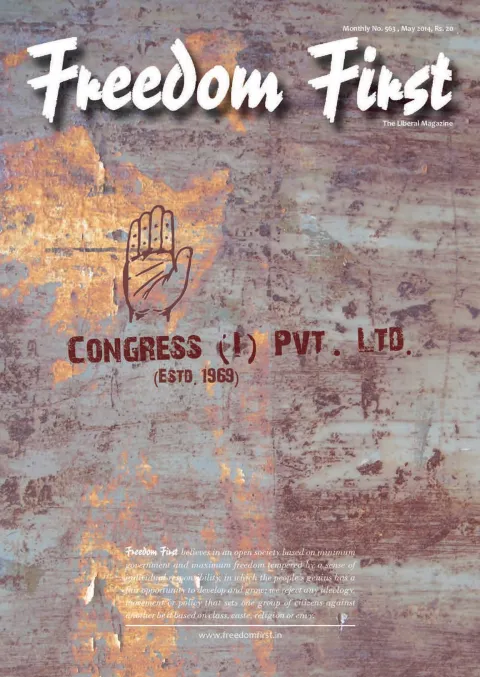
Freedom First No. 563 (May 2014), the 62nd-year issue of the Bombay-based liberal monthly, is dominated by the run-up to the 2014 Lok Sabha election. The cover (‘Congress (I) Pvt. Ltd. (Estd. 1969)’) and lead editorial frame the campaign as a personal contest between Narendra Modi and Sonia Gandhi rather than a party contest, and reprint a 1985 Minoo Masani column distinguishing the historic Indian National Congress from its post-1969 dynastic successor. Regular columnists Firoze Hirjikaka, Sunil S. Bhandare, T. H. Chowdary, Ashok Karnik and B. Ramesh Babu cover the BJP/Congress manifestos, communal and communist politics, and India’s strategic positioning against China; Suresh C. Sharma and Nitin G. Raut contribute on the India-China border, illegal immigration from Bangladesh, and naval unpreparedness following Admiral D. K. Joshi’s resignation. Rounding out the issue are an obituary for long-time contributor B. M. N. Murthy, a Nostalgia feature on the Alexandra Girls’ English Institution’s time capsule, reader letters, two book reviews, an ‘Educating Adults’ section on vocational education, CSR, and girls’ education, pieces on Tamil Eelam and Kashmiri Pandit displacement, and a reprinted profile of Narendra Modi’s leadership style.
Essays
The Alexandra Girls’ English Institution’s Time Capsule
An unsigned Nostalgia feature (with excerpts from a poem by school principal Freny Mehta) reports on the Alexandra Girls’ English Institution, Mumbai, burying a time capsule on 31 March 2014 to mark the end of its 150th-anniversary (sesquicentennial) celebrations, to be opened only at the school’s bicentenary in 2062. The piece is dedicated to founder Manockjee Cursetjee and notes the event passed unnoticed by the Mumbai press, unlike Freedom First’s tribute, which the editor links to the spirit of the magazine’s late founder Minoo Masani.
- Time capsule buried 31 March 2014 (Gudi Padva), to be opened at the school’s bicentenary on 1 September 2062.
- Marks the conclusion of the 150th birth anniversary celebrations of founder Manockjee Cursetjee.
- Capsule contains a record of the school’s history, objects, memorabilia, and letters from current students/staff to their 2062-63 counterparts.
- Event went unreported in the Mumbai press despite its significance.
- Freedom First frames its coverage as a tribute in the spirit of founder Minoo Masani.
B. M. N. Murthy, R.I.P.
An unsigned In Memoriam tribute to B. M. N. Murthy, a Freedom First contributor who died on 28 March 2014 aged 83. Murthy had written nearly 800 weekly articles for the magazine over 14 uninterrupted years (January 2000 to January 2014) before retiring due to age and health, and the tribute recalls his eclectic reading, his role as an informal mentor to an extended family circle, and a 2010 letter of his praising a booklet critical of the RSS’s narrow conception of Hindutva.
- Murthy wrote nearly 800 articles for Freedom First between January 2000 and January 2014.
- He announced his retirement from writing in a January 2014 letter, citing age (turning 84) and personal/health reasons.
- Described by family and press as an eclectic, self-made autodidact with wide-ranging interests (Vedanta, Kalidasa, Churchill, JFK, Ramana Maharishi).
- A 2010 letter from Murthy to Freedom First endorsed a critical analysis of the RSS and BJP by K. K. Pathak, urging the RSS to embrace ‘Vasudhaiva Kutumbakam.’
- Freedom First conveys condolences to his son Ravi Banavar and family.
From Our Readers
The reader-letters section carries responses on several April 2014 topics: a defence of Manmohan Singh’s record as a ‘political obituary,’ a rejoinder to an article on Muzaffarnagar riot victims that raises the treatment of displaced Kashmiri Hindus, several letters contrasting the Swatantra Party’s ideological seriousness with the Aam Aadmi Party’s perceived lack of one, and a personal anecdote about being refused an autograph by C. Rajagopalachari at a 1960s function for the blind.
- One letter calls Manmohan Singh ‘a leader who could not speak and did not speak’ but credits him with steering India through diversity without chaos.
- A letter on the Muzaffarnagar riots draws a parallel to the unaddressed plight of Kashmiri Hindu refugees.
- Several correspondents contrast the Swatantra Party’s clear economic and constitutional positions with AAP’s perceived lack of a coherent one.
- A personal anecdote recounts being denied C. Rajagopalachari’s autograph at a 1960s Robert Money High School event for the blind.
- One letter notes the absence of foreign-policy debate among Indian parties ahead of the World War I centenary.
Editorial: Congress (I) Private Ltd. / What Congress? Which Congress?
The unsigned editorial ‘Congress (I) Private Ltd.’ argues the 2014 campaign is really a personal contest between Narendra Modi and Sonia Gandhi rather than a BJP-versus-Congress or NDA-versus-UPA fight, tracing the Congress’s transformation from Gandhi and Nehru’s national movement into a dynastic vehicle after Indira Gandhi’s 1969 split, through Rajiv, Sonia and the presumptive Rahul succession, and criticising the party’s failure to counter Modi’s attacks. It appends a reprinted 1985 Freedom First column by founder Minoo Masani, ‘What Congress? Which Congress?’, which distinguishes the pre-independence Indian National Congress he served from the post-1969 Congress (I), quoting former Congress president Nijalingappa’s condemnation of Indira Gandhi for having ‘defamed, degraded and destroyed the original Congress.’
- Frames the 2014 election as a personal contest between Narendra Modi and Sonia Gandhi, not a party or alliance contest.
- Traces Congress dynastic control from Indira Gandhi’s 1969 split (“Congress (I) Private Limited”) through Rajiv, Sonia, and the readied Rahul Gandhi candidacy.
- Criticises the Congress for reacting defensively to BJP attacks instead of exposing BJP-side corruption or Modi’s inconsistencies.
- Calls for Congress (I) to ‘go into liquidation’ and credits Narendra Modi as the only figure positioned to end dynastic rule, while noting he ‘is no liberal.’
- The reprinted 1985 Masani column argues the Indian National Congress effectively died at independence and that what is celebrated today has ‘nothing in common’ with the party he belonged to.
A Tale of Two Sons
By Firoze Hirjikaka
Firoze Hirjikaka’s ‘A Tale of Two Sons’ argues the Congress has handed Narendra Modi the 2014 election through its own strategic failure to counter BJP attacks proactively, criticising Rahul Gandhi’s indecisiveness and the party’s toleration of unprincipled candidates for the sake of winnability, while noting Modi’s own missteps (attacks on Kejriwal, hypocrisy over the Ashok Chavan and Yedurappa tickets). A second section, ‘The Son Does Not Rise,’ predicts the Shiv Sena’s long-term decline, arguing that Balasaheb Thackeray’s charisma and willingness to sanction violence built the party’s fearsome reputation among Maharashtra’s ‘sons of the soil,’ but that his gentler son and successor Uddhav lacks the same authority, while nephew Raj Thackeray’s breakaway MNS increasingly draws away Sena loyalists drawn to strongman politics (including admiration for Modi).
- Congress’s reactive, defensive strategy against BJP’s corruption charges is described as its central failure in the campaign.
- Modi is criticised for personal attacks (labelling Kejriwal a ‘Pakistan agent’) and for hypocrisy over BJP’s own tainted candidates like Yedurappa and the Adarsh land allotment charge against Ashok Chavan.
- Rahul Gandhi is portrayed as sincere but lacking the conviction to stand up to the Congress ‘old guard.’
- Predicts the Shiv Sena could ‘cease to exist altogether’ by 2025 as loyalty to the late Balasaheb Thackeray’s memory fades.
- Argues Uddhav Thackeray’s more moderate style and reluctance toward strong-arm tactics has driven Sena ‘foot soldiers’ toward Raj Thackeray’s MNS.
- Notes irony that both Sena factions now look to Narendra Modi’s authoritarian style as the role model Balasaheb once was.
A Tale of Two Manifestos – Their Economic Significance
By Sunil S. Bhandare
Sunil S. Bhandare’s ‘A Tale of Two Manifestos’ compares the Congress (INC-M) and BJP (BJP-M) election manifestos, arguing there is substantive convergence on many policy fronts despite differing rhetoric (INC-M’s ‘rights-based’ approach to health, pension and housing versus BJP-M’s growth-and-governance-first framing). He walks through specific areas of convergence and divergence — economic growth targets, manufacturing policy, inflation control, corruption/black money, FDI, and centre-state relations — concluding that implementation, not manifesto rhetoric, will be the real test for whichever party wins.
- INC-M promises restoration of 8%+ growth within three years; BJP-M is more qualitative, promising ‘stable and balanced’ growth.
- BJP-M gives inflation control top priority with concrete measures (Price Stabilisation Fund, unbundling FCI operations); INC-M offers a general assurance.
- BJP-M opposes FDI in multi-brand retail but otherwise supports FDI more broadly than INC-M explicitly states.
- BJP-M offers more distinctive centre-state relations proposals (Regional Councils of States, states as equal partners with the PM).
- Concludes that policy implementation will prove ‘far more arduous than preparing promising manifestos.‘
Of Rahul Gandhi’s Lies and Communists’ Opportunism
By T. H. Chowdary
T. H. Chowdary’s polemical essay accuses Rahul Gandhi of falsely blaming the RSS for Mahatma Gandhi’s assassination and of unfairly questioning Narendra Modi’s exoneration in the 2002 Gujarat riots, arguing the Nehru-Gandhi dynasty has dishonoured the Mahatma’s own wishes (that Congress disband after independence) while cultivating a ‘bhajan’ of dynastic personality worship. A second section attacks Indian communist parties (CPI, CPM and offshoots) as opportunistic and irrelevant, willing to ally with ideologically opposed regional parties for marginal electoral gains while their global reference states (North Korea, Cuba, China, Vietnam) have become either dynastic-totalitarian or effectively capitalist.
- Argues no investigation or court has found the RSS responsible for Gandhi’s assassination, and notes Nehru himself invited the RSS to the 1963 Republic Day parade.
- Points to the 1984 anti-Sikh pogrom under Rajiv Gandhi’s watch as a counter-example to Congress’s professed reverence for Gandhian non-violence.
- Criticises Sonia-era Congress for tolerating conversion-linked political rhetoric while claiming fidelity to Gandhi.
- Describes CPI and CPM as willing to ally with any regional party (TRS, Congress, YSR Congress) purely for electoral survival, calling them ‘orphans’ since the fall of the USSR and China’s turn to capitalism.
- Concludes India’s communists are ‘totally irrelevant,’ noting only North Korea and Cuba remain in the old Marxist-Leninist mould.
Point Counter Point
By Ashok Karnik
Ashok Karnik’s recurring ‘Point Counter Point’ column presents both sides of three live debates: whether Crimea’s referendum to join Russia validates a general right to national self-determination given the precedent it sets for other secessionist claims; whether ‘paid news’ should be curbed by regulation or left to media plurality as a democratic safeguard; and whether India’s proliferation of corruption scandals reflects genuine wrongdoing or a corrosive ‘witch hunt’ culture that paralyses honest decision-making.
- On self-determination: notes the historical inconsistency of Western support for the principle, citing Lincoln’s opposition to Southern secession and Wilson’s later dilemmas.
- Argues Russia’s own restiveness over Chechnya and Dagestan shows self-determination is invoked selectively by great powers.
- On paid news: argues media plurality, not government control, is democracy’s real safeguard against biased reporting.
- On scams: warns that after 2G, Coalgate, Adarsh and CWG, any deal can now be portrayed as a scam, paralysing administrative decision-making.
- Closes with an Aubrey Menen quote lamenting that independent India produced ‘the Indian politician’ rather than an Einstein or Milton.
Deterring the Dragon: Countervailing Coalition Needed
By B. Ramesh Babu
B. Ramesh Babu’s ‘Deterring the Dragon’ argues China’s growing assertion of maritime and territorial claims across the Asia-Pacific requires a durable countervailing coalition, proposing a US-India-Japan Trilateral as its institutional core. He analyses the symbiotic but competitive US-China relationship, India-China cooperation on North-South global governance issues (BRICS) alongside their unresolved bilateral disputes, and Japan’s more assertive posture under Prime Minister Abe, concluding India should prioritise border defence modernisation and closer strategic coordination with the US, Japan and Australia while continuing selective cooperation with China.
- China has territorial or maritime disputes with over 20 countries; a 2014 Philippines incident near Spratly islands is cited as a recent flashpoint.
- The US-China relationship is described as a ‘mutual hostage’ situation of deep economic interdependence unlike the Cold War-era US-USSR rivalry.
- India and China are described as aligned on North-South global governance issues (BRICS, IMF/World Bank reform) despite their bilateral disputes.
- Japan under PM Abe is portrayed as shedding post-WWII foreign-policy restraint and actively courting India as a counterweight to China.
- Recommends the US-India-Japan Trilateral take a more enduring institutional shape and calls for India to prioritise border-defence capability.
Review of Indo-China Talks on Border Dispute
By Suresh C. Sharma
Suresh C. Sharma’s review of Indo-China border talks surveys decades of failed diplomacy — from Rajiv Gandhi’s 1988 visit and the 1993 Border Peace and Tranquillity Agreement to the October 2013 Border Defence Cooperation Agreement (BDCA) signed during Manmohan Singh’s visit — arguing none has resolved the Line of Actual Control (LAC) dispute and that China has consistently pressed territorial claims (declaring Arunachal ‘Southern Tibet,’ establishing a camp in the Depsang Plateau in 2013) while India relied on diplomacy over infrastructure-building, leaving it at a strategic disadvantage.
- In 2003 Vajpayee accepted Tibet as part of China without securing a reciprocal concession; China responded by declaring Arunachal ‘Southern Tibet.’
- The October 2013 Border Defence Cooperation Agreement commits both sides only to non-specific periodic meetings, non-tailing patrols, and a hotline.
- China established a camp in India’s Depsang Plateau in April 2013 despite multiple confidence-building measures signed since 1993.
- Chinese Premier Wen Jiabao is quoted (2010) suggesting China sees little urgency in resolving the border dispute.
- Argues India gave up building border infrastructure under a mistaken belief this would reduce tension, while China built up Tibet’s infrastructure and troop presence.
Illegal Immigration from Bangladesh
By Suresh C. Sharma
Suresh C. Sharma’s ‘Illegal Immigration from Bangladesh’ cites Army Chief General Bikram Singh’s warning that illegal immigration remains a grave national-security concern despite government claims of decline, detailing demographic change and security risks in Assam and the North East, the political exploitation of immigrant votes, and the striking down of Assam’s own immigration-control law. It closes with a comparative look at US immigration enforcement under the Obama administration as a model of a more rigorously enforced (if still incomplete) deportation regime.
- Nine illegal Bangladeshi immigrants were found working in a Bangalore army establishment, one having obtained an Aadhaar card.
- The Assam Immigration Act was struck down by courts; the Foreigners Registration Act was then used instead, in what the article calls disregard for national security.
- A 1990s Maharashtra attempt to deport a trainload of immigrants back to Bangladesh via Kolkata failed after the train was stoned.
- Under Obama, the US expelled illegal immigrants at nine times the rate of two decades earlier, deporting 2 million during his tenure.
- Argues no Indian political party addresses the issue seriously for fear of losing vote banks, including in Assam.
Admiral D. K. Joshi: The Dignified Exit of an Officer and a Gentleman
By Nitin G. Raut
Nitin G. Raut’s tribute to Admiral D. K. Joshi frames his April 2014 resignation as Chief of Naval Staff, following the INS Sindhuratna submarine mishap, as an honourable acceptance of moral responsibility comparable to General V. K. Singh’s earlier standoff with the government. The piece argues repeated naval accidents reflect not the failure of servicemen but decades of political neglect of defence modernisation — an aging, undersized submarine fleet, ships kept in service well past their design life, and stalled acquisition programmes — leaving India’s Navy dangerously underprepared against China’s much larger fleet and ‘String of Pearls’ regional strategy.
- Admiral Joshi’s resignation followed the deaths of 18 sailors on INS Sindhurakshak and two officers on INS Sindhuratna (1988-vintage, under refit).
- India’s submarine programme, launched in 1999 with a target of 20 submarines by 2010, has instead shrunk to 12, versus China’s roughly 50.
- 50% of the Navy’s fleet is over twenty years old; it operates with 60% of needed frigates and 40% of needed destroyers.
- The Western Naval Command reportedly begged for new INS Sindhuratna batteries in 2012-2013 without response, eventually cannibalising a battery from another submarine.
- Frames Joshi’s pointed question to Defence Minister A. K. Antony — what the Navy is meant to do with a 1988 submarine — as exposing a serious civil-military disconnect.
Band of Men in Their Yellow Submarine!
By Probir Roy
Probir Roy’s ‘Band of Men in Their Yellow Submarine!’ surveys the global history of submarine accidents since 1947 (27 major incidents since 2000 alone) to argue that peacetime sinkings at one’s own berthing station are inexcusable regardless of cause, given the Indian Navy’s otherwise blemish-free 40-year submarine safety record. He calls for a rigorous Board of Inquiry into the Sindhuratna incident, greater indigenisation of submarine maintenance to reduce dependence on foreign shipyards, and expedited fleet modernisation, while an adjoining boxed item on defence capital budgeting notes that only 5% of India’s annual defence budget is earmarked for new acquisitions.
- Since 2000 there have been 27 major submarine incidents worldwide (10 American, 5 Russian, 5 British, 2 Canadian, 2 Indian, 1 each Chinese, Australian, French).
- Naval tradition holds that captains of sunk warships in wartime often go down with their ships; a peacetime sinking at berth is held to a stricter standard.
- Cites USS Thresher (1963) and USS Scorpion (1968) as historical turning points that produced the US Navy’s SUBSAFE safety programme.
- Calls for reduced dependence on foreign shipyards for submarine overhauls and refits.
- An adjoining item notes just 5% of India’s annual defence capital budget (Rs. 2,955 crore in FY2014) goes to new acquisitions, with only 50-60% of even that remaining balance actually spent.
A Sound Barrier – An Ancient Aviator’s Anecdote
By Cecil Parker
Cecil Parker’s ‘A Sound Barrier’ is a personal reminiscence by a retired Indian Air Force Air Vice Marshal on the loud, unshielded cockpits of early post-independence fighter and transport aircraft, his generation’s gradual and unmeasured hearing loss over long flying careers, being fitted with a hearing aid in his 70s, and a 1980 UK familiarisation flight on the Hawk jet trainer that India would not induct into service for another 25 years.
- Early post-independence IAF pilots trained on noisy propeller aircraft with engines positioned near the cockpit.
- Jet aircraft in the 1950s reduced cockpit noise for pilots but created harmful noise for ground crew, necessitating ear defenders.
- The author was fitted with a hearing aid after a 1980 pre-flight medical check ahead of test flights on the Hawk jet trainer, which India did not induct for another 25 years.
- Notes wryly that nearly all his octogenarian course-mates at a recent reunion also wore hearing aids.
Interlinking of Rivers in India
By K. S. Puttaswamy
Justice K. S. Puttaswamy (retd.) reviews the Supreme Court’s 27 February 2013 judgment on the ‘Networking of Rivers’ case, which arose from a 2002 PIL prompted by President Kalam’s Independence Day speech on interlinking rivers. He summarises the Court’s finding of broad consensus among Centre and states on the project’s benefits despite decade-long delay, its direction to form a 9-member implementation committee, and subsequent developments including the Union government’s own review petitions against the judgment, closing with a Swiss dam expert’s comment that India’s individual-rights-based democracy makes a China-style Three Gorges-scale project practically infeasible.
- The case originated from a 2002 PIL following President A. P. J. Abdul Kalam’s Independence Day speech on interlinking rivers.
- A three-judge bench (Kapadia CJ, Patnaik J, Swatantar Kumar J) delivered a unanimous judgment on 27 February 2013.
- The judgment found near-unanimity among the Centre and states on the project’s benefits and directed formation of a 9-member committee for implementation.
- The Union of India subsequently filed three belated review petitions against the same judgment it had earlier supported, which the same bench dismissed.
- A Swiss dam expert’s comment on China’s Three Gorges Project is invoked to argue such a mega-project ‘can never be a possibility in India, under a democracy based on individual rights and freedoms.‘
Atlantic Gandhi: The Mahatma Overseas (book review)
By reviewed by Dr. Parvati Vasudevan
Dr. Parvati Vasudevan reviews Nalini Natarajan’s ‘Atlantic Gandhi: The Mahatma Overseas,’ which examines Gandhi’s evolving relationship with the Indian indentured-labour diaspora (‘coolie class’) across the Atlantic and Indian Ocean worlds, his legal advocacy for both merchants and labourers in South Africa, the writing of ‘Hind Swaraj’ aboard ship, his preference for pre-industrial travel modes over the railway, his transformative role in improving the status of Tamil women in the Transvaal, and his friendship with C. F. Andrews, concluding that Gandhi’s diasporic, cosmopolitan formation made him a model for later leaders like Martin Luther King and Nelson Mandela.
- The book highlights Gandhi’s ‘own racial blind spots,’ including a passage describing native Africans as escaped American slaves.
- Discusses Gandhi’s authorship of ‘Hind Swaraj’ by hand aboard ship, and the British seizure of the print manuscript, which Gandhi called ‘unBritish.’
- Gandhi preferred bullock carts and walking to rail travel, partly attributed by the author to his traumatic 1893 experience of being thrown off a train.
- Covers Gandhi’s significant role in improving the social status of Tamil women in South Africa’s Transvaal region.
- Concludes Gandhi became a diasporic and cosmopolitan role model for later leaders including Martin Luther King and Nelson Mandela.
Measuring Voting Behaviour in India (book review)
By reviewed by Brig. Suresh Sharma (retd.)
Brig. Suresh Sharma (retd.) reviews Sanjay Kumar and Praveen Rai’s ‘Measuring Voting Behaviour in India,’ a CSDS-authored primer on the history and methodology of Indian election surveys from Gallup’s 1930s US polling and India’s 1950s-era Institute of Public Opinion through modern exit polls, covering questionnaire design, sampling challenges, respondent hostility to surveys in politically sensitive regions, and the Election Commission and Supreme Court rulings that led to the current 48-hour pre-vote ban on publishing opinion and exit poll results.
- Traces Indian election polling from Dr. Eric de Costa’s 1950s Indian Institute of Public Opinion through Dr. Prannoy Roy’s 1989 exit polls with MARG.
- Notes predictions failed in India’s last two elections while US exit polls remained accurate, attributed to differing data-collection methods (phone/email in the US vs. face-to-face in India).
- Describes survey hostility in Andhra Pradesh (Telangana supporters) and Kashmir (separatist sympathisers wary of political links).
- Covers the Election Commission’s 1998 ban on opinion/exit poll dissemination during elections, challenged by Frontline in the Supreme Court, resulting in the current 48-hour restriction.
- Closes with a George Gallup quote framing polling as an instrument for measuring public opinion, not a substitute for it.
Neglect of Vocational and Skills Education
By Dilip Thakore
An unsigned ‘Educating Adults’ piece, courtesy of Dilip Thakore’s Education World editorial, argues India has chronically neglected vocational education and skills training (VET) — with only 11,250 VET centres versus China’s 500,000, and just 2% of Indian workers formally VET-trained versus 60-80% in OECD countries — attributing part of the neglect to the state’s historical preference for public-sector heavy industry over social-sector investment, and noting the belated 2009 launch of the National Skill Development Corporation as a public-private response.
- India has roughly 11,250 vocational education and training (VET) centres versus China’s 500,000.
- Only around 2% of Indian workers have received formal VET education, against 60-80% in OECD countries.
- Attributes part of India’s education neglect to a Soviet-inspired post-independence focus on heavy industry over social-sector investment.
- The National Skill Development Corporation, launched in 2009, is cited as a belated public-private response to skills shortages amid rising youth unemployment.
- Notes India needs to create 12 million new jobs per year.
A Second Chance for India Inc - CSR for Education and Health
By Dilip Thakore
A second Educating Adults item, also courtesy Dilip Thakore’s Education World editorial, argues the Companies Act 2013’s new mandatory 2%-of-profit CSR obligation gives Indian industry ‘a second chance’ to redeem decades of underinvestment in public education and health, noting a steady decline in rural primary-school learning outcomes per the Annual Status of Education Report 2013, while cautioning that the new law’s implementation must avoid becoming another avenue for bureaucratic harassment of business.
- The Companies Act 2013 mandates CSR spending of 2% of average net profit for companies above certain net worth, revenue or profit thresholds.
- Contrasts early 20th-century philanthropists like J. N. Tata and G. D. Birla with contemporary Indian industry’s broader disengagement from public education.
- Cites the Annual Status of Education Report 2013 (Pratham) showing declining learning outcomes in India’s 700,000 rural primary schools.
- Warns the new CSR mandate could become another vector for bureaucratic harassment unless liberally interpreted.
Girls’ Education
By Suresh C. Sharma
Suresh C. Sharma’s ‘Girls’ Education’ argues female education yields the highest development returns of any investment, citing India’s Project Nanhi Kali (started 1996 by the K. C. Mahindra Education Trust, joined by the Naandi Foundation in 2005) as a successful model that has grown to support roughly 100,000 girls across seven states through partnerships with government schools, citing measured learning-ability gains of 40% in Chhattisgarh and 70% in Mumbai and drop-out rates below 10%.
- Opens with the maxim ‘Educate a man and you educate one person, educate a woman and you educate the whole family.’
- Project Nanhi Kali, started in 1996, aims at ten years of schooling for underprivileged girls and now supports about 100,000 children in seven states via 21 partner NGOs.
- Measured learning-ability improvements of 40% in Chhattisgarh and 70% in Mumbai are cited, with drop-out rates under 10%.
- Cites World Bank findings linking female education to reduced maternal mortality and fertility rates and improved child nutrition.
Two Poems
By Arjun Karnik
Two poems by 11-year-old Arjun Karnik (great-grandson of V. B. Karnik), ‘Where I Am From’ and ‘What I See,’ reflect a child’s view of India’s contrasts of poverty and wealth, and of the sea as a site of both peace and violent struggle among marine creatures.
- The poems are by 11-year-old Arjun Karnik, great-grandson of V. B. Karnik.
- ‘Where I Am From’ describes India through contrasts of poverty and wealth, sadness and happiness.
- ‘What I See’ reimagines the sea, usually seen as peaceful, as a site of predation and conflict among fish, sharks and whales.
The Carving of Tamil Eelam in Sri Lanka: When…??
By Durba Das, Khushboo Mishra
Durba Das and Khushboo Mishra’s ‘The Carving of Tamil Eelam in Sri Lanka’ traces the origins of the Sri Lankan civil war (1983-2009) to British colonial ‘divide and rule’ policies favouring the Sinhalese majority, discriminatory post-independence measures against Tamils (the Sinhala Only Act, university admission quotas) that fed militant Tamil organisations culminating in the LTTE, and India’s fraught involvement — from covert support for Tamil militant groups in the 1980s to the costly IPKF deployment (1987-1990) and the eventual 1991 assassination of Rajiv Gandhi by the LTTE — concluding India risks strategic marginalisation to China and Pakistan in Sri Lanka if it does not engage more actively.
- The Sinhala Only Act (1946) and discriminatory university admission quotas (e.g., 250 marks required of Tamils versus 229 for Sinhalese in medicine) fuelled Tamil militancy.
- The LTTE (formerly the Tamil New Tigers, founded 1972, renamed 1976) fought a 26-year civil war until its defeat by Sri Lankan forces in May 2009.
- India’s RAW provided arms, training and support to six Tamil militant groups including the LTTE in the 1980s.
- The Indian Peace Keeping Force (IPKF) remained in Sri Lanka for 32 months (to March 1990), costing over Rs. 10.3 billion and 1,200 Indian soldiers’ lives, and Rajiv Gandhi was later assassinated by the LTTE in 1991.
- Warns that India’s passive stance risks ceding strategic ground in Sri Lanka to China and Pakistan.
Displacement and Migration of Kashmiri Pandits
By Agnes George
Agnes George’s ‘Displacement and Migration of Kashmiri Pandits’ situates the 1980s-90s exodus of roughly 140,000 Kashmiri Pandits within a longer history of religiously and politically driven displacement in the Kashmir Valley stretching back to 14th-century forced conversions, through periods of relative tolerance under rulers like Akbar and Zain-ul-Abiden, to the post-1989 militancy that drove Pandits into refugee camps in Jammu where many still live in poor conditions, their hoped-for return remaining, as of 2010 government data, a largely unrealised ‘permanent displacement.’
- Around 140,000 Kashmiri Pandits fled the Valley between 1980 and 1998.
- By 1981 Pandits made up only about 5% of the Kashmir Valley’s population, having declined steadily since the 14th-century forced conversions under Sultan Sikandar Butshikam.
- Akbar’s 1587 conquest and Zain-ul-Abiden’s earlier tolerant rule are cited as periods when Hindus in Kashmir enjoyed relative security and high government posts.
- As of 2010, only 808 Pandit families (3,445 people) remained in the Valley, with government financial incentives offered to encourage return.
- Frames the displacement as having shifted from an expected ‘temporary’ 1989 dislocation to what is now, for many families, a ‘permanent displacement.‘
Why Do Police Officers Join Politics?
By V. Balachandran
A short excerpt from V. Balachandran’s Sunday Guardian column ‘Police & State,’ reprinted as a boxed item, questions why senior police officers who join politics are singled out for scrutiny when they cite a wish for continued ‘public service,’ arguing that the impartial, non-political power they held while serving would have let them achieve more than joining a political party that has itself shown little inclination to reform the police force it controls.
- Questions why media coverage singles out police officers (versus, e.g., teachers or lawyers) who enter politics after retirement.
- Argues serving officers already held the power to act impartially and investigate crime without prejudice, which they lose relevance for once outside government.
- Suggests some officers may be driven by frustration with a particular state administration rather than genuine reformist ambition.
- Notes that political parties reportedly give tickets to individuals with criminal backgrounds, undercutting claims that joining politics serves reform.
Inside the Mind of Narendra Modi
By Uday Mahurkar (excerpted from ‘Centrestage: Inside the Narendra Modi Model of Governance’, reproduced from India Today)
A press statement by Maj. Gen. (Retd.) Satbir Singh, Chairman of the Indian Ex-Servicemen Movement (IESM), condemns Uttar Pradesh Samajwadi Party minister Azam Khan’s remarks injecting a communal dimension into the Indian Army’s 1999 Kargil War operations, arguing the armed forces are India’s only genuinely secular institution and demanding legal action against Khan and his permanent exclusion from public life.
- Condemns Samajwadi Party minister Azam Khan’s remarks attributing communal significance to the Kargil War victory.
- Notes 527 Indian personnel died and 1,363 were wounded in the Kargil War, describing their religious or social background as irrelevant.
- Argues the Indian Army is a uniquely secular institution, with each unit maintaining a shared ‘Sarva-Dharmsthala’ for all faiths.
- Demands legal action against Azam Khan and his permanent debarment from public life.
Essay 26
An unsigned reprinted excerpt from Uday Mahurkar’s book ‘Centrestage: Inside the Narendra Modi Model of Governance’ (via India Today) profiles Modi’s leadership psychology, describing his use of district-level exhibitions and symbolic gestures (relocating Republic Day celebrations, repatriating revolutionary Shyamji Krishna Varma’s ashes) to cultivate regional pride, his deliberate cultivation of unpredictability and awe among aides and rivals, and a personal anecdote from the 2002 Gujarat Gaurav Yatra in which Modi encouraged a Muslim BJP worker’s daughters to pursue education and professional careers.
- Describes Modi’s district-level exhibitions during his 2011 Sadbhavna Mission as designed to link local pride in historical figures to a broader sense of national pride.
- Cites Modi’s 2003 decision to repatriate the ashes of revolutionary Shyamji Krishna Varma from Geneva, honouring a five-decade-old unfulfilled wish, and build a memorial at Mandvi.
- Argues Modi cultivates ‘fear mixed with awe’ among aides by withholding his decisions until the last moment, citing his surprise 2007 selection of a young tribal MLA as Assembly Speaker.
- Recounts a 2002 Gujarat Gaurav Yatra episode in which Modi personally encouraged a Muslim BJP worker’s young daughters to pursue education and professional careers.
Generated by the v1.5 extraction pipeline. Awaiting editorial review.
Metadata and summary are AI-extracted from the source PDF and reviewed for editorial accuracy. The original work is available via the Read PDF tab above (where present); paragraph-level citation inside the PDF is deferred to a future engagement.