
periodical issue
Freedom First
The Liberal Magazine
By Sunil S. Bhandare, Sharad Joshi
Published by J. R. Patel for the Indian Committee for Cultural Freedom and printed by him at Union Press, 13 Homji Street, Fort, Mumbai 400001. Tel. 22660357, 22665526. Typeset by Narendra Kotak, A-605/606, Mahavir Platinium, Next to Indian Oil Nagar, Govandi, Mumbai 400043. · Mumbai · 2014
40 pages
Freedom First
Summary
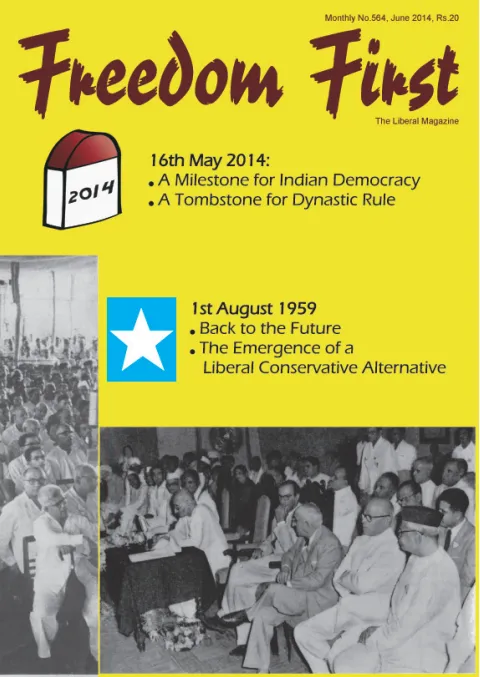
Freedom First No. 564 (June 2014), the 63rd year of this Bombay-based liberal magazine published by the Indian Committee for Cultural Freedom and edited by S. V. Raju, appears in the immediate aftermath of Narendra Modi’s landslide 2014 general election victory. The issue’s framing device pairs 16 May 2014 (“A Milestone for Indian Democracy… A Tombstone for Dynastic Rule”) with 1 August 1959, the 55th anniversary of C. Rajagopalachari’s founding of the classical-liberal Swatantra Party, arguing that Modi’s win could be a “tipping point” for a liberal-conservative revival — one still blocked by a pending Bombay High Court writ petition (excerpted on p.39) challenging the constitutional requirement that registering political parties swear allegiance to “socialism.” A dedicated General Elections 2014 section carries commentary from Ashok Karnik, H. R. Bapu Satyanarayana, N. S. Venkataraman and the editor on the BJP’s win, the outgoing Manmohan Singh government, and structural weaknesses in Indian electoral democracy, alongside Firoze Hirjikaka’s pre-results “Cornucopia” column and a two-sided “Point Counter Point” feature.
Beyond the election, the issue carries economic commentary (Sunil Bhandare’s “don’ts” for the new government, Neelakant Patri on inflation and IMF double standards), two foreign-policy essays (B. Ramesh Babu on the manifestos’ neglect of foreign affairs, Ranga Kota on the limits of a “muscular” diplomacy), Probir Roy on defence-budget planning, Sharad Joshi’s case for a separate Vidarbha state, an obituary of Swatantra-era commentator K. Vedamurthy, Sunanda K. Datta-Ray’s tribute to economist R. C. Cooper, a soldier’s-father remembrance by Wing Comdr Venki Iyer, R. Srinivasan’s review of Aroon Tikekar’s book on Bombay’s Anglo-Indian press, and Ishita Marwah’s short story “The Boy with the Nose-ring,” which frames the infancy of Nathuram Godse — Mahatma Gandhi’s eventual assassin — as a case study in son-preference superstition before appending a straight biographical account of Godse’s radicalisation and execution.
Essays
From Our Readers
The cover feature draws a parallel between two dates: 16 May 2014, when the BJP under Narendra Modi routed the Congress (I), and 1 August 1959, when C. Rajagopalachari founded the Swatantra Party in opposition to Nehru’s socialist economic policies. It argues the Swatantra Party’s classical-liberal platform of “farm family, freedom” was later vindicated by India’s economic troubles, and recounts the party’s post-1974 fragmentation, the Maharashtra branch’s refusal to dissolve, and its ongoing (since 1994) Bombay High Court writ petition against the mandatory “socialism” oath under Section 29(A) of the Representation of the People Act.
- Congress (I) suffered its worst-ever defeat on 16 May 2014, denied even official Opposition status in the Lok Sabha.
- Credits Rajaji’s Swatantra Party (founded 1 August 1959) with pioneering “prosperity through freedom” as a counter to Nehruvian socialism.
- Swatantra achieved national-party status by 1962-67 and functioned as an unofficial opposition before dissolving in 1974 after its 1971 defeat.
- The Maharashtra branch kept the party alive and, since 1994, has fought a Bombay High Court writ petition against the Election Commission’s refusal to register it under the compulsory “socialism” oath of Section 29(A).
- Frames Modi’s 2014 win as a possible “tipping point” for a liberal-conservative revival.
In Memoriam: K. Vedamurthy
By Editor
A letters section responding to the May 2014 editorial’s criticism of the Gandhi “Dynasty.” Correspondents debate whether singling out the Gandhi family is fair given dynastic politics across Indian parties, weigh Modi’s efficiency against fears of an unchecked “one-man regime,” satirically propose legalising and taxing bribery, and question PMO influence over the Army Chief’s appointment and the economic logic behind the Telangana statehood demand. A wire item profiles Shanti Gandhi, Mahatma Gandhi’s Kansas-based Republican great-grandson, who declines to trade on the Gandhi name.
- V. Krishna Moorthy and Firoze Hirjikaka debate whether the editor’s antipathy toward the “Dynasty” is fair given that dynastic politics is common across Indian parties.
- Firoze Hirjikaka worries about an unchecked “one-man regime” even while endorsing anti-corruption efficiency.
- Dharmendra Nagda satirically proposes legalising and taxing bribery in a piece titled “Transparent Corruption.”
- Brig. Suresh Sharma (retd.) questions PMO influence over Army Chief appointments; a reprinted 2009 quote from N. Vittal frames the Telangana demand as economic rather than purely linguistic.
- A Hindustan Times wire piece profiles Shanti Gandhi, a Kansas state legislator and great-grandson of Mahatma Gandhi who runs as a Republican without invoking his family name.
Editorial: Congratulations to NaMo and the BJP on their Historic Win
By Editor
An obituary for K. Vedamurthy (1939-2014), a Chennai-based LIC employee, Swatantra Party sympathiser and long-time contributor to Freedom First and Swarajya, closely associated with C. Rajagopalachari’s political legacy and the Rajaji biography project undertaken with Rajmohan Gandhi. The piece reproduces three of his memorable published remarks, including on the death of Swatantra leader G. K. Sundaram and on the Rajaji-Nehru relationship.
- K. Vedamurthy died in Chennai on 29 April 2014, aged 75, of cardiac failure.
- He assisted the Rajaji Biography Committee (1973-75) that helped Rajmohan Gandhi write “The Rajaji Story.”
- He was a devotee of the Kanchi Sankaracharya and a long-time Freedom First contributor since the Swatantra Party years of the 1960s-70s.
- Quoted remarks include his comparison of socialism to “ritual and dogma” versus truth, and an anecdote about a mispronounced Tamil Nadu river name.
Modi’s Tsunami
By Ashok Karnik
The editorial congratulates Narendra Modi and the BJP on their decisive 2014 win, framing the Congress-led UPA’s rump as an “unofficial opposition” too small even to qualify formally for that status. It welcomes the result as clearing the ground for a “liberal polity” but flags two obstacles: Indira Gandhi’s 1976 42nd Amendment inserting “Socialist” into the Constitution’s Preamble, and Rajiv Gandhi’s 1989 Representation of the People Act amendment (Section 29(A)) barring parties unwilling to swear allegiance to socialism from registering — the very provision blocking the Swatantra Party Maharashtra’s re-registration since 1994.
- Congress (I)/UPA was reduced to 59 seats, unable to claim official Opposition status.
- Credits regional leaders (Naveen Patnaik, Mamata Banerjee, Jayalalithaa) with congratulating Modi “without rancour,” contrasted with the Congress leadership’s half-hearted message.
- Reprints the editor’s own May 2014 postscript arguing India’s democracy has been “anaemic… because of inbreeding” (dynastic politics).
- Identifies the 42nd Amendment (1976) and the 1989 RPA amendment/Section 29(A) as continuing obstacles to a non-socialist party’s registration.
- Frames Modi’s win as a possible “tipping point” for the Swatantra Party’s re-emergence.
History’s Verdict: He was Fortunate to Escape Being Impeached
By H. R. Bapu Satyanarayana
Karnik argues Modi’s landslide (330+ NDA seats vs. 60+ UPA) reflected voter yearning for decisive government after a “non-functional” Manmohan Singh administration, driven by a presidential-style campaign centred on development rather than ideology. He flags challenges ahead — restive BJP seniors, RSS hardliners pushing Swadeshi and Ram Mandir causes, state-level “oligarchs,” and a decimated but entrenched Congress — and cautions against triumphalism. A sidebar list of “Random Thoughts” and a boxed item on Saudi blogger Raif Badawi’s blasphemy sentence round out the piece.
- The NDA’s 330+ seat “tsunami” surprised even BJP loyalists; Modi ran a personalised, presidential-style campaign focused on development and jobs.
- Lists internal challenges: sidelined seniors, RSS pressure to revive Swadeshi/Ram Mandir/Ram Setu causes, and state-level power brokers Modi must contend with.
- Criticises the outgoing Congress/UPA for arrogance and non-accountability, and predicts the Left’s continued marginalisation and AAP’s inability to scale beyond its “crumbs.”
- Urges giving Modi’s government “a chance” and warns against treating the 2002 riots stigma as disqualifying.
- A sidebar reports Saudi blogger Raif Badawi’s 2013 sentence of seven years and 600 lashes for “insulting Islam” and founding the liberal forum Free Saudi Liberal.
Is India’s Electoral Democracy Deceptive
By N. S. Venkataraman
A reassessment of Manmohan Singh’s premiership prompted by Sanjaya Baru’s memoir, arguing Singh was “fortunate to escape being impeached” despite the Coalgate and Commonwealth Games scams, because his personal reputation for integrity shielded the government. The piece blames the “Dynasty” for stripping him of authority, compares his survival to Bill Clinton’s escape from impeachment, and closes with an image of Singh as a swimmer needing frequent foreign trips as relief from domestic pressure.
- Argues Baru’s book “bails out” Manmohan Singh rather than damaging him, since it confirms his personal integrity even as it exposes his powerlessness.
- Coalgate is traced to Singh’s own earlier tenure as coal minister; the CBI’s targeting of coal secretary P. C. Parakh is called unfair.
- The “Dynasty” (Congress high command) is blamed for undermining the PM’s authority and dignity by constantly monitoring his office.
- Singh’s assertion of authority over the Nuclear Deal is cited as a rare exception to his general passivity.
- Compares Singh’s survival without accountability to Bill Clinton’s escape from impeachment over his “sexual escapade.”
Cornucopia: End of an Ordeal
By Firoze Hirjikaka
Venkataraman argues that India’s impressive scale of election administration masks a deteriorating “quality” of democracy, driven by dynastic and personality-centred parties, the corrosive role of money power and black money in campaigns, and the rise of career politicians who treat politics as a business. He concludes that unless checked, these trends could undermine the long-term stability of Indian democracy.
- Praises the scale of India’s 2014 nine-phase election but questions whether scale equals democratic “quality.”
- Identifies dynastic control of most parties (barring the BJP and Communist parties) as eroding internal party democracy.
- Details how “money power” — TV channels, advertising blitzes, vote-buying, coercion of business houses — drives administrative and political corruption.
- Notes politicians who “never took up any job” yet amass wealth through political patronage and government contracts.
- Concludes India’s electoral democracy “may be deceptive” if caste, religion and family-loyalty politics continue unchecked.
Don’ts for the New Government
By Sunil S. Bhandare
A reprint of the editor’s postscript to the May 2014 editorial (circulated 1 May, before results), arguing the “Muslim vote bank” is a Congress-manufactured phenomenon now splintering four ways among Congress, SP, BSP and AAP to the BJP’s advantage, and reiterating the call to end “family rule” in Indian politics.
- Argues the Muslim vote bank was historically a Congress creation reliant on low turnout and multi-cornered contests.
- Notes the vote’s 2014 fragmentation across Congress, the Samajwadi Party, the Bahujan Samaj Party and the Aam Aadmi Party.
- Frames even a hypothetical Modi loss as still a victory over the “bogus slogan of secularism.”
- Repeats the call for “fresh blood” to replace family-based political succession.
Their Concerns, Our Concerns
By Neelakant Patri
Writing before the election results were known, Hirjikaka predicts a BJP-led win and skewers the Congress campaign as rudderless, arguing Rahul and Sonia Gandhi squandered a potential “sympathy card” through personal invective against Modi rather than substantive critique. He condemns communal rhetoric at a Mumbai rally tacitly permitted by Shiv Sena and BJP leaders, criticises Baba Ramdev’s opportunistic pivot to politics, and predicts a bruising, personalised contest between a “megalomaniac Supremo” and a decimated opposition.
- Predicts a BJP victory (written before 16 May), with the party expected to gain “fair weather allies.”
- Criticises the Congress campaign as reactive and lacking strategy, “running helter shelter like agitated chickens.”
- Accuses BJP-Shiv Sena leaders of tacitly permitting communal rhetoric (a Sena candidate’s anti-Muslim speech) at a 21 April Mumbai rally.
- Portrays Baba Ramdev as a self-interested “guru of charlatans” riding the Modi wave for business gain.
- Warns that an “unbridled Modi with no opposition to speak of” could become “a contingency the country may live to regret.”
2014 Election Manifestos and Foreign Policy: Undeserved Low Priority
By B. Ramesh Babu
Bhandare, writing just after the BJP-led NDA’s win, lists seven things the incoming government must avoid: vindictive politics, reversing pending reforms (GST, FDI liberalisation, labour policy, the Delhi-Mumbai corridor), relaxing fiscal discipline, expanding “rights-based” welfare schemes without funding, retrospective tax changes, interference with RBI independence, and steamrolling opposition-run states given the NDA’s rare single-party majority.
- Frames “what not to do” as more important than “what to do” for the incoming government.
- Warns against reversing GST, FDI in multi-brand retail, labour reform and mega infrastructure projects like the Delhi-Mumbai Industrial Corridor.
- Calls for strict adherence to the Fiscal Responsibility and Budget Management Act and no fiscal stimulus.
- Cites Moody’s and Deloitte’s reports warning that India’s growth may not return to 7-8% even under a reform-minded government.
- Cautions against tampering with RBI autonomy, quoting then-Finance Minister P. Chidambaram’s defence of the sitting Governor’s tenure.
India’s Foreign Policy: Will it Become Muscular?
By Ranga Kota
Patri contrasts the IMF’s concern over dangerously low inflation in the Euro zone with India’s own persistently high (8%+) retail inflation, arguing global financial institutions apply a double standard that ignores developing-country concerns. He reviews March 2014 price data before citing RBI Governor Raghuram Rajan’s call at a Washington IMF meeting for a global “safety net” for emerging markets, rebuffed by the ECB’s Vitor Constancio, and concludes the developed world’s “adjust” message leaves India little real recourse.
- India’s March 2014 retail inflation hit 8.38%, driven by rises in cereals, coarse grains and vegetables despite record food production (263.20 million tonnes in 2013-14).
- Suggests election-season cash disbursement of accumulated “black money” as a possible driver of the March price spike.
- Notes ample official foodgrain stocks (41.138 million tonnes) that should have allowed supply-side price management.
- RBI Governor Raghuram Rajan urged a global “safety net” for emerging markets at an IMF meeting, a call rejected by the ECB’s Vitor Constancio.
- Concludes the international financial system’s message is asymmetric: “emerging markets have to adjust,” while industrial countries “are going to do what they have to do.”
Point Counter Point
By Ashok Karnik
Babu criticises both major parties’ election manifestos for giving foreign policy “undeserved low priority” relative to domestic issues. He contrasts the BJP manifesto’s tougher rhetoric on China and Pakistan and its Hindutva-inflected offer of refuge to persecuted Hindus, against the Congress manifesto’s emphasis on “human security” and its continued list of grievances on Pakistan, Sri Lanka, China and UN Security Council reform.
- Both BJP and Congress manifestos placed foreign policy at low priority relative to domestic economic issues.
- The BJP manifesto promised a review of “No First Use” nuclear policy, closer BRICS/G-20/SAARC/ASEAN ties, and a larger, more influential Foreign Service.
- The BJP manifesto also promised refuge in India to persecuted Hindus, placed just ahead of its Hindutva agenda section (Ram Mandir, Uniform Civil Code, Article 370).
- The Congress manifesto reframed security as “human security” and reiterated positions on Pakistan-sponsored terrorism, Sri Lankan Tamil rehabilitation, China’s border dispute, and UNSC membership.
- The article judges the minor parties’ foreign-policy planks not worth discussing given their unlikely role in the next government.
Defence Planning – A Ticking Time Bomb Waiting to Explode
By Probir Roy
Kota surveys India’s diplomatic “trust deficit” with neighbours (Pakistan, Bangladesh, Sri Lanka, Nepal) and larger powers (China, the US, Russia), arguing India lacks real leverage over Pakistan or China and that “muscular” foreign policy rhetoric is unlikely to translate into substantive change. He reviews Afghanistan post-US-withdrawal, friction with Washington, the “Putin factor” in Ukraine, and Africa as an under-leveraged opportunity, concluding that India’s diplomatic power will only grow in step with its economic power.
- Argues India has “no leverage” over Pakistan (no shared economic or security interest) or China (economic and military asymmetry) despite hawkish domestic rhetoric.
- Surveys friction points with the US: the Nuclear Liability Act, Indian patent law and compulsory licensing, and the Devyani Khobragade episode.
- Frames Vladimir Putin’s “Russia First” posture and Ukraine intervention as a cautionary parallel to any Indian “muscular” nationalism.
- Describes Africa as an opportunity for India’s private sector, limited by China’s economic might and India’s own reputational issues around contract transparency.
- Concludes that beyond “semantics and sound bites,” no significant near-term shift in India’s foreign policy should be expected.
A Separate State of Vidarbha – For a Prosperous and Wealthy Bali Rajya
By Sharad Joshi
A recurring feature presenting two opposing viewpoints on three issues: Pakistan’s “jugular vein” rhetoric over Kashmir’s river waters (contrasted with India’s adherence to the 1960 Indus Waters Treaty despite repeated provocations), the fairness of Sanjaya Baru’s exposé of Manmohan Singh as an “Accidental PM,” and the coarsening “Art of Debate” during the 2014 campaign.
- On “Pakistan’s Jugular”: one side calls Pakistani anxiety over Kashmir’s river-fed water security legitimate; the other insists India has honoured the 1960 Indus Waters Treaty despite wars and terrorist attacks.
- On “Accidental PM”: both sides agree Sanjaya Baru’s book betrays no confidences but portrays Manmohan Singh as capable yet hemmed in by loyalty to the Gandhi family.
- On “Art of Debate”: one side welcomes the end of campaign mud-slinging; the other predicts a swift return to reflexive “Government bashing” devoid of wit or substance.
- The feature’s format invites readers to submit their own “point counter point” submissions on serious issues of the day.
R. C. Cooper – The One That Got Away
By Sunanda K. Datta-Ray
Roy argues Indian defence planning lacks the rigorous budgeting tools long used in the US (Zero-Based Budgeting and the Program Planning & Budgeting System pioneered by Robert McNamara), noting that just 5% of the armed forces’ already-small capital budget goes to new acquisitions. He attributes lopsided capex-to-opex ratios across the Army, Navy and Air Force to distinct institutional cultures and calls for the new Mountain Strike Corps to be matched with cheaper deterrents against China.
- Only 5% of India’s annual defence capital budget (Rs. 2,955 crore in FY14) goes to new acquisitions, and even that is only 50-60% utilised.
- Compares this capital budget unfavourably to the Bombay Municipal Corporation’s Rs. 2,500 crore pothole-and-road maintenance budget for 2014-15.
- Contrasts Indian planning with the Zero-Based Budgeting and Program, Planning & Budgeting System tools pioneered by US Defense Secretary Robert McNamara.
- Attributes divergent Army/Navy/Air Force capex-opex ratios to differing institutional cultures (“boots on the ground” versus equipment-intensive forces).
- Recommends supplementing the new Mountain Strike Corps with lower-cost deterrents against China — cyber warfare, tactical nuclear options, long-range missiles, satellite imagery.
When U.K. Prime Minister David Cameron failed to find a seat on a public transport
By Contributed by D. S. Ranga Rao, Mumbai
Joshi, founder of the Shetkari Sanghatana farmers’ movement, argues Vidarbha’s cotton, mineral and power wealth has been systematically exploited by the rest of Maharashtra since its 1960 merger under the “Nagpur Pact,” particularly through the state’s Cotton Monopoly Procurement Scheme. He traces the decades-long demand for a separate Vidarbha state to the Fazal Ali Commission and situates the Shetkari Sanghatana’s 1996 call for a “Bali Rajya” as a vision of prosperity built on farmers rather than politicians.
- The Cotton Monopoly Procurement Scheme forced Vidarbha’s cotton growers to sell exclusively to the state at prices favouring Mumbai mill owners, at an estimated cost of over Rs. 40,000 crore.
- Vidarbha (11 districts of the former Central Provinces and Berar) was recommended for separate statehood by the Fazal Ali Commission but merged into Maharashtra via the “Nagpur Pact.”
- Despite being rich in bauxite, manganese, coal, iron ore and hydropower, Vidarbha faces chronic load-shedding and underdevelopment.
- The Shetkari Sanghatana has organised agitations (“Vij Roko,” “Koila Roko,” “Jay Vidarbha Pad Yatra”) since 1996 demanding a separate state.
- Joshi envisions a “Bali Rajya” — invoking the legendary just king Bali — as a state where “government will be poor but the people will be prosperous.”
A Soldier’s Father
By Wing Comdr Venki Iyer
A tribute to R. C. Cooper, the Swatantra Party general secretary and chartered accountant-economist who successfully challenged Indira Gandhi’s 1969 bank nationalisation in the Supreme Court (argued by Nani Palkhivala) and later emigrated to Singapore in 1975 on the advice of J. R. D. Tata, where he spent 38 years advising Singapore, the Ivory Coast, the Maldives and Indonesia — the author laments that India lost the benefit of his talents.
- Cooper, a director/shareholder of the Central Bank of India, won a Supreme Court stay against Indira Gandhi’s bank-nationalisation ordinance, argued by Nani Palkhivala.
- India retaliated with the Banking Companies (Acquisition and Transfer of Undertakings) Act; without Cooper’s suit, the government might not have provided any compensation at all.
- Cooper moved to Singapore in 1975 with help from J. R. D. Tata and Naval Tata, contributing to the island’s early industrialisation via Tata Precision Industries.
- He went on to advise Singapore, the Ivory Coast, the Maldives and Indonesia over a 38-year career abroad.
- The author frames Cooper’s expatriation as India’s loss: “Singapore, the Ivory Coast, Maldives and Indonesia benefited from his professional guidance. India didn’t.”
Book Review: Collaborators or Conformists? The British Indian Editors of Bombay and Other Addresses by Aroon Tikekar, reviewed by R. Srinivasan
By R. Srinivasan
A human-interest wire item recounting how an Indian expatriate actress, Sanyogita Mayer, unexpectedly encountered UK Prime Minister David Cameron riding the London Underground during rush hour, and remarked that Indian politicians would never travel by public transport — framed by Freedom First as a contrast with Indian VIP culture.
- David Cameron rode the London Underground during rush hour to reach an appointment faster than by car.
- Sanyogita Mayer, an Indian-origin Bollywood actress, initially disbelieved that the commuter complimenting her baby was the Prime Minister.
- The item is framed rhetorically (“In India can we ever imagine politicians travelling in a public transport?”) as a comment on Indian VIP culture.
The Boy with the Nose-ring – A Short Story
By Ishita Marwah
A first-person recollection by a former Flight Commander of receiving Lachhman Singh Rathore, an elderly farmer, at an Air Force base to conduct the last rites of his son, Flying Officer Vikram Singh, killed in a flying accident. The father’s composure — despite having already lost two other sons in the 1962 and 1965 wars — leads the narrator to reflect that such unrecognised sacrifice by ordinary families outweighs the honours conferred on celebrities.
- Lachhman Singh Rathore lost three sons in India’s wars/military service: Capt. Ghanshyam Singh (1962, Ladakh), Major Bir Singh (1965, Ichogil Canal), and Flying Officer Vikram Singh (flying accident).
- The narrator recounts managing Vikram Singh’s funeral with full military honours and the father’s composed, commander-like instructions.
- The essay contrasts the father’s unrecognised sacrifice with Bharat Ratna and Padma awards given to cricketers and actors.
The Writ Petition: Some Excerpts
By Filed by L. R. Sampat and S. V. Raju
Srinivasan reviews Aroon Tikekar’s “Collaborators or Conformists? The British-Indian Editors of Bombay and Other Addresses,” a study of Bombay’s Anglo-Indian literary and press culture from the mid-19th century onward. The review highlights forgotten “transplant literature” novelists, the Bombay Asiatic Society’s historical exclusion of Indian members, the rivalry between the establishment Times of India and nationalist papers, and a chapter on foreign scholarly “Friends of India” such as Max Müller.
- Tikekar’s book covers Bombay’s Anglo-Indian “transplant literature,” including forgotten novelists like P. C. Wren and the once-widely-read “Pandurang Hari” (1829).
- Describes Bombay’s newspaper landscape: the establishment Times of India versus nationalist papers, the Bombay Chronicle (founded by Pherozeshah Mehta) and Benjamin Horniman’s Bombay Sentinel.
- Details the Bombay Asiatic Society’s historical exclusion of Indian members, including Manekjee Cursetjee, and its rare holdings such as a manuscript of Dante’s Divine Comedy.
- A chapter on “Foreign Friends of India” credits scholars like Max Müller with popularising Indian civilisation abroad.
- The reviewer calls the book “a must for those interested in the mental life of India.”
Essay 21
A short story set in Poona/Baramati depicting Laxmibai’s traumatic childbirth history and her decision to disguise her newborn son as a girl (piercing his nose with a nath) to trick the gods into sparing him, naming him “Ramachandra.” A closing historical note reveals this boy grows up to become Nathuram Godse, and traces his path from devotion to Gandhi to his 1948 assassination of Gandhi and 1949 execution.
- Fictionalised account of Nathuram Godse’s mother Lakshmi disguising him as a girl in infancy after losing earlier sons, a regional superstition of the era.
- The nickname “Nathuram” (“Ram with a nose-ring”) is explained as originating from this disguise.
- The story is followed by a biographical postscript on Godse’s radicalisation: his break with Gandhi over Partition, his involvement with the Hindu Mahasabha and RSS, and his editorship of “Agrani”/“Hindu Rashtra.”
- Details Godse’s 30 January 1948 assassination of Gandhi and his 15 November 1949 execution, despite clemency pleas from Nehru and Gandhi’s own sons.
Essay 22
Excerpts from the Swatantra Party (Maharashtra)‘s writ petition, filed by L. R. Sampat and Freedom First editor S. V. Raju, challenging Section 29(A)(5) of the Representation of the People Act, 1951, which requires parties to swear allegiance to “socialism” to register with the Election Commission. The excerpts argue the term is undefined in the Constitution and not part of its “basic structure,” and close with an appeal for readers to help expedite the Bombay High Court hearing.
- The petition, filed by L. R. Sampat (Swatantra Party Maharashtra general secretary) and S. V. Raju, seeks to strike down Section 29(A)(5) of the Representation of the People Act, 1951.
- Argues “socialism” is undefined in the Constitution and that no party’s registration has ever been denied for falsifying such an oath, making the requirement arbitrary.
- Contends the party accepts allegiance to democracy, secularism and the Constitution but not to an undefined “principle of socialism.”
- Cites that socialism is not part of the Constitution’s “basic structure,” making Section 29(A) an unconstitutional restriction on a citizen’s right to seek constitutional amendment.
- Closes with a direct appeal for readers to join the case by impleading themselves to help expedite the 20-years-pending Bombay High Court hearing.
Generated by the v1.5 extraction pipeline. Awaiting editorial review.
Metadata and summary are AI-extracted from the source PDF and reviewed for editorial accuracy. The original work is available via the Read PDF tab above (where present); paragraph-level citation inside the PDF is deferred to a future engagement.