
periodical issue
Freedom First
The Liberal Magazine
By D. R. Pendse, Sharad Joshi, Sunil S. Bhandare
PUBLISHERS: Indian Committee for Cultural Freedom (ICCF), 3rd floor, Army & Navy Building, 148, Mahatma Gandhi Road, Mumbai 400001. PUBLISHED BY: J. R. Patel for the ICCF and printed by him at Union Press, 13, Homji Street, Fort, Mumbai 400001. · Mumbai · 2015
40 pages
Freedom First
Summary
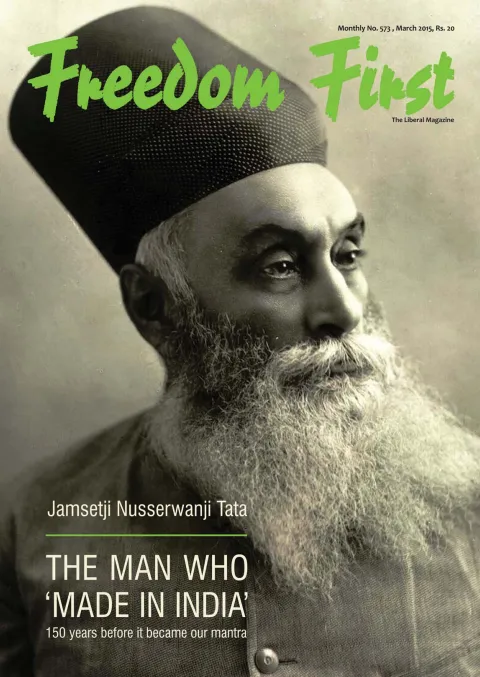
Freedom First No. 573 (March 2015) is a 40-page issue of the Bombay-based liberal monthly, edited by S. V. Raju with R. Srinivasan as Associate Editor, published by the Indian Committee for Cultural Freedom. The cover honours Jamsetji Nusserwanji Tata on his 175th birth anniversary, and the issue’s centre of gravity is the extraordinary run of Indian and world politics in early 2015: the Aam Aadmi Party’s landslide in the Delhi Assembly election, the fall from favour of BJP candidate Kiran Bedi, President Obama’s Republic Day visit and its ‘intolerance’ remark, Modi’s Russia and Gujarat diplomacy, and the pre-Budget debate over agriculture. Regular features (readers’ letters, Ashok Karnik’s ‘Point Counter Point’, the Adult Education Institute’s ‘Educating Adults’ page, and a book review) sit alongside guest contributions from politicians, economists and retired civil servants, giving the volume its characteristic mix of polemic, first-person reportage and policy argument from a classical-liberal, free-enterprise perspective.
Essays
800th Anniversary of the Signing of the Magna Carta
By R. Srinivasan
R. Srinivasan marks the 800th anniversary of the Magna Carta, tracing its origin in the baronial revolt against King John and arguing that the principle it embodies — that supreme executive power operates only at the sanction of the legislature — became the germ of all subsequent democracies. He notes the irony that the Charter was wrested for the nobility, not the common man, yet was retrospectively mythologised as a people’s document, a ‘misunderstanding’ he calls historically beneficial.
- The Magna Carta arose from a council of 25 barons forcing King John to concede rights after years of antagonising the population.
- Its core legacy is the principle that supreme executive power is exercised only with legislative sanction.
- The rights it secured were originally for the nobility and Church, not the common man (‘hoi polloi’).
- Subsequent history reinterpreted it as an ancient charter of the common people’s rights, which Srinivasan calls a beneficial misunderstanding.
- Almost every modern constitution, democratic or not, embodies some version of its principles.
Between Ourselves…
By Editor
The unsigned editorial ‘Between Ourselves’ explains the choice of Jamsetji Tata for the cover (marking his 175th birth anniversary and new commemorative coins) and reflects on Arvind Kejriwal’s political comeback, praising his regrouping after the 2014 resignation and his decisive 2015 Delhi win. The editor commits Freedom First to withholding judgement on the new AAP government’s performance for six months while reserving contributors’ right to comment on individual policies from a liberal perspective.
- The March 2015 cover honours Jamsetji Tata, coinciding with government-issued commemorative coins for his 175th birth anniversary.
- The editor recalls that the February 2015 issue was dedicated to Gopal Krishna Gokhale on his 150th death anniversary.
- The editorial praises Arvind Kejriwal for learning from his earlier resignation and decisively defeating both the Congress and BJP in Delhi.
- Freedom First pledges to refrain from judging the new Delhi government for six months, while allowing policy-specific commentary.
From Our Readers
The letters column carries reader reactions to the February issue and to the 2015 Delhi election. Contributors debate whether Freedom First’s editorial line has drifted from liberal principle, praise the AAP’s ‘spectacular victory’ as proof that dynastic and money politics are becoming obsolete, list grievances about the conduct of Indian elections, and defend Nehru’s Cold War-era distance from the United States by cataloguing US interventions across Latin America. Other letters raise river-water-sharing reform and a complaint about Congress spokesman Digvijay Singh’s remarks on airport naming.
- R. C. Saxena praises the magazine’s February back-cover statement as a bold liberal stand; the editor replies that Freedom First’s core principles are unchanged.
- N. R. Bala reads the 2015 Delhi result, following the 2014 Lok Sabha result, as proof that dynastic politics is becoming an ‘extinct species’.
- Dharmendra Nagda lists concerns about mudslinging, high-decibel TV debates, engineered defections and misuse of money in Indian elections.
- B. P. Rastogi rebuts criticism of Nehru’s foreign policy by cataloguing a long list of US interventions in Latin America from 1846 to 1994.
- A letter proposes a national grid of reservoirs and canals modelled on the National Power Grid to resolve inter-state river disputes.
- Dr. T. H. Chowdary criticises Congress leader Digvijay Singh for ridiculing dual-name airports, noting Chennai’s own precedent.
Jamsetji Tata Commemorative Coins - A Gesture of the Country’s Gratitude
By D. R. Pendse
Dattatraya R. Pendse reflects on the Modi government’s release of commemorative Rs.100 and Rs.5 coins for Jamsetji Tata’s 175th birth anniversary, framing it as the state’s first such gesture toward a businessman and an implicit admission of decades of hostility toward private, especially large, industry under the ‘socialistic pattern of society’. He invokes Alfred Marshall’s praise of the Tatas and JRD Tata’s complaint of feeling ‘not wanted’, arguing the coin signals a genuine, if overdue, reversal. A companion unbylined press report describes Modi’s coin-release speech, which paired Jamsetji Tata with Swami Vivekananda as sharing a common vision for a self-reliant India, and recapped Tata’s founding of the Tata Group in 1868 and its industrial firsts (Tata Steel 1907, Tata Power’s Khopoli plant 1910, the Indian Institute of Science 1909).
- The commemorative coins mark the first time India has honoured a businessman this way, 111 years after Jamsetji Tata’s death.
- Pendse reads the gesture as a second, quieter repentance for socialist-era economic policy, the first being the 1991 reforms.
- He questions why gestures of gratitude have gone only to Tatas and not other large industrial houses.
- JRD Tata’s 1991 remark that he felt ‘not wanted’ after fifty years of service is cited as evidence of past official hostility to big business.
- The companion press report notes Modi linking Jamsetji Tata’s 1893 shipboard meeting with Swami Vivekananda to a shared vision of self-reliant India.
Thank God for The TATA’s - A Tribute
By Lakshmi Mittal
Steel magnate Lakshmi Mittal (excerpted from an online piece) describes a personal visit to Jamshedpur as evidence that corporate India can practise genuine social responsibility. He praises Tata Steel’s investment in the town’s infrastructure, the calm of its industrial relations, and a residential program educating 48 tribal girls, crediting Ratan Tata and managing director Muthuraman for a culture that values dignity over pure profit and contrasting Jamshedpur favourably with the rest of the country.
- Mittal contrasts Jamshedpur’s calm, well-maintained conditions with industrial unrest and neglect typical elsewhere in India.
- He highlights a nine-month residential program that has given 48 tribal girls confidence and a new language (Bengali) within eight weeks.
- Jamshedpur was selected as a UN Global Compact City, edging out Bangalore as India’s nominee.
- Mittal notes that no Tata executive has been targeted by Naxalites in the region, reading it as a sign of earned social respect.
- He calls on the reader to see Jamshedpur as a mandatory model for replication by corporate India.
Thoughts on Recent Political Developments
By B. Satyanarayana
H. R. Bapu Satyanarayana surveys early 2015 political developments: the AAP’s Delhi landslide as a chastening lesson for Modi and the BJP; the acclaimed 7th Vibrant Gujarat Summit; and Obama’s Republic Day visit, praised for its warmth (the ‘chai pe charcha’ moment, Modi pouring tea) and for Obama’s unusually direct warning to Pakistan on 26/11, but criticised for Obama’s ‘intolerance’ remark at Siri Fort, seen as ill-informed of India’s history and exploited by the Congress. The piece closes on Jayanti Natarajan’s resignation from the Congress after 30 years, which she attributed to being sidelined over environment-ministry file clearances.
- AAP’s 67-of-70 win is read as a lesson that development rhetoric alone cannot substitute for simplicity, honesty and integrity in governance.
- The 7th Vibrant Gujarat Summit drew praise from the UN Secretary General and the US Secretary of State for Modi’s outreach.
- Obama’s visit produced warmth, a rare US warning to Pakistan on 26/11, and progress on the civil nuclear deal.
- Obama’s Siri Fort remark on religious tolerance is criticised as a weapon handed to the Congress and as historically uninformed.
- Jayanti Natarajan’s resignation from the Congress is attributed to being made to withhold environment-ministry clearances on Rahul Gandhi’s instruction.
Point Counter Point
By Ashok Karnik
Ashok Karnik’s recurring ‘Point Counter Point’ column presents both sides of three live debates: whether the Obama visit produced substantive ‘deliverables’ beyond bonhomie; whether the Delhi result reflects genuine AAP trust or BJP overreach and impatience with unmet promises; and whether the government’s action against Greenpeace activist Priya Pillai (stopped from travelling abroad) was a justified check on foreign-funded agitation or an unconstitutional curb on free speech. A boxed excerpt from the National Review separately condemns Greenpeace’s vandalism of the Nazca Lines in Peru during a climate-publicity stunt.
- On Obama’s visit, one side stresses the nuclear deal, defence production and ‘Turn East’ policy breakthroughs; the other says agreements still await conversion into concrete action.
- On the Delhi result, one side calls it evidence that people are impatient for quick fixes; the other says the BJP is inventing excuses rather than confronting its true failure to deliver.
- On Priya Pillai, one side asks how far foreign-linked agitation against government policy should be tolerated; the other notes the Delhi High Court found the government’s action ‘inappropriate’.
- A separate boxed item condemns Greenpeace’s defacement of the Nazca Lines in Peru as vandalism in the name of climate publicity.
The Delhi Assembly Elections of 2015 - The Political Paralysis of the BJP and the Congress
By B. N. Mehrish
B. N. Mehrish analyses the 7 February 2015 Delhi Assembly election, in which AAP won 67 of 70 seats on record 67.14% turnout. He attributes the result to Kejriwal’s emotional reconnection with voters after his earlier resignation, an ‘aam aadmi’ appeal that cut across caste and community, and support concentrated among slum-dwellers, auto drivers, industrial labour, migrants, Dalits and Muslims, framed by Kejriwal as a ‘David vs. Goliath’ contest against entrenched politics.
- AAP won 67 of 70 seats; the Congress was wiped out and the BJP reduced to 3 seats.
- Voter turnout reached a record 67.14%; turnout in the three chief-ministerial candidates’ own constituencies is reported individually.
- A pre-election IMRB-The Week survey had already shown the BJP short of a majority and Kejriwal preferred over Bedi as chief minister, especially among younger voters.
- AAP’s campaign promises included a discom audit, women’s-safety CCTV, education loans, 20 new colleges and citywide wi-fi.
- Kejriwal cast the election as a ‘David vs. Goliath’ battle, framing a BJP vote as a vote for the failures of politicians through the ages.
The Anti-Renaissance of Kiran Bedi
By Firoze Hirjikaka
Firoze Hirjikaka delivers a scathing polemic against Kiran Bedi, tracing her transformation from an upright, Magsaysay Award-winning police reformer and Anna Hazare-movement crusader to a suddenly compliant BJP chief-ministerial candidate who showers ‘cloying sycophancy’ on Modi. He accuses her of abandoning Anna Hazare, whom he calls the person he feels most sorry for, avoiding a direct debate with her former ally Kejriwal, and displaying an authoritarian, condescending campaign style that alienated Delhi voters — predicting, correctly as a postscript notes, a watershed AAP win.
- Bedi is described as reversing decades of anti-establishment, anti-corruption positioning to join the BJP she once criticised, including its RSS-affiliated wing.
- Hirjikaka accuses her of using Anna Hazare to gain political visibility and then discarding him.
- Her campaign manager’s resignation, calling her ‘dictatorial’, is cited as evidence of her imperious temperament.
- She avoided a one-on-one debate with Kejriwal and chose a ‘safe’ constituency to avoid embarrassing defeat.
- The article, written before results were declared, predicts a watershed AAP victory and speculates on Bedi’s uncertain future within the BJP.
BJP and Narendra Modi
By S. Arunajatesan
S. Arunajatesan, responding to earlier Freedom First pieces, argues Modi is ‘overrated’ as a charismatic orator whose ‘Gujarat model’ has not been proven to beat Mumbai, Bangalore or Chennai on any measurable dimension, contrasting it with Verghese Kurien’s genuine dairy-development achievement in Anand. He warns that BJP fringe groups’ controversies are undermining Modi’s government and that the unresolved question of secularism, given India’s demographic complexity, poses a serious risk to investment and social peace.
- Arunajatesan calls Modi a charismatic but overrated leader whose RSS background may impede governing for all of a complex India.
- He questions whether the celebrated ‘Gujarat model’ has produced measurable competitive advantage in textiles, chemicals or ‘Make in India’.
- Verghese Kurien’s dairy-development success in Anand is cited as a genuine, replicated model Modi has yet to match.
- He argues India cannot be declared a Hindu country despite its 85% Hindu population without risking turmoil.
- He predicts the BJP government may fail even to match the ‘low standard’ of the preceding Congress government.
The Rural Perspective: Union Budget 2015-16 (1) - Taking Care of Farmers’ Interests
By Yalamanchili Sivaji
In pre-Budget testimony to the Finance Ministry, former MP Yalamanchili Sivaji argues that decades of economic reform have unshackled industry while leaving agriculture, which supports over 70% of the population, under continued state stranglehold — citing inconsistent export-import policy (e.g. onion export bans), restrictions on internal movement and storage of produce, and inadequate rural infrastructure. He calls for decentralised, state-led foodgrain procurement, a rationalised Minimum Support Price linked to inflation, and disinvestment of government stakes in cigarette maker ITC to fund infrastructure.
- Unlike industrialists, farmers cannot freely sell produce across state or district lines, let alone export it, due to inconsistent government intervention.
- Sivaji calls for decentralising foodgrain procurement to the states and rationalising the taxes and cesses that have raised procurement costs by about Rs.2,500 per ton.
- He proposes the government treat food security as a duty, not question whether to tax essential grains like liquor and cigarettes.
- He recommends the Union government fix a Minimum Support Price consolidating state-level cost-of-production data, linked to inflation.
- He suggests disinvesting the government’s over one-third stake in ITC to raise roughly Rs.1,000 billion for infrastructure investment.
The Rural Perspective: Union Budget 2015-16 (2) - Exploitation of Agriculture
By Sharad Joshi
Sharad Joshi’s pre-Budget submission (read in absentia due to poor health) argues India has entered a third, ‘Modi era’ phase of agricultural exploitation following the colonial and post-1947 socialist phases, citing the revival of the Essential Commodities Act for potato and onion despite the Bibek Debroy Committee’s recommendation to abolish it. He argues nearly all agricultural loans are legally void because government price-depressing measures breach the implicit condition that borrowers be able to repay, and that the government, via decades of negative subsidies, in fact owes far more to farmers than they owe it. He also opposes the Land Acquisition Ordinance as unconstitutional executive overreach on property rights.
- Joshi frames Modi-era policy as a new, third phase of agricultural exploitation after the colonial and post-1947 socialist phases.
- He argues under the Contract Act, government price-depressing measures void farmers’ loan contracts, making rural indebtedness both illegal and immoral.
- WTO-based estimates put negative subsidies imposed on farmers between 1991-2000 at around three hundred thousand crore rupees, dwarfing farmer debt.
- He asks the Finance Minister to re-examine the Debt Relief and Loan Waiver Scheme’s exclusion of electricity bills, citing RBI Governor Raghuram Rajan’s observations.
- He argues the Land Acquisition Ordinance strips farmers of a constitutional right to property that predates its later dilution by amendments.
Distortion, Damned Distortion and National Accounts Statistics
By Sunil S. Bhandare
Sunil S. Bhandare examines the Central Statistical Organisation’s revised national-accounts series, which lifted reported GDP growth for 2013-14 and 2014-15 from roughly 5% to 6.9% and 7.4% respectively through a new base year, methodology and market-price rather than factor-cost measurement. He is sceptical of the revision’s usefulness, citing warnings from Chief Statistician T. C. A. Anant and Chief Economic Adviser Arvind Subramanian that the new numbers are ‘mystifying’ and should not be used mechanically, notes the RBI has stuck with the old series, and flags a contrarian structural shift toward agriculture and industry that lacks corroborating evidence of investment recovery.
- The revised series moved the GDP base year from 2004-05 to 2011-12 and switched from GDP at factor cost to GDP at market prices.
- Reported real GDP growth rose from 5.0% to 6.9% for 2013-14 and from an estimated 5.5% to 7.4% for 2014-15 under the new series.
- Chief Statistician T. C. A. Anant cautions that a China-comparable growth rate does not mean the economy is booming, and that RBI should not use the revision mechanically.
- NITI Aayog’s Bibek Debroy states any comparison with the earlier series is ‘not only difficult but impossible’.
- The revised data implies a contrarian structural shift toward agriculture and industry at the expense of services, without corroborating signs of stronger capital productivity.
Foreign Relations in the 21st Century - Global Power Structure in Transition (Part 2): A New Bipolar World Underway?
By B. Ramesh Babu
In Part 2 of a series on the emerging global power structure, B. Ramesh Babu argues India must rebuild its historic Russia relationship, noting Modi’s Kudankulam nuclear expansion, new defence and diamond-trade agreements with Putin, and a proposed rupee-ruble arrangement, all pursued despite US displeasure. He then surveys the deeper US-China rivalry, citing former US Ambassador Robert Blackwill’s warning of ‘diametrically opposed and mutually incompatible’ grand strategies, and concludes that as global power structures realign, India, now a global player in its own right, should stay agile and avoid unnecessary defensiveness.
- Modi revived India’s Russia relationship via the BRICS/G-20 summits, Putin’s Kudankulam visit, twenty new agreements and a proposed rupee-ruble trade arrangement.
- The US expressed displeasure at India’s renewed Russia ties, but Babu argues India should not be unduly worried by American reaction.
- Robert D. Blackwill’s December 2014 Beijing speech is cited describing the US and China as having ‘diametrically opposed and mutually incompatible’ grand strategies in Asia.
- Babu contrasts Obama’s outreach to China as a prospective ‘G-2’ partner early in his presidency with China’s refusal to accept a junior role.
- He concludes a new, still-forming balance of power gives India reason to stay engaged and confident rather than defensive.
Obama Visit: A New Era in India-USA Relations?
By Nitin G. Raut
Nitin G. Raut argues Obama’s visit inaugurated a ‘Modi Doctrine’ delinking India-US relations from the Pakistan factor and centring them on a wider Asia-Pacific and Indian Ocean strategy, driven by shared interest in balancing China. He credits Modi with pragmatic, ideology-free diplomacy that keeps doors open to both the US and China while asserting Indian naval primacy, highlights US support for a large Indian aircraft carrier as recognition of India’s Indian Ocean role, and suggests India should bolster its Andaman naval base to hold potential leverage over Chinese oil shipments through the Malacca Strait.
- Raut argues China’s rise as a military and economic rival to the US should itself ensure convergence of US and Indian strategic interests.
- He credits Modi’s ‘pragmatic’ foreign policy with balancing closer US ties against continued openness to Chinese investment.
- US support for a 65,000-tonne Indian aircraft carrier is read as explicit acceptance of India’s strategic role in the Indian Ocean.
- He proposes India strengthen its Andaman naval base to be able to blockade the Malacca Strait, through which 70% of China’s Gulf oil passes.
- He argues Sri Lanka’s change of government under Sirisena gives India an opportunity to restore warmth in bilateral relations.
Political Transition in Sri Lanka - Its Impact on the Balance of Power in Asia
By B. N. Mehrish
B. N. Mehrish reports on Sri Lanka’s January 2015 presidential election, in which Maithripala Sirisena defeated Mahinda Rajapaksa’s bid for a third term, a shift he links to Rajapaksa’s close alliance with China (including a $4 billion Chinese investment programme and use of Sri Lankan territory for Chinese naval activity). He argues Sirisena’s anti-China stance and his victory with Tamil and Muslim support create a crucial opportunity for India to script a fresh understanding with Sri Lanka on bilateral ties and the Tamil issue.
- Sirisena’s January 8, 2015 victory ended Rajapaksa’s attempt at a constitutionally amended third term.
- Rajapaksa’s alliance with China, including $4 billion in Chinese investment and use of Sri Lankan territory for Chinese naval activity, is cited as a factor in his fall.
- Sirisena’s win was secured with support from Tamils, Muslims and a sizeable share of the Sinhalese vote, giving him room to address the Tamil issue.
- Mehrish argues Modi should strengthen economic and strategic ties with Sri Lanka to counter China’s regional inroads.
People to People Contact - Can’t Resolve the Indo-Pakistan Conflict
By Suresh C. Sharma
Brig. Suresh C. Sharma argues that people-to-people contact — tourism, trade, or military exchange — cannot resolve the India-Pakistan conflict, opening with a Pakistan Army textbook’s characterisation of the ‘Hindu’ national character as ‘presumptuous, persistent and devious’. He surveys Pakistani elite rhetoric blaming India, the US, and even Pakistan’s own army for terrorism (including claims that RAW bombed the Marriott Hotel and that the Peshawar school attack was linked to the anniversary of India’s 1971 victory), and personal anecdotes of hostility, concluding that shared cultural tastes should not be mistaken for a step toward political reconciliation between the two nations.
- Sharma opens with a Pakistan Army textbook passage by Lt.Col. (later Lt.Gen.) Javed Hassan describing Hindus as ‘presumptuous, persistence and devious’.
- He argues tourism, trade and military collaboration between India and Pakistan are all constrained by mutual suspicion, denial of ‘Most Favoured’ trade status, and Pakistan’s insistence that the Kashmir issue be resolved first.
- He recounts I. K. Gujral’s failed attempt to progress an Ambani gas pipeline project due to Pakistan tying it to Kashmir.
- Pakistani academics and officials are quoted blaming the US, India, Israel and even Pakistan’s own establishment for terrorist attacks, including the Marriott bombing and the Peshawar school massacre.
- Sharma concludes that shared enjoyment of Indian films or Urdu poetry should not be mistaken for genuine cultural exchange or political reconciliation.
Will Merkel and Hollande Succeed in De-escalating Conflict in Ukraine?
By R. G. Gidadhubli
R. G. Gidadhubli reviews the February 2015 flurry of diplomacy — Merkel and Hollande’s Minsk summit with Putin and Poroshenko — aimed at de-escalating the year-old Ukraine conflict, which had by then killed over 5,500 people. He explains Putin’s insistence on maximal autonomy for pro-Russian separatists in eastern Ukraine within his vision of a ‘Novo Russia’, against Poroshenko’s pursuit of Western defence support, and closes on a cautious note of hope following the 11 February Minsk talks, while doubting a total de-escalation is likely.
- The Minsk summit of 11 February 2015 followed separate meetings between Merkel/Putin and Merkel/Obama over the year-old Ukraine conflict.
- UN estimates cited put the conflict’s toll at over 5,500 killed and 15,000 injured, with separatists expanding control of a ‘Buffer Zone’ beyond the September 2014 Minsk line.
- Putin is described as seeking a ‘virtual division’ giving pro-Russian regions self-rule within Ukraine, consistent with his vision of a ‘Novo Russia’.
- Poroshenko sought Western defence equipment while declaring himself a president of peace, with NATO announcing new command posts and a 5,000-strong spearhead force in Eastern Europe.
- Merkel is portrayed as favouring diplomacy over a military solution, urging both Western hardliners and Putin to make concessions.
Book Review: The Indian Federalist - The Original Will of India’s Founding Fathers by Sanjiv Agarwal
By Sankar Ramamurthy
Sankar Ramamurthy reviews Sanjiv Agarwal’s ‘The Indian Federalist’, which uses Constituent Assembly debates to argue that the 42nd (1976) and 44th (1978) constitutional amendments — adding ‘socialist and secular’ to the Preamble and removing property as a fundamental right — betray the founders’ original intent. The review traces Assembly debates in which Nehru resisted formally labelling the Republic ‘socialist’ and Ambedkar insisted economic policy could not be frozen into the Constitution, alongside members like Naziruddin Ahmad who defended property rights, and notes Agarwal’s ongoing but so far unsuccessful legal challenge to have the amendments struck down as violating the Constitution’s basic structure.
- Agarwal argues the 42nd and 44th amendments contradict the founders’ intent as expressed in the Constituent Assembly debates.
- Nehru, despite his own socialist leanings, resisted formally inserting ‘socialist’ into the Preamble, calling it potentially controversial and undemocratic to fix policy permanently.
- Ambedkar argued economic and social policy could not be laid down in the Constitution itself without ‘destroying democracy altogether’.
- Assembly members like Naziruddin Ahmad and K. T. M. Ahmed Ibrahim defended private property and fair compensation as essential constitutional rights.
- Agarwal’s legal challenges, based on the basic-structure doctrine, have so far been called ‘academic’ by the Supreme Court and remain unresolved.
Educating Adults - ‘Nehruvian Ideology and the Indian Celluloid’ (Report on a Film Festival in a Mumbai College)
By Mithilaa Naik-Satam
Mithilaa Naik-Satam reports on a Mumbai college film festival, ‘Nehruvian Ideology and the Indian Celluloid’, held to mark Nehru’s 125th birth anniversary. Screenings of films including Awara, Naya Daur, Mother India, Pyaasa and Chak De! India were used to illustrate how early post-independence cinema absorbed Nehru’s optimism, later films like Pyaasa critiqued the souring of that dream, and Chak De! India echoed the challenge of national integration Nehru and Patel faced. Panel discussions covered Nehruvian socialism’s cinematic impact and its continuing relevance today.
- The festival, organised by SIES College’s Politics and History departments, screened Awara, Naya Daur, Mother India, Pyaasa, Namak Haraam, Do Bigha Zamin, Manthan and Chak De! India.
- Screenwriter Anjum Rajabali credited Nehru with establishing the Films Division and the International Film Festival, inspiring the first generation of Indian filmmakers with hope and optimism.
- Convenor Dr. Rashmi Bhure said Nehru’s idealism and faith in democratic values gave a newly independent, partition-scarred India a needed sense of hope.
- Guru Dutt’s Pyaasa is presented as a critique showing the souring of the Nehruvian dream for free thinkers and artists.
- Concluding remarks framed Nehru’s idea that citizens need not wait for government action, and could drive development through their own initiative, as still relevant today.
IndianLiberals.in - A Repository for All Indian Liberal Works
By Editor
A short unsigned feature introduces IndianLiberals.in, an online repository founded to digitise and preserve Indian liberal writings, describing its progress since 2013 to about 20,000 pages of books, periodicals, correspondence and over 20 videos covering nine individuals and six periodicals, and inviting readers to contribute leads on further materials, including in Indian regional languages.
- IndianLiberals.in aims to be a comprehensive online repository of Indian liberal works, including regional-language material.
- As of the report, the site holds about 20,000 pages of books, periodicals and correspondence plus over 20 lecture and interview videos.
- Works of nine individuals and six periodicals have been included so far, with more digitisation planned.
- The project, envisaged in 2009, only began active work in late 2013 after 15 months of preparation.
Sone Ki Chidiya Federation
By Supratim Basu
Supratim Basu forwards, on behalf of the Sone Ki Chidiya Federation (a Delhi trust formed in 2013 to promote liberal values), the first edition of its ‘Total Reform Agenda’, an executive summary of which follows. The agenda argues India, though independent, is ‘definitely not free’ after decades of big, corrupt and incompetent government, and proposes a fundamental overhaul: contractual, accountable civil service and local government, state funding of elections with fast-track courts for cases against elected representatives, a shift to first-order government functions (law and order, low taxation, economic liberalisation), and second-order goals of privatised-with-vouchers school access, health cover for the poor, and elimination of extreme poverty within three years via targeted negative income tax, projecting India as a $50 trillion economy by 2050 if adopted.
- The Sone Ki Chidiya Federation, a Delhi trust formed in 2013, invites political parties to adopt its liberal reform agenda in full or part, noting the vacuum left by the Swatantra Party’s dissolution in the early 1970s.
- The agenda’s diagnosis is that big government, corrupt and incompetent, has curbed enterprise and liberty despite the 1990s reforms partially reducing statism.
- Proposed governance reforms include state funding of elections, fast-track courts for cases against elected representatives, and replacing tenured civil services (including the IAS) with contractual, accountable executives.
- First-order priorities are law and order (including US First Amendment-level free speech and full religious freedom), reduced and broadened taxation, and removal of restrictions on production and trade.
- Second-order goals include privatised school education with vouchers for the poor, health cover for the poor, and eliminating extreme poverty within three years through targeted negative income tax.
- The agenda projects India could become a $50 trillion economy by 2050 if the reforms are implemented in full.
Generated by the v1.5 extraction pipeline. Awaiting editorial review.
Metadata and summary are AI-extracted from the source PDF and reviewed for editorial accuracy. The original work is available via the Read PDF tab above (where present); paragraph-level citation inside the PDF is deferred to a future engagement.