
book
HOW BUSINESSMEN CAN ENRICH PUBLIC LIFE
D.N. Patodia – Reflections
By S. V. Raju
Project for Economic Education, 3rd floor, Army & Navy Building, 148, Mahatma Gandhi Road, Mumbai 400 001 · Mumbai · 2014
249 pages
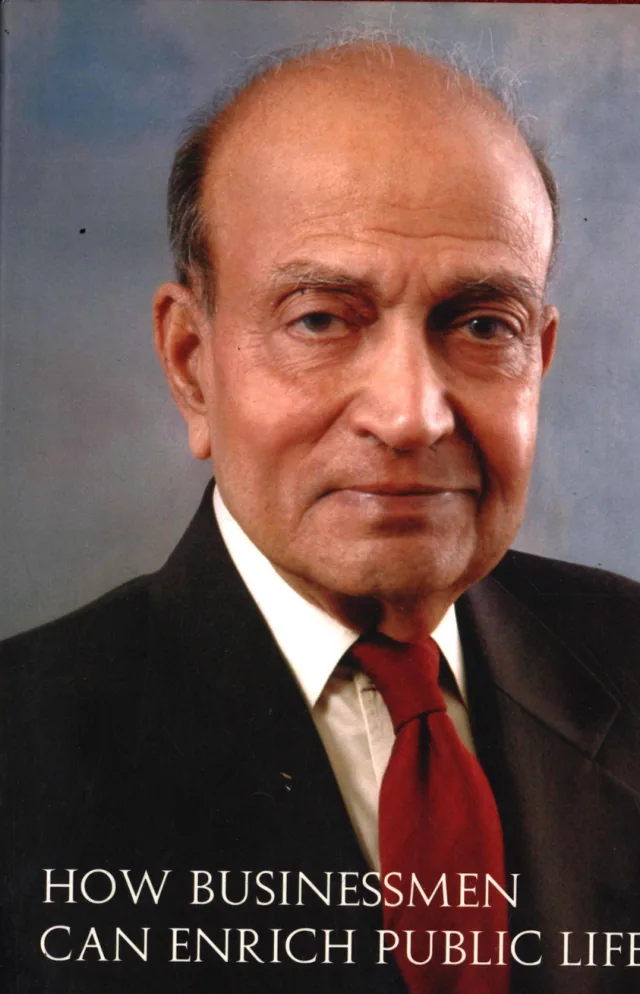
HOW BUSINESSMEN CAN ENRICH PUBLIC LIFE
Summary
This is a topical, document-based portrait of D. N. Patodia (about 40 when first elected), a Calcutta-based Marwari businessman who sat in the Fourth Lok Sabha (1967 to 1970) for the Swatantra Party from Jalore-Sirohi in Rajasthan and was President of the Federation of Indian Chambers of Commerce and Industry (FICCI) in 1985-86. S. V. Raju, a Swatantra Party organiser who knew Patodia from 1967, wrote it from Patodia’s parliamentary speeches, seminar papers and lectures after Patodia declined to write memoirs (“Let my work speak for me”). Raju states that it is not a biography. The book is sponsored by the Project for Economic Education, the Mumbai body founded by Minoo Masani, and published in November 2014. Its argument, set out in the Introduction, is that businessmen owe the country a role in public life as citizens and not merely as traders: they should join politics, argue for the market, and refuse the post-independence presumption that commerce is something to be taxed and distrusted. The Introduction frames the Second Five Year Plan of 1957 and the permit-licence-quota Raj as the beginning of Statism and the source of corruption, credits Rajaji and Masani with founding the Swatantra Party in 1959 to bring businessmen into electoral politics, and treats the 1967 election, in which nine young businessmen including Patodia won Lok Sabha seats, as a turning point.
Patodia’s own chapter of reminiscences (printed pp. 13-46) covers his family trading business in Calcutta, the Birla connection that led him into politics, his selection by Masani and Maharani Gayatri Devi, his maiden speech on President’s Rule in Rajasthan, and Masani as mentor. He then runs through Indian political history to the 2014 general election as he saw it: the Congress split, the 1971 defeat, his regretted vote for the Swatantra-Lok Dal merger, the Emergency, the Janata Party, Bofors, the 1991 crisis and reforms, and the Vajpayee and Manmohan Singh years. It also records his FICCI term (joint business councils, Rajiv Gandhi addressing business forums in Paris and Tokyo, the Kirloskar detention protest), his foreign visits (Friedrich Naumann Stiftung in 1970, Israel, the Caux Round Table, the 1996 Delhi convention on Liberal Values), and a warm account of cross-party courtesy in the Fourth Lok Sabha. Part I (Inter-State Relations in a Federal Polity) reconstructs his parliamentary interventions on state-by-state questions. On Rajasthan he argued that the Governor and the Home Ministry misused Article 356 in 1967 and described the 1969 famine in Jalore and the central government’s indifference to it. On West Bengal he argued that the Naxalbari insurrection was encouraged by China and that the Centre let law and order decay. On the North East he linked illegal migration, secessionist agitation and Chinese pressure on the Seven Sisters, with later editorial additions on AFSPA, Irom Sharmila and the death of Nido Tania. On Kashmir he reported on the 1967 parliamentary visit and concluded that the unrest was economic as much as communal and that Article 370 should go. Part II reproduces his 1967 speech that India had betrayed Tibet by conceding Chinese suzerainty in the 1954 treaty and should recognise the Dalai Lama’s government in exile. Part III sets out his questions in the Lok Sabha on Soviet interference in Indian elections, Radio Peace and Progress, the Novosti agreement with the Press Information Bureau, Soviet arms to Pakistan, the economics of rupee trade, and Soviet pressure over the choice of aircraft for Indian Airlines, including an exchange with Indira Gandhi.
Part IV, The Indian Economy, is the largest section. It draws on Patodia’s 1988 article on missed growth opportunities, which uses Japan, South Korea and China as comparators for resources India left idle, and on Masani’s 1965 “four fallacies” of planning. It also covers his 1969 critique of the Planning Commission’s Approach Paper to the Fourth Plan, which he said ignored irrigation, corporate farming, public-sector losses and unemployment. Masani’s account of the 1969 bank-nationalisation ordinance and the Cooper writ petition in the Supreme Court is quoted at length from Against the Tide, alongside Patodia’s December 1970 Lok Sabha speech on the deterioration of banking service, the Finance Ministry’s takeover of the Reserve Bank’s role and the need for trade and industry directors. The statist-policies chapter marshals his April 1969 Finance Bill and industry-demands speeches on taxation, deficit financing, Hindustan Machine Tools and licensing delays, ending with his proposal to rename the Ministry of Industrial Development the Ministry of Industrial Obstruction. The reform chapter reproduces his 1979 speech to the Indian Chamber of Commerce, Calcutta, in the presence of H. M. Patel, and his 1992 assessment, for the Project for Economic Education, of the Narasimha Rao and Manmohan Singh reforms; Raju argues the later stalling of reform followed neglect of the conditions Patodia listed. The FICCI chapter summarises the history of the Federation and Patodia’s presidency. Part V gathers three papers: a 1969 report on housing (a proposed National Housing Authority and 50 lakh houses a year), a 1992 paper on the oceans as the area of future opportunity, and a 2010 Rotary Club of Delhi Midtown address on global integration.
Appendices A to C abridge his 1985 New Delhi Traders Association address (Trader or Producer, with long quotations from G. D. Birla and J. R. D. Tata on nationalised industry and the TISCO takeover proposal), the 1985 Frank Moraes Memorial Lecture on the Third Industrial Revolution, and the 1986 Raja Ramdeo Anandilal Podar Memorial Lecture on Opportunities and Challenges for Business, which ends by suggesting that the 21st century may belong to India. Appendix D is a chronology of landmarks from 1969 to 2014, and the Notes supply background drawn largely from Wikipedia. Throughout, speeches are reported in the 1960s and 1980s register of a Swatantra liberal: free enterprise, low taxation, the primacy of agriculture and trade, deregulation, federal balance, and a sceptical reading of non-alignment. The editorial voice is Raju’s and is sympathetic; Patodia’s positions are given through his own quoted words, and the book is therefore best read as a primary-source record of Swatantra-era parliamentary liberalism by a businessman-legislator, framed and annotated by a later liberal admirer.
Notable passages
"I have never accepted the theory that it is the business of the businessman only to do business. It is his duty, first and foremost, to be a good citizen and to do his duty by the nation."
"I do not think this country would have come to this abysmal sorry pass if even one-tenth of our businessmen had done their duty."
"The permit licence quota Raj sowed the seeds of corruption."
"that the Indian voter has, by and large, made good use of the system and voted for change when he or she felt such change was needed."
"this book may not be his memoirs but it indeed is a refreshing collection of events leading to enrichment of public life and it certainly justifies the statement Patodia made to me when I was persuading him to write his biography: "Let my work speak for me." Indeed it does."
Metadata and summary are AI-extracted from the source PDF and reviewed for editorial accuracy. The original work is available via the Read PDF tab above (where present); paragraph-level citation inside the PDF is deferred to a future engagement.