speech · memorial lecture
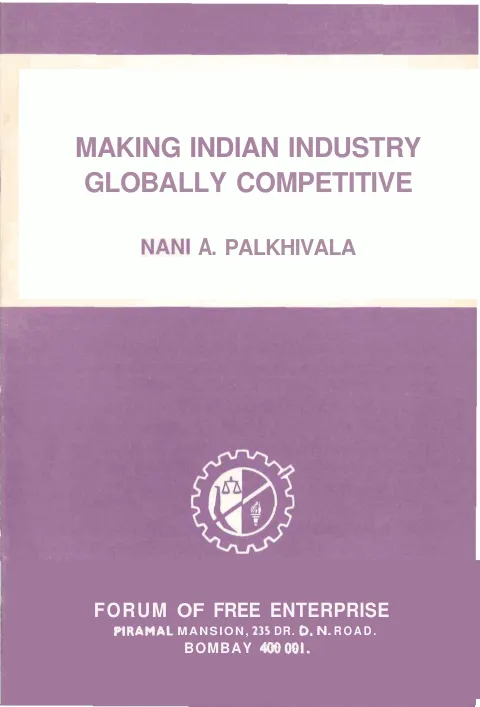
Making Indian Industry Globally Competitive
Published by M. R. Pai for the Forum of Free Enterprise, 235, Dr. D. N. Road, Bombay 400 001, and Printed at Tata Press Limited, 414, Veer Savarkar Marg, Prabhadevi, Bombay 400 025. · Bombay · 1995
11 pages
Making Indian Industry Globally Competitive
By Nani A. Palkhivala
Summary
This booklet reproduces the Twelfth T. A. Pai Memorial Lecture, delivered by Nani A. Palkhivala in Bombay on 17 January 1995 under the auspices of the T. A. Pai Institute of Management, Manipal, and published by the Forum of Free Enterprise. Opening with a tribute to the late T. A. Pai of Manipal as a rare blend of vision and pragmatism, Palkhivala argues that entrepreneurship ‘comes naturally to Indians’ and that the liberalization launched after 1991 finally let the ‘arthritic economy’ begin to perform like an athletic one.
The core of the lecture is a programme for making Indian industry globally competitive. Palkhivala insists that to compete a country must be ‘blessed with two favourable factors — an unlimited reservoir of talented and skilled labour and an abundance of capital,’ and he ranges across a set of reforms: spreading education (since half of India is ‘literally illiterate’), privatizing the public sector (‘the black holes, the money guzzlers’), reforming the labour policy and the tax system (calling the Income-tax Act ‘a national disgrace’), ending the government telephone monopoly, and rolling back caste-based reservations, which he calls ‘the greatest Himalayan blunder of India in this decade.’ He credits Manmohan Singh’s reforms but warns that ‘half-hearted reforms yield only half-baked results,’ and closes by lamenting India’s lack of moral leadership and contrasting Indian socialism with the British Labour Party’s repudiation of ideological socialism under John Smith and Tony Blair.
Key points
-
The work is a single-author memorial lecture by Nani A. Palkhivala (the 12th T. A. Pai Memorial Lecture, 17 January 1995), published as an FFE booklet.
-
Palkhivala opens by honouring T. A. Pai of Manipal and arguing entrepreneurship comes naturally to Indians.
-
He hails the post-1991 New Industrial Policy as a turning point that ended ‘the period of collective insanity’ and made India a ‘shareholding democracy’.
-
Global competitiveness, he argues, requires an abundance of skilled labour and capital, and above all the spread of education and value-based education.
-
His reform agenda: privatize the public sector, change labour policy, overhaul the tax system, end the telephone monopoly, and abolish caste reservations.
-
He calls reservations ‘the greatest Himalayan blunder of India in this decade’ and warns casteism is turning democracy into a ‘misguided democracy’.
-
He credits Dr. Manmohan Singh’s reforms but warns that ‘half-hearted reforms yield only half-baked results’.
-
He closes by contrasting India’s continued constitutional socialism with the British Labour Party’s dissociation from ideological socialism under John Smith and Tony Blair.
Generated by the v1.5 extraction pipeline. Awaiting editorial review.
Metadata and summary are AI-extracted from the source PDF and reviewed for editorial accuracy. The original work is available via the Read PDF tab above (where present); paragraph-level citation inside the PDF is deferred to a future engagement.