
periodical issue
Quest
a bi-monthly of arts and ideas
By S. Natarajan, Urmila Chowdhury, J. K. Chowdhury, J. N. Chubb, Swami Agehananda Bharati, Ramaswamy R. Iyer, S. S. Kapur, T. M. P. Mahadevan, N. A. Nikam, G. Sukumaran Nair, S. Ookerjee, David Mark
Indian Committee for Cultural Freedom, Army & Navy Building, 148, Mahatma Gandhi Road, Bombay 1 · Bombay · 1956
74 pages
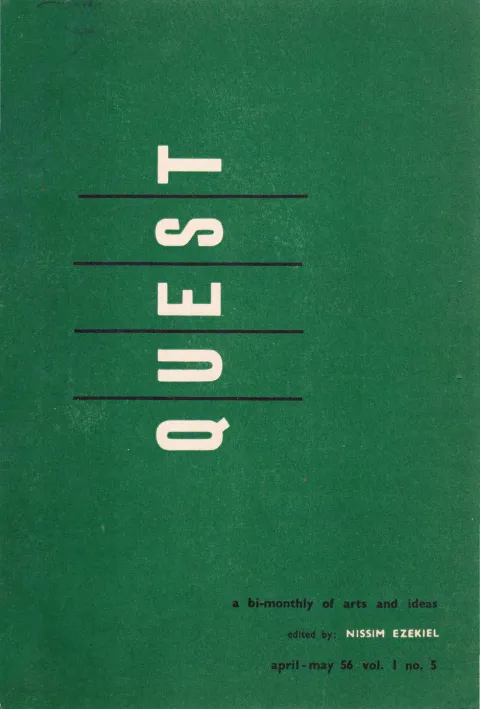
QUEST
Summary
QUEST Vol. I No. 5 (April-May 1956), edited by Nissim Ezekiel for the Indian Committee for Cultural Freedom, opens with an unsigned editorial on what a ‘free society’ means and closes 66 pages later with a page of brief contributor notes. In between it runs a wide arc typical of the magazine’s ‘arts and ideas’ remit: S. Natarajan’s political essay on Bombay’s place in the linguistic-states reorganisation and the January 1956 riots; a long illustrated essay by architects Urmila and J. K. Chowdhury on the design and reception of Le Corbusier’s Chandigarh, with an unlisted four-page photo insert of the city’s buildings; J. N. Chubb’s defence of the 1955 Nagpur session of the Indian Philosophical Congress against S. Ookerjee’s earlier attack, which spills into a five-letter correspondence exchange at the back of the issue; Swami Agehananda’s travel letter from Bangkok; dance and theatre criticism on Bharata Natyam/Kathak and on a Calcutta production of Tagore’s Rakat Karabi; and nine book reviews ranging from Japanese Kabuki and Buddhist scripture to contemporary Indian and Western fiction.
Essays
A Matter of Loyalties (the linguistic question)
By S. NATARAJAN
S. Natarajan argues that Congress’s own history of organising itself along linguistic lines since 1921 undercuts its 1956 preference for larger ‘composite’ states, and applies this to Bombay’s contested status under the States Reorganisation Commission. He rejects Chief Minister Morarji Desai’s claim that the four-day January 1956 riots were a Maharashtrian conspiracy to capture the administration, attributing the unrest instead to ‘leftist, undemocratic elements’ exploiting genuine linguistic grievance, and notes that C. D. Deshmukh’s resignation as Union Finance Minister over Bombay’s detachment from Maharashtra revealed how deep Maharashtrian sentiment ran even among the political elite. He concludes that if linguistic states are ‘irresistible’, they should be settled quickly while national unity can still be secured, rather than left to fester through evasive composite-state compromises.
- Congress’s 1920s linguistic reorganisation of its own party units undercuts its 1956 preference for composite states.
- The States Reorganisation Commission’s proposal to keep Bombay a composite bilingual state is attributed to the city’s wealth, not principle.
- Morarji Desai’s charge that the January 1956 riots were a conspiracy to capture the administration is called unjustified, though the unrest did aim to paralyse government.
- C. D. Deshmukh’s resignation as Union Finance Minister over Bombay’s detachment from Maharashtra is cited as proof of the depth of Maharashtrian feeling.
- Natarajan urges settling linguistic-state boundaries quickly while there is still scope to secure national unity.
Chandigarh (the birth of a city)
By URMILA CHOWDHURY & J. K. CHOWDHURY
Architects Urmila and J. K. Chowdhury recount Chandigarh’s founding controversy (rival Punjab towns competing for capital status after Lahore went to Pakistan), then defend Le Corbusier’s master plan — its rectangular sector grid separating high-speed traffic from pedestrians, its ‘Golden Mean’ proportional scale, and its deliberately economical material choices (brick jalis, vertical corner windows, built-in furniture) — against a catalogue of resident complaints about house size, joint-family accommodation, sweeper segregation and construction-era hardships (power cuts, leaking roofs). They read most of the criticism as a clash between traditional expectations and a frankly modern, cost-constrained design philosophy, and close by declaring plot demand has consistently outstripped supply despite the controversy.
- Chandigarh was built from scratch partly to resolve rival claims among Ambala, Jullundur, Amritsar and Simla to be East Punjab’s new capital after Partition.
- Le Corbusier’s plan organises the city into sectors served by a road hierarchy that keeps through-traffic away from pedestrian areas, with round-abouts planned to become two-level crossings.
- Widespread complaints (house size, sweeper segregation via caste custom, brick jalis mocked as ‘pigeon holes’/‘wasps’ nests’) are presented as friction between tradition and deliberately economical modern design.
- Economic constraints (brick cheapest, steel and glazing costly) directly shaped design choices such as vertical corner windows and built-in furniture.
- The essay carries an unlisted four-page photographic insert of Chandigarh buildings credited to Maxwell Fry, Jane Drew, P. Jeanneret and Le Corbusier, with no separate contents-page entry.
- Despite construction-period hardships, demand for building plots in Chandigarh has always exceeded supply.
Truth and Misrepresentation (The Indian Philosophical Congress)
By J. N. CHUBB
J. N. Chubb, professor of philosophy at Elphinstone College, rebuts S. Ookerjee’s earlier Quest article attacking the 1955 Nagpur session of the Indian Philosophical Congress. While conceding some of Ookerjee’s procedural complaints (late paper submissions, no cross-discussion among symposiasts), Chubb quotes the printed Congress Proceedings at length to argue that Ookerjee’s substantive charges against session president T. M. P. Mahadevan — that he prejudged Western philosophy as barren and urged ‘half closed minds’ — are ‘unabashed misrepresentations’ unsupported by the Address itself. He closes by calling Ookerjee’s claim that Congress sessions attract only dull students both illogical and empirically false, and notes Ookerjee’s reply appears later in the issue.
- Chubb accepts Ookerjee’s complaints about late paper acceptance and lack of symposiast cross-discussion as fair criticism.
- He rejects Ookerjee’s charge that Mahadevan’s presidential address prejudged Western philosophy as barren, quoting the printed Proceedings to show no such statement appears.
- Chubb accuses Ookerjee of ‘suppressio veri and suggestio falsi’ to discredit Indian philosophy professors.
- He calls Ookerjee’s claim that dull students are drawn to philosophy by Congress ‘muddle-headedness’ a confused, illogical argument.
- The piece ends noting Ookerjee’s reply is printed later in the same issue (page 63).
Saffron Robes and Joie de Vivre (a letter from Thailand)
By SWAMI AGEHANANDA
Swami Agehananda, an Austrian-born monk writing from Bangkok, describes Thai Buddhist monastic discipline (stricter daily rules than in India, but not lifelong vows) coexisting easily with modern urban pleasure, then surveys Thai classical Lakon/Khon dance-drama — whose Ramayana-derived plots he traces via a Tamil, not Valmiki, lineage — and Thai literary culture. He credits a Bengali monk sent by Rabindranath Tagore before the war with pioneering Thai-Indian cultural contact, and closes on a critical note about the roughly 16,000-strong resident Indian trading community in Bangkok, whom he finds almost totally indifferent to Thai culture.
- Thai monks keep stricter daily rules (no food after noon, no film or music) than Indian ascetics, but ordination is not for life.
- Thai Khon masked dance-drama draws its Ramayana plots via what the author traces as a South Indian (Tamil/Kamban) rather than Valmiki lineage.
- A Bengali monk sent by Rabindranath Tagore before the war is credited with pioneering modern Thai-Indian cultural liaison.
- Bangkok’s roughly 16,000 resident Indians (mostly Punjabi cloth-dealers and Gorakhpuri labourers) are described as almost totally indifferent to Thai culture, with even long-term residents never having visited major local sights.
- The letter closes by contrasting its own ‘gay’ travelogue tone with this final ‘negative’ observation about the Indian settler community.
Bharata Natyam and Kathak
By RAMASWAMY R. IYER
Ramaswamy R. Iyer rebuts Krishan Sondhi’s earlier Quest comparison of Bharata Natyam and Kathak as ‘highly misleading’, arguing Sondhi over-generalised an entire tradition from the dancer Shanta Rao alone and misunderstood both the centrality of abhinayam (facial and gestural expression) to Bharata Natyam and the secular, playful character of its Krishna- and Siva-themed padams. He also corrects Sondhi’s claim linking Bharata Natyam to matriarchy, noting matriarchy is confined to Kerala — home instead of the male-performed Kathakali — and closes hoping the regional dance and music traditions will ‘influence each other’ while remaining ‘distinct entities’.
- Sondhi’s three claims (Bharata Natyam weak in abhinayam; inspired mainly by awe of Siva; a masculine-vigour form opposed to Kathak’s femininity) are each rebutted as misstatements.
- Balasaraswati is cited as the greatest living exponent of Bharata Natyam’s abhinayam, contra Sondhi’s generalisation from Shanta Rao alone.
- Iyer argues the padams’ themes (Krishna’s and Siva’s amours) are secular love-poetry in disguise, not narrow devotional glorification of masculinity.
- Matriarchy exists only in Kerala, home of the male-performed Kathakali, undercutting Sondhi’s proposed link between matriarchy and Bharata Natyam.
- Iyer hopes North and South Indian dance and music traditions will influence each other while remaining distinct.
Rakat Karabi—Notes on a Play
By S. S. KAPUR
S. S. Kapur reads Tagore’s play Rakat Karabi (Red Oleanders) — about a gold-mining town enslaved by its rulers’ ‘megalomania and unthinking avarice’ — as neither weak dramaturgy nor a simple Marxist allegory but a symbolist ‘reaffirmation of Tagore’s faith in the human individual’, with Nandini and the worker Bisu embodying freedom and joy against the self-imprisoned King and the sterile intellect of the Professor. The essay situates Tagore’s technique between realist ‘clinical reportage’ and Shakespeare-to-Shaw expressionism, and closes by praising a 1956 Delhi staging by Calcutta’s Bohurupee group for its austere geometric sets and red-lit signalling of the King’s invisible presence.
- Rejects both the ‘weak dramaturgy’ critique and the purely Marxist allegorical reading of Rakat Karabi.
- Frames the play’s real conflict as ‘man’s flight from reality’ rather than a class struggle, with tragedy arising from ‘man’s fall from a state of natural grace’.
- Nandini and Bisu are read as twin symbols of freedom and joy; the King as the town’s self-imprisoned spirit; the cynical Professor as sterile meddling intellect.
- Situates Tagore’s dramatic technique between realist ‘clinical reportage’ and the Shakespeare-to-Shaw expressionist tradition.
- Reviews the Bohurupee group’s Delhi production (1955 and February 1956) for its geometric sets and red facade-lighting signalling the King’s entrances.
The Kabuki Theatre of Japan by A. C. Scott (review)
By N. J. N.
N. J. N. reviews A. C. Scott’s The Kabuki Theatre of Japan, describing Kabuki as a ‘comprehensive and living embodiment of Japanese aesthetic values’ rooted in its Tokugawa-era popular origins, built on the principle of suggestion over realism (the shibui aesthetic, the ‘doll-like’ ningyo no naru technique, onnagata female-role specialists), and closes with an extended point-by-point comparison to Kerala’s Kathakali as a kindred, though independently evolved, Asian dance-drama tradition.
- Kabuki is presented as key not just to Japanese culture but to ‘the soul of an entire people’, rooted in its popular Tokugawa-era origins.
- The aesthetic of shibui — suggestion, restraint, ‘completing through the incomplete’ — is treated as Kabuki’s defining principle, exemplified by the ningyo no naru (‘becoming a doll’) technique.
- Onnagata (male performers of female roles) are said to ‘suggest and symbolise feminine qualities as no woman can’.
- An extended comparison finds Kabuki and Kathakali share suggestion over realism, dance-based storytelling and elaborate costuming despite Kathakali being ‘mainly tandava, masculine, energetic, violent and acrobatic’ where Kabuki is described as generally quieter.
The Living Thoughts of Gotama the Buddha by A. Coomaraswamy and I. B. Horner (review)
By SARDAR MAHOMED
Sardar Mahomed reviews Coomaraswamy and Horner’s The Living Thoughts of Gotama the Buddha as a personal, questioning encounter with Buddhist doctrine, dwelling on parallels between the Buddha’s ‘Sermon on Fire’ and the Christian Epistle of James, the paradox that enlightenment’s ‘knowledge… is deep silence’ alongside the injunction to ‘swelter at the task’ oneself, and the Buddha’s studied refusal to definitively affirm or deny God, soul or eternity.
- Notes the book’s unexplained choice of the spelling ‘Gotama’ over the more familiar ‘Gautama’.
- Draws a parallel between the Buddhist ‘Sermon on Fire’ (‘the tongue is a fire… the wheel of becoming’) and James 3:6.
- Observes only 38 of the book’s 324 pages present the Buddha’s life and doctrine directly, and found these the most rewarding part.
- Highlights the Buddha’s refusal to straightforwardly affirm reincarnation, and the paradox that enlightenment ‘cannot be explained, it can only be felt’.
Pan by Knut Hamsun (review)
By R. CHOKSI
R. Choksi reviews the Artemis Press’s new translation of Knut Hamsun’s Pan, praising its lyrical, nature-suffused prose (comparing it to Growth of the Soil and Hunger, which he first read after Hamsun’s 1920 Nobel Prize) while criticising the novel’s melodramatic postscript revealing Lt. Glahn’s death as an unconvincing, unnecessary addition that undercuts the story’s otherwise complete emotional close.
- Choksi recalls first reading Hamsun after his 1920 Nobel Prize, and contrasts Pan’s compression with Growth of the Soil’s ‘cumulative epic force’.
- Criticises the postscript revealing Glahn’s death as unconvincing (‘the manner is still Lt. Glahn’s’) and unnecessary.
- Describes the Glahn-Edvarda relationship as ‘a sex duel, in which both the principals are creatures of feeling and unreason’.
- Concludes Pan holds its place among Hamsun’s best works despite its slight plot, crediting the translator’s fidelity to the prose style.
Some Inner Fury by Kamala Markandaya (review)
By AAMIR ALI
Aamir Ali gives Kamala Markandaya’s Some Inner Fury a sharply critical review, calling it ‘a painful disappointment’ despite prose ‘sensitivity rare in Indians writing in English’, and cataloguing a series of plot implausibilities (an unnamed provincial capital, a wartime interracial romance unnoticed by anyone, an idyllic holiday during 1942 unrest) that he argues destroy the novel’s verisimilitude and leave its purpose unclear.
- Calls the novel ‘a painful disappointment’ despite ‘passages and incidents of moving power and beauty’.
- Lists successive plot implausibilities — an unnamed provincial capital, a secret Anglo-Indian romance unnoticed by anyone, an idyllic wartime holiday — as fatal to the story’s credibility.
- Invokes Hamdi Bey’s thesis (from elsewhere in Quest) that Indian fiction’s heroes lack independent will, reading the heroine Mira’s excessive freedom of action as the reverse failure.
- Unfavourably compares the novel’s treatment of interracial romance to Han Suyin’s.
Inqilab by K. Ahmad Abbas (review)
By LAEEQ FUTEHALLY
Laeeq Futehally gives K. Ahmad Abbas’s Inqilab a satirical pan, mocking its checklist approach to nationalist milestones (Jallianwala Bagh, the Dandi march, Bhagat Singh) and its overuse of exclamation marks, arguing the hero Anwar ‘never becomes a human being’ and ‘remains a repository of proper feelings’, though she credits the book’s quoted Urdu poetry as its one redeeming feature.
- Compares Abbas unfavourably to Upton Sinclair’s Lanny Budd novels as an example of history-as-fiction that fails through weak characterisation.
- The hero Anwar is said to ‘never become a human being. He remains a repository of proper feelings.’
- Mocks Abbas’s reliance on exclamation marks to signal emotion the prose itself fails to convey.
- Credits the book’s quoted Urdu poetry, especially from Hali, as its best feature, closing by quoting Hali against the author himself.
The Genius and the Goddess by Aldous Huxley (review)
By LOLA CHATTERJI
Lola Chatterji reviews Aldous Huxley’s The Genius and the Goddess, summarising its triangle of the physicist Henry Maartens, his wife Katy and the young researcher John Rivers, praising the ‘aging Huxley[‘s]… many-sided approach to love — penetrating and humane’ compared with his earlier ‘acid, freezing’ fiction, but criticising the Chinese-box narration for an ‘air of artificiality’ and arguing that Huxley, like T. S. Eliot, ‘presuppose[s] far too great a conditioned response’ from ordinary readers.
- Summarises the Henry/Katy/John Rivers triangle and the daughter Ruth’s adolescent entanglement with Rivers.
- Praises the ‘aging Huxley[‘s]… many-sided approach to love’ as a departure from the ‘acid, freezing tones’ of his early novels.
- Criticises the Chinese-box (story-within-a-story) narration for giving the novel ‘an air of artificiality’.
- Concludes that Huxley, like T. S. Eliot, demands too great an intellectual ‘conditioned response’ from ordinary readers, alienating most of them.
China Phoenix by Peter Townsend (review)
By K. GURU DUTT
K. Guru Dutt reviews Peter Townsend’s China Phoenix as one of the most sympathetic foreign accounts of the Chinese Revolution, valuing its first-hand sincerity (Townsend served with the Friends Ambulance Unit and Chinese Co-operatives) despite a confusing twelve-part structure with restarting chronologies and ‘touched-up journalism’ drawn from his Spectator, New Statesman and BBC dispatches; he finds the book largely fair except for a suspected ‘attempt at white-washing’ in its chapter on political ‘brain washing’.
- Notes Townsend’s first-hand authority from service with the Friends Ambulance Unit and Chinese Co-operatives.
- Criticises the book’s confusing twelve-part structure, in which chronology restarts within several Parts.
- Quotes Mao Tse-tung’s line, ‘Dogma is no better than cow dung’, cited approvingly as evidence the book resists doctrinaire readings of Chinese Communism.
- Finds the account of foreign relations fair, but suspects ‘an attempt at white-washing’ in the chapter on political re-education (‘brain washing’).
The Philosophy of Mahatma Gandhi by D. M. Dutta (review)
By N. L. KHANOLKAR
N. L. Khanolkar reviews Dhirendra Mohan Dutta’s The Philosophy of Mahatma Gandhi, valuing it as a useful compact account of Gandhi’s synthesis of the Bhagavad Gita, Mahavir, Buddha, Christ, Ruskin and Tolstoy into the five-fold ethical structure of ahimsa, satya, asteya, brahmacharya and aparigraha, but arguing that no such handbook can substitute for the lived biographical record of the man whose philosophy ‘had become the man’ — leaving the reader, in the reviewer’s words, feeling offered ‘the husk and not the grain’.
- Gandhi’s philosophy fused the Bhagavad Gita, the teachings of Mahavir, Buddha and Christ, and Ruskin and Tolstoy, into a lived practice rather than an abstract ‘ism’.
- The review argues no perspective on Gandhi’s philosophy can be gained without his ‘struggle, his asceticism…, his sense of humour’ recorded in full biographical detail.
- Lists Gandhi’s five-fold Vedic ethical structure: ahimsa (harmlessness), satya (truthfulness), asteya (non-stealing), brahmacharya (chastity) and aparigraha (non-possession).
- Notes Gandhi wanted to live to 120 years to fully realise his programme of ‘moral enthusiasm’.
One Hundred Poems from the Japanese by Kenneth Rexroth (review)
By IQBAL LUKMANI
Iqbal Lukmani praises Kenneth Rexroth’s One Hundred Poems from the Japanese for capturing ‘the infinite power of suggestion’ of Japanese verse despite the form’s near-untranslatable reliance on homonyms and extreme compression, quoting several haiku as examples of ‘poignant simplicity’ and singling out the volume’s elegant physical production as a rare case of care amid an era of ‘economy-printing’.
- Argues Japanese poetry’s reliance on homonyms and double meanings makes it ‘practically untranslatable’, requiring far more skill than composing an original poem.
- Credits Rexroth with capturing ‘some of the daintiness of the originals’ despite acknowledged losses in translation.
- Quotes several haiku, including ‘No one spoke, / The host, the guest, / The white chrysanthemums’, as examples of poignant simplicity.
- Praises the book’s physical production and design as unusually careful for an ‘economy-printing’ era.
Correspondence: The Indian Philosophical Congress
By T. M. P. MAHADEVAN
T. M. P. Mahadevan, president of the attacked Nagpur session, writes to defend himself against Ookerjee’s charges, arguing Ookerjee’s ‘deep-seated prejudice against Indian philosophy’ leads him to invent views — that Western reasoning is ‘perverse’ and to be avoided — that Mahadevan’s printed Address never expressed, and challenges Ookerjee with a series of rhetorical questions about his East/West dichotomy.
- Accuses Ookerjee of assuming from the outset ‘that there is no such thing as Indian philosophy’.
- Poses a series of rhetorical questions challenging Ookerjee’s East/West philosophical dichotomy.
- Notes Ookerjee has already pronounced ‘final judgment’ branding Indian philosophy teachers ‘muddle-headed’.
Correspondence: The Indian Philosophical Congress
By N. A. NIKAM
N. A. Nikam, Secretary of the Indian Philosophical Congress, defends the institution’s international standing — citing its Proceedings’ circulation abroad, Unesco-sponsored symposia, and membership of the International Federation of Philosophical Societies — and points out that Ookerjee himself submitted his own symposium paper five to six weeks late and over the length limit he criticises in others.
- Cites the Congress’s Proceedings being listed in Philosophy, East and West (Hawaii) and ordered by libraries in Europe, Moscow, China, Japan and Latin America.
- Details Unesco-sponsored symposia the Congress has organised, including on ‘The Place of the Philosopher in Modern Society’.
- Notes Ookerjee himself sent his own symposium paper five to six weeks late and exceeded the length limit he faults in the Presidential Address.
- Quotes a Josef Pieper/Walter Weymann-Weyhe debate on ‘The Foundations of Freedom’ on the predicament of contemporary Western philosophy.
Correspondence: The Indian Philosophical Congress
By G. SUKUMARAN NAIR
G. Sukumaran Nair, an eyewitness at the Nagpur session, rebuts Ookerjee’s central conclusion that the Congress represents philosophy in India as ‘a menace and a mockery’, defending the doctrine of the ‘self-luminosity of Truth’ by quoting Kant, and accusing Ookerjee’s argument of ‘mal-observation and non-observation’ leading to a non-sequitur conclusion even if its premises were granted.
- Frames Ookerjee’s argument as a non-sequitur: even granting his premises, his conclusion that Congress philosophy is ‘a menace and a mockery’ does not follow.
- Defends Mahadevan’s address by quoting the printed Proceedings directly to show it does not disparage Western scientific method.
- Invokes Kant to defend the Indian doctrine that ‘Truth is self-luminous’.
- Argues Western philosophical schools (logical positivism, existentialism) are just as capable of dogmatic ‘fanaticism’ as any Indian school.
A Reply to My Critics
By S. OOKERJEE
S. Ookerjee replies combatively to Chubb, Mahadevan, Nikam and Sukumaran Nair, standing by his original description of the Nagpur Congress as ‘a farce… imposing from the outside and rotten within’, quoting Mahadevan’s own Address at length to argue it does show an anti-Western ‘externalist’ framing, conceding one ‘elementary mistake’ while downplaying it, and closing with a barbed logical challenge to Sukumaran Nair.
- Opens by declaring ‘Truth hurts, and my critics have been hurt badly. I have done some plain speaking, and they don’t like it and can’t take it.’
- Quotes Mahadevan’s Address at length (condemning Descartes, Spinoza, Leibniz, Locke, the Positivists and Existentialists as ‘externalist’) to argue his own original characterisation was accurate.
- Admits an ‘elementary mistake’ Chubb identified but insists it took him only ‘about 60 seconds’ to recognise it, unlike, he implies, the Congress’s usual practice.
- Rebuts Nikam by arguing Nikam’s letter actually confirms rather than contradicts his own claims about the Congress’s external activities.
- Closes by challenging Sukumaran Nair: his utterances are ‘either logical or illogical’ and either way undermine his own position.
Some Observations
By DAVID MARK
David Mark, writing from Madras, responds to two pieces in the previous issue: dismissing Krishan Sondhi’s Bharata Natyam/Kathak comparison as ‘over-simplified… inadequate and false’, but praising Hamdi Bey’s essay on the Indian novelist’s dilemma as genuinely ‘provocative in a creative sense’, and closes by criticising the short story ‘Binda’ for resolving its climax in a single unprepared, vague sentence.
- Calls Sondhi’s earlier piece ‘over-simplified… inadequate and false in its conclusion’, citing his own wife’s expertise as a Bharata Natyam student.
- Endorses Hamdi Bey’s ‘Dilemma of the Indian Novelist’ as raising a genuine, underexplored question about character motivation in Indian fiction.
- Contrasts the Western fictional hero, who is ‘driven and compulsive’ but whose authors and readers ‘want to know why’ he acts, with what he implies is a gap in Indian fiction.
- Faults the short story ‘Binda’ for an unearned mystical climax resolved in the single sentence ‘Suddenly I felt a certain relief.‘
Essay 21
NOT IN TOC. The unsigned lead editorial asks ‘what exactly do we mean when we call a society free?’, arguing that the internal argument among believers in freedom about its proper limits matters as much as the external argument against communism, and warns that India’s ‘resources of faith in freedom and democracy are limited’, illustrating the danger with a Lok Sabha exchange in which a minister defended postal censorship ‘in the interests of the security of the country’.
- Frames the ‘communist vs free society’ argument as an ethical and philosophical dispute, not merely political, that ‘must continue’.
- Warns that critics of the free society judge it against an ‘ideal of freedom’, so internal debate among liberals about freedom’s proper limits is as necessary as anti-communist argument.
- Cites a Lok Sabha exchange (Mr. C. N. Malaviya questioning, Mr. Raj Bahadur admitting and justifying postal censorship) as evidence of quiet public acceptance of illiberal practice in India.
- Warns ‘before freedom is destroyed a state of mind must be popular to which freedom does not matter’, naming rival values like ‘national emergency’ and ‘the people’s will’.
- Concludes that exploring what freedom means ‘in a sharply Indian and contemporary context… is also the purpose for which QUEST exists’.
Essay 22
NOT IN TOC. A house feature, ‘to our readers’, reprints unsolicited praise for QUEST from readers and public figures — including the novelist R. Prawer Jhabvala, an Indian ambassador, and several university professors — explicitly as part of a circulation drive inviting readers to send in acquaintances’ addresses for free specimen copies.
- Quotes praise from novelist Mrs. R. Prawer Jhabvala, Stanley Maron of the University of California, Ambassador R. R. Saksena, and Delhi University’s Professor Daya Kishen, among others.
- Explicitly frames the endorsements as a circulation-building device, inviting readers to supply acquaintances’ names and addresses for free specimen copies.
Essay 23
NOT IN TOC. The back-matter ‘contributors to this issue’ page gives one-line biographical notes for four of the issue’s contributors (S. Natarajan, Urmila and J. K. Chowdhury, J. N. Chubb, Swami Agehananda), followed by the standing invitation for unsolicited manuscripts and the editor’s disclaimer that contributors’ views are their own.
- Identifies S. Natarajan as ‘the former editor of the Free Press Journal, (Bombay)’.
- Identifies Urmila and J. K. Chowdhury as ‘architects connected with the Chandigarh scheme’.
- Identifies J. N. Chubb as ‘professor of Philosophy at Elphinstone College, Bombay’.
- Identifies Swami Agehananda as ‘Austrian by birth’, a previous contributor of ‘Philosophy East and West’ to Vol. 1, No. 2.
- States editorial policy: contributions are invited and paid for, and views expressed are the contributors’ own, not necessarily those of the Indian Committee for Cultural Freedom.
Generated by the v1.5 extraction pipeline. Awaiting editorial review.
Metadata and summary are AI-extracted from the source PDF and reviewed for editorial accuracy. The original work is available via the Read PDF tab above (where present); paragraph-level citation inside the PDF is deferred to a future engagement.
People in this work
- S. Natarajanauthor
- Urmila Chowdhuryauthor
- J. K. Chowdhuryauthor
- J. N. Chubbauthor
- Swami Agehananda Bharatiauthor
- Ramaswamy R. Iyerauthor
- S. S. Kapurauthor
- T. M. P. Mahadevanauthor
- N. A. Nikamauthor
- G. Sukumaran Nairauthor
- S. Ookerjeeauthor
- David Markauthor
- Sardar Mahomed
- R. Choksi
- Aamir Ali
- Laeeq Futehally
- Lola Chatterji
- K. Guru Dutt
- N. L. Khanolkar
- Iqbal Lukmani
- Nissim Ezekiel
- Indu P. Saraiya
- Maxwell Fry
- Jane Drew
- P. Jeanneret
- Le Corbusier
- Jawaharlal Nehru
- C. Rajagopalachari
- C. D. Deshmukh
- Rabindranath Tagore
- Mao Zedong
- Mahatma Gandhi
- Immanuel Kant