
periodical issue
FF567
The Liberal Magazine
By R. M. Mohan Rao, Ajit Karnik, Sunil S. Bhandare
Published by J. R. Patel for the Indian Committee for Cultural Freedom (ICCF) and printed by him at Union Press, 13 Homji Street, Fort, Mumbai 400 001. · Mumbai · 2014
40 pages
Freedom First
Summary
Freedom First No. 567 (September 2014) is the monthly magazine of the Indian Committee for Cultural Freedom, edited by S. V. Raju, in its 63rd year of publication. The cover and opening insert frame Prime Minister Narendra Modi’s August 15, 2014 Independence Day pledge to replace the Planning Commission against the Swatantra Party’s near-identical 1967 election-manifesto promise to dissolve it, and much of the issue reads the new NDA government’s first hundred days — the Planning Commission’s abolition, the maiden Union Budget 2014-15, and BRICS summit diplomacy — through a classical-liberal, free-enterprise lens. Regular features (reader letters, an editorial, the ‘Point Counter Point’ debate column, a book review, and the historical-quotes page ‘Many Voices from the Past’) sit alongside signed opinion pieces by a roster of economists, retired civil/military officials and academics, including V. K. Krishna Moorthy, Subroto Roy, Ashok Karnik, B. Ramesh Babu (with an addendum by Dr. R. G. Gidadhubli), Suresh C. Sharma, T. H. Chowdary, R. M. Mohan Rao, Shyam Ashtekar, Ajit Karnik, Sunil S. Bhandare and M. D. Kini.
Beyond domestic economic policy, the issue covers foreign affairs (the BRICS Fortaleza summit, the Islamic State’s rise in Iraq/Syria, and Israel’s Gaza offensive against Hamas), rural distress (an agriculture-indebtedness series and a health-sector policy essay), and a substantial ‘Educating Adults’ section devoted almost entirely to the 2014 UPSC Civil Services Aptitude Test (CSAT) language controversy, in which seven distinct short opinion pieces debate whether dropping English-comprehension marks from the merit list was a justified corrective for regional-language candidates or an unprincipled capitulation to protest.
Essays
From Our Readers
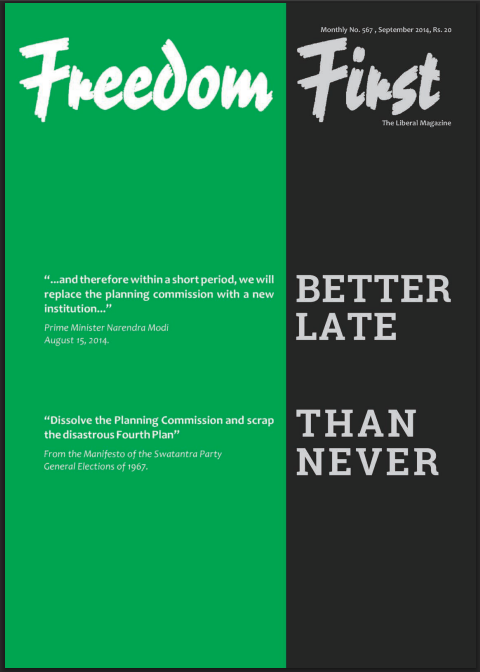
An unsigned inside-cover feature explains the issue’s cover juxtaposition: PM Modi’s August 15, 2014 Independence Day pledge to replace the Planning Commission is set against the Swatantra Party’s 1967 general-election manifesto promise to ‘dissolve the Planning Commission and scrap the disastrous Fourth Plan.’ It reprints the manifesto’s core pledges — cutting government expenditure and taxes, ending the ‘Permit-Quota-Licence Raj,’ freeing agriculture, trade and industry from state control, ending monopolies, and ensuring free compulsory elementary education — and notes the party’s 1967 electoral result.
- Cover pairs a 2014 Modi quote on replacing the Planning Commission with the Swatantra Party’s 1967 manifesto promise to dissolve it.
- The 1967 manifesto promised to cut taxes and government expenditure, end the ‘Permit-Quota-Licence Raj’, and free agriculture, trade, industry, panchayats and cooperative societies from state control.
- It also promised to end all monopolies (State or private), restore free competition, and provide free compulsory elementary education.
- Swatantra won 44 of 179 contested Lok Sabha seats in the 1967 general election, polling 8.68% of the total votes cast.
Editorial
By Editor
The ‘From Our Readers’ letters page carries an exchange between Tibetan activist Tenzin Tsundue and a North-East Indian correspondent on shared experiences of discrimination and non-violent resistance; several letters respond approvingly to the editor’s earlier web-edition note on Goa Deputy Chief Minister Francis D’Souza’s description of himself as a ‘Christian Hindu’; a letter citing Nani Palkhivala argues the Modi government’s first budget has not changed India’s coercive ‘tax collection culture’; and a letter argues the Swatantra Party’s ideas, if not the party itself, could be revived to influence the new government.
- Tenzin Tsundue (Dharamshala) and Avi Abram Krocha (Chennai) exchange letters on discrimination faced by Tibetan refugees and North-East Indians, and on non-violent resistance.
- Several readers (Ranga Kota, Dan Driscoll, Girdhar Patil, H. R. Bapu Satyanarayana, Venkatraman Anantha Nageswaran) respond to the editor’s note on Francis D’Souza’s ‘Christian Hindu’ self-description.
- M. B. Damania cites Nani Palkhivala’s charge that income-tax officers are ‘tax extortionists’ and argues the 2014 budget shows no change in India’s tax-collection culture.
- Hina Manerikar argues Swatantra’s ideas could be ‘reactivated’ via a liberal caucus advising the Modi government, and urges continued efforts to keep the Congress (I) out of power.
Exit – India’s National Planning Commission
By V. K. Krishna Moorthy
The editorial revisits Goa Deputy Chief Minister Francis D’Souza’s description of himself as a ‘Christian Hindu’ and juxtaposes it with Rabindranath Tagore’s essay ‘Atma Parichaya’ (Introducing Oneself), reprinted by Freedom First in September 2011, in which Tagore argued ‘Hindu’ denotes a shared Indian cultural inheritance rather than a religious creed, citing historical ‘Hindu Christians’ such as Kali Charan Banerjee and Jnanendra Mohan Tagore. The editor notes that Bengali-language media discussions of D’Souza’s remark seemed unaware of Tagore’s own essay on the same theme, and directs readers to the magazine’s online archive for the full piece.
- Revisits a controversy over Goa Deputy CM Francis D’Souza’s July 2014 self-description as a ‘Christian Hindu.’
- Quotes at length from Tagore’s Atma Parichaya (trans. Buddhadeva Basu, reprinted Freedom First Sept. 2011) distinguishing ‘Hindu’ as culture/nationhood from religion.
- Cites Tagore’s examples of historical ‘Hindu Christians’ (Kali Charan Banerjee, Jnanendra Mohan Tagore, Krishna Mohan Banerjee).
- Notes that Bengali press and TV discussions of the D’Souza episode appeared unaware of Tagore’s parallel essay, and points readers to the magazine’s web archive.
Haksar, Manmohan and Sonia
By Subroto Roy
V. K. Krishna Moorthy traces the history of centralized economic planning in India, from Subhash Chandra Bose’s 1938 National Planning Committee through Nehru’s 1950 Planning Commission, and argues six decades of centralized planning failed to significantly improve rural living standards even as inequality worsened during the UPA years. He reports the Commission’s own Independent Evaluation Office criticizing its ‘opaque functioning’ and recommends replacing it, and closes by reproducing PM Modi’s August 15, 2014 Independence Day announcement that a new institution — expected to be called the National Development and Reforms Commission — will replace the Planning Commission.
- Traces Indian economic planning from Subhash Chandra Bose’s 1938 National Planning Committee and the 1944 Bombay Plan (B. R. Shenoy and A. D. Shroff) through Nehru’s 1950 Planning Commission.
- Cites Business Standard data showing rising inequality in more than two-thirds of India’s 29 states between 2004-05 and 2011-12 despite continuous central planning.
- Notes the Planning Commission’s own Independent Evaluation Office found it exceeded its mandate as a ‘control commission’ and recommended a leaner replacement think tank.
- Reproduces PM Modi’s August 15, 2014 Independence Day speech announcing a new institution — ‘a new body, a new soul, a new thinking’ — to replace the Planning Commission, expected to be modelled on China’s National Development and Reform Commission.
Point Counter Point
By Ashok Karnik
Economist Subroto Roy offers a first-person memoir disputing recent published accounts by Natwar Singh and Sanjaya Baru of how P. N. Haksar allegedly engineered Manmohan Singh’s rise to the premiership. Roy recounts meeting a young Manmohan Singh in 1973 (introduced by his father), his own role creating Rajiv Gandhi’s 1990-91 economic-reform advisory group, unheeded warnings he gave about Rajiv’s security, and his single meeting with Sonia Gandhi in 1991, concluding that Manmohan Singh’s eventual premiership under Sonia Gandhi was long anticipated rather than an ‘accident.’
- Roy’s father hosted G. Parthasarathi and a young Manmohan Singh in Paris in 1973, when Singh was said to be ‘expected to become prime minister of India some day.’
- Roy created and led a 1990-91 advisory group for Rajiv Gandhi on economic liberalisation, and disputes Sanjaya Baru’s account of how that group came to exist.
- Disputes Natwar Singh’s claim that P. N. Haksar engineered a failed 1991 attempt to install S. D. Sharma as PM before Sonia Gandhi turned to P. V. Narasimha Rao.
- Argues Manmohan Singh’s 2004 premiership under Sonia Gandhi was long foreseen, drawing a Soviet-era Kosygin/Brezhnev analogy for a technocrat premier serving a party-boss dynast.
Foreign Relations in the 21st Century: BRICS and Beyond: Development at Home and Peace Abroad
By B. Ramesh Babu
Ashok Karnik’s recurring ‘Point Counter Point’ feature stages opposing views on three controversies: alleged ‘arrogance of power’ among fringe NDA/Sangh Parivar supporters after the 2014 change of government (including a Shiv Sena MP’s mistreatment of a Muslim canteen manager and VHP rhetoric); the July 2014 Pune bomb blast and India’s chronically stalled CCTV surveillance rollout; and journalist Ved Prakash Vaidik’s controversial meeting with LeT chief Hafiz Saeed as an instance of reckless ‘Track II diplomacy.’
- Point view: incidents involving Shiv Sena MPs, VHP’s Ashok Singhal and Togadia, and ABVP’s action against the UPSC English test suggest emboldened extremist elements reflecting on the whole regime.
- Counter view: such acts are not government policy, but the ruling coalition must rein in supporters whose ‘arrogance’ squanders public goodwill.
- Both sides agree the Pune blast underlines India’s stalled CCTV/surveillance rollout, still stuck in procurement red tape years after 26/11.
- The Vaidik-Hafiz Saeed meeting is debated as either a naive diplomatic overreach or simple self-promotion by a ‘self-appointed diplomat.‘
The Islamic State of Iraq and Syria
By Suresh C. Sharma
B. Ramesh Babu reviews the outcomes of the Sixth BRICS Summit (Fortaleza, Brazil, July 2014), highlighting the New Development Bank’s equal-capital structure as a diplomatic win for PM Modi against Chinese pressure for a dominant share, the $100 billion Contingent Reserve Fund, and Modi’s bilateral meetings with Xi Jinping, Putin, Rousseff and Zuma. He remains skeptical that BRICS heralds a stable multipolar order, warning that Chinese military assertiveness and fresh Ladakh incursions (even during the summit) remain India’s central strategic threat. An addendum by Dr. R. G. Gidadhubli assesses BRICS’s economic weight (a third of world territory, 42% of population, 30% of global GDP) and structural challenges such as dollar dependence.
- The New Development Bank was capitalised with equal contributions from all five members — a diplomatic win for India against China’s push for a dominant share — alongside a $100bn Contingent Reserve Fund (China: $41bn; India, Russia, Brazil: $18bn each; South Africa: $5bn).
- Modi’s meeting with Xi Jinping raised the border dispute, trade imbalance, and China’s invitation for India to join the Shanghai Cooperation Organisation and the Asian Infrastructure Investment Bank.
- Modi’s meetings with Putin, Rousseff and Zuma expanded energy ties, cyber-security cooperation, and historical India-South Africa links dating to Gandhi’s era.
- The author argues India must hedge against China’s ‘aggressively expansionist’ posture in the Himalayas via defence build-up and closer ties with the US and Japan, rather than rely on BRICS goodwill.
- Gidadhubli’s addendum notes BRICS covers a third of world territory, 42% of population and 30% of global GDP, but flags continued dollar dependence and slowing India/Russia growth as challenges.
Israel’s Gaza War on the Hamas
By T. H. Chowdary
Brig. Suresh C. Sharma (retd.) surveys the sectarian roots of the Iraq and Syria civil wars and the rise of ISIS under Abu Bakr al-Baghdadi’s self-declared Caliphate, describing the proxy dynamics pitting Saudi/Turkey/Jordan-backed Sunni rebels against Iran-aligned Shia governments. He warns of spillover into Afghanistan, Pakistan and India, notes 18 Indian youths have already left to join the ‘holy war,’ and recommends screening people returning from or travelling to the Middle East, diversifying oil imports, and abandoning any trans-Pakistan gas pipeline.
- The Iraq/Syria conflicts have caused over 300,000 deaths and displaced more than 1.5 million people.
- Abu Bakr al-Baghdadi proclaimed the Islamic State of Iraq and Syria a Caliphate on 29 June 2014, demanding allegiance from all Muslims and claiming historically Muslim-ruled lands including parts of India.
- 18 youths from India have already left to join ISIS; Al-Qaeda is said to view India as a potential source of jihadi recruits.
- Recommends India institute screening procedures for people returning from or travelling to the Middle East, diversify oil imports away from the region, and scrap any planned Pakistan-transit gas pipeline.
- A postscript notes reports, after the article was written, of ISIS committing genocide against Yezidis and Christians in Kurdistan, with US airdrops of food but no ground troop commitment.
The Rural Perspective: Agriculture and Rural Indebtedness - II
By R. M. Mohan Rao
T. H. Chowdary draws a historical analogy between President Truman’s 1945 decision to drop two atomic bombs on Japan and Israel’s 2014 Gaza offensive against Hamas, arguing both faced a ‘lesser evil’ calculus against a fanatical, no-surrender adversary, and likening Hamas and wartime Japan to the Mahabharata’s Samsaptakas. He notes no Arab government seriously challenges Israel’s campaign beyond formal condemnation, and recommends India limit itself to pro-forma ceasefire statements given its own vulnerability to jihadist mobilisation in Kashmir.
- Analogises Truman’s atomic-bomb decision, taken to end WWII with the least total slaughter, to Israel’s dilemma in confronting Hamas in Gaza.
- Compares Hamas’s fight-to-the-death posture, and its willingness to sacrifice its own people, to the Mahabharata’s Samsaptakas and to Imperial Japan’s resistance at Okinawa.
- Notes that no Arab government, including Gaza’s neighbour Egypt, is seriously challenging Israel’s campaign beyond condemnation, since they consider Hamas fanatic and reckless.
- Recommends India, given its own jihadist threat in Kashmir under AFSPA, restrict itself to proforma calls for a ceasefire rather than take sides.
The Health Sector Radar
By Shyam Ashtekar
In the second installment of a series on Indian agriculture, R. M. Mohan Rao surveys structural problems 67 years after independence: shrinking and degrading landholdings, groundwater depletion worsened by subsidised power, the decline of public agricultural extension and cooperative credit, growing commercialisation risk for small and marginal farmers, and the erosion of joint-family and community safety nets. He calls for corrective policy fine-tuning to make Indian agriculture more equitable and resilient, with the series to continue in a future issue.
- Land degradation and shrinking per-capita holdings remain the central constraint on rural livelihoods.
- Cheap or free electricity encourages excess groundwater extraction, disproportionately harming small farmers who rely on dug wells rather than deep bore wells.
- Institutional agricultural credit’s role has declined; the number of farm bank accounts fell from 207.1 million (1998) to 161 million (March 2003).
- Public agricultural extension has shifted from a technical/knowledge role toward a ‘regulatory and administrative’ one, effectively withering.
- Decline of the joint family and rural community networks has left farmers, especially the young, more exposed to economic shocks.
The Economy: Did the NDA Government Inherit “Empty Coffers”?
By Ajit Karnik
Dr. Shyam Ashtekar sets out design principles for national health policy under the new NDA government and applies a ten-point ‘health radar’ (a spider chart) to score India’s current standing against goals across areas including social health insurance, primary care, hospital economics, drugs/technology, disease control, demography, AYUSH, and legal reform. He argues Universal Health Care is achievable only through a phased Social Health Insurance (SHI) model that converts existing out-of-pocket spending into prepaid contributions, alongside expanded community paramedics, AYUSH-run sub-centres, and review of laws such as the PNDT Act and Clinical Establishment Act.
- A full UHC on the UK-NHS model would require 6-10% of GDP; India spends about 5% (public+private) already, with the Srinath Reddy committee proposing 2.5% of GDP for a tax-funded package the author considers inadequate for HR costs alone.
- Recommends Social Health Insurance (SHI), building on existing ESIS reforms, to convert roughly Rs 3,000 per-capita annual out-of-pocket spending into a prepaid resource pool.
- About 60% of rural specialist positions remain vacant despite eight years of NRHM; roughly 7 lakh ASHAs are paid under Rs 1,000 a month.
- Proposes trained community paramedics for about 50 common ailments, AYUSH doctors running roughly one lakh health sub-centres, and handing sub-centres to local panchayats.
- Calls for review of the PNDT Act and Clinical Establishment Act, and a major overhaul of the Medical Council of India Act to better regulate AYUSH and human resources.
The Budget 2014-15 from a Liberal Perspective
By Sunil S. Bhandare
Prof. Ajit Karnik statistically tests PM Modi’s claim, disputed by former Finance Minister P. Chidambaram, that the outgoing UPA government left government coffers empty, by comparing revenue expenditure/receipts, revenue deficits and gross fiscal deficits for April-May and Quarter 2 of each fiscal year from 2003-04 to 2014-15. He finds the pattern of high early-year deficits followed by improved Q2 positions is a structural feature of every year examined, not unique to 2014, and concludes Modi’s ‘empty coffers’ remark was ‘probably an exaggeration’ meant to signal limited fiscal room for the new Finance Minister.
- Revenue Expenditure consistently exceeds Revenue Receipts in April-May of every fiscal year from 2003-04 to 2014-15 — a structural mismatch, not evidence of reckless UPA behaviour.
- By Quarter 2 (July-September), revenue receipts exceed revenue expenditure in most years, the reverse of the Quarter 1 pattern.
- The UPA’s use of 45.6% of the budgeted Gross Fiscal Deficit in April-May 2014 was not exceptional — the ratio was higher in 2006-07 (48.5%) and 2008-09 (54.9%).
- Concludes there is no statistical evidence the outgoing UPA government behaved recklessly to constrain its successor’s fiscal room.
Budget 2014-15: Continuity and Change
By M. D. Kini
Sunil S. Bhandare assesses Finance Minister Arun Jaitley’s maiden NDA budget from a classical-liberal standpoint, identifying five ‘building blocks’: continued fiscal consolidation, commitment to GST, a re-energised PSU disinvestment target, ease-of-doing-business measures, and a large infrastructure/PPP push. He criticises the government’s failure to articulate a clear privatisation stance comparable to Thatcher-era Britain, calling the budget ‘directional’ rather than ‘transformational,’ and withholds judgment on whether Modi will develop his own distinctive model of economic leadership.
- Fiscal deficit is targeted to fall from 4.1% (2014-15) to 3% by 2016-17; revenue deficit from 2.9% to 1.6% over the same period.
- Recalls the Indian Liberal Group’s own three ‘Liberal Budget’ documents (2004-05 to 2006-07) as a benchmark for fiscal-responsibility rigour.
- PSU disinvestment target raised to Rs 58,425 crore versus roughly Rs 16,000 crore actually realised the previous year; the author wants a genuine ownership shift, not just revenue mobilisation.
- Welcomes the GST commitment, ease-of-doing-business measures (the eBiz platform, Indian Customs Single Window), and infrastructure/PPP initiatives such as 100 Smart Cities and a National Industrial Corridor Authority.
- Concludes it would be premature to say whether Modi will build his ‘own unique model of inspiring economic leadership’ akin to Lee Kuan Yew, Thatcher, or Deng Xiaoping.
Book Review: Persian Gulf 2013: India’s Relations with the Region, edited by P. R. Kumaraswamy
By Reviewed by Dr. B. Ramesh Babu
M. D. Kini frames Finance Minister Jaitley’s budget as balancing policy continuity — accepting the 4.1%-to-3% fiscal deficit glide path and continuing MGNREGA and other welfare schemes — with new initiatives: 49% FDI in defence production, expanded Aadhaar-linked bank accounts with overdraft and insurance, APMC Act reform to free farmers to sell to any buyer, a venture-capital fund and ‘Skill India’ training programme, and new textile and handicraft clusters, concluding ‘no sector’ was left out of the budget.
- The 4.1%-to-3% fiscal deficit glide path over three years is treated as a bipartisan continuity commitment.
- The 49% FDI cap in defence production is intended to bring in both capital and technical know-how, reducing India’s reliance on imported armaments.
- The government plans two bank accounts per household nationwide, each with a Rs 5,000 overdraft facility and Rs 1 lakh accident insurance, to eliminate leakage in benefit transfers.
- The Finance Minister proposes to persuade states to amend the APMC Act so farmers can sell produce to any buyer at the best price, ending mandi licence-holders’ monopoly.
- New measures include a Rs 10,000 crore venture-capital fund, a Rs 100 crore Village Entrepreneurship Programme, and a ‘Skill India’ vocational training scheme.
Educating Adults: Notes on Education: Compulsory Education
By Suresh C. Sharma
Dr. B. Ramesh Babu reviews Persian Gulf 2013: India’s Relations with the Region, edited by P. R. Kumaraswamy, praising it as a comprehensive annual survey compiled by younger scholars at JNU’s Centre for West Asian Studies. The review highlights the editor’s 40-page introduction on India’s underdeveloped West Asia expertise, growing India-Israel pragmatism, and the complicating effect of the ‘Arab Spring’ on the region’s traditional Shia-Sunni and Arab/non-Arab divides, while suggesting the region be termed ‘West Asia’ rather than ‘Persian Gulf.’
- India’s energy security is deeply tied to the ‘vast and troubled’ Persian Gulf/West Asia region, yet the country’s foreign-policy expertise on it is called ‘woefully inadequate.’
- The volume is conceived as an annual country-wise survey; the reviewer urges the publisher to continue the series.
- The book highlights India’s balancing act between US pressure on Iran/Iraq/Afghanistan policy and growing India-Israel pragmatic cooperation.
- The ‘Arab Spring’ is flagged as reshaping regional politics beyond the traditional Shia-Sunni and Arab/non-Arab divides.
Civil Services Examination: The Uncivil Protest
By Dr. Jyoti Marwah
Brig. Suresh C. Sharma (retd.) argues India’s Right to Education Act’s compulsory-schooling provision is unenforceable because no agency is tasked with enforcement, contrasting this with the US, Australia, Denmark, Finland and Germany, which pair truancy laws with active enforcement mechanisms such as counselling officers, police liaison, fines, and withdrawal of welfare benefits. Using personal anecdotes, he argues India should focus on providing accessible, quality schooling rather than unenforceable compulsion, noting only 5% of candidates qualify Maharashtra’s teacher eligibility test and 25% of teachers are absent daily.
- The RTE Act’s compulsory-education mandate has no enforcement agency in India, unlike truancy-enforcement regimes in the US, Australia, Denmark, Finland and Germany.
- In the US, ‘truancy’ is enforced by counselling officers, courts and magistrates; in Australia, police patrol near schools; in Denmark and Germany, welfare benefits or fines are used against truant families.
- The author recommends a pragmatic approach — expanding access and quality rather than imposing compulsion India cannot enforce, given overburdened courts and police.
- Notes only 5% of candidates qualify Maharashtra’s Teacher Eligibility Test and about 25% of teachers are absent from duty daily.
UPSC Civil Services Examination and the Language Controversy
By Dr. Rita P. Bhambi
Dr. Jyoti Marwah argues the 2014 protests against the UPSC Civil Services Aptitude Test (CSAT) were nominally about English-language bias but really reflect students’ inability to handle analytical-reasoning questions, and criticises the government’s concession to drop the 20-mark English comprehension component from the merit list. She cites 1979 and CSAT-era data showing English-medium candidates have long outperformed Hindi-medium candidates regardless of test format, concluding that language has become a ‘poll strategy’ rather than a genuine grievance.
- The government agreed to exclude the 20-mark English comprehension score from the CSAT merit list barely two weeks before the 24 August 2014 preliminary exam.
- 1979 data: of 7,500 mains candidates, 86% wrote in English versus only 14% in Indian languages (12% Hindi, 2% non-Hindi), which the author says undercuts the ‘English bias’ narrative.
- Since Gujarat’s 1960s push to replace English with Hindi in UPSC exams, language has recurred in India as an electoral ‘poll strategy.’
- Since CSAT’s 2011 introduction, Hindi-medium qualifying numbers fell sharply relative to English medium, but English medium had already outperformed Hindi medium even before CSAT.
Mistake of Ignoring English
By T. Hari Krishna Devanshu
Dr. Rita P. Bhambi surveys the 2011 (CSAT) and 2013 UPSC pattern changes and the resulting language controversy and rural-urban divide debate, concluding the reforms are not inherently discriminatory since regional-language mains candidates are still accommodated under specific conditions, and that increased weight on the General Studies paper helps bridge the rural/urban divide. She recommends UPSC consider printing question papers in all 22 Eighth Schedule languages and letting candidates choose their mains and interview language freely.
- The 2011 CSAT change and 2013 mains changes triggered protests in Maharashtra, Karnataka, Andhra Pradesh, Gujarat and Tamil Nadu.
- Candidates need a graduation degree in a regional language (or to have studied it as an optional subject), and a minimum of 25 test-takers, to sit the mains examination in that language.
- Retaining English as a scored mains paper is defended as necessary given English’s role as the all-India administrative link language.
- Recommends UPSC print question papers in all 22 Eighth Schedule languages and allow candidates to choose their examination and interview language.
Competitive Approach Needs To Remain Alive
By R. K. Cheema
T. Hari Krishna Devanshu, a first-year college student, argues the government’s decision to drop CSAT English-comprehension marks from the merit list was political capitulation rather than sound policy, rejecting comparisons to Germany or Japan given India’s uniquely multilingual character. He proposes allowing prelims to be written in any Eighth Schedule language from 2015, retaining CSAT’s underlying skills testing, and mandating 300 hours of spoken-English training for successful candidates.
- Argues English remains India’s essential administrative link language and that dropping its marks reflected ‘political expediency’ over ‘common sense.’
- Draws a historical parallel to former Bihar Education Minister Karpoori Thakur’s move to remove compulsory English for matriculation.
- Recommends allowing the preliminary examination to be written in any Eighth Schedule language from 2015, while retaining CSAT’s core skills testing.
- Recommends mandating roughly 300 hours of spoken-English training over 12 months for successful candidates, per language-specialist recommendations for non-native speakers.
UPSC Row over English is Baseless
By Rahul Sunilkumar
Dr. R. K. Cheema argues the CSAT protests reflect aspirants’ fear of competition rather than a legitimate grievance, contending basic English comprehension and analytical skills are essential for future civil servants regardless of educational medium, and warns that scrapping CSAT could set a precedent weakening standards across other national competitive examinations.
- Frames opposition to CSAT as an unwillingness to compete rather than genuine discrimination.
- Argues English comprehension and analytical reasoning are basic requirements for civil-service office regardless of educational medium.
- Warns that scrapping CSAT could set a precedent weakening standards in other exams such as NDA, IMA, CAT, NET and SET.
Why the Rage Over English - To Be or Not To Be
By Qureshi Fareen Wahid
Rahul Sunilkumar argues the anti-CSAT protests conflate resentment of English with resentment of the exam’s difficulty, tracing the English-medium debate back to Macaulay’s 1835 education minute and noting English’s official status in Nagaland and its role in Anglo-Indian identity as evidence it is not merely a ‘colonial hangover.’ He concludes candidates opposing English comprehension are simply unwilling to compete academically.
- Traces the English-medium debate to Lord Macaulay’s 1835 introduction of English education in India.
- Notes English’s official status in Nagaland and its role for Anglo-Indian identity as evidence against the ‘colonial hangover’ framing.
- Frames the CSAT protests as reflecting an unwillingness to study hard enough to compete academically, not a legitimate policy grievance.
Essay 22
Qureshi Fareen Wahid reconstructs the 2011-2013 UPSC pattern changes that sparked the CSAT protests and the government’s last-minute concession to drop English-comprehension marks from the 2014 merit list, with a fresh attempt promised to the 2011 cohort in 2015. She argues the underlying grievance is with the exam’s numerical and analytical rigour, and with Science/Engineering/Management graduates’ resulting competitive edge, rather than with English itself.
- Details the 2011 CSAT introduction and its emphasis on reasoning, decision-making, and Class-X-level English and numeracy skills.
- Argues the real grievance is with mathematics and analytical-reasoning content that disadvantages Humanities graduates, not with English comprehension per se.
- Notes the government’s last-minute decision to exclude comprehension marks from the merit list, with a fresh 2015 attempt promised to the affected 2011 cohort.
Essay 23
‘Many Voices from the Past,’ a relaunched historical-quotes feature, reprints short quotations from Freedom First’s earliest issues (starting December 1952) alongside contemporaneous press clippings, spanning tributes to Gandhi, Cold War-era satire on Soviet food aid and Lysenkoism, remarks by Nehru, Churchill and Rajagopalachari on retaining English, and acerbic parliamentary sketches — reviving the magazine’s original ‘Many Voices’ page after reader interest waned in a prior ‘This month in [year]’ format.
- Relaunches the magazine’s original ‘Many Voices’ page (first appearing in Freedom First No. 6, December 1952) after declining reader interest in a prior historical-retrospective format.
- Reprints C. Rajagopalachari’s 1953 defence of retaining English (‘acquired by accident of history’) from The Hindustan Times weekly.
- Includes a Cold War-era joke about Lysenko’s genetics claims and Soviet food aid to famine-stricken India.
- Includes Acharya Vinoba Bhave’s aphorism on leaders who claim to control their people without controlling their own minds.
Generated by the v1.5 extraction pipeline. Awaiting editorial review.
Metadata and summary are AI-extracted from the source PDF and reviewed for editorial accuracy. The original work is available via the Read PDF tab above (where present); paragraph-level citation inside the PDF is deferred to a future engagement.