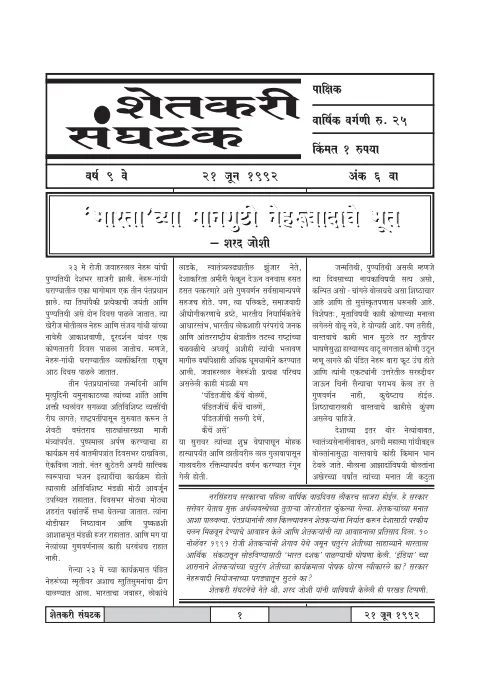
periodical issue
शेतकरी संघटक
Shetkari Sanghatak
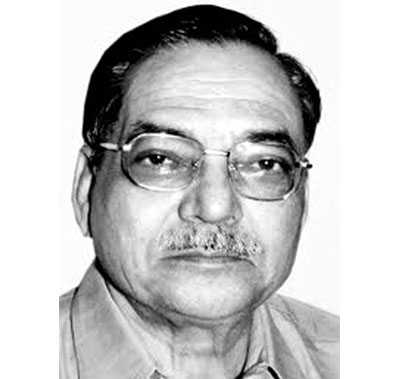
By sharad-joshi, sharad-joshi, गेल ऑम्बेट, मा. शरदरावजी जोशी, गो. ह. आणाले
पाक्षिक शेतकरी संघटक — मालक : मोहन विठ्ठलराव परदेशी; मुद्रण स्थळ : चाकण प्रिंटिंग प्रेस, चाकण; फोन - खेड ५०२६२; संपादक, मुद्रक, प्रकाशक : सुरेशचंद्र म्हात्रे; ६ व २१ तारखेला प्रसिद्ध होतो. प्रकाशन स्थळ : ११४०/६६ विश्रामबाग, पुणे ४११ ००५ · Pune · 1992
12 pages
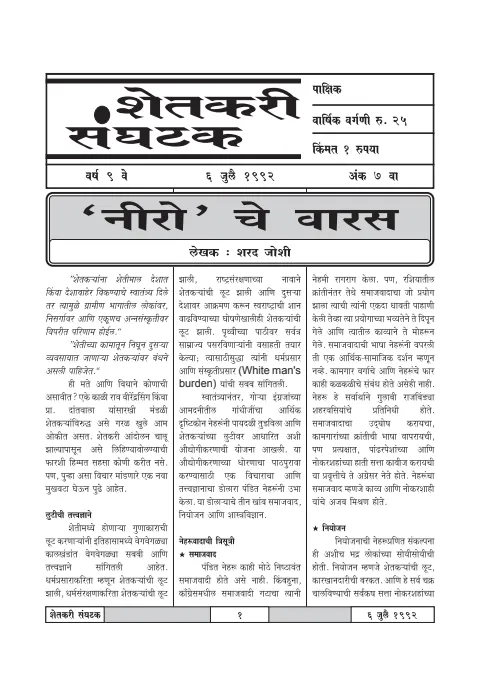
शेतकरी संघटक
Summary
Shetkari Sanghatak (शेतकरी संघटक), the Marathi-language fortnightly of the agrarian-reform Shetkari Sanghatana founded by Sharad Joshi, devotes this issue (Year 9, No. 7, dated 6 July 1992) to a sustained polemic against the Nehruvian intellectual settlement and its post-1991 inheritors. Joshi’s lead essay ‘नीरो चे वारस’ (‘Nero’s Heirs’) casts the new environmentalist, anti-Dunkel and anti-multinational chorus as the latest avatar of the closed-economy, planning-state mentality that Nehru bequeathed. Companion pieces extend the critique to the cotton monopoly purchase scheme (Joshi’s open letter refusing committee membership), the dairy ‘permit raj’ that survives the 1991 liberalisation only for rural ‘Bharat’, and the dynastic corruption embodied in the Rajiv Gandhi-era ‘Idvellisia/KGB’ affair. A reported summary of Joshi’s Sapre Smarak lecture at Sangli broadens the indictment to Nehru’s political failures — Kashmir, the Sino-Indian collapse — alongside the economic ones, while Mo. Ha. Ajagaonkar’s column attacks the Sharad Pawar electoral machine in Maharashtra. Gail Omvedt contributes the second half of her field report on the Lakshmimukti (women’s land-rights) movement, including her North-American tour and meetings with U.S. Green Party feminists. Two short closing items from the ground — a drought-year editorial urging subsistence cropping and a reportorial note on a farmer-run night market at Wakad, Pune that bypasses middlemen — extend the issue’s market-versus-state frame into operational practice. The back page also reproduces the Sanghatana’s masthead notice ‘ऊठ किसाना घे मशाल, अन्यायाला जाळ खुशाल’ alongside the official cotton-scheme price-and-grade table.
Key points
-
This 6 July 1992 issue (Year 9, No. 7) of Shetkari Sanghatak leads with Sharad Joshi’s ‘नीरो चे वारस’ (Nero’s Heirs), which casts Nehru as ‘Nero’ and today’s environmentalist, anti-Dunkel and anti-multinational lobby as his ideological heirs.
-
Joshi distinguishes ‘Bharat’ (rural producers) from ‘India’ (urban consumers) and argues that both Nehruvian planners and the new environmentalists have served the latter at the expense of the former.
-
He defends the Dunkel draft of the GATT Uruguay Round as the first credible external pressure capable of dismantling India’s licence-permit-quota regime.
-
In a companion open letter to the Maharashtra Minister of Cooperation and Textiles, Joshi formally declines a seat on the Cotton Monopoly Purchase Scheme committee, calling the scheme anti-farmer by design.
-
A boxed sidebar asks why the courage shown in exposing certain financial scandals was absent in the Bofors affair, reading it as the untouchable scandal of the Congress establishment.
-
Gail Omvedt contributes the concluding half of her field report on the Lakshmimukti women’s land-rights movement, recounting meetings with Green Party women and activist Dr. Aileen Diamond during a United States tour.
-
Mo. Ha. Ajagaonkar’s column separately attacks the Sharad Pawar electoral machine in Maharashtra, while a drought-year editorial urges subsistence cropping and a report covers a farmer-run night market at Wakad, Pune that bypasses middlemen.
Essays
’नीरो’ चे वारस
By लेखक : शरद जोशी
Sharad Joshi’s flagship polemic, occupying the entire first half of the issue, names Nehru as the ‘Nero’ who fiddled while India burned and identifies a new generation of his heirs — Marxists, Gandhian socialists, anti-Dunkel campaigners, anti-multinational activists, and the freshly mobilised environmentalist lobby — as the same closed-economy mentality reincarnated under fresh banners. Joshi opens by quoting the position he intends to demolish: that giving farmers the freedom to sell at home or abroad will damage ‘rural people, nature, and the whole anti-culture’. He then traces the lineage from Nehru’s industrial planning through the Indira-era nationalisations to the present coalition of NGO-style environmentalists who, he argues, function as the urban-intellectual front for keeping ‘Bharat’ (the rural producer) subordinated to ‘India’ (the protected urban consumer). The Dunkel draft of the GATT Uruguay Round — proposed by an international official named Dunkel — becomes the test case: Joshi defends it as the first external pressure capable of dismantling the licence-permit-quota regime that Nehruvian self-reliance built, and treats the noisy opposition to it as proof that the ‘Nero’s Heirs’ coalition is alive and well. The essay closes with a programmatic image — that Nero’s half-burnt remains must be permanently buried — and a call for farmers to recognise the new environmentalism as old socialism in green clothing.
- Frames Nehru as ‘Nero’ and the contemporary anti-reform lobby — environmentalists, anti-Dunkel campaigners, residual socialists — as his heirs.
- Distinguishes ‘Bharat’ (rural producers) from ‘India’ (urban consumers) and argues both Nehruvian planners and new environmentalists serve the latter at the expense of the former.
- Defends the Dunkel draft of the GATT Uruguay Round as the first credible solvent for India’s licence-permit-quota regime.
- Reads the post-1991 environmentalism as a re-coding of Nehruvian industrialisation-critique that nevertheless preserves the same dirigiste reflexes.
- Closes with the programmatic image that ‘Nero’s’ charred remains must be buried for good — a call to bury the planning-state inheritance entirely.
कापूस एकाधिकार — नवीन योजनाही शेतकरीविरोधीच असणार
By शरद जोशी
An open letter from Sharad Joshi to the Maharashtra Minister of Cooperation and Textiles (dated 1 July 1992) declining a seat on the Cotton Monopoly Purchase Scheme committee. Joshi argues that the new scheme is, like its predecessors, structurally anti-farmer and that his participation would only lend the appearance of farmer endorsement to a fundamentally unsound policy. He recapitulates the Shetkari Sanghatana’s long-standing objection to monopoly procurement and lists, point by point, why a committee re-design cannot rescue a policy whose premises are wrong.
- Joshi formally refuses to serve on the Maharashtra government’s Cotton Monopoly Purchase Scheme committee.
- Argues the scheme is anti-farmer by design — committee redesign cannot save a flawed monopoly.
- Frames his refusal as preventing the state from using a farmer-leader’s name to legitimise the policy.
ही हिम्मत बोफोर्स प्रकरणी का नाही?
A boxed sidebar on the same page asks why the journalistic and political courage now on display in exposing certain financial scandals was absent in the Bofors affair — a brief polemical aside on selective scrutiny of the Rajiv Gandhi-era armaments scandal.
- Short polemical box questioning the selective courage of the press and politicians.
- Reads Bofors as the paradigmatic untouchable scandal of the Congress establishment.
लक्ष्मीमुक्ती आणि स्त्रीमुक्ती चळवळीच्या कार्यकर्त्यांना (उत्तरार्ध)
By गेल ऑम्बेट, कासेगाव (सांगली)
The concluding (उत्तरार्ध) half of Gail Omvedt’s field report on the Lakshmimukti and women’s-liberation activists associated with the Shetkari Sanghatana, picking up from a February 1992 instalment. Writing from Kasegaon (Sangli district), Omvedt recounts a U.S. tour: meetings with Green Party women, the activist Dr. Aileen Diamond, and others in California; conversations with American feminists on environment-and-development questions; and the connection she draws back to organising in Maharashtra. The essay also describes solidarity links spanning Andhra Pradesh, Punjab, Tamil Nadu and the Marathi countryside, situating Lakshmimukti as both a property-rights movement (joint-titling of land for wives) and a women’s-autonomy movement. A right-hand sidebar lists Shetkari Sanghatak’s lifetime subscribers from late June to early July 1992.
- Continues Omvedt’s earlier (February 1992) account of Lakshmimukti — the joint-titling-of-land campaign — as both a property-rights and women’s-liberation initiative.
- Reports on her U.S. tour: encounters with Green Party women, Dr. Aileen Diamond, and American feminists working on environment-and-development.
- Maps cross-state activist links — Andhra Pradesh, Punjab, Tamil Nadu — and reads them as a single emergent network.
- Side panel enumerates Shetkari Sanghatak’s lifetime subscribers from 21 June to 4 July 1992.
नेहरूंचे आर्थिकच काय, राजकीय धोरणही अपयशी
By मा. शरदरावजी जोशी यांनी सप्रेम नमस्कार वि. वि.
A boxed report on Sharad Joshi’s 21 June 1992 address at the Sapre Smarak Vyakhyanmala (Sangli), filed for the fortnightly. The lecture argues that not only Nehru’s economic policies but his political policies failed — the Kashmir question, the Hindi-Chini bhai-bhai collapse, and the broader strategic settlement. Joshi places Nehru and Gandhi at the top of the modern Indian pantheon but insists that if a third figure must be named it is Lokmanya Tilak, and he uses the Sapre platform to argue that India’s foreign-policy failures and economic failures share a common root in the Nehruvian assumption that the state can substitute for society. References to M.N. Roy’s critique of socialism, the Kashmir and border problems, and Govind Vallabh Pant frame the political argument.
- Reports Joshi’s claim that Nehru’s political record (Kashmir, China) is as much a failure as his economic record.
- Names Mahatma Gandhi and Jawaharlal Nehru as the twin pillars of modern Indian leadership, with Lokmanya Tilak as the only possible third.
- Connects foreign-policy collapse and economic stagnation to the same Nehruvian state-overreach premise.
सत्तामत्त फुडारी
By गो. ह. आणाले, ३५ व सुभाषनगर, पुणे १६
A signed column by Mo. Ha. Ajagaonkar (Pune, 25 June 1992) attacking Maharashtra Chief Minister Sharad Pawar as a ‘power-drunk’ (सत्तामत्त) leader whose electoral machine extracts office through gangster-style coercion. The piece reaches back to the Bofors-era Congress to argue that the dynastic-corruption habit has been internalised by state-level satraps and warns that Pawar’s grip on Maharashtra reproduces in miniature the national pattern.
- Frames Sharad Pawar’s politics in Maharashtra as ‘satta-matt’ (power-drunk) and coercive.
- Reads the Pawar machine as a regional echo of Bofors-era Congress dynastic corruption.
‘भारता’साठी परमिट राज्यच!
An editorial column reading a 12 June 1992 Economic Times report on the dairy-monopoly regime: while urban ‘India’ has enjoyed the post-1991 liberalisation rhetoric, the milk producer in ‘Bharat’ continues to live under licensing, single-buyer compulsion and permit-raj. The piece argues that the persistence of the milk monopoly is the cleanest empirical refutation of the claim that India has ‘opened up’.
- Uses the dairy procurement regime as evidence that the post-1991 reforms left the rural producer inside an unreformed permit-raj.
- Reads the divide as the Sanghatana’s ‘India versus Bharat’ axis applied to one commodity.
चिखलप्रूफ भ्रष्ट घराणे
A polemical column on what it calls the ‘mud-proof corrupt dynasties’ of Indian politics — focused on the Rajiv Gandhi-era Italian/KGB-linked ‘Idvellisia’ affair and the broader Congress habit of letting scandal slide off its first family. The piece argues that institutional accountability cannot function while the same Nehru-Gandhi lineage controls both the executive and the discursive frame.
- Names the ‘Idvellisia’ affair as another iteration of unaccountable Congress dynastic corruption.
- Argues that institutional accountability fails when the ruling family also controls the discourse.
शेतकऱ्यांनी यंदा स्वतःपुरते पिकवावे
A short back-page editorial calling on farmers to grow only for their own subsistence during the 1992 monsoon — the rains have failed in stretches, market prices will not compensate sown-area expansion, and the state’s procurement architecture cannot be relied on. The piece reads less as a tactical recommendation than as an act of protest: if the market is rigged and the procurement state is broken, withdrawal of surplus is the only rational reply.
- Urges farmers to confine 1992 cropping to household subsistence given the failed monsoon and broken procurement system.
- Frames the withdrawal of marketable surplus as a deliberate protest against rigged commodity markets.
शेतकऱ्यांनी स्वतःच मार्ग शोधला — दलालांपासून मुक्ती मिळविलेला रात्रीचा बाजार
A reportorial note from the Krushi Utpanna Bazar Samiti at Wakad, near Pimpri-Chinchwad in Pune district, describing a newly opened night vegetable market (rātrīcā bāzār) that lets producers reach urban buyers without dealer middlemen. Sales began 19 June 1992 and have grown rapidly. The piece reads the experiment as practical confirmation of the Sanghatana’s policy line — disintermediation is what farmers actually want, given the option.
- Reports a successful farmer-run night vegetable market at Wakad that bypasses dealer commissions.
- Reads the experiment as on-the-ground vindication of the Sanghatana’s anti-middleman programme.
Generated by the v1.5 extraction pipeline. Awaiting editorial review.
Metadata and summary are AI-extracted from the source PDF and reviewed for editorial accuracy. The original work is available via the Read PDF tab above (where present); paragraph-level citation inside the PDF is deferred to a future engagement.