periodical issue
Shetkari Sanghatak
शेतकरी संघटक
By sharad-joshi, गेल ऑम्व्हेट, कासेगाव (सांगली), प्रतिनिधी, कृ. अ. प्र.
पाक्षिक शेतकरी संघटक / मालक — मोहन विहारीदास परदेशी / मुद्रण स्थळ — चाकण प्रिंटिंग प्रेस, चाकण / संपादक, मुद्रक, प्रकाशक: सुरेशचंद्र म्हात्रे / प्रकाशन स्थळ: ११४७/५६ विश्वा..., पुणे ४११ ००५ ; SHETKARI SANGHATAK (Marathi Fortnightly) Regd. No. 39926/83 · Pune · 1992
6 pages
Shetkari Sanghatak
Summary
This is the 21 June 1992 fortnightly issue (Year 9, No. 6) of Shetkari Sanghatak, the Marathi-language organ of the Shetkari Sanghatana farmers’ movement. The issue is anchored by two substantive pieces in the rendered pages: a long front-page polemic by Sharad Joshi titled ‘´भारता´च्या मानगुटी नेहरुवादाचे भूत’ (“The Ghost of Nehruvianism on India’s Shoulders”), timed to the 23 May commemorations of Jawaharlal Nehru’s death anniversary, which uses the occasion to attack Nehruvian dirigisme, mixed-economy planning and the Nehru-Gandhi dynasty as obstacles to India’s liberalisation; and a report-essay by Gail Omvedt of Kasegaon (Sangli) on the women activists of the Shetkari Sanghatana’s ‘Lakshmimukti’ (women’s land-rights) campaign and the broader stri-mukti movement that grew out of it after 2 October 1990. In the rendered pages, supporting matter includes a side news item on a daily-wage worker dismissed for wearing the Sanghatana’s badge and a village-level ban on MLAs in Parbhani district; an announcement and life-subscriber list for the Majghar Sheti agricultural exhibition; and a ‘Sitasheti’ technical column on the fourth experiment in the Prayog Parivar method of soil-and-seed agronomy. The volume’s argumentative centre, across these pieces, is the Sanghatana’s classical-liberal agrarian programme: economic opening for farmers, dismantling of state-protectionist planning, and the linkage of women’s emancipation to property rights in land.
Key points
-
Sharad Joshi’s front-page polemic, timed to the 23 May observance of Jawaharlal Nehru’s death anniversary, calls Nehruvianism a ‘ghost’ still riding on India’s back despite producing three Nehru-Gandhi prime ministers in succession.
-
Joshi argues Nehru’s economic synthesis of socialist planning, public-sector dominance and a closed economy has collapsed alongside the fall of Stalinism and Leninism internationally.
-
He recovers Sardar Vallabhbhai Patel, Subhash Chandra Bose, Maulana Azad and Govind Vallabh Pant as contemporaries Nehru sidelined, to challenge the official Nehru-centric account of independence.
-
Joshi claims that Nehru himself, in his final phase, was already shifting toward an open economic policy, so post-1991 liberalisation completes rather than breaks with Nehru’s own late direction.
-
Side reports describe a daily-wage worker dismissed in Maharashtra for wearing the Shetkari Sanghatana badge and a Parbhani-district village-level ban on MLAs, offered as field evidence for Joshi’s critique.
-
Gail Omvedt of Kasegaon profiles the Sanghatana’s ‘Lakshmimukti’ campaign, launched 2 October 1990 with the Shetkari Mahila Aghadi to register farm land jointly in the names of farmers’ wives.
-
Omvedt reports roughly one and a half lakh women had already engaged with the campaign, comparing its rural reach to the 1962 land-ceiling agitation.
-
She situates the campaign as a successor to the reformism of Jotiba Phule and Babasaheb Ambedkar and names organisers such as Swavalan and Liliana who run its mobilisation work.
Essays
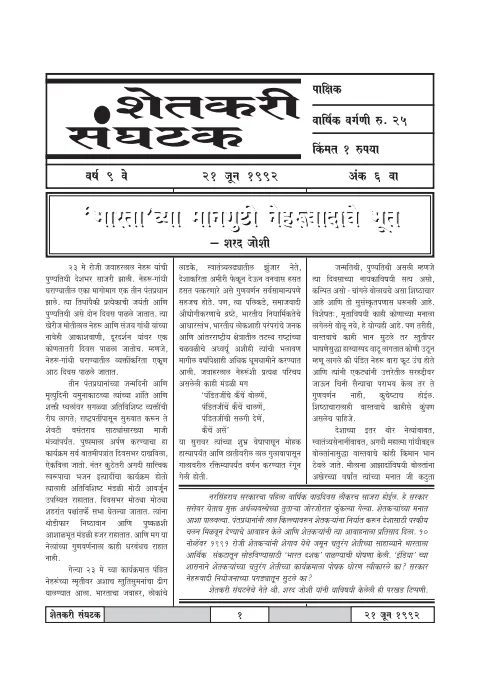
’भारता’च्या मानगुटी नेहरूवादाचे भूत
By शरद जोशी
Sharad Joshi’s front-page polemic uses the 23 May 1992 nationwide observance of Jawaharlal Nehru’s death anniversary — marked by three Nehru-Gandhi prime ministers in succession and a week of state-television tributes — to argue that Nehruvianism (नेहरुवाद) is a ‘ghost’ still riding on India’s back. Joshi’s claim is that the official liturgy of praise around Nehru has hardened into a sectarian, dynastic cult that obscures how thoroughly Nehru’s own policy synthesis — socialist planning, public-sector dominance, an inward-looking economy, and a ‘mixed’ compromise with capital — has now collapsed. He sets Nehru against the contemporaries he sidelined — Sardar Vallabhbhai Patel, Subhash Chandra Bose, Maulana Azad and Govind Vallabh Pant — and notes that even the global edifice of Stalinism and Leninism that flattered Nehru’s economic instincts has fallen. The piece’s editorial twist, sharpened in the latter columns, is that Nehru’s own last position, before he died, was already shifting toward the kind of open economic policy that India is being told in 1991–92 it must now belatedly accept; Nehruism, Joshi argues, has become the alibi the Congress establishment uses to slow that opening. The essay closes by tying this critique to the Shetkari Sanghatana’s own line: the farmers’ movement has from its start named Nehruvian planning, not colonialism, as the source of rural poverty, and a side box reports on Maharashtra Congress legislators being barred from villages in Parbhani district and a daily-wage worker sacked for wearing the Sanghatana badge as illustrations of the regime the critique describes.
- Frames Nehru’s 23 May death-anniversary celebrations as the latest installment of a Nehru-Gandhi dynastic cult that has produced three prime ministers in succession.
- Argues that Nehruvianism as an economic doctrine — socialist planning, public-sector primacy, closed economy — has been overtaken by events, including the collapse of Stalinism and Leninism.
- Recovers the contemporaries Nehru displaced (Patel, Bose, Azad, Govind Vallabh Pant) to denaturalise the official Nehru-centric narrative of independence.
- Claims Nehru himself, in his last phase, was moving toward an open economic policy, so the post-1991 liberalisation is not a break from Nehru but a delayed completion.
- Connects the polemic to the Shetkari Sanghatana’s own line that Nehruvian planning, not colonialism, is the proximate cause of rural Indian poverty.
- Side-bar dispatches — a worker dismissed in Maharashtra for wearing the Sanghatana badge, a Parbhani village-level ban on MLAs — are presented as field-level evidence of the dirigiste order the essay attacks.
लक्ष्मीमुक्ती आणि स्त्रीमुक्ती चळवळीच्या कार्यकर्त्या
By गेल ऑम्व्हेट, कासेगाव (सांगली)
Gail Omvedt, writing from Kasegaon in Sangli, profiles the women activists of the Shetkari Sanghatana’s ‘Lakshmimukti’ (Lakshmi-emancipation) campaign and the wider stri-mukti (women’s-liberation) movement it has seeded. The Lakshmimukti programme, launched on 2 October 1990 by the Sanghatana and the Shetkari Mahila Aghadi, demands that ownership of farm land be transferred to or jointly registered in the names of farmers’ wives — a ‘joint patta’ approach. Omvedt records that despite resistance, around one and a half lakh women in India have now moved on this path, and that the campaign has spread through hundreds of villages in Maharashtra’s countryside on a scale unseen since the 1962 land-ceiling agitation. She situates the campaign as a direct successor to the women-and-caste reformism of Jotiba Phule and Babasaheb Ambedkar, distinguishes it from urban, Gandhian and middle-class feminisms, and stresses that its constituency is the rural, often illiterate poor and middle-peasant woman whose claim to land is also a claim to economic personhood. The latter columns describe the small core of full-time and volunteer women organisers — named as Swavalan, Liliana and others — who run literacy, training and mobilisation work and are now the seedbed of a politically autonomous women’s wing inside the Sanghatana.
- Profiles the Shetkari Sanghatana / Shetkari Mahila Aghadi ‘Lakshmimukti’ campaign launched 2 October 1990 to put farm land in women’s names (‘joint patta’).
- Reports an estimated one-and-a-half-lakh women already engaged with the campaign and compares its rural reach to the 1962 land-ceiling agitation.
- Locates the movement in the Phule–Ambedkar reformist lineage rather than urban, Gandhian or middle-class feminism.
- Names a working core of women organisers — ‘Swavalan’, ‘Liliana’ and others — as the activist backbone of the rural stri-mukti work.
- Insists that the campaign’s specific constituency is the rural, often illiterate or middle-peasant woman, for whom property in land is the operative form of emancipation.
सीताशेती (प्रयोग सूत्र ४) / सीताशेती - सहभाग
By प्रतिनिधी, कृ. अ. प्र.
The ‘Sitasheti’ column on the back page presents the fourth instalment (‘प्रयोग सूत्र २’) of an ongoing extension series on the Prayog Parivar approach to small-plot, soil-and-seed-centred farming. The first half lays out a step-by-step formula for preparing a Sitasheti test bed — plot dimensions, depth of soil work, organic-matter and ash mixtures (including a recipe combining ash from kadbas with cow dung), spacing for groundnut and other crops, and a guidance not to use chicken-droppings unmixed. A second short piece, ‘Sitasheti — Sahabhag’ (Sitasheti — Participation), invites readers to send back month-by-month observation notes from their own plots so that the Sanghatana can collate experimental data centrally. The column reads as the technical-agronomy companion to the issue’s political and organisational pieces, taking the Sanghatana’s classical-liberal agrarian programme down to the individual cultivator’s field.
- Continues the ‘Prayog Sutra’ instalment-series on the Prayog Parivar / Sitasheti soil-and-seed extension method, now at instalment 4.
- Gives a worked recipe for plot preparation — dimensions, soil work, ash-and-dung organic input, crop spacing — aimed at small cultivators experimenting on a sub-acre plot.
- Solicits monthly observation reports from readers under ‘Sitasheti — Sahabhag’ to build a participatory experimental record across the movement’s reach.
- Functions as the technical-agronomy counterpart to the issue’s political articles, embedding the Sanghatana’s economic line in concrete farm practice.
Generated by the v1.5 extraction pipeline. Awaiting editorial review.
Metadata and summary are AI-extracted from the source PDF and reviewed for editorial accuracy. The original work is available via the Read PDF tab above (where present); paragraph-level citation inside the PDF is deferred to a future engagement.