pamphlet
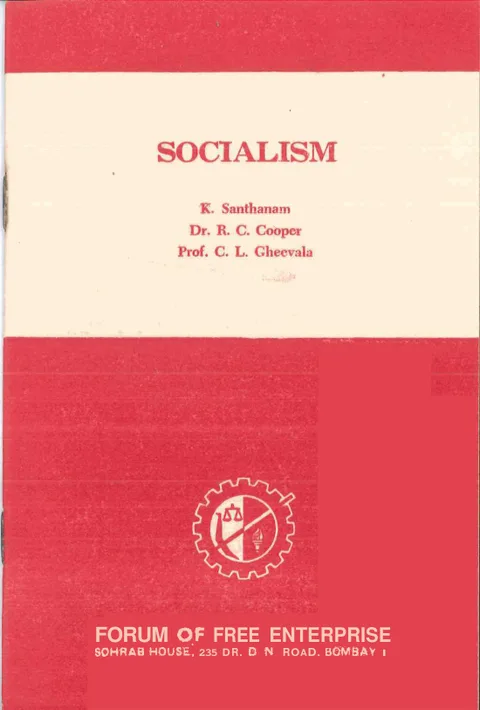
Socialism or State Capitalism
By K. Santhanam, R. C. Cooper, C. L. Gheevala
Forum of Free Enterprise, Bombay · Bombay · 1970
17 pages
Socialism or State Capitalism
A Forum of Free Enterprise pamphlet, with essays by K. Santhanam, Dr. R. C. Cooper and Prof. C. L. Gheevala (Bombay, 1970)
Summary
Socialism or State Capitalism? is a Forum of Free Enterprise pamphlet (Bombay, 1970) that gathers three essays around a single contention: that what India practised in the name of socialism was in truth an inefficient State Capitalism, and that the real goals of socialism — full employment, social services and social security — are better served by regulated private enterprise, competition and decentralisation than by nationalisation and an ever-expanding public sector. The Forum, founded in 1956 to educate opinion on free enterprise and its links with democracy, notes that the views expressed are not necessarily its own.
In the title essay K. Santhanam — economist, former Union minister and chairman of the Second Finance Commission — argues that both capitalism and socialism have been misunderstood since Marx’s day. Modern large-scale production, he says, is essentially capitalistic whoever owns it, since it everywhere rests on accumulated capital, expert management and elaborate accounting; the Planning Commission’s error has been to confuse State Capitalism with socialism. State Capitalism, on his account, suffers three special handicaps — a tendency to monopoly, bureaucratic management, and interference by politicians — and does not even secure a better deal for labour. He judges the twenty-year record of India’s public sector no warrant for its expansion, and calls the government’s fresh ventures into small cars, scooters, the cotton trade and sugar reckless. True socialism, for Santhanam, means the equitable distribution of work and income through full employment, free social services and comprehensive social security, and he points to Scandinavia and Western Europe, where income inequality is far narrower than in professedly socialist India.
The second essay, by the chartered accountant R. C. Cooper (a vice-president of the Forum), contrasts a pragmatic Twentieth Century Socialism with the outdated nineteenth-century variety to which he thinks India, Ceylon and Burma remain wedded. Modern socialists, he argues, no longer equate their ends with nationalisation — which breeds inefficiency, erodes accountability and concentrates economic power in the State — but pursue equality of opportunity, economic security and an expanding economy. Where Indian socialism distributes poverty, he says, modern socialism distributes prosperity; and he marshals the fast-growing economies of Japan, Australia, Singapore, Hong Kong, Taiwan and Malaysia — quoting J. R. D. Tata on their per-capita gains — as proof that private enterprise and openness, not state ownership, drive development. He lists nine features common to these countries and prescribes a public-works programme, mass production of consumer goods and selective controls in place of nationalisation.
In the closing essay, Socialist Dilemma, C. L. Gheevala, secretary of the Indian Merchants’ Chamber, dwells on the socialists’ confusion of means with ends. Drawing on C. A. R. Crosland’s revisionism, he argues that Marx’s prophecies have been falsified, that a mere change of ownership guarantees nothing, and that “nationalisation is not socialisation”. There is, he insists, no a priori case for nationalisation: each proposal must be justified on economic grounds, and the public sector held to a competitive test of performance. Above all he warns, citing Gandhi’s fear of the State as a Leviathan, that centralisation and bureaucratisation threaten individual freedom, and that democratic socialism must preserve a private sector as an essential check on state power.
Key points
-
A Forum of Free Enterprise pamphlet (Bombay, 1970) collecting three essays with a shared thesis: what India calls socialism is really an inefficient State Capitalism.
-
K. Santhanam argues modern large-scale production is essentially capitalistic whoever owns it, and that the Planning Commission has confused State Capitalism with socialism.
-
Santhanam holds State Capitalism suffers from monopoly, bureaucracy and political interference, and that India’s twenty-year public-sector record does not justify expansion into cars, scooters, cotton and sugar.
-
He defines true socialism as full employment, free social services and comprehensive social security, noting income inequality is far narrower in Western welfare states than in India.
-
R. C. Cooper contrasts pragmatic “Twentieth Century Socialism” (Japan, Australia, Singapore, Hong Kong, Taiwan, Malaysia) with the outdated nineteenth-century socialism he says binds India, Ceylon and Burma.
-
Cooper argues nationalisation breeds inefficiency and concentrates power in the State, and prescribes public works, mass-produced consumer goods and selective controls instead.
-
C. L. Gheevala, drawing on C. A. R. Crosland, argues a change of ownership guarantees nothing — “nationalisation is not socialisation” — and that each nationalisation must be justified on economic grounds.
-
Gheevala warns, citing Gandhi’s fear of the State as a Leviathan, that centralisation and bureaucratisation endanger individual freedom, so democratic socialism must keep a private sector as a check on state power.
Ingested 2026-07-21 from the CCS source archive. AI-drafted summary awaiting editorial review.
Metadata and summary are AI-extracted from the source PDF and reviewed for editorial accuracy. The original work is available via the Read PDF tab above (where present); paragraph-level citation inside the PDF is deferred to a future engagement.