essay
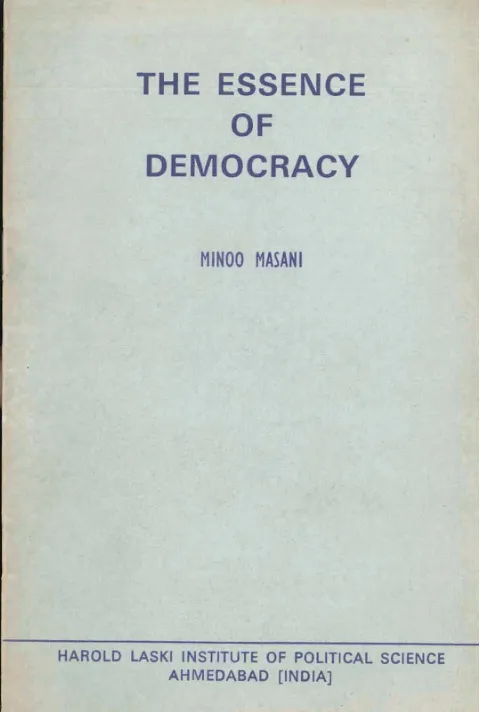
The Essence of Democracy
By Minoo Masani
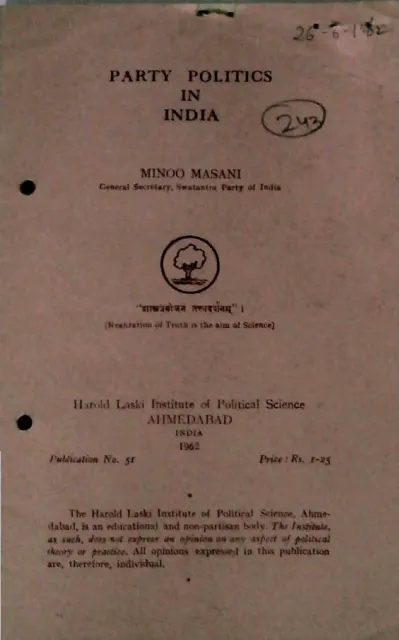
Harold Laski Institute of Political Science, Ahmedabad · Ahmedabad · 1989
16 pages
The Essence of Democracy
By Minoo Masani
Summary
The Essence of Democracy is the G. V. Mavalankar Birth Centenary Lecture, delivered under the auspices of the Harold Laski Institute of Political Science, Ahmedabad, in March 1989 by the veteran liberal parliamentarian and author Minoo Masani, and — in his absence for health reasons — read out on his behalf by the Institute’s Director, P. G. Mavalankar. Masani’s central argument is that democracy is far more than majority rule. Invoking E. F. M. Durbin’s The Politics of Democratic Socialism, he holds that where there is no effective opposition there is no democracy, and that the right to dissent is worthless unless it can actually be exercised. Majority rule, he insists, is not democracy at all: Stalin and Hitler won huge (bogus) majorities, African autocrats claim electoral mandates, and — as Elspeth Huxley put it — the pattern is often “one man one vote, once.” He judges majority rule “particularly pernicious” in societies that are not homogeneous ethnically, linguistically or religiously, such as South Africa, Fiji, Sri Lanka and India, where a built-in permanent majority turns it into the tyranny of one community over the minorities.
Against this, Masani sets out the positive conditions of a “real” democracy. The first is limited government: quoting Benedetto Croce, he argues that once the State becomes the only employer and only landlord, society ceases to be free, so a democracy needs “autonomous social forces” — the farmer who owns his land, the industrialist his factory, the professional who works for himself. He warns that India sits on the borderline between limited and total government because of excessive controls, the takeover of the “commanding heights” of the economy, and state domination of universities, writers and artists (through bodies like the Sahitya Akademi), with repeated assaults on the freedom of the press; the 1975 Emergency, he says, showed that the “socialist pattern” and democracy cannot long co-exist. Power must be shared both horizontally — minorities electing their own representatives rather than being condescendingly co-opted at the majority’s “meherbani” — and vertically, through grassroots vigilance and active citizenship, which he finds gravely weak in India, where parties “float on top” without internal democracy and citizens defer to the cult of personality, sycophancy and the permit-licence-quota economy. To these he adds the primacy of individual liberty (the State is made for the individual, not the individual for the State; liberty, in Lord Acton’s words, is the supreme good), the rule of law or due process, and freedom of the press.
Turning to institutional design, Masani argues for proportional representation over the Anglo-Saxon “first past the post” system, which wastes millions of votes and manufactures bogus majorities (he cites Margaret Thatcher’s re-election on a minority of votes cast), holding up Switzerland’s rotating, PR-based, canton-respecting power-sharing as the model for divided societies. He stresses the separation of powers and the checks the Indian Constitution placed on the Prime Minister and Cabinet — the President, the Supreme Court, the Civil Service, the States and the Fundamental Rights — most of which, he laments, were eroded by Indira Gandhi’s centralising amendments. Finally, he condemns Reservation: conceived as a ten-year measure for the Scheduled Castes and Tribes, it has become a permanent “crutch” and a major source of corruption in public life, and should be terminated or at least rapidly phased out. An appended report of a 1985 Bombay seminar organised by the Indian Liberal Group and the Freedom First Foundation, which Masani chaired, elaborates this case, judging Reservation a failure and recommending reforms and alternatives centred on expanding jobs, self-employment, vocational training and an economic rather than a caste-based test of backwardness.
Key points
-
The G. V. Mavalankar Birth Centenary Lecture (March 1989), published by the Harold Laski Institute of Political Science, Ahmedabad, and read out on Masani’s behalf by the Institute’s Director, P. G. Mavalankar.
-
Central claim: democracy is not majority rule — citing E. F. M. Durbin, Masani holds that without an effective opposition and an exercisable right to dissent there is no democracy.
-
Majority rule is “particularly pernicious” in ethnically, linguistically or religiously divided societies (South Africa, Fiji, Sri Lanka, India), where a permanent majority becomes a tyranny over minorities: “one man one vote, once.”
-
Real democracy requires limited government; warns India is drifting toward a total state through excessive controls, state domination of universities and culture, and threats to press freedom (the 1975 Emergency as precedent).
-
Power must be shared horizontally (minorities electing their own representatives, not co-opted at the majority’s “meherbani”) and vertically (grassroots vigilance and active citizenship, not five-yearly voting).
-
Upholds individual liberty as the supreme good (Acton), the rule of law / due process, and freedom of the press as essential safeguards.
-
Advocates proportional representation over first-past-the-post (which wastes votes and manufactures bogus majorities), holding up Switzerland’s rotating, PR-based power-sharing as the model.
-
Calls for Reservation — intended as a ten-year measure — to be terminated or phased out as a corrupting “crutch”; an appended 1985 Indian Liberal Group / Freedom First seminar report recommends reforms and self-employment- and economic-criteria-based alternatives.
Ingested 2026-07-21 from the CCS source archive. AI-drafted summary awaiting editorial review.
Metadata and summary are AI-extracted from the source PDF and reviewed for editorial accuracy. The original work is available via the Read PDF tab above (where present); paragraph-level citation inside the PDF is deferred to a future engagement.