periodical issue
The Indian Libertarian
An Independent Journal of Economic and Public Affairs
By MA Venkata Rao, M. N. Tholal, A Ranganathan, C. Rajagopalachari
Libertarian Publishers (Private) Ltd., 26, Durgadevi Road, Bombay 4 · Bombay · 1962
20 pages
The Indian Libertarian
Summary
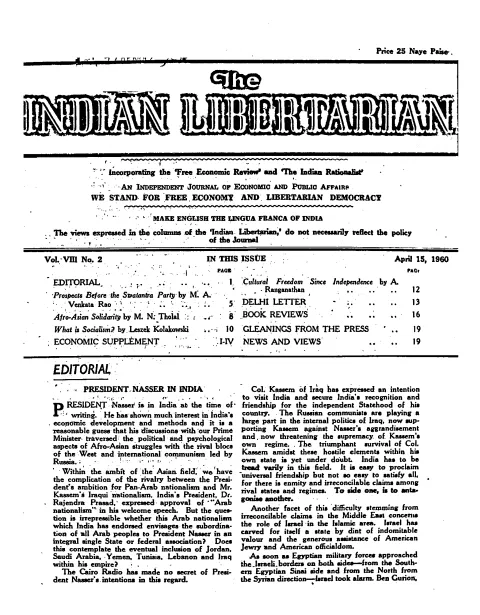
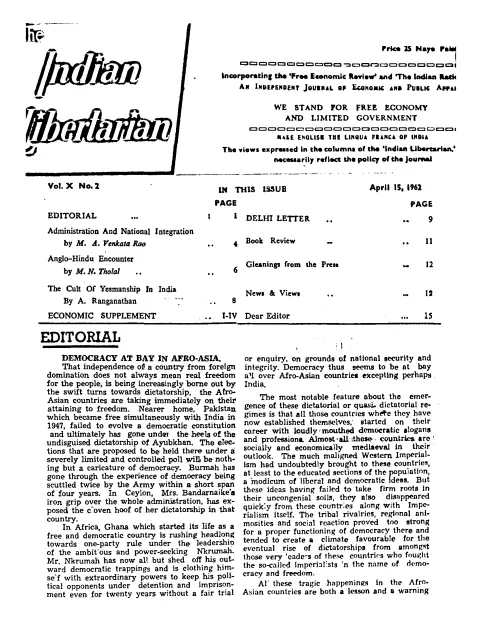
This 15 April 1962 issue of The Indian Libertarian (Vol. X No. 2) — an independent journal of economic and public affairs that ‘stands for free economy and limited government’ and is edited by D. M. Kulkarni for Libertarian Publishers Pvt. Ltd., Bombay — pairs an editorial on the post-colonial slide towards dictatorship in Afro-Asia with signed essays by M. A. Venkata Rao on civil-service administration and national integration, M. N. Tholal on India’s confrontation with Western liberal values, and A. Ranganathan on sycophancy under Nehru. A four-page Economic Supplement carries Prof. S. Kesava Iyengar’s statistical critique of the Third Plan and a long excerpt of Ambassador J. K. Galbraith’s Ahmedabad address on the causes of poverty. The back half of the issue runs a Delhi Letter on the post-third-general-election political mood, a review of John Strachey’s The Great Awakening, ‘Gleanings from the Press’ built around a Frank Moraes column, and a ‘Dear Editor’ contribution defending Swatantra Party planning. Across its sections the issue holds together as a classical-liberal periodical attacking central planning, one-party drift, ministerial sycophancy and the survival of the licence-permit regime, while welcoming Swatantra’s gains in the new Lok Sabha.
Key points
-
The unsigned lead editorial, Democracy at Bay in Afro-Asia, argues that Ghana under Nkrumah, Pakistan under Ayub Khan, Ceylon under Mrs. Bandaranaike, and Burma under its army have all slid into one-party rule or military regimes since independence.
-
The editorial attributes the failure of liberal-democratic ideas to take root in post-colonial states to imperialism, regional rivalries and social reaction, reading new dictatorships as posing in the name of democracy and freedom.
-
M. A. Venkata Rao’s Administration And National Integration warns that pressure on civil servants to identify emotionally with the ruling party under slogans of socialism and national integration is corroding administrative neutrality.
-
Venkata Rao calls for civic education and a liberal-democratic ethos as an alternative to the monolithic one-party atmosphere he sees overtaking Indian governance.
-
M. N. Tholal’s Anglo-Hindu Encounter reads modern India as the meeting of an Anglo-Saxon liberal-democratic order built on rights and due process and a Hindu social order whose toleration has not yet translated into political liberty.
-
Tholal disputes the traditionalism of Vinoba Bhave and Jayaprakash Narayan, arguing their categories underplay how much modern Indian freedom owes to the liberal English inheritance.
-
A. Ranganathan’s The Cult Of Yesmanship In India uses a P. G. Wodehouse comic frame, along with John W. Gardner’s Self-Renewal and American debates over McCarthyism, to attack sycophancy around Nehru and his cabinet.
-
The issue’s Economic Supplement carries Prof. S. Kesava Iyengar’s statistical critique of the Third Plan alongside an excerpt of Ambassador J. K. Galbraith’s Ahmedabad address on the causes of poverty.
-
The back pages include a Delhi Letter on the post-third-general-election political mood and a review of John Strachey’s The Great Awakening.
Essays
Editorial — Democracy At Bay In Afro-Asia
The unsigned lead editorial, ‘Democracy at Bay in Afro-Asia,’ argues that independence from foreign rule has not produced real freedom across the post-colonial belt: Ghana under Nkrumah, Pakistan under Ayub, Ceylon under Mrs. Bandaranaike and Burma under its army have all slid into one-party rule, military regimes or ‘caricatures of democracy.’ The editorial reads the trend as the natural consequence of Western liberal-democratic ideas failing to root in ‘their uncongenial soils,’ and warns that imperialist rivalries and social reaction have created a climate favourable to dictatorships dressed up ‘in the name of democracy and freedom.’ The piece is paired on later pages with reports on the Syrian military coup and Pakistan’s eastern border dispute with Afghanistan, all framed as further evidence of the Afro-Asian democratic recession.
- Argues that decolonisation has not produced real freedom — Ghana, Pakistan, Ceylon and Burma are read as case studies in democratic regression.
- Treats Nkrumah’s detention of opponents and Ayub Khan’s ‘undisguised dictatorship’ as illustrative of the pattern.
- Attributes the failure of liberal-democratic ideas to take root in Afro-Asia to imperialism, regional rivalries and ‘social reaction.’
- Reads new dictators as imperialists ‘in the name of democracy and freedom,’ inverting the rhetoric of liberation.
- Frames the Syrian military coup and Pakistan–Afghanistan frontier moves as part of the same anti-democratic drift.
Administration And National Integration
By MA Venkata Rao
M. A. Venkata Rao argues that the central problem of Indian administration is the collision between the inherited tradition of an impersonal, rule-bound civil service and the new emotional and ideological demands of post-independence nationalism. He warns that the steady politicisation of services under the slogans of socialism and ‘national integration’ — including pressure on officers to identify themselves emotionally with the ruling party — corrodes the very neutrality on which an integrated administration depends. The essay closes by calling for civic education and a frankly liberal-democratic ethos in place of the one-party ‘monolithic’ atmosphere that he sees overtaking the country.
- Reads administration as a contest between rule-bound civil service inheritance and post-independence political pressure.
- Warns that ‘national integration’ is being conflated with conformity to the ruling party’s ideology.
- Argues that officers’ enforced identification with Congress doctrine destroys impartial administration.
- Calls for civic education and a self-consciously liberal-democratic alternative to monolithic one-party politics.
- Connects the integrity of services to the survival of constitutional government itself.
Anglo-Hindu Encounter
By M. N. Tholal
M. N. Tholal’s ‘Anglo-Hindu Encounter’ reads modern India as the meeting ground of two civilisations: an Anglo-Saxon liberal-democratic order built on rights, due process and freedom of expression, and a Hindu social order whose virtues — toleration, the absorption of difference, a tradition of philosophical disputation — have not yet translated into political liberty. He contrasts what he calls Western ‘live and let live’ with the Hindu-Muslim animosities of the subcontinent and is sharply critical of leaders who invoke ancient toleration while presiding over communal violence. The article also engages contemporary Indian commentators — including Vinoba Bhave and Jayaprakash Narayan — who, in his reading, romanticise tradition at the cost of acknowledging how much modern Indian freedom actually owes to the liberal English inheritance.
- Frames the article as an encounter between Anglo-Saxon liberalism and Hindu civilisation.
- Credits the West with the practical lesson of ‘live and let live’ in religious and political life.
- Argues that Hindu toleration in theory has not produced political toleration in practice.
- Disputes Vinoba and JP’s traditionalism: their categories underplay the debt to English liberal ideas.
- Reads communal violence as evidence that the civilisational encounter is incomplete.
The Cult Of Yesmanship In India
By A Ranganathan
A. Ranganathan’s ‘The Cult Of Yesmanship In India’ uses a P. G. Wodehouse Mulliner story as a comic frame to attack the climate of sycophancy that has grown up around Nehru and his cabinet. Drawing on John W. Gardner’s Self-Renewal and on American debates over McCarthyism, he argues that the absence of real intellectual disagreement around the Prime Minister — the willingness of ministers and officials to echo every directive — is a sickness of the political class, not of the masses. He invokes the Khosla Commission’s strictures and the careers of Pandit Pant and Krishna Menon to show how the ‘yesman’ style corrupts both administration and the public sphere, and reads the cult of consensus as the domestic counterpart of the one-party drift the issue’s editorial attacks.
- Opens with a Wodehouse Mulliner conceit to introduce sycophancy as a national pathology.
- Draws on John W. Gardner’s Self-Renewal to diagnose intellectual conformism in the ruling class.
- Compares Indian ‘yesmanship’ to American McCarthyism as a parallel failure of liberal courage.
- Cites the Khosla Commission’s findings on official sycophancy in defence of his argument.
- Reads ministerial flattery of Nehru as a domestic mirror of the Afro-Asian one-party slide.
- Calls for revival of independent judgment within the political class as a precondition for democracy.
Essay 5
Prof. S. Kesava Iyengar, Director of the Indian Academy of Economics, opens the Economic Supplement with a statistical critique of the official claim that national income rose by 42% in the decade 1950–61. Using R.B.I. and C.S.O. figures and a comparison with the 1941, 1951 and 1961 censuses, he shows that the simple annual rate of growth of national income between 1951-52 and 1960-61 at 1948-49 prices was about 3%, with an annual per-capita increase of only ₹2.05 — and that the ‘real’ figure on a revised census base is closer to ₹1.29 a year. Drawing on Colin Clark, he argues that any plan that claims acceleration without a ‘radical reversal of price policy’ is engaged in ‘window-dressing,’ and that the Third Plan must be re-adjusted in light of the steep price rise and runaway population growth.
- Uses R.B.I. and C.S.O. data to challenge the 42% national-income growth claim for 1950-61.
- Shows annual per-capita income growth of just ₹2.05 (and only ₹1.29 on revised census base).
- Argues authorities have used inflation and population estimates for ‘window-dressing.’
- Calls for the Third Plan to be re-cast given the ‘price explosion’ since 1958 and runaway population.
- Cites Colin Clark on U.K. comparison: India’s per-capita income growth lags far behind.
- Demands a ‘radical reversal of price policy’ as a precondition for genuine growth.
Economic Supplement — Patent Pitfalls In Planning — The Indian Experiment
By Prof. S. Kesava Iyengar, Director, Indian Academy of Economics
The supplement reproduces (in part) U.S. Ambassador John Kenneth Galbraith’s address at Gujarat University on ‘The Causes of Poverty: A Clinical View.’ Galbraith treats poverty as a population of countries to be diagnosed rather than a moral failing of individuals: he proposes that poor countries be examined empirically for the institutional, climatic, accumulation and cultural conditions that keep them poor. The excerpt enumerates assumed causes — supposed racial and cultural weaknesses, climatic determinism, lack of capital, lack of skill, feudal land tenure, and the survival of medieval economic forms — and tests them against the geographic distribution of poor countries today, treating Sub-Saharan Africa, parts of South America, the Arab world and South and East Asia as the cases to be explained. The piece is marked ‘To be continued.’
- Reframes poverty as a problem to be diagnosed clinically across countries rather than moralised.
- Lists candidate causes — race, climate, capital scarcity, skills, feudal land tenure, medieval institutions — to be tested empirically.
- Treats Sub-Saharan Africa, Latin America, the Arab world and South/East Asia as the geography to be explained.
- Implicitly criticises stadial accounts that take Northern European development as the universal template.
- Closes with a procedural call for evidence-based investigation rather than ideological pronouncement.
- Marked ‘To be continued’ — only the first half of the address is reproduced.
Delhi Letter — Prime Minister Joins A Thriving Industry
By John Kenneth Galbraith
The unsigned ‘Delhi Letter,’ headed ‘Prime Minister joins A Thriving Industry,’ reports the mood in the capital after the third general election. Its sting is that Nehru himself, in the post-election period, has joined the chorus of intellectuals and politicians publicly worrying that Indian democracy is in trouble — a ‘thriving industry’ of pessimism. The Letter then runs through the new Lok Sabha line-up: Acharya Kripalani, Frank Anthony, Dr. Lohia and Asoka Mehta on the opposition benches; the arrival of a Swatantra contingent led by figures like Achyut Patwardhan; and behind the scenes, conflicts around Vinoba Bhave’s Bhoodan movement, M. C. Chagla’s foreign-policy interventions, K. M. Munshi’s continuing presence in cultural life, and renewed worry about Chinese aggression in the Himalayan border. A short concluding section on ‘The New Parliament’ reflects on the dissolution of the second Lok Sabha and the temper of the third.
- Reads Nehru’s own warnings about democratic decay as joining a Delhi ‘industry’ of pessimism.
- Surveys the opposition in the new Lok Sabha — Kripalani, Frank Anthony, Lohia, Asoka Mehta — and the Swatantra contingent.
- Notes Achyut Patwardhan and other Swatantra figures as a substantive new voice.
- Tracks Vinoba Bhave’s Bhoodan movement and M. C. Chagla’s foreign-policy role.
- Warns that Chinese aggression on the Himalayan frontier could colour parliamentary politics for years.
- Closes with the dissolution of the second Lok Sabha and the temper of the third.
Book Review — The Great Awakening (John Strachey)
By M. A. Venkatrao
No summary was extracted for this article. Listed for completeness.
Gleanings from the Press / News & Views
By MA Venkata Rao
M. A. Venkatrao reviews John Strachey’s The Great Awakening (Encounter Pamphlet No. 5), treating it as the latest stage of Strachey’s long retreat from doctrinaire Marxism. Strachey, he writes, now concedes that the early Marxist account of imperialism — capital exporting itself to colonies and reaping super-profits — does not survive the post-war record: capital has flowed predominantly between developed economies, and the chief recent transformations have been in Germany, Japan and post-Stalin Russia rather than in the old colonial periphery. The reviewer welcomes Strachey’s willingness to revise the inherited Left framework but notes that the pamphlet stops short of drawing the full liberal implications — that the world’s great economic question is now how poor countries themselves create the conditions for capital accumulation and entrepreneurship.
- Frames Strachey as a Left intellectual revising the Marxist account of imperialism in the light of post-war evidence.
- Notes the empirical fact that capital has flowed mostly among developed economies, not from metropoles to colonies.
- Highlights post-Stalin Russia, Germany and Japan as the real sites of recent transformation.
- Welcomes Strachey’s empirical honesty but criticises him for not following the logic to liberal-economic conclusions.
- Reads the pamphlet as part of a wider ‘great awakening’ of Western Left intellectuals to liberal realities.
Dear Editor — Swatantra Planning
By M. R. Masani, General Secretary, Swatantra Party
‘Gleanings from the Press’ reprints a Frank Moraes column, ‘Stirring Pendulum Passions,’ from the Indian Express. Moraes notes that no Indian political party — including the Congress in its present condition — could ever convince him that India will survive the ‘pendulum passions’ of populist enthusiasm and disenchantment. He uses the failed coup in Pakistan, the Communist takeover in Kerala and the rise of Swatantra as evidence that Indian politics swings violently between extremes, and warns that the country’s democratic strength lies in keeping the centre — secular, constitutional, classically liberal — intact against the temptations of both Left and Right.
- Reprints Frank Moraes’s Indian Express column on India’s ‘pendulum passions.’
- Reads Pakistan’s coup, the Kerala Communist phase and Swatantra’s rise as one continuous swing of the political pendulum.
- Defends a ‘centre’ that is secular, constitutional and classically liberal against both Left and Right surges.
- Treats popular passions as the chief threat to durable liberal-democratic politics.
- Frames the Indian Libertarian as a vehicle for that centrist liberal position.
Essay 10
The ‘News & Views’ department runs a tight set of short items on the Cold War backdrop to the issue’s politics. Lead pieces report Communist China’s surprising decision to reintroduce cash incentives for industrial workers — a tacit admission, in the Libertarian’s reading, that pure exhortation does not raise productivity — and a Polish discussion of the dismantling of Stalinist collectivisation. A ‘Diplomats Perplexed’ section examines Soviet manoeuvres in Syria after the Damascus coup, the U.S. response, and the position of the U.A.R. A short note on Jamaica covers Sir Alexander Bustamante’s election, and a ‘Heart-Searching the With India’ note records Hong Kong observers reading Vinoba Bhave’s Bhoodan movement as evidence of a deeper Indian rural crisis. The section also carries a report on Swatantra being recognised as the official opposition in the Gujarat Assembly and a ‘Praise Plea For Goolers’ note from Calcutta on a U.P. Vijayalakshmi Pandit-led campaign.
- China reintroduces cash incentives for industrial workers, treated as a quiet defeat for pure ideological mobilisation.
- Poland reports continuing retreat from Stalinist collectivisation.
- Reads Soviet manoeuvres in post-coup Syria as the next Cold War contest in the Arab world.
- Covers Sir Alexander Bustamante’s victory in Jamaica as a small classical-liberal bright spot.
- Notes Hong Kong commentators reading Vinoba’s Bhoodan movement as a symptom of Indian rural distress.
- Reports Swatantra recognised as official opposition in the Gujarat Assembly.
Essay 11
In the ‘Dear Editor’ column, the General Secretary of the Swatantra Party writes in to rebut the Orissa Chief Minister Mr. Patnaik’s charge — made in the Orissa Legislative Assembly on 6 March — that Swatantra is opposed to all planning. Patnaik had argued that opposition to planning means opposition to national development; the letter answers that Swatantra has always supported planning that strengthens national enterprise but opposes the wholesale state-socialist planning of the kind that produces controls, shortages and political patronage. The contributor closes by inviting the Chief Minister to read the Swatantra Party’s election manifesto, which he says distinguishes carefully between development-oriented planning and the licence-permit raj.
- Responds to Orissa CM Mr. Patnaik’s claim that Swatantra is anti-planning as such.
- Distinguishes development-supporting planning from state-socialist planning that breeds controls and shortages.
- Locates the dispute in the Orissa Legislative Assembly’s 6 March 1962 debates.
- Treats the licence-permit regime, not ‘planning’ abstractly, as the real Swatantra target.
- Invites readers to consult the Swatantra Party manifesto for the party’s actual position.
Generated by the v1.5 extraction pipeline. Awaiting editorial review.
Metadata and summary are AI-extracted from the source PDF and reviewed for editorial accuracy. The original work is available via the Read PDF tab above (where present); paragraph-level citation inside the PDF is deferred to a future engagement.