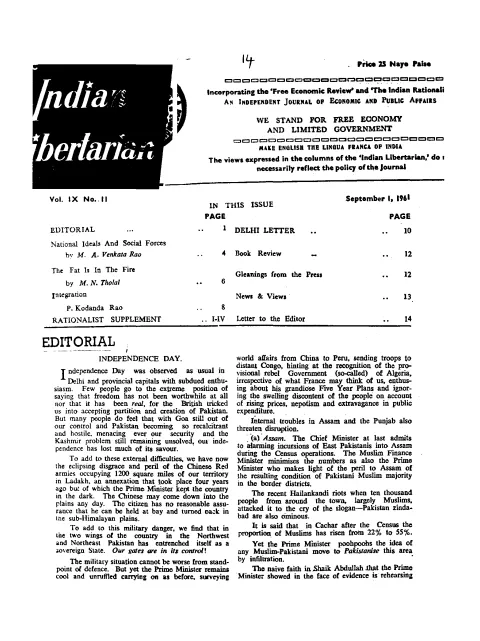
periodical issue
The Indian Libertarian
Independent Journal of Free Economy and Public Affairs — Vol. VIII No. 9, August 1, 1960
By MA Venkata Rao, M. N. Tholal
The Indian Libertarian · Bombay · 1960
24 pages
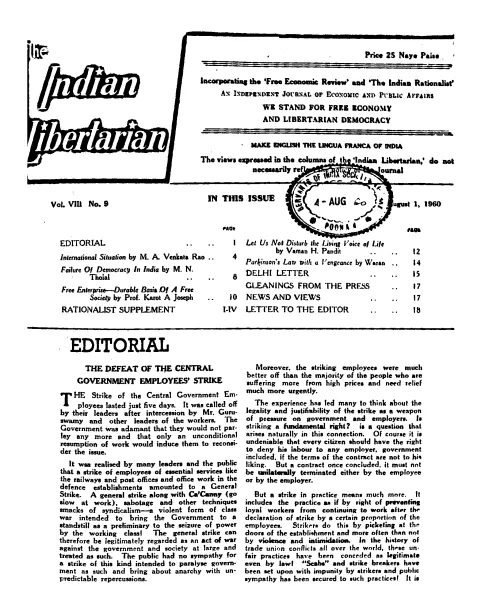
The Indian Libertarian
Summary
The 1 August 1960 issue of The Indian Libertarian (Vol. VIII, No. 9) leads with a sharply-worded editorial on the just-collapsed Central Government Employees’ Strike, arguing that a strike in essential public services amounted to a general strike — an act of war against state and society that the public was right to refuse. Subsequent editorial notes treat the rise of Hindi imperialism in Assam, the Punjabi Suba agitation, and a Congress proposal for compulsory national service for students. Feature articles by M. A. Venkata Rao on the international situation, M. N. Tholal on the failure of democracy in India, and Prof. Karot A. Joseph on free enterprise as the durable basis of a free society fill out the main pages. A four-page Rationalist Supplement honours the recently-deceased Bombay industrialist and rationalist R. B. Lotvala with a biographical sketch by S. Ramanathan and reproduces Lotvala’s own essay on the Sisyphean task of the Indian rationalist. Shorter pieces by Vaman H. Pandit (on the threat posed to English by linguistic provincialism), Waran (a Parkinson’s-Law-style tabulation of bloating central government employment) and a Delhi Letter on the Assam language imbroglio and the Subramaniam case round out the rendered pages.
Key points
-
The lead editorial argues that the just-collapsed Central Government Employees’ Strike amounted to a general strike and ‘an act of war against the government and society at large’ that the public was right to refuse to support.
-
The editorial concedes striking employees were worse off than the general public and need relief, while rebuking the Centre’s coercive Bengali/Hindi language policy in Assam and welcoming the Akali Dal’s Punjabi Suba demand as a legitimate constitutional question.
-
A further editorial note rejects the Congress proposal for compulsory national service for students as a sovietising device that would militarise youth.
-
M. A. Venkata Rao’s ‘International Situation’ surveys the post-U-2 US-Soviet standoff, Communist-led student agitations on American campuses, the Cuban crisis under Castro, and the unfolding Congo independence.
-
M. N. Tholal’s ‘Failure of Democracy in India’ attributes democratic hollowing-out to an overwhelmingly illiterate electorate voting on caste and communal cues and reads Indira Gandhi’s elevation to the Congress presidency as the entry of dynastic politics.
-
Prof. Karot A. Joseph argues in ‘Free Enterprise — Durable Basis of a Free Society’ that economic concentration in state hands destroys the conditions for a free society regardless of egalitarian intent.
-
A four-page Rationalist Supplement honours the recently deceased industrialist and rationalist R. B. Lotvala with a biographical sketch by S. Ramanathan and reproduces Lotvala’s own essay on the Sisyphean task of the Indian rationalist.
-
Shorter pieces cover the threat linguistic provincialism poses to English, a Parkinson’s-Law-style tabulation of bloating central government employment by Waran, and a Delhi Letter on the Assam language imbroglio and the Subramaniam case.
Essays
EDITORIAL — The Defeat of the Central Government Employees’ Strike / Provincialism in Assam
The lead editorial, “The Defeat of the Central Government Employees’ Strike,” treats the five-day strike called by Mr. Guruswamy and other leaders as a victory for the rule of law. The paper concedes that striking employees were worse off than the general public and need relief, but draws a hard line on the legality of the strike itself: a stoppage in essential services like railways, post offices and defence is a general strike, an “act of war against the government and society at large” that the public was right to refuse to support. A second editorial note welcomes the formation of the Akali Dal’s Punjabi Suba demand into a constitutional question and rebukes the Centre’s coercive language policy in Assam, where the imposition of Bengali and Hindi has provoked tribal agitations. A third note opposes the Congress proposal for compulsory national service for students as a sovietising device that would militarise youth.
- Strikes in essential public services are characterised as general strikes amounting to an act of war against the state.
- The editorial concedes that striking employees were worse off than the general public and need relief from high prices.
- Imposition of Bengali/Hindi in Assam is framed as the chief cause of the recent agitations there.
- The Akali Dal’s Punjabi Suba demand is treated as a legitimate linguistic-state question that the Centre must address.
- Congress’s proposed compulsory national service for students is rejected as a step toward militarised regimentation.
International Situation
By MA Venkata Rao
M. A. Venkata Rao’s “International Situation” surveys the post-U-2 standoff between the United States and the Soviet Union, the wave of Communist-led agitations on American campuses (notably against the House Un-American Activities Committee), the renewed Cuban crisis under Castro, and the unfolding Congo independence. Rao treats Khrushchev’s diplomacy as fundamentally hostile to peaceful coexistence on Western terms and reads the recent ferment in U.S. universities as Communist infiltration of innocent student bodies. He is sympathetic to the United States’ difficulty in defending Cuban exiles while opposing Castro, and analyses the collapse of order in the Congo as the predictable consequence of Belgium’s failure to prepare Africans for self-government — but warns that the Soviet bloc is poised to exploit any vacuum left by the West.
- Khrushchev’s post-U-2 posture is read as a strategic shift toward open hostility, not a tactical outburst.
- Communist organisation is held responsible for the anti-HUAC and other student agitations on American campuses.
- The Cuban crisis is framed as a moral dilemma for the U.S., torn between non-intervention and resistance to Castro’s drift toward the Soviet bloc.
- Belgium is faulted for granting Congo independence without preparing Africans for self-government.
- The Soviet bloc is expected to move into any African vacuum the West leaves behind.
Failure Of Democracy In India
By M. N. Tholal
M. N. Tholal’s “Failure of Democracy in India” diagnoses a democracy hollowed out by the absence of an effective adult franchise: literate participation is thin, mass politics is delivered through caste and communal blocks, and the ruling Congress operates as a single-party machine whose internal disputes substitute for opposition. Tholal singles out the elevation of Mrs. Indira Gandhi to the Congress presidency as confirmation that dynastic succession, not democratic competition, is consolidating in India. He reads the Prime Minister’s recent platitudes as evidence that even the Congress leadership no longer believes its own democratic creed, and warns that the result will be the steady atrophy of constitutional liberty.
- Effective adult franchise is held to be absent because the electorate is overwhelmingly illiterate and votes on caste/communal cues.
- The Congress monopoly converts internal faction fights into a substitute for genuine opposition.
- Indira Gandhi’s elevation to the Congress presidency is read as the entry of dynastic politics.
- The Prime Minister’s public speeches are described as platitudes that reveal a loss of democratic conviction.
- Without contestation, constitutional liberty is expected to atrophy under the weight of the ruling-party apparatus.
Free Enterprise—Durable Basis Of A Free Society
By Prof. Karot A Joseph
Prof. Karot A. Joseph’s “Free Enterprise — Durable Basis of a Free Society” argues that economic concentration in the hands of the state — whatever its egalitarian intent — destroys the conditions of political liberty. Drawing on the Indian Constitution’s special-powers provisions and the trajectory of postwar Asian states, Joseph contends that diffused private ownership of the means of production is the only institutional check on tyranny that has ever been demonstrated to work. Liberty, he writes, is the collective body what health is to every individual body; once economic power is monopolised by the state, free political life cannot be enjoyed by society.
- Concentration of economic power in the state extinguishes the conditions of political freedom.
- Diffused private property and competitive enterprise are framed as the only durable institutional guarantees of liberty.
- The argument is illustrated by the Indian Constitution’s emergency-powers and special-powers provisions.
Essay 5
The Rationalist Supplement opens with S. Ramanathan’s biographical sketch of Ranchhoddas Bhavan Lotvala (1875–), the Bombay flour-mill industrialist who used his fortune to bankroll Indian rationalism and the labour press. Born into the Gosain cult at Vallabhacharias, Lotvala escaped religious superstition through self-education in modern science and philosophy and converted his Duncan Road flour mill into a hub of progressive thought. Ramanathan recounts Lotvala’s patronage of the Indian Sociologist, his support for Anthony Elenjimittam’s reformist work, his founding of the Libertarian Book House and the Lotvala Trust, and the role of the Arya Bhavan as a meeting-place for the early Indian peasant movement led by Indulal K. Yagnik. The piece presents Lotvala as a self-made Rationalist whose patronage was the indispensable material condition for the survival of free-thought publishing in Bombay.
- Lotvala’s escape from the Vallabhacharia / Gosain cult is told as a paradigmatic case of self-rescue through modern science and philosophy.
- His flour mill at Duncan Road financed rationalist publishing, the Libertarian Book House and the Lotvala Trust.
- Arya Bhavan, his residence, hosted the early Indian peasant-movement meetings under Indulal K. Yagnik.
- Anthony Elenjimittam is acknowledged as a fellow-traveller whose writing Lotvala supported.
RATIONALIST SUPPLEMENT (R. B. Lotvala, a Life Sketch by S. Ramanathan; A Message to My Fellow-Rationalists by R. B. Lotvala; poem by Richard J. Briggs)
R. B. Lotvala’s own essay, “A Message to My Fellow-Rationalists,” subtitled “Rationalist’s Task in India — A Sisyphus Labour,” diagnoses the peculiar difficulty of Indian rationalism: where European free-thought could build on a Renaissance and a scientific revolution that loosened the grip of revealed religion, the Indian rationalist must clear a field still covered by astrology, palmistry and caste-religious ritual that even the educated reproduce uncritically. Lotvala traces the genealogy of modern liberty through the English, American and French revolutions and contrasts it with the Indian record: a Renaissance gestured at, a real revolution never carried through, and a freedom that is purely political because economic and social bondage remain. He argues that the rationalist must therefore work simultaneously on superstition, caste and the economic basis of caste.
- Indian rationalism is described as Sisyphean because the soil it must clear has not been broken by a prior Renaissance or scientific revolution.
- Astrology, palmistry and caste ritual are diagnosed as live forces even among the Indian educated class.
- The English, American and French revolutions are presented as the institutional carriers of modern liberty that India lacks.
- Lotvala argues that political freedom without economic and social emancipation is hollow.
- The rationalist’s task is reframed as simultaneous struggle against superstition, caste and the economic basis of caste.
Let Us Not Disturb the Living Voice of Life
By Vaman H. Pandit
Vaman H. Pandit’s “Let Us Not Disturb the Living Voice of Life” defends the place of English as the link language of India against the regional-language purists. Pandit reports on the difficulty of teaching English under the new schemes that have downgraded it in school curricula, and warns that displacing English will not promote Hindi or any regional language to its functional role — it will simply impoverish public life and cut the educated Indian off from the world’s scholarship.
- English is defended as the indispensable link language of India.
- Schemes that downgrade English in school curricula are reported to be failing in their stated aim.
- Displacing English is argued to impoverish public life rather than to elevate any regional language.
Parkinson’s Law with a Vengeance
By Waran
Waran’s “Parkinson’s Law with a Vengeance” presents a month-by-month table of employment in Central Government establishments (excluding railways) from February 1958 through February 1959, showing a steady rise from roughly 6.93 lakh to over 7.16 lakh employees, and traces the parallel growth of civil-administration expenditure from Rs. 35.50 crores in 1948-49 to a budgeted Rs. 2.22 crores per quarter by 1959-60. Waran argues that the government’s claim to be solving the unemployment problem by absorbing labour is an unintended consequence of its socialist commitments, and that so long as the State expands administrative employment as a substitute for productive activity, costs will outrun any improvement in service.
- Central Government establishment employment grew steadily, from 6.93 lakh in Feb 1958 to 7.16 lakh in Feb 1959.
- Civil-administration expenditure rose from Rs. 35.50 crores in 1948–49 to a budgeted Rs. 2.22 crores in 1959–60.
- Waran argues that socialism’s commitment to absorb labour through state employment is the structural cause of the bloat.
- Hiring is described as growing faster than the productive functions it is supposed to deliver.
DELHI LETTER — Power Politics In Full Swing
By From Our Correspondent
No summary was extracted for this article. Listed for completeness.
GLEANINGS FROM THE PRESS
The Delhi Letter, “Power Politics in Full Swing,” reports from the capital on the manoeuvring inside Congress as Pandit Nehru’s grip on the party visibly loosens and the succession question begins to be discussed openly. The correspondent argues that the unifying Gandhian-Nehruvian frame that held the party together is breaking down, and treats the Assam language imbroglio (where the imposition of Assamese has alienated the Bengali-speaking population) and the Subramaniam case as twin demonstrations of the Centre’s growing administrative drift. Both episodes are read as evidence that the moral capital accumulated under Gandhi and the freedom struggle is now being consumed faster than it can be replaced.
- Pandit Nehru’s hold over the Congress party is described as visibly weakening in the rendered pages.
- The Assam language imbroglio is offered as proof that the Centre is mishandling linguistic federalism.
- The Subramaniam case is read as a barometer of the Congress organisation’s moral decline.
- The Gandhian frame is held to have been the source of Congress unity, and is now described as exhausted.
Generated by the v1.5 extraction pipeline. Awaiting editorial review.
Metadata and summary are AI-extracted from the source PDF and reviewed for editorial accuracy. The original work is available via the Read PDF tab above (where present); paragraph-level citation inside the PDF is deferred to a future engagement.