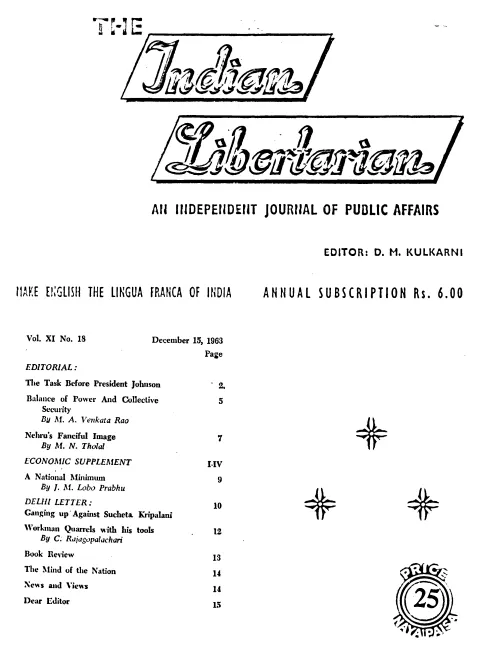
periodical issue
The Indian Libertarian
An Independent Journal of Public Affairs
The Libertarian Publishers (Private) Ltd., First floor, Arya Bhuvan, Sandhurst Road West, Bombay 4 · Bombay · 1963
16 pages
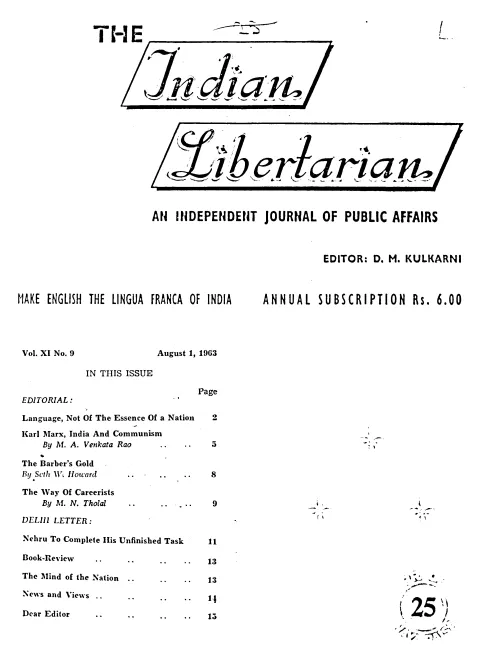
The Indian Libertarian
Summary
The Indian Libertarian Vol. XI No. 9 (August 1, 1963), edited by D. M. Kulkarni and published by Libertarian Publishers Private Ltd., Bombay, opens with an editorial arguing that language is not the essence of nationhood and pressing the case for English as India’s lingua franca over imposed Hindi. The body of the issue is dominated by M. A. Venkata Rao’s long analytical essay on Karl Marx, India and world communism, which reads the Sino-Soviet split, the Cuban missile crisis, and the China-India border conflict as exposing the Communist project as conspiratorial power-seizure dressed in humanitarian rhetoric. Seth W. Howard’s parable ‘The Barber’s Gold’ lampoons Morarji Desai’s budget through a king-and-barber fable, M. N. Tholal’s ‘The Way of Careerists’ skewers what he calls Nehru’s Gandhian-flavoured opportunism in the wake of the Chandigarh speech, and an unsigned Delhi Letter handicaps the succession contest among Shastri, Indira Gandhi, Morarji Desai, Y. B. Chavan and Jagjivan Ram against the backdrop of Jaya Prakash Narayan’s and Rajaji’s rival reform proposals.
Key points
-
The unsigned editorial rejects the claim that a single national language is the essence of nationhood, citing Prussia’s absorption of Slavic populations and Heine’s polyglot Germany as counter-examples.
-
It defends English as India’s practical lingua franca for clarity of thought and federation-binding utility, framing Hindi imposition as a Congress-driven expedient that risks fracturing the country.
-
The editorial also raises the worsening position of Indians in East Africa and warns Nehru against personality cult, careerism and an ‘Anti-India Defence Lobby’ around him.
-
M. A. Venkata Rao’s ‘Karl Marx, India And Communism’ calls the Communist Party ‘primarily a conspiracy to do violence and seize power by force’ rather than a humanitarian movement.
-
He reads the Sino-Soviet split, the Cuban missile crisis and the Sino-Indian border war as evidence that Khrushchev’s ‘peaceful coexistence’ and Maoist militancy are two faces of the same revolutionary project.
-
Venkata Rao warns that Indian Communists’ ultimate loyalty runs to the international party line rather than to the nation.
-
Seth W. Howard’s fable ‘The Barber’s Gold’, prompted by Morarji Desai’s budget, satirises rulers who hear only flattering reports while inconvenient truths seep out regardless.
-
M. N. Tholal’s ‘The Way Of Careerists’ reads Nehru’s Chandigarh speech as evidence he has turned the ‘Gandhian technique’ of renunciation into a careerist’s borrowed moral capital.
-
An unsigned Delhi Letter handicaps the succession contest among Shastri, Indira Gandhi, Morarji Desai, Y. B. Chavan and Jagjivan Ram against rival reform proposals from Jayaprakash Narayan and Rajaji.
Essays
Language, Not Of The Essence Of a Nation
The unsigned editorial responds to an article in NIRAVADYA (July 13, 1963) by examining the claim that a single national language is the essence of a nation. It rejects romantic-nationalist arguments that derive nationhood from linguistic uniformity, citing the Prussian absorption of Slavic populations and Heine’s German example to show that great political communities have always been polyglot. The editorial then makes a positive case for English as India’s working lingua franca on the grounds of clarity of thought, accumulated scholarship, and a flea for clarity over emotive expediency, and frames Hindi imposition as a Congress-driven expedient that will fracture the federation.
The back half of the editorial pivots to two further fronts: the worsening position of Indians in East Africa (Tanganyika, Kenya, Uganda) and a direct address to Nehru — ‘Let not you overwhelm the country, Mr. Nehru’ — warning against personality cult, the Anti-India Defence Lobby, and the careerist climbers around the Prime Minister. C. Rajagopalachari is invoked approvingly as the elder voice arguing for a measured language policy.
- Argues language is not the essence of a nation and rejects monolingual nationalism by appeal to Prussian and Heine’s German examples.
- Defends English as India’s lingua franca on grounds of clarity, scholarship and federation-binding utility.
- Treats Hindi imposition as a Congress-led expedient that risks fracturing the polity.
- Pivots to the position of Indians in East Africa as a foreign-policy concern.
- Direct address to Nehru warns against personality cult, careerism, and an ‘Anti-India Defence Lobby’.
Karl Marx, India And Communism
By MA Venkata Rao
M. A. Venkata Rao’s lead article is a sustained polemic against the view that communism is at root a humanitarian movement for social justice. He insists that the Communist Party is ‘primarily a conspiracy to do violence and seize power by force’ and that the doctrines of Marx and Lenin remain the operative ideology of both Moscow and Peking despite their visible quarrel. Reading the Sino-Soviet split, the Cuban missile crisis and the China-India border war together, he argues that Khrushchev’s ‘peaceful coexistence’ is a tactical variant of the same revolutionary project that Mao Tse-tung pursues by harder means.
The essay then turns to India: it warns that Indian Communists’ loyalty is finally to the international party line, that fellow-travelling intellectuals provide cover, and that the Chinese aggression should have ended any illusion that communism can be domesticated to nationalist purposes. Venkata Rao draws on the Welt-Politik tradition, references Krupskaya, Stalin and Hitler as comparative cases, and closes by urging Indian liberals to recognise the doctrinal core beneath the diplomatic theatrics.
- Rejects the framing of communism as humanitarianism — calls it a conspiracy to seize power by force.
- Reads the Sino-Soviet split as a tactical quarrel, not a doctrinal break.
- Argues ‘peaceful coexistence’ and Maoist militancy are two faces of the same revolutionary project.
- Treats the Cuban missile crisis and Sino-India war as case studies in Communist intent.
- Warns that Indian Communists’ first loyalty is to the international party, not the nation.
The Barber’s Gold
By Seth W. Howard
Seth W. Howard’s short prose piece frames itself as a fable triggered by Morarji Desai’s budget and the comfortable living of Union ministers. A king relies entirely on his Prime Minister and barber for news of the realm; the Minister tells him only what is convenient, while the barber, sworn to confidence, eventually has to whisper the king’s secret into a hole in the ground. The moral is bent at India’s political class: rulers who hear only flattering reports from courtiers will find the inconvenient truth seeping out from below them whether they wish it or not.
- Frames the fable explicitly as commentary on Morarji Desai’s budget and ministerial comfort.
- Uses the king-and-barber story to satirise insulated rulers fed flattering reports.
- Argues unwelcome truths surface despite efforts to suppress them.
The Way Of Careerists
By M. N. Tholal
M. N. Tholal reads Nehru’s Chandigarh speech as proof that the Prime Minister has perfected the ‘Gandhian technique’ as a career instrument rather than a moral discipline. The essay argues that Nehru has mastered the rhetorical register of self-sacrifice and renunciation while in practice retaining power, and that the speech’s appeal to the Mahatma is therefore a careerist’s borrowing of moral capital. Tholal extends the critique into a broader account of the post-Independence political class: the careerist learns to clothe ambition in Gandhian, socialist or constitutional vocabulary as the occasion requires.
The second half of the article ranges over comparative cases — Lenin, Hitler and the psychology of the ‘true believer’ — to argue that Indian public life has produced a soft variant of the same type. Tholal treats Indira Gandhi’s emerging role and the cult-of-personality tendencies around the Prime Minister as symptoms of the same disease, and warns that genuine democratic culture cannot survive the substitution of slogans for argument.
- Reads Nehru’s Chandigarh speech as a careerist’s appropriation of Gandhian moral capital.
- Argues post-Independence politicians have made Gandhian, socialist and constitutional vocabularies interchangeable career tools.
- Draws comparative parallels with Lenin and Hitler as cases of the ‘true believer’ converted into the careerist.
- Treats the cult-of-personality around Nehru and the rise of Indira Gandhi as symptoms of the same disease.
- Warns that democratic culture cannot survive the substitution of slogans for argument.
Nehru To Complete His Unfinished Task
By From Our Correspondent
The Delhi Letter (signed ‘From Our Correspondent’) reports that Nehru’s Chandigarh declaration — that his refusal to resign reflects a duty to complete the unfinished task imposed by the Chinese aggression — has reopened the succession question rather than closed it. The dispatch handicaps the contenders: Lal Bahadur Shastri as the colourless consensus heir, Morarji Desai as the orthodox conservative, Y. B. Chavan as the rising defence minister, Indira Gandhi as the dynastic option, and Jagjivan Ram as the Harijan card. It argues that none of these can yet command both the Congress organisation and the country.
The second half discusses Jaya Prakash Narayan’s and Rajaji’s rival reform projects as the more interesting question — whether Indian politics will be reorganised around a Swatantra-style liberal opposition or whether JP’s sarvodaya line will absorb dissent back into a Gandhian framework. The correspondent also reads the AICC mood, P. C. Joshi’s intervention, and a constitutional crisis in U.P. as signs that the centre cannot hold the old Nehruvian coalition together much longer.
- Reads Nehru’s Chandigarh refusal-to-resign speech as reopening rather than settling succession.
- Handicaps Shastri, Morarji Desai, Chavan, Indira Gandhi and Jagjivan Ram as rival heirs.
- Treats Jaya Prakash Narayan and Rajaji as the more interesting reform poles outside Congress.
- Reports a constitutional crisis brewing in U.P. as evidence of fraying Congress hegemony.
- Frames the Chinese aggression as the structural fact that has changed all Indian political calculations.
Book-Review
By MA Venkata Rao
M. A. Venkata Rao reviews ‘New Horizons in Creative Thinking — A Survey and Forecast’, a volume of thirteen addresses delivered under the Theosophical auspices in Madras in October 1962. The review summarises the book as a multi-disciplinary survey of post-war thought — covering science, philosophy, education, social organisation and international affairs — and credits the editor with assembling a coherent picture of where mid-twentieth-century intellectual life is heading. Venkata Rao reads the volume as broadly congenial to the liberal-humanist position the journal represents, while flagging the chapters on planning and on Indo-Pakistan relations as the ones whose optimism he finds least supported.
- Reviews a thirteen-address survey volume from a 1962 Madras meeting.
- Reads the book as a liberal-humanist survey of post-war thought.
- Praises the editor’s success in assembling a coherent picture across disciplines.
- Flags planning-economy and Indo-Pakistan chapters as the weakest in their optimism.
The Mind of the Nation
By M. A. Venkata Rao
‘The Mind of the Nation: A Red Solution for the Sino-India Dispute’ is an editorial comment on a Communist Party of India proposal for resolving the border conflict on terms congenial to Peking. The piece treats the CPI position as evidence that the party’s first loyalty remains international, not national, and links the proposal to the wider debate over Krishna Menon’s defence stewardship and Nehru’s reluctance to discipline fellow-travelling intellectuals.
- Treats a CPI proposal on the Sino-India dispute as Peking-favourable.
- Reads the CPI line as evidence of international, not national, first loyalty.
- Links the episode to the wider Krishna Menon defence-policy controversy.
News and Views
The News & Views column compiles short notes: completion of the Hawk and Honest John air-defence missile deals with the United States, a Washington report that Chinese pressure is being used to stall further arms shipments to India, news that over fifty thousand Chinese have reportedly fled into Soviet territory amid the Sino-Soviet quarrel, and Lakshmi N. Menon’s frank parliamentary criticism of the Berlin Wall. Further notes cover a Peking ban on Russian entries and pro-China Tibetan lama activity in Spiti. The selection works as a tour of cold-war fault lines as they touch Indian interests.
- Reports completion of Hawk and Honest John missile purchases from the United States.
- Notes Washington claims that China is pressuring the US to halt further arms transfers to India.
- Reports over 50,000 Chinese fled into the Soviet Union amid the Sino-Soviet split.
- Highlights Lakshmi N. Menon’s frank criticism of the Berlin Wall in parliament.
- Flags pro-China Tibetan lama activity in Spiti as an internal-security note.
Dear Editor
The Dear Editor section carries two reader letters. The first, from K. Atmaram of Cuddapah, debates an earlier piece on China policy and democratic defence; the second, signed M. A. Venkata Rao from Bangalore, returns to the theme of fellow-travelling intellectuals and the journal’s editorial line. Both letters reinforce rather than contest the journal’s anti-Communist, pro-civil-liberty stance.
- Two reader letters, both broadly aligned with the journal’s editorial line.
- K. Atmaram debates an earlier China-policy article.
- M. A. Venkata Rao returns to the fellow-traveller theme he develops in the lead article.
Generated by the v1.5 extraction pipeline. Awaiting editorial review.
Metadata and summary are AI-extracted from the source PDF and reviewed for editorial accuracy. The original work is available via the Read PDF tab above (where present); paragraph-level citation inside the PDF is deferred to a future engagement.