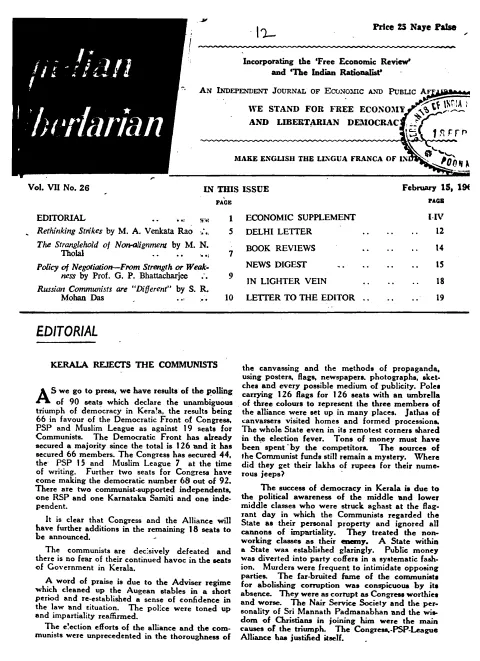
periodical issue
The Indian Libertarian
Incorporating the 'Free Economic Review' — An Independent Journal of Economic and Public Affairs
By MA Venkata Rao, M. N. Tholal, G N Lawande
The Indian Libertarian — Independent Journal of Free Economy and Public Affairs, Edited by KUSUM LOTWALLA, Arya Bhuvan, Sandhurst Road, Bombay 4 · Bombay · 1959
24 pages
The Indian Libertarian
Summary
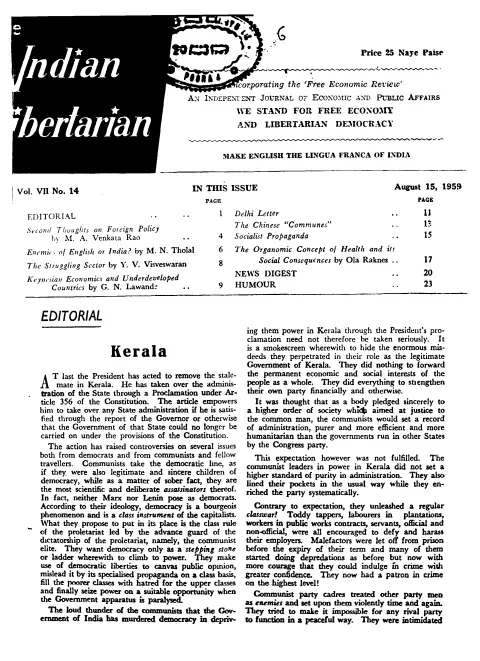
The August 15, 1959 number of The Indian Libertarian (Vol. VII, No. 14), the Bombay fortnightly edited by Kusum Lotwalla and styled an ‘Independent Journal of Free Economy and Public Affairs’, leads with an editorial defending the Centre’s invocation of Article 356 to dismiss the Communist ministry in Kerala, and then assembles a roster of classical-liberal contributors who attack central planning, Nehruvian foreign policy, the Mao-era Chinese communes, and what they call socialist propaganda. Pieces by M. A. Venkata Rao on foreign policy, M. N. Tholal on language, Y. V. Visveswaran on the private sector, G. N. Lawande on the limits of Keynesian prescriptions in underdeveloped economies, an unsigned Delhi Letter on Nehru and Hindi, an unsigned report on the Chinese communes, Reginald Jebb on socialist propaganda, and Ola Raknes on an ‘organomic’ conception of health together advance a Swatantra-aligned programme of private enterprise, federal restraint, and resistance to collectivism.
The issue functions as a partisan record of the new Swatantra Party’s founding rhetoric: an editorial section on the Swatantra Party follows the Kerala leader, and a sidebar on page 8, ‘Heard at the Swatantra Party Pandal’, prints terse aphorisms attributed to Ruthnasawmy, H. P. Mody, K. M. Munshi, M. R. Masani, and B. Satyanarayana. News Digest items, a notice from the Libertarian Social Institute, Bangalore, and the journal’s standing ‘WE STAND FOR FREE ECONOMY AND LIBERTARIAN DEMOCRACY / MAKE ENGLISH THE LINGUA FRANCA OF INDIA’ masthead frame the contents.
Key points
-
The 15 August 1959 issue, Vol. VII No. 14, edited by Kusum Lotwalla, leads with an editorial defending the Centre’s use of Article 356 to dismiss the Communist ministry in Kerala.
-
The Kerala editorial charges the Namboodiripad government with corruption and class warfare against opponents, and frames the newly launched Swatantra Party as the constitutional alternative to Congress and the Communist Party.
-
M. A. Venkata Rao’s Second Thoughts on Foreign Policy treats the Chinese seizure of Tibet as a hinge event and argues that non-alignment has left India without Western support.
-
M. N. Tholal’s Enemies of English or India? opposes replacing English with Hindi as India’s lingua franca, distinguishing Rajagopalachari’s reasoned reservations from wholesale anti-English sentiment.
-
Y. V. Visveswaran’s The Struggling Sector surveys private enterprise hemmed in by the 1948 Industrial Policy Resolution and the 1956 Avadi Resolution, quoting Barbara Wootton against the idea that planning kills enterprise.
-
A sidebar, Heard at the Swatantra Party Pandal, prints aphorisms attributed to Ruthnasawmy, H. P. Mody, K. M. Munshi, M. R. Masani and B. Satyanarayana.
-
The issue’s masthead declares the journal stands for free economy and libertarian democracy and calls for making English the lingua franca of India.
Essays
EDITORIAL (Kerala)
The unsigned editorial ‘Kerala’ defends the President’s dismissal of the Communist-led Kerala ministry under Article 356 and treats the Communist outcry as cynical noise. The editorial argues that the Communists’ performance in office betrayed their pledges to provide ‘a higher standard of purity in administration’: they lined their pockets, unleashed regular class war against opponents, and used ‘democratic liberties to canvas public opinion, mislead it by its specialised propaganda on a class basis, fill the poorer classes with hatred for the upper classes and finally seize power on a suitable opportunity when the Government apparatus is paralysed.’ Communists, the editorial insists, only treat democracy as ‘a stepping stone or ladder wherewith to climb to power’. The piece flows into a companion section on ‘The Swatantra Party’, framing the new party’s Madras formation as the constitutional alternative to both Congress drift and Communist subversion.
- Defends Centre’s Article 356 proclamation removing the Kerala Communist ministry as legitimate and necessary.
- Reads Communist participation in democracy as instrumental — democracy as ‘a class instrument of the capitalists’ to be overthrown once power is consolidated.
- Charges the Namboodiripad government with corruption, class warfare against political opponents, and patronage of crime.
- Frames the newly launched Swatantra Party as the constitutional alternative to Congress and the CPI.
- Asserts that Marx and Lenin themselves never claimed to be democrats — the editor’s central rhetorical move.
Second Thoughts on Foreign Policy
By MA Venkata Rao
M. A. Venkata Rao calls for a wholesale rethink of Indian foreign policy after what he describes as the Red Chinese ‘annihilation of Tibet in its totalitarian communist society by way of a ruthless invasion’. He argues that non-alignment has insulated India from Western support while the Soviet bloc and China have moved openly hostile to Indian interests, and that Nehru’s refusal to associate with the Western democracies has left India strategically alone. The piece urges that India align with the free world, accept Commonwealth and American security guarantees, and abandon the diplomatic pieties that have, in his view, treated ‘aggressors’ as friends.
- Frames the Chinese seizure of Tibet as a hinge event requiring India to revise its foreign-policy posture.
- Argues that non-alignment has supplied neither security nor moral leverage.
- Calls for closer association with the Western democracies and Commonwealth.
- Criticises the diplomatic premium placed on remaining friendly with aggressive neighbours.
Enemies of English or India?
By M. N. Tholal
M. N. Tholal opposes the Congress drive to replace English with Hindi as India’s lingua franca, arguing that English is in fact the ‘mightiest pillar of freedom’ available to a federation of distinct linguistic nations. He distinguishes Chakravarti Rajagopalachari’s reasoned reservations about Hindi from the wholesale anti-English ideology of the Hindi enthusiasts, and contends that English is the practical glue of the all-India bureaucracy, the universities, and the press. Tholal sees the imposition of Hindi as a form of cultural majoritarianism that will erode rather than build the Indian Union.
- Defends English as the practical lingua franca of post-colonial India.
- Argues that compulsory Hindi will provoke regional resentment and weaken the federation.
- Distinguishes Rajagopalachari’s nuanced position from the absolutist anti-English camp.
- Frames the language question as a civil-liberty and federalism issue, not a nationalist one.
The Struggling Sector
By Y. V. Visveswaran, M. A.
Y. V. Visveswaran surveys the ‘struggling sector’ — Indian private enterprise — and finds it boxed in by central planning, the 1948 Industrial Policy Resolution, and the 1956 Avadi Resolution’s preference for the public sector. Quoting Barbara Wootton’s warning that ‘“Economic Planning” does not mean the death warrant of all private enterprise’, he argues that the Indian private sector has nonetheless been forced into ‘a period of trial and tribulations, stresses and strains’ and is treated as a Cinderella in the Five-Year Plan map of the world. The article cites A. D. Shroff and Lal Bahadur Shastri on the need to reward and unshackle private enterprise, and closes with a sidebar of quotable lines from the Swatantra Party Pandal.
- Diagnoses the squeeze on Indian private enterprise from the 1948 Industrial Policy Resolution onward, accelerated by the 1956 Avadi Resolution.
- Treats the Planning Commission and Industrial Finance Corporation as institutional pressures on private capital.
- Cites A. D. Shroff and Lal Bahadur Shastri as voices urging that the private sector be allowed to flourish.
- Reports the founding rhetoric of the Swatantra Party Pandal — Ruthnasawmy, H. P. Mody, K. M. Munshi, M. R. Masani, B. Satyanarayana — verbatim.
Keynesian Economics and Underdeveloped Countries
By G N Lawande
G. N. Lawande argues that the Keynesian theory of underemployment equilibrium and deficit-financed public investment, developed for the chronically demand-deficient economies of the inter-war West, has been misapplied wholesale to Indian conditions. In underdeveloped countries the binding constraint is not deficient effective demand but shortages of capital, technical capacity, and entrepreneurship; pump-priming and large public outlays therefore produce inflation rather than employment. Lawande reads the Indian planners’ enthusiasm for Keynesian prescriptions as a category error that has converted a tool for advanced economies into a justification for politically attractive but economically destructive deficit spending.
- Distinguishes Keynesian conditions (excess capacity, demand deficiency) from underdeveloped conditions (capital scarcity, structural bottlenecks).
- Argues that deficit financing in India produces inflation, not employment.
- Treats the application of Keynes to Indian planning as a misuse of imported theory.
- Connects monetary policy to the broader critique of central planning.
Delhi Letter — Nehru Must Make His Choice (From our Correspondent)
The ‘Delhi Letter’ (titled ‘Nehru Must Make His Choice’) treats the controversy over Hindi and the Sikh demand for a Punjabi-speaking state as twin tests of the Prime Minister’s commitment to federalism and to liberal pluralism. The columnist argues that Nehru has long protected the imposition of Hindi while permitting Congress-aligned politicians to denounce English-knowing minorities, and that he must now choose between accommodating regional and linguistic claims or backing the maximalist Hindi camp. The piece reads the ‘Sikh imbroglio’ over a separate Punjabi Suba as a parallel case where Congress evasion has hardened communal resentment.
- Reads the Hindi controversy as a constitutional question, not a cultural one.
- Charges Nehru with equivocation between assimilationist Hindi advocates and English-knowing minorities.
- Connects the language fight to the Sikh demand for Punjabi Suba.
- Treats both as failures of Congress federalism.
The Chinese “Communes” (Concluded)
The unsigned report ‘The Chinese “Communes”’ continues a previous instalment’s argument that the 1958 commune drive in China was a coerced political reorganisation, not the spontaneous peasant movement Chinese propaganda claimed. Tracing the commune scheme back to Mao Tse-tung’s Honan tour and to Liu Shao-chi’s role in the ‘people’s communes’ resolution, it cites Chinese sources to show that local cadres organised, drilled, and disciplined peasants in militarised production brigades. The piece argues that the resulting collapse of household life, private plots, and intra-family solidarity has been disguised by the regime as a triumph of socialism.
- Treats the people’s communes as engineered from the top, not spontaneous.
- Names Mao Tse-tung and Liu Shao-chi as architects of the 1958 commune resolution.
- Highlights the destruction of family life, private plots, and household autonomy.
- Reads the experiment as evidence against the communist claim of voluntary collectivism.
Socialist Propaganda — The result is increased taxes on the people it impoverishes
By Reginald Jebb
Reginald Jebb’s ‘Socialist Propaganda’ argues, against the conventional Fabian claim, that twentieth-century socialism has not enlarged liberty but transferred it from individuals to bureaucracies. Drawing on British experience under post-war Labour government and on the rhetoric of subsidised housing, nationalised medicine and pensions, Jebb contends that the ‘Socialist blueprint of utopia’ substitutes paternalist administration for self-government. He distinguishes the genuine impulse of social reform — to relieve hardship — from the propaganda use of those reforms to justify the permanent enlargement of the state.
- Treats the British post-war welfare state as the working example of socialist propaganda.
- Argues that ‘rent control, socialised medicine, old-age pensions’ are presented as freedoms but in practice enlarge official discretion.
- Separates the moral case for relief from the political case for permanent state expansion.
- Closes with the ‘false claims of socialism’ as a polemical frame.
The Organonic Concept of Health and Its Social Consequences
By Ola Raknes, Ph.D.
Ola Raknes, drawing on Wilhelm Reich’s orgone research, sketches an ‘organomic’ concept of health in which health is not merely the absence of disease but the free pulsation of biological energy across the whole organism. He argues that the medical profession has failed to supply a positive definition of health, that diagnostic specialisation by organ obscures the unity of the organism, and that armoured patterns of muscular and emotional restriction in modern life — produced by sexual repression and authoritarian upbringing — are the underlying source of widespread psychosomatic illness. The piece presents these claims as the social consequence of an ‘organomic’ rather than mechanistic medicine.
- Critiques the absence of a positive definition of health in standard medicine.
- Locates health in unimpeded biological pulsation across the whole organism.
- Identifies ‘armouring’ — chronic muscular and emotional restriction — as the somatic substrate of widespread illness.
- Reads the medical model as a social and political question, not merely a clinical one.
NEWS DIGEST
The ‘News Digest’ on page 20 collects short notices: India’s exhibition at the Chicago International Fair, Nehru’s call describing Pak firing across the Punjab border as unjustified, the modest first three-year losses of Punjab cooperative sugar mills, and an American-university survey on student attitudes to democratic ways. Each item is paragraph-length and editorialised in the journal’s classical-liberal voice.
- India at Chicago International Trade Fair as a soft-power story.
- Nehru on Pakistani firing across the Punjab border (‘PAK FIRING UNJUSTIFIED’).
- Three-year balance sheet of Punjab cooperative sugar mills.
- American-university survey on students’ democratic attitudes.
Generated by the v1.5 extraction pipeline. Awaiting editorial review.
Metadata and summary are AI-extracted from the source PDF and reviewed for editorial accuracy. The original work is available via the Read PDF tab above (where present); paragraph-level citation inside the PDF is deferred to a future engagement.