periodical issue
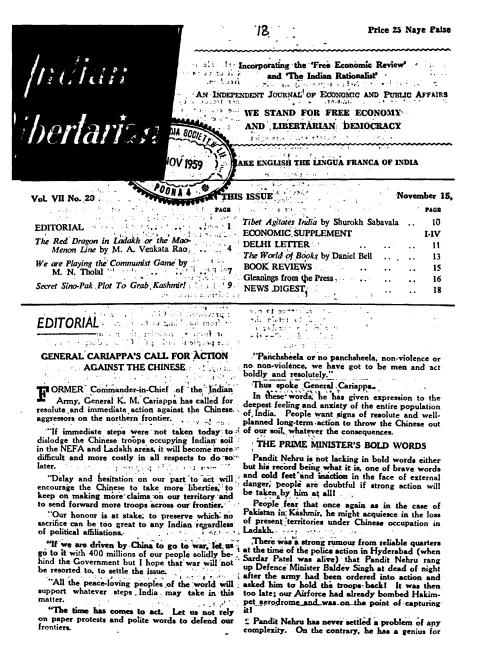
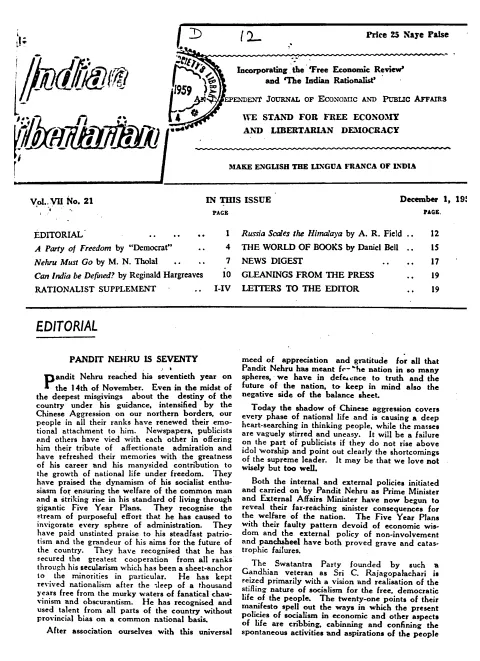
The Indian Libertarian
An Independent Journal of Economic and Public Affairs — Incorporating the 'Free Economic Review' and 'The Indian Rationalist'
By M. N. Tholal
The Indian Libertarian · Bombay · 1959
24 pages
The Indian Libertarian
Summary
The 1 December 1959 issue of The Indian Libertarian (Vol. VII No. 21), a Bombay fortnightly that styles itself as an ‘Independent Journal of Economic and Public Affairs’ standing ‘For Free Economy and Libertarian Democracy’, is dominated by the magazine’s reaction to two interlocking events of late 1959: Jawaharlal Nehru’s seventieth birthday and the launch of C. Rajagopalachari’s Swatantra Party. The editorial offers a measured, ambivalent tribute to Nehru — praising his secularism, anti-provincialism and steadfast patriotism while pinning the Five Year Plans and the policy of non-involvement on his shoulders as ‘grave and catastrophic failures’. A signed companion piece by ‘Democrat’ welcomes the Swatantra Party as a long-overdue parliamentary vehicle for classical-liberal opinion, and M. N. Tholal’s polemic ‘Nehru Must Go’ calls for the Prime Minister’s resignation over the handling of the Chinese aggression on India’s northern borders. Reginald Hargreaves’s strategic essay ‘Can India be Defended?’ surveys the country’s military options against China, while A. R. Field’s ‘Russia Scales the Himalayas’ tracks Soviet penetration of Nepal, Sikkim and Bhutan in the rendered pages. The mid-issue Rationalist Supplement carries a condensed report on the 33rd Congress of the World Union of Freethinkers held at Brussels, and the World of Books section opens Daniel Bell’s two-part essay ‘The Meaning of Alienation — II’ on the young Marx. Across these contributions the volume’s argumentative centre — in the rendered pages — is a coordinated assault on Nehruvian planning, non-alignment and what the editors call the ‘illusion of the epoch’, socialism of the Marxist variety.
Key points
-
The unsigned editorial marks Jawaharlal Nehru’s seventieth birthday with a guarded tribute, praising his secularism, anti-provincialism, and patriotism while calling the Five Year Plans and the policy of non-alignment and Panchsheel “grave and catastrophic failures.”
-
A companion passage in the editorial welcomes the newly founded Swatantra Party around C. Rajagopalachari as the answer to the “stifling nature of socialism,” calling its twenty-one-point manifesto a direct challenge to Nehruvian economic policy.
-
Elsewhere, the editorial reports on the Communist Party of India’s Meerut conference and a violent mob attack on the Indian Merchants’ Chamber at Kanpur over the Nagpur land-reform resolution.
-
Writing under the pseudonym “Democrat,” a contributor traces the Swatantra Party’s origins to the land-reform resolution at the Nagpur Congress and the subsequent June 1959 Madras conclave convened by Rajagopalachari.
-
“Democrat” charges that the State Trading Corporation’s grain monopoly, the nationalisation of life insurance, and the Mahalanobis-designed Third Plan target of Rs. 10,000 crores have driven the country toward bankruptcy.
-
The same writer names Marxist socialism the “illusion of the epoch” and presents the Swatantra Party as its principled parliamentary challenger, warning it leads “ultimately to totalitarianism and the extinction of the free way of life.”
-
M. N. Tholal’s polemic “Nehru Must Go” calls for the Prime Minister’s resignation, tracing a pattern of “acquiescence of complicity” in Chinese expansion from Nehru’s silence on Tibet through the Panchsheel-era exchanges.
-
Reginald Hargreaves’s essay “Can India be Defended?” surveys the country’s military options against China, while A. R. Field’s “Russia Scales the Himalayas” tracks Soviet penetration of Nepal, Sikkim, and Bhutan.
-
The mid-issue Rationalist Supplement reports on the 33rd Congress of the World Union of Freethinkers held at Brussels, and the World of Books section opens the second part of Daniel Bell’s essay on the young Marx.
Essays
EDITORIAL — Pandit Nehru is Seventy
The unsigned editorial ‘Pandit Nehru is Seventy’ uses the Prime Minister’s seventieth birthday on 14 November as the occasion for a balance-sheet assessment. It credits Nehru with anchoring secularism against ‘fanatical chauvinism and obscurantism’, reviving nationalism on a common national basis rather than provincial lines, and inspiring administrative effort across every sphere. But it argues that ‘the shadow of Chinese aggression’ has exposed deep faults: the Five Year Plans and the policy of non-involvement and Panchsheel are described as ‘grave and catastrophic failures’. The editorial then welcomes the Swatantra Party founded by ‘such a Gandhian veteran as Sri C. Rajagopalachari’ as the natural alternative to the ‘stifling nature of socialism’ and its twenty-one-point manifesto as a challenge to the ‘cribbing, cabinning and confining’ of free individual life under Nehruvian socialism. The piece closes with a remembrance of the Communist Party of India’s Meerut conference and an account of the Mob Explosion at Kanpur over the All-India Agricultural Federation’s Nagpur land-reforms resolution.
- Issues a guarded tribute to Nehru on his seventieth birthday — praising his secularism, anti-provincialism, and patriotism while attacking the Five Year Plans and Panchsheel.
- Frames the Swatantra Party as the answer to the ‘stifling nature of socialism’ and welcomes its founding around Rajagopalachari.
- Calls the ‘twenty-one points’ of the Swatantra Party manifesto a direct challenge to Nehru’s economic and ‘other aspects of life’.
- Reports on the CPI’s Meerut conference and a violent mob attack on the Indian Merchants’ Chamber at Kanpur over the Nagpur land-reform resolution.
- Treats the Chinese aggression as the lens through which all Government policy must now be re-examined.
A Party of Freedom
By “Democrat”
Writing under the pseudonym ‘Democrat’, the author surveys the formation of the Swatantra Party of ‘Shri C. Rajagopalachari, Prof. Ranga, and Mr. M. R. Masani’, tracing its origins to the land-reform resolution at the Nagpur Congress and the subsequent Madras conclave of June 1959 convened under Rajagopalachari’s aegis as ‘friend, philosopher and guide’. The piece presents the Swatantra Party as a ‘Party of Freedom’ organised around the ‘central principle’ of the ‘dynamics of progress in the economic and other spheres’ being ‘released more by individual freedom than by socialist control’. It charges that the Nehru Government’s planning, the State Trading Corporation’s grain monopoly, the Life Insurance nationalisation and the Mahalanobis-designed Third Plan target of Rs 10,000 crores have led the country toward bankruptcy and totalitarianism. ‘Democrat’ then frames the Swatantra Party as the parliamentary instrument of an All-India organisation ‘born after the State’ to articulate liberal opposition across the country.
- Treats the founding of the Swatantra Party as a structural response to Nehruvian centralisation — agriculture, industry, insurance and trading all cited.
- Identifies the Mahalanobis-designed Third Plan target of Rs 10,000 crores as ‘unable to fulfil’ the ‘special aid given by many creditor countries’.
- Names the ‘illusion of the epoch’ as socialism of the Marxist variety — and the Swatantra Party as its principled challenger.
- Asserts that Marxist socialism leads ‘ultimately to totalitarianism and the extinction of the free way of life’.
- Reads the Swatantra Party’s twenty-one-point manifesto as the doctrinal counterpart to the Forum of Free Enterprise’s earlier critique.
Nehru Must Go
By M. N. Tholal
M. N. Tholal’s signed polemic argues that Nehru should resign over his handling of the Chinese aggression on India’s Himalayan frontier. Tholal opens by accusing Nehru of ‘cantankerousness’ and a misplaced personal animus toward Kashmir; he then walks through what he calls Nehru’s pattern of ‘acquiescence of complicity’ in Chinese expansion — from his refusal to take a public stand on Tibet through the secret bargains struck during the Panchsheel-era exchanges. Tholal contends that the threats of retirement Nehru periodically dangles before the country and his loyal lieutenants in the Cabinet are themselves political instruments that paralyse opposition. Citing Gandhi’s example in 1947, he insists India should have stood with the West in clear-eyed alignment rather than indulging the ‘amazing conduct’ of treating Communist China as a fraternal partner. The piece reads as a direct ultimatum: Nehru’s continuation in office is, in Tholal’s view, incompatible with India’s national survival.
- Names Nehru’s behaviour ‘cantankerousness’ and frames his policy posture as personal rather than statesmanlike.
- Reads Panchsheel and non-alignment as ‘acquiescence of complicity’ in Chinese expansion across Tibet and the Indian borderlands.
- Holds that Nehru’s recurring threats of retirement function as a domestic political weapon, not as serious resignation offers.
- Treats Gandhi’s 1947 conduct as the standard of clear moral commitment Nehru has failed to meet.
- Concludes that India’s defence requires Nehru’s removal — the title is also the argument.
Can India be Defused?
By REGINALD HARGREAVES
Reginald Hargreaves’s essay treats the Chinese pressure on India’s northern frontier as a strategic problem rather than a moral or diplomatic one. He surveys the comparative military balances — terrain, logistical depth, weapons mix — and argues that India’s defence rests on three things: a credible mountain force, alliance arrangements that compensate for the asymmetry in raw numbers, and willingness to fight in the high passes. Hargreaves traces the Soviet-American great-power overlay (the ‘invasion routes’ through which the Himalayan crisis must now be read), and concludes the rendered pages by arguing that without re-armament and clarity about external alliances, the territorial integrity of India in Ladakh and along the McMahon Line cannot be guaranteed.
- Treats the China question as primarily strategic, not moral — defensible borders require force, not declarations.
- Surveys the comparative logistics of Chinese versus Indian forces in the high Himalaya.
- Reads the Himalayan crisis through the lens of Soviet-American competition — the great powers shape the local game.
- Concludes that re-armament and external alliance commitments are the necessary conditions of Indian territorial defence.
RATIONALIST SUPPLEMENT — The International Congress of Freethinkers (Condensed from articles by Colin McCall and Charles Bradlaugh Bonner in The Freethinkers)
By CONDENSED FROM ARTICLES BY COLIN McCALL AND CHARLES BRADLAUGH BONNER IN THE FREETHINKERS
The mid-issue Rationalist Supplement, condensed from articles by Colin McCall and Charles Bradlaugh Bonner in The Freethinker, reports on the 33rd Congress of the World Union of Freethinkers held at the Free University of Brussels from 4 to 8 September 1959. The supplement reconstructs the procession of the international delegations, the laying of wreaths at the Place du Grand Sablon to honour the martyrs to Philip II of Spain, and the addresses delivered by Andre Lorulot of French Freethought and Madame Sol Ferrer, daughter of the executed Spanish martyr Francisco Ferrer. The Congress identified secular education as ‘the most urgent task’ and adopted resolutions on a ‘Scientific Attitude of Mind’ and a ‘New Humanist Manifesto’ calling for a wholly naturalistic conception of moral and intellectual life. The supplement’s argumentative throughline is that science, civil liberty and freedom of conscience form a single tradition continuous from the European Enlightenment through Bradlaugh to mid-twentieth-century humanism.
- Reports the 33rd Congress of the World Union of Freethinkers, Brussels, September 1959, as the ‘most important’ meeting of organised humanism for the year.
- Centres the Congress on the rallying cry of free secular education and a ‘New Humanist Manifesto’.
- Treats the Ferrer martyrology as the connecting tissue of European freethought across language and country.
- Names a Scientific Attitude of Mind — naturalistic, evidence-based, hostile to dogma — as the supplement’s working definition of rational citizenship.
- Reads humanism as the contemporary inheritor of the rule-of-law and freedom-of-conscience tradition.
Russia Scales the Himalayas
By A. R. Field
A. R. Field’s geopolitical essay reads the Soviet penetration of the Himalayan rim as the strategic complement to the Chinese pressure on India’s northern frontier. The piece opens with Premier Khrushchev’s official visit to Nepal in February 1959 — ‘14,500 tons of Soviet technicalo-economic equipment’ and an interest-free loan — and reads it as the foothold for an enduring Russian role in Nepal, Sikkim and Bhutan. Field then turns to the parallel Chinese moves: an attempt to drive a wedge between Nepal and India through soft-power presents and roadbuilding; the rolling occupation of border tracts; the ‘amazing conduct’ of treating buffer states as zones of Chinese protection. He closes the rendered pages with a short notice of A. D. Shroff’s address on ‘State Ownership is a Failure’ and a paragraph on the State Trading Corporation as a case study in the practical defects of public ownership.
- Frames the Soviet aid programme to Nepal of February 1959 as the strategic counterpart to Chinese border pressure.
- Tracks the Chinese-Indian rivalry over Sikkim and Bhutan via roadbuilding and trade incentives.
- Quotes ‘amazing conduct’ as the diagnostic phrase for Chinese behaviour toward the buffer states.
- Closes the rendered pages with a notice of A. D. Shroff’s argument that ‘State Ownership is a Failure’ and a brief on State Trading Corporation problems.
THE WORLD OF BOOKS — The Meaning of Alienation – II
By Daniel Bell
Daniel Bell’s essay, the second in his series for The World of Books, develops the ‘Quest for the historical Marx’ begun in the previous issue. Working from the radical sociology of the young Hegelians and the Encyclopaedists, Bell argues that the early Marx’s central category was not yet class but alienation — the rupture between the labourer, his product, and the ‘species being’. Tracing the term through Hegel, Feuerbach and the 1844 Paris Manuscripts, Bell reads the young Marx as a critic of property and Christianity in a single move: private property is the form religious estrangement takes in industrial society. The essay closes the rendered pages with a contrast between the ‘humanist’ young Marx of the 1844 manuscripts and the ‘economic’ mature Marx of Capital, suggesting that the rediscovery of the early texts has reorganised mid-twentieth-century debate on what Marxism actually demands of its inheritors.
- Tracks the concept of alienation from Hegel through Feuerbach into the young Marx of the 1844 manuscripts.
- Argues the early Marx reads private property as the industrial form of religious estrangement.
- Distinguishes the ‘humanist’ young Marx from the ‘economic’ mature Marx of Capital.
- Treats the post-war rediscovery of the 1844 texts as a re-organisation of Marxist intellectual history.
- Frames alienation as a category prior to class, with consequences for how socialism is to be argued.
Generated by the v1.5 extraction pipeline. Awaiting editorial review.
Metadata and summary are AI-extracted from the source PDF and reviewed for editorial accuracy. The original work is available via the Read PDF tab above (where present); paragraph-level citation inside the PDF is deferred to a future engagement.