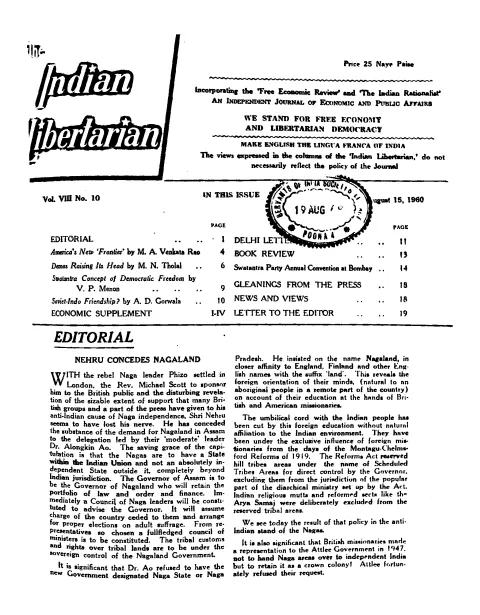
periodical issue
The Indian Libertarian
Independent Journal of Free Economy and Public Affairs
By MA Venkata Rao, M. N. Tholal, G N Lawande
The Indian Libertarian — Independent Journal of Free Economy and Public Affairs; printing/publishing address: Arya Bhavan, Sandhurst Road, Bombay 4 · Bombay · 1961
22 pages
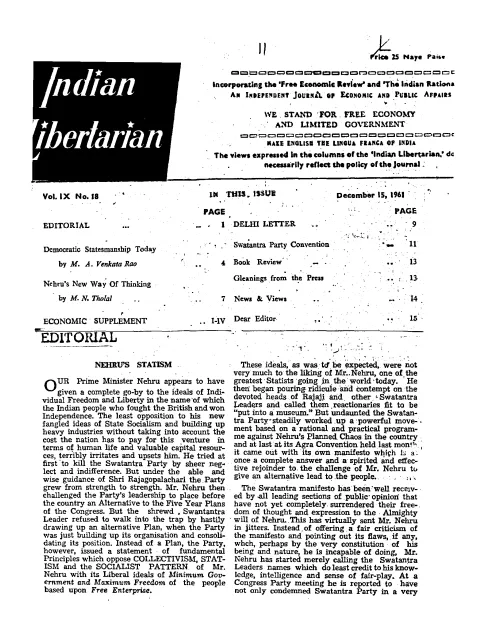
The Indian Libertarian
Summary
The Indian Libertarian Vol. IX No. 18 (December 15, 1961) is a fortnightly issue published by Libertarian Publishers, Bombay, advocating free economy and limited government from the classical-liberal end of Indian political opinion. The unsigned editorial ‘Nehru’s Statism’ charges that the Prime Minister and the Congress have abandoned the ideals of individual freedom in favour of a ‘socialistic pattern’ that, in the journal’s reading, mirrors the collectivist drift of the communist world. M. A. Venkata Rao’s ‘Democratic Statesmanship Today’ makes the corresponding positive case by sketching the philosophical and ethical qualifications a democratic leader needs in the post-colonial age. M. N. Tholal’s ‘Nehru’s New Way Of Thinking’ picks apart what he reads as the Prime Minister’s drift on foreign policy.
The Economic Supplement carries Prof. G. N. Lawande’s exposition of ‘The Swatantra Manifesto’ and the second instalment of Wendel Bull’s ‘Equalizing Opportunities — Next Step For Mankind’, both pressing the case for market-based development against state planning. News and political reportage dominate the rest of the issue: a Delhi Letter on India’s diplomatic defeats over Tibet and China, an extended account of the Swatantra Party Convention at Agra (its draft manifesto, resolutions on China and government policy, and M. R. Masani’s role), M. A. Venkata Rao’s review of F. A. Hayek’s ‘The Constitution of Liberty’, a ‘Gleanings from the Press’ column, and a ‘News & Views’ miscellany. Across the issue the editorial centre of gravity is anti-statist, sympathetic to the Swatantra Party, and sharply critical of Nehru’s domestic socialism and China policy alike.
Key points
-
Volume nine, number eighteen of The Indian Libertarian, dated 15 December 1961, carries the unsigned editorial ‘Nehru’s Statism,’ charging that the Prime Minister and Congress have abandoned individual freedom for a ‘socialistic pattern’ mirroring the collectivist world.
-
The same editorial treats the Swatantra Party as the legitimate liberal alternative to Congress collectivism and endorses the proposed Malaysian Federation, uniting Malaya, Singapore, North Borneo, Sarawak and Brunei, as a voluntary liberal-constitutional experiment.
-
M. A. Venkata Rao’s ‘Democratic Statesmanship Today’ argues democratic leadership is a philosophical vocation requiring competence in political philosophy, and warns that new-democracy Asia is most threatened by the incompetence of its own elected legislators.
-
Rao calls for a sustained civic education in political philosophy and the history of liberty, citing Lincoln as the standing example of democratic statesmanship.
-
M. N. Tholal’s ‘Nehru’s New Way of Thinking’ reads the Prime Minister’s foreign-policy accommodations with China and the Soviet Union, and his comparison to Tito’s Yugoslavia, as rhetoric papering over Congress’s policy failures.
-
Prof. G. N. Lawande’s Economic Supplement piece expounds the Swatantra Manifesto, while Wendel Bull’s second instalment of ‘Equalizing Opportunities’ presses the case for market-based development against state planning.
-
The issue also carries an extended account of the Swatantra Party Convention at Agra, covering its draft manifesto, resolutions on China policy, and M. R. Masani’s role, alongside M. A. Venkata Rao’s review of Hayek’s The Constitution of Liberty.
Essays
Essay 1
The unsigned lead editorial, ‘Nehru’s Statism’, argues that the Prime Minister has given the go-by to the ideals of individual freedom and liberty in whose name Indians fought British rule. It reads Nehru’s defence of the ‘socialistic pattern’ and his hostility to the new Swatantra Party as evidence that the Congress has aligned itself, in spirit and method, with the collectivist regimes the journal opposes. The editorial uses recent statements from the Congress leadership as a frame to insist that the genuinely Indian alternative is a free people based on free enterprise.
A second editorial block under the same essay turns to international affairs: it praises the planned Malaysian Federation as a constitutional-liberal experiment uniting Malaya, Singapore, North Borneo, Sarawak and Brunei, and contrasts that voluntary association with the coercive integrations attempted by the communist powers. Together the two pieces stake out the issue’s editorial line — domestic anti-statism abroad, support for cooperative federations grounded in consent rather than command.
- Frames Nehru’s ‘socialistic pattern’ as a betrayal of the freedom-ideals of the independence movement.
- Treats the Swatantra Party as the legitimate liberal alternative to Congress collectivism.
- Links Indian statism to the wider communist world as a matter of method, not just rhetoric.
- Endorses the proposed Malaysian Federation as a voluntary liberal-constitutional experiment.
- Insists ‘free enterprise’ is the appropriate organising principle for a free Indian people.
Democratic Statesmanship Today
By M. A. Venkata Rao
M. A. Venkata Rao’s ‘Democratic Statesmanship Today’ is a philosophical essay on the qualifications of leadership in mass democracies. Opening with an anecdote about a princely heir who was discouraged from reading philosophy by his English tutor, Rao argues that the modern democratic statesman cannot afford that kind of intellectual narrowness: in an age in which voters are forming judgements about planning, foreign policy and the moral foundations of public life, those who would lead them must themselves have wrestled with the great questions.
Rao surveys the qualifications he thinks democratic leadership requires — competence in philosophy and morality, a feel for the deep history of European and American constitutional thought, and the ability to use the apparatus of government without succumbing to the modern temptation of tyranny. He warns that ‘democracy is in danger everywhere today — even in America’, and that in newly independent Asian countries the danger lies above all in the incompetence and self-indulgence of elected legislators. The essay closes by linking democratic statesmanship to a sustained programme of education in political philosophy, citing Lincoln as the standing example.
- Sets democratic leadership as a philosophical vocation, not just an electoral skill.
- Argues new-democracy Asia is most threatened by the incompetence of its own legislators.
- Reads twentieth-century history as the story of democracy’s vulnerability to tyranny from within.
- Calls for a serious civic education in political philosophy and the history of liberty.
- Uses Lincoln (and indirectly Marx) as the polar examples that frame the modern political imagination.
Nehru’s New Way Of Thinking
By MA Venkata Rao
M. N. Tholal’s ‘Nehru’s New Way Of Thinking’ is a polemical column on the Prime Minister’s foreign policy, written in the wake of recent border tensions and a fresh round of speeches at home and abroad. Tholal argues that Nehru’s ‘new way of thinking’ amounts to a series of accommodations with Communist powers — particularly China and the Soviet Union — that Indian liberals cannot accept, and that the public is increasingly unwilling to swallow either.
The column moves between three registers: a close reading of Nehru’s recent speeches and replies in Parliament, a comparison with Marshal Tito’s Yugoslavia as an apparent template for non-alignment, and a domestic political reading in which the Congress is portrayed as papering over its policy failures with rhetoric about peace. Cuba and Khrushchev’s pronouncements are cited as further illustrations of how the same vocabulary of ‘peace’ can shelter very different political projects.
- Treats Nehru’s recent speeches as a coherent shift, not stray remarks.
- Reads Indian non-alignment as drifting toward soft alignment with the communist bloc.
- Uses Tito’s Yugoslavia and Castro’s Cuba as comparative reference points.
- Connects foreign-policy drift to the Congress’s domestic political needs.
Economic Supplement — The Swatantra Manifesto
By Prof. G. N. Lawande, M.A.
Prof. G. N. Lawande’s ‘The Swatantra Manifesto’, which opens the Economic Supplement, is a programmatic exposition of the two-year-old Swatantra Party’s just-released election manifesto. Lawande argues that what separates Swatantra from every other party in the field is not a slightly different policy mix but a different organising principle: liberty of the citizen as the centre of economic and political life. He reads the manifesto as a coherent critique of state monopoly in industry and trade, of agricultural collectivisation, and of the steady erosion of independent economic power that the Congress’s planning model has produced.
The essay then walks through the manifesto’s positive programme — protection of property and enterprise, a more limited role for the state in industry and agriculture, and stronger constitutional safeguards against executive encroachment — and connects it to the wider liberal tradition that the Forum of Free Enterprise and like institutions have been building in India. Lawande presents the Swatantra Party as the partisan vehicle for a long-running, hitherto unorganised liberal current in Indian public life.
- Reads the Swatantra Manifesto as a single-principle programme built on the liberty of the citizen.
- Identifies state monopoly and forced cooperativisation as the core grievances of Indian liberals.
- Places the party in continuity with India’s older non-Congress liberal current.
- Treats the next general election as a real opportunity to break the planning consensus.
- Frames property and free enterprise as constitutional, not merely economic, demands.
Economic Supplement — Equalizing Opportunities—II: Next Step for Mankind
By G N Lawande
Wendel Bull’s ‘Equalizing Opportunities — II: Next Step For Mankind’ is the second instalment of a Balanced Living-school essay reprinted in the Economic Supplement. Bull argues that a government’s geographic dominion is irrelevant to its citizens until it becomes a factor in the relationships people actually have with one another, and that the proper test of any political order is whether it equalises opportunities — not outcomes — across those relationships. He uses the Eskimo’s environment and the small-trader’s position as concrete illustrations of what ‘equal opportunity’ has to mean in practice if it is to mean anything at all.
The essay then turns to economics, arguing against the politically administered prices and protected positions that ride along with planning regimes, and in favour of a competitive order in which entry, mobility and price are open. A short closing column, ‘The Force of Nationalisation’, extends the argument with a brief case study, arguing that nationalisation tends to lock in the very inequalities of opportunity it claims to dissolve.
- Reframes ‘equality’ from outcomes to opportunities inside concrete human relationships.
- Uses the Eskimo and the small trader as test cases for what equal opportunity must cover.
- Targets administered prices and protected positions as the real enemies of opportunity.
- Treats nationalisation as opportunity-restricting, not opportunity-expanding.
Delhi Letter — Nehru Beaten By China On All Fronts
By (From Our Correspondent)
The ‘Delhi Letter’ from the magazine’s correspondent, ‘Nehru Beaten By China On All Fronts’, surveys the Government of India’s recent diplomatic setbacks. The correspondent reports that Congress members of the U.N. delegation have themselves been embarrassed by the Prime Minister’s defence of India’s defeat on the Tibet question at the U.N. General Assembly, and that the Soviet bloc’s solidarity with Peking on Tibet and on India’s border claims has stripped non-alignment of much of its practical cover.
The letter ties these foreign-policy reverses to domestic discontent: Mr. Mahavir Tyagi, Acharya Kripalani and Dr. Raghu Vira are reported as openly critical of the Government’s handling of China, and the column reads their dissent as a sign that the Nehruvian consensus on China has begun to break inside the Congress itself.
- Reports India’s diplomatic defeat at the U.N. on the Tibet question.
- Notes Soviet-bloc backing for China as the decisive factor.
- Identifies named Congress dissenters as evidence of a fracturing consensus.
- Reads non-alignment as having lost its strategic cover.
Swatantra Party Convention At Agra
No summary was extracted for this article. Listed for completeness.
Book Review — The Constitution of Liberty by Dr. F. A. Hayek (Routledge & Kegan Paul, 1960)
By M. A. Venkata Rao
An unsigned report covers the Swatantra Party Convention at Agra and the General Council meeting that adopted the party’s election manifesto and a series of political resolutions. The report opens with the convention’s ‘Clean Government’ pledge — a promise of accountable, low-corruption administration as the central plank of the Swatantra appeal — and walks through its resolutions on state transport, on the demand for cleaner public finance and on the conduct of Congress governments in the states.
A second block summarises the convention’s foreign-affairs resolutions. The party demanded the immediate severance of diplomatic relations with China if the Union Government would not act to dislodge Chinese forces from occupied Indian territory; censured the Government’s broader handling of the China crisis; and recorded its view that the Prime Minister bore principal responsibility for the deterioration. M. R. Masani’s role at the convention is recounted, alongside contributions from K. M. Munshi, Frank Anthony and others.
- Records the convention’s adoption of the election manifesto with minor amendments.
- Highlights ‘Clean Government’ as the framing pledge of the campaign.
- Adopts a hard line on China, including conditional severance of diplomatic relations.
- Identifies the Prime Minister as bearing principal responsibility for the China reverses.
- Showcases the party’s leadership — Masani, Munshi, Anthony — as a coalition of liberal and constitutionalist voices.
Gleanings from the Press
By MA Venkata Rao
M. A. Venkata Rao reviews F. A. Hayek’s ‘The Constitution of Liberty’ (Routledge and Kegan Paul, 1960), placing it in continuity with Hayek’s earlier ‘The Road to Serfdom’ and reading it as the most systematic statement to date of the classical-liberal case in the post-war world. The reviewer summarises Hayek’s argument that the rule of law, generality of legislation and the dispersion of knowledge through markets are not separable institutions but parts of a single constitutional order of freedom.
Rao then takes Hayek’s treatment of the welfare state on its own terms, noting that Hayek concedes a place for some forms of social insurance but insists on strict inherent limitations against arbitrary administrative power. The review closes by recommending the book to Indian readers as an antidote to the ‘omnicompetent State’ assumption that underwrites contemporary planning debates, and as a constructive companion to the Swatantra Party’s economic critique.
- Treats ‘The Constitution of Liberty’ as the systematic sequel to ‘The Road to Serfdom’.
- Foregrounds the rule of law and generality of legislation as Hayek’s central institutional claims.
- Notes that Hayek concedes social insurance but draws hard limits against arbitrary administration.
- Recommends the book as direct ammunition against Indian planning orthodoxy.
Generated by the v1.5 extraction pipeline. Awaiting editorial review.
Metadata and summary are AI-extracted from the source PDF and reviewed for editorial accuracy. The original work is available via the Read PDF tab above (where present); paragraph-level citation inside the PDF is deferred to a future engagement.