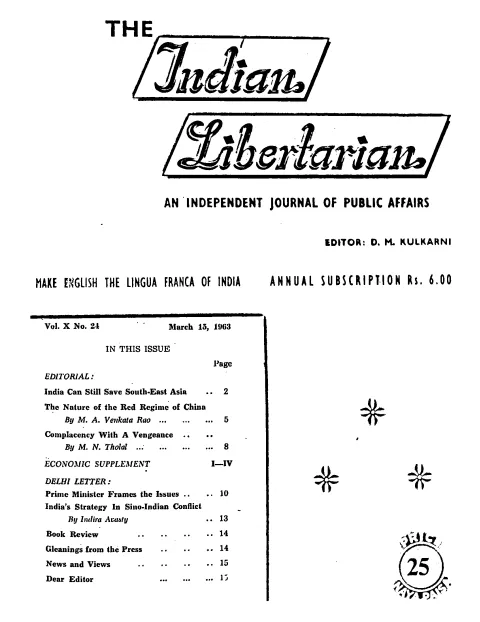
periodical issue
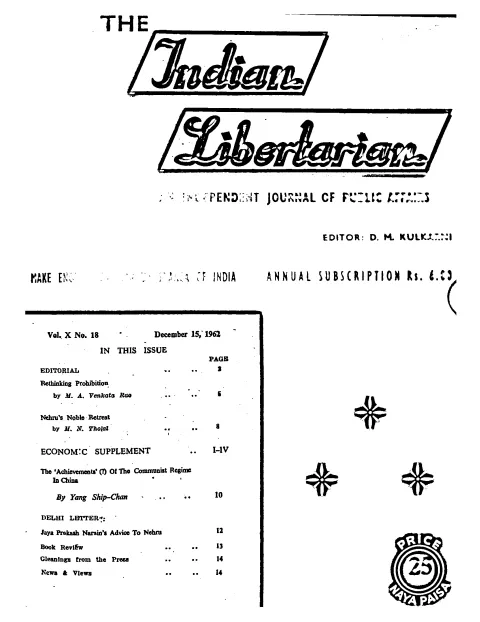
The Indian Libertarian
An Independent Journal of Public Affairs
By MA Venkata Rao, M. N. Tholal
Published by D. M. Kulkarni for the Libertarian Publishers (Private) Ltd., 26, Durgadevi Road, Bombay 4. Printed by G. N. Lawande at G. N. Printers, Indra Bhuwan, Tadwadi, Bombay 2. · Bombay · 1962
20 pages
The Indian Libertarian
Summary
The 15 December 1962 number of The Indian Libertarian (Vol. X No. 18), edited by D. M. Kulkarni, appears in the immediate aftermath of the Sino-Indian war and centres almost every article on what the editorial calls the ‘Kingdom of Freedom’ — the argument that India’s military defeat exposed the bankruptcy of Nehruvian non-alignment, Five-Year Plan priorities, and ideological accommodation with communism. The lead editorial calls for a ‘rethinking’ of foreign policy and Panchsheel; M. A. Venkata Rao extends that logic to domestic policy with a sustained classical-liberal critique of Prohibition; M. N. Tholal reads Nehru’s restraint within his own party as a ‘noble retreat’; and a Delhi letter reports Jayaprakash Narayan’s call for Krishna Menon’s resignation and a war cabinet.
The four-page pulled-out Economic Supplement carries Prof. C. N. Lavande on ‘Defence or Economic Growth’ and M. A. Master on ‘Foreign Aid — The Problem of Utilisation’, both arguing that the Third Plan and U.S. P.L.-480 assistance are being mis-deployed and that defence cannot be financed without recasting planning priorities. Yang Shih-Chan’s reprinted open letter to Mao Tse-tung — a remarkable first-person dissent from a Communist Party finance professor in Wuhan — supplies the issue’s longest indictment of the Chinese regime. The closing Press Gleanings and News & Views pages collate quotations from Mr. Nehru, Defence Minister Y. B. Chavan, Ambassador B. K. Nehru, General Kelly and The New York Times around the same theme: vigilance against China, scepticism of Pancha Sheel, and a hardening of the liberal-libertarian critique of Congress rule.
Key points
-
This 15 December 1962 issue, Vol. X No. 18, edited by D. M. Kulkarni, appears in the immediate aftermath of the Sino-Indian war and argues the defeat exposed the bankruptcy of Nehruvian non-alignment and Panchsheel.
-
The lead editorial, Seek Ye First the Kingdom of Freedom, frames the choice facing India as between a kingdom of freedom and the totalitarian illusions of Marxism-Leninism, quoting James Burnham to mock Ambassador Galbraith’s earlier optimism about Indian planning.
-
M. A. Venkata Rao’s Rethinking Prohibition mounts a classical-liberal case against the ban on alcohol, invoking the failure of American Prohibition and arguing lost excise revenue is indefensible while defence finance strains the exchequer.
-
M. N. Tholal’s Nehru’s Noble Retreat credits Nehru’s refusal to purge the Congress party after the NEFA rout, tracing his dependence on the Communist Party of India in domestic legislative manoeuvring.
-
A Delhi letter reports Jayaprakash Narayan’s call for Defence Minister Krishna Menon’s resignation and the formation of a war cabinet.
-
The Economic Supplement carries Prof. C. N. Lavande on Defence or Economic Growth and M. A. Master on Foreign Aid, both arguing the Third Plan and US P.L.-480 aid are being mis-deployed.
-
Yang Shih-Chan’s reprinted open letter to Mao Tse-tung, written by a Communist Party finance professor in Wuhan, supplies the issue’s longest first-person indictment of the Chinese regime.
Essays
EDITORIAL — Seek Ye First The Kingdom Of Freedom
The unsigned lead editorial, titled ‘Seek Ye First the Kingdom of Freedom’, uses the Chinese invasion to re-open the case against non-alignment and Panchsheel. It argues that India had been seduced by a Vedantic illusion of equivalence between the ‘maya’ of Western liberal democracy and the ‘maya’ of Sino-Soviet communism, and that the border war has stripped away that illusion. The editorial then turns to the Russo-Chinese conflict, totalitarian tensions inside the Congress Parliamentary Party, and Indo-Pakistani relations, calling for a moral and material re-armament of Indian democracy through alignment with the free world rather than diplomatic neutrality.
A boxed ‘Food for Thought’ panel reproduces James Burnham’s barbed observation that U.S. Ambassador John Kenneth Galbraith’s optimism about India’s planning record had been overtaken by events, framing the editorial’s larger insistence that American aid and Western institutions, not socialist self-sufficiency, are India’s natural allies.
- Sino-Indian war is treated as the decisive refutation of Nehruvian non-alignment and Panchsheel.
- The editorial frames the choice as between the ‘kingdom of freedom’ and the totalitarian ‘maya’ of Marxism-Leninism.
- Indo-Pakistani amity is urged as a condition of any serious subcontinental defence posture.
- James Burnham is quoted to mock the over-optimism of Ambassador John Kenneth Galbraith about India’s planning record.
- Totalitarian instincts inside the Congress Parliamentary Party are flagged as a domestic counterpart of the external threat.
Essay 2
M. A. Venkata Rao mounts a classical-liberal case for re-examining Prohibition on the basis of laws of liberty, personal freedom, and the new fiscal implications of the war with China. He argues that the legislation banning intoxicating drinks was passed as part of the Gandhian reformist programme of the Congress without serious thought about its practical consequences, and that the resulting regime of police inspection, illicit liquor, and lost excise revenue has been imposed on a reluctant population by a small minority of fanatical reformers.
The essay distinguishes between drinking as a personal choice and as a social problem, draws comparisons with the failure of Prohibition in the United States, and contends that moderate, legal supply with civic education is more compatible with individual freedom and public order than blanket suppression. Venkata Rao closes by arguing that the war emergency, which has put a premium on every rupee of public revenue, is a particularly poor moment to be forgoing alcohol excise and tolerating a corrupt enforcement bureaucracy.
- Prohibition is treated as a Gandhian dogma forced on a reluctant population by a fanatical reforming minority.
- The author invokes the failure of American Prohibition as a cautionary precedent for India.
- Police inspection and illicit liquor are described as the predictable by-products of a paternalist ban.
- Lost excise revenue is highlighted as indefensible at a moment when defence finance is straining the exchequer.
- The piece argues that personal liberty and civic education, not statutory suppression, are the correct response to social drinking.
Rethinking Prohibition
By MA Venkata Rao
M. N. Tholal congratulates Nehru on his refusal, after the rout in NEFA, to indulge in a ‘Congress purge’ of the kind the rank and file had been demanding. The article treats this restraint as a ‘noble retreat’: Nehru, the author argues, has had to recognise that the Communist Party of India and the Praja Socialists are too entangled with the Congress’s own ideological line for a witch-hunt to be either honest or politically survivable. Tholal then traces how Nehru came to depend on the Communists in domestic legislative manoeuvres and how the war has now made that dependence acutely embarrassing.
The continuation on page 9 picks up the same thread through two short notes — ‘Ranga’s Great Contribution’ and ‘India Never Argued War’ — that praise the Swatantra leader Ranga for offering the Government a serious parliamentary opposition and rebut, on B. K. Nehru’s authority, the charge that India had provoked the Chinese. Throughout, Tholal’s tone is sympathetic to Nehru’s predicament but unsparing about the Congress Parliamentary Party’s drift into one-party absolutism.
- Nehru’s refusal to purge Communist-leaning Congressmen is read as a ‘noble retreat’, not capitulation.
- The Congress’s long-standing dependence on Communist Party support inside Parliament is identified as the root of the present awkwardness.
- Ranga and the Swatantra Party are credited with providing the only coherent opposition to one-party drift.
- Ambassador B. K. Nehru is cited rebutting the suggestion that India had any role in provoking the Chinese attack.
- Tholal warns against the ‘totalitarian tension’ inside the Congress Parliamentary Party.
Nehru’s Noble Retreat
By M. N. Tholal
Prof. C. N. Lavande’s ‘Defence or Economic Growth’ opens the Economic Supplement by arguing that the post-Independence Indian state has so completely identified itself with raising per-capita income that the rude arrival of a defence emergency has caught both Government and people unprepared. Lavande contends that the Third Plan was written on the assumption that defence outlay could be safely treated as a residual; the Chinese invasion has now made that assumption untenable.
The essay argues that India cannot finance a serious defence effort merely by squeezing consumption or relying on foreign loans. It must instead rethink the place of the public sector and the rate of capital formation, accept a measure of inflation, and treat the country’s productive capacity — not its planning targets — as the binding constraint. Lavande is sceptical that the Finance Minister’s exhortations to ‘tighten the belt’ can substitute for an honest reordering of priorities between growth and defence.
- The Third Plan implicitly treated defence spending as a residual on a growth-first programme.
- The Sino-Indian war exposes the inadequacy of a planning model built around per-capita income.
- Foreign loans alone cannot finance a serious defence build-up; domestic productive capacity is the binding constraint.
- Calls for belt-tightening are no substitute for an explicit reordering of plan priorities.
- A rebalancing between public-sector ambition and defence necessity is overdue.
ECONOMIC SUPPLEMENT — Defence Or Economic Growth; Foreign Aid—The Problem Of Utilisation
By Prof. G. N. Lavande, M.A.; M. A. Master
M. A. Master’s ‘Foreign Aid — The Problem of Utilisation’ follows in the same Economic Supplement and shifts the discussion from defence finance to the management of external assistance. Master assembles figures from successive Five-Year Plans to argue that the real Indian problem is not the volume of aid sanctioned but the chronically poor rate at which it is utilised: very large balances of sanctioned U.S. and IDA assistance remain undrawn at the end of each Plan period, while imports under P.L. 480 are tabulated separately and Rupee proceeds are treated, in effect, as gifts back to the donor.
The essay presses two consequences. First, the Government cannot blame donors for the shortfall: the bottleneck is Indian administrative and project-execution capacity. Second, transparency itself is inadequate — the Economic Survey and the External Assistance publications do not reconcile, so neither Parliament nor the public can see what aid has actually done. Master closes by calling for a clearer Chapter on foreign loans in the annual Economic Survey and for the Finance Minister to address the question candidly in his Budget speech.
- Large unutilised balances of sanctioned foreign aid have accumulated at the end of every Plan period.
- Rs. 1,113 crores of P.L. 480 assistance is structurally distinct from project aid and is in effect spent within India.
- The binding constraint is Indian project-preparation and execution capacity, not donor willingness.
- The published Economic Survey and External Assistance reports give inconsistent pictures and need reconciliation.
- True democratic accountability requires a fuller, more candid account of foreign aid in the annual Budget.
The ‘Achievements’ (?) Of The Communist Regime In China
By Yang Ship-Chan
Yang Shih-Chan, a veteran Communist Party member and Professor of Accountancy at the Central-South Institute of Finance and Economics in Wuhan, addresses an open letter to Mao Tse-tung. Reprinted here from The Hankow Chang Chiang Daily, the letter is one of the documents that emerged during the brief ‘Hundred Flowers’ moment when the Chinese Communist Party invited ‘rectification’ criticism in 1957 and then turned on its critics as ‘rightists’.
Yang’s complaint is essentially that the Party has substituted slogans for the rule of law. He cites the Chinese Constitution’s guarantees of freedom of residence, of the person, and of speech, and matches each against documented cases — a peasant nurse separated from her husband by a forced transfer, citizens detained without warrant during the 1955 counter-revolutionary campaign — in which Party cadres have over-ridden the constitution at will. He pleads for clemency, benevolence, the abolition of the ‘coordinating permit’ system that ties workers to a single workplace, and an eight-hour day. Underneath the deferential tone the argument is uncompromising: a Party that wins power by force and then governs by intimidation cannot expect to retain the affection of the people.
- An open letter from a Communist insider to Mao Tse-tung, reprinted from The Hankow Chang Chiang Daily.
- Yang Shih-Chan was a Communist Party member and Professor of Accountancy at the Central-South Institute of Finance and Economics.
- The letter argues that constitutional guarantees of personal liberty, freedom of residence and freedom of the person are being systematically violated.
- The suppression-of-counter-revolutionaries campaign of 1955 is cited as the paradigm case of arbitrary detention.
- Yang calls on the Party to govern by ‘clemency and benevolence’ rather than fear, and to abolish the work-permit system.
DELHI LETTER — Jaya Prakash Narain’s Advice To Nehru
By From our Correspondent
The Delhi Letter reports a public meeting in Delhi on 1 December at which Jaya Prakash Narain demanded the resignation of Defence Minister Krishna Menon and the formation of a small inter-party war cabinet of five or six members under Nehru. Narain is described as arguing that the present moment of national emergency cannot be conducted as one-man government and that the Praja Socialist, Swatantra and Jana Sangh leaders should be drawn into a coordinated war direction.
The report goes on to relay parallel exchanges between the Swatantra leader Ranga and the Prime Minister over a circular issued by the AICC that the opposition treated as an attempt to identify the Bharatiya Jana Sangh and Swatantra with communalism; and it records a public clarification by Ambassador B. K. Nehru that India had at no point pleaded a case for war. The composite picture is of an opposition pressing for institutional reform of war direction while the Congress leadership tries to hold its line.
- Jaya Prakash Narain has publicly demanded Krishna Menon’s resignation in the wake of the NEFA reverses.
- Narain proposes a small inter-party war cabinet of five or six members under Nehru.
- Swatantra leader Ranga is reported challenging an AICC circular that branded opposition parties as communal.
- Ambassador B. K. Nehru is quoted denying that India ever pleaded a case for war.
- The Delhi Letter treats institutional reform of war direction as the central question of the moment.
Book Review
A short Book Review on page 13 notices a Right Book Club publication on the foundations of British patriotism, treating it as a reference point for the kind of civic loyalty the editors of The Indian Libertarian believe India must now cultivate in the face of the Chinese threat. The notice is brief and largely descriptive.
- A short notice of a Right Book Club volume on the foundations of British patriotism.
- The review treats the book as a model for the civic loyalty India must now cultivate.
Gleanings from the Press
‘Gleanings from the Press’ on page 14 reprints under the heading ‘First Things First, Fellow Citizens’ a passage from M. A. Venkata Rao on the moral and political prerequisites of national defence, alongside a second clipping on ‘Russia Sending MiGs to India’. The page functions as a thematic continuation of the issue’s lead articles by curating outside voices that take the same view.
- Reprints a Venkata Rao essay on the civic prerequisites of national defence.
- Functions as an editorial echo chamber for the issue’s anti-non-alignment line.
News & Views
‘News & Views’ compiles short despatches: a New York report on non-alignment and Pancha Sheel vis-à-vis China attributed to Nehru; a West Bengal report on fifth-column activity; Defence Minister Y. B. Chavan’s statement in the Lok Sabha that the Soviet Union has agreed to supply MiG fighters and stand by its undertaking to build a factory in India; General Kelly’s advice that the Indian army be ‘vigilant always’; a New York Times editorial ‘Strain on Red China’ arguing that a resolute Indian defence can check the Chinese threat; and Ambassador B. K. Nehru’s BBC interview declaring ‘India will never be the same again’. An announcement on the same pages flags a forthcoming Indian Libertarian book by Ralph Borsodi on ‘The Challenge of Asia’.
- Defence Minister Y. B. Chavan confirms Soviet MiG supplies and the plan for an aircraft factory in India.
- General Kelly is reported urging the Indian army to perpetual vigilance against Chinese tactics.
- A New York Times editorial is cited for the proposition that a resolute Indian defence will check the Chinese threat.
- Ambassador B. K. Nehru tells BBC that ‘India will never be the same again’.
- An announcement flags Ralph Borsodi’s forthcoming ‘The Challenge of Asia’ from the Libertarian Publishers.
Generated by the v1.5 extraction pipeline. Awaiting editorial review.
Essay 10
No summary was extracted for this article. Listed for completeness.
Metadata and summary are AI-extracted from the source PDF and reviewed for editorial accuracy. The original work is available via the Read PDF tab above (where present); paragraph-level citation inside the PDF is deferred to a future engagement.