periodical issue
The Indian Libertarian
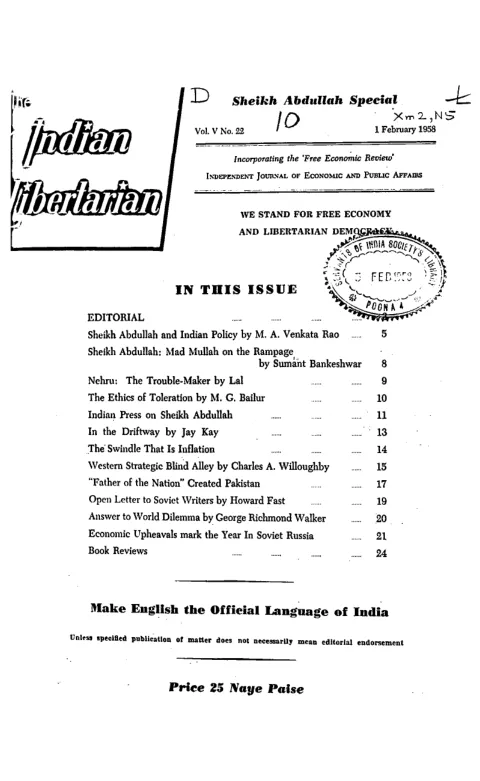
Independent Journal of Economic and Public Affairs — Sheikh Abdullah Special, Vol. V No. 22, 1 February 1958
By MA Venkata Rao, B. R. Shenoy, A. D. Shroff
The Indian Libertarian · Bombay · 1958
28 pages
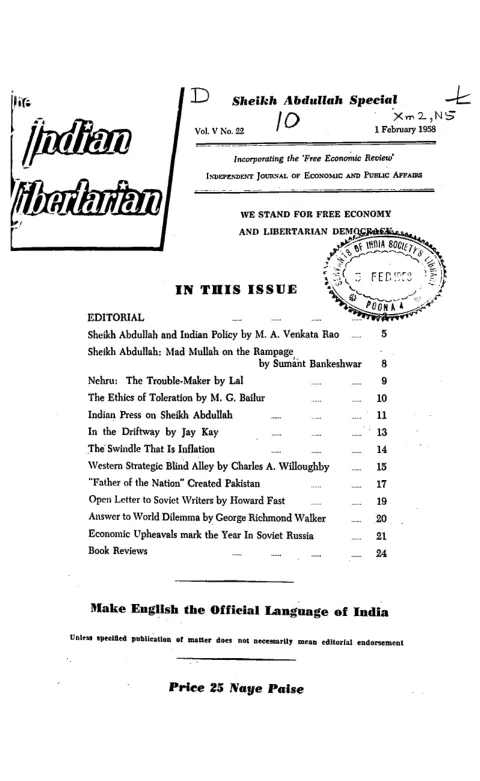
The Indian Libertarian
Summary
This is a ‘Sheikh Abdullah Special’ number of The Indian Libertarian (Vol. V, No. 22, 1 February 1958), an English-language Bombay fortnightly that bills itself as an ‘Independent Journal of Economic and Public Affairs’ which stands ‘for free economy and libertarian democracy’. Edited by Miss Kusum Lotwala and published by the Libertarian Social Institute, the issue is built around the Government of India’s continued detention of Sheikh Abdullah and uses that case to attack what the journal sees as Pandit Nehru’s disregard for constitutional propriety, his appeasement of Pakistan, and his drift toward statist ‘finished despotism’ at home. The lead editorial and the long pieces by M. A. Venkata Rao, Sumant Bankeshwar and the columnist ‘Lal’ carry that polemical centre, supported by reprinted reactions of the Indian press to Abdullah’s re-arrest. Around this Kashmir spine the issue gathers its standard libertarian preoccupations: M. G. Bailur on the ethics of toleration, the in-house ‘Drift Way’ column on the Mundhra–Krishnamachari scandal, a column on inflation as a state-run ‘swindle’, B. R. Shenoy on food prices, A. D. Shroff on Mundhra, plus three transplanted Cold War items — Charles A. Willoughby on Western strategy, Howard Fast’s open letter to Soviet writers, and George Richmond Walker on the clash of ideologies. The argumentative centre is that civil liberty, economic liberty and constitutional procedure are a single bundle, and that the Congress government is dismantling all three at once.
Key points
-
This “Sheikh Abdullah Special” issue of The Indian Libertarian, Vol. V No. 22, 1 February 1958, edited by Miss Kusum Lotwala and published by the Libertarian Social Institute, is built around the Government of India’s continued detention of Sheikh Abdullah.
-
The unsigned editorial treats Pakistani Prime Minister Feroze Khan Noon’s threat to reduce Hindus to forced labour as proof of a totalitarian turn, and accuses the Government of India of meeting it with diplomatic silence.
-
The editorial reads Abdullah’s re-arrest as evidence that Nehru’s government detains first and justifies later, and frames the revived Razakar agitation in Hyderabad as a domestic counterpart to Pakistani communalism.
-
M. A. Venkata Rao’s “Sheikh Abdullah and Indian Policy” traces the original error to Mahatma Gandhi’s instinct of treating princely states as matters for elite negotiation rather than popular will.
-
Venkata Rao connects the Kashmir mishandling to Indian softness toward Pakistani interlocutors such as President Iskander Mirza, Mohammed Ali Bogra and Ambassador Nawab Sir Mohammed Hidayatullah.
-
Sumant Bankeshwar’s piece recalls that Nehru installed Abdullah as premier directly out of the Maharaja’s prisons in 1947, and reads every subsequent crisis as the price of that original act of personalised patronage.
-
The issue also carries M. G. Bailur on the ethics of toleration, the in-house “Drift Way” column on the Mundhra-Krishnamachari scandal, B. R. Shenoy on food prices, and A. D. Shroff on Mundhra.
-
Three transplanted Cold War items round out the number: Charles A. Willoughby on Western strategy, Howard Fast’s open letter to Soviet writers, and George Richmond Walker on the clash of ideologies.
Essays
Editorial
The unsigned editorial opens with Pakistani Prime Minister Feroze Khan Noon’s threat that Hindus in Pakistan will be reduced to forced labour on national projects, treating the threat as proof that Pakistan has openly adopted a ‘totalitarian-fascist-or-communist line’ against its minorities while the Government of India offers no protest worth the name. From this it pivots to the re-arrest of Sheikh Abdullah, which the editorial reads as further evidence that Nehru’s government has slid into ‘finished despotism’ at home — willing to detain a former ally without charge the moment he becomes inconvenient, and willing to discredit him only after the detention is a fait accompli. A third section turns to the renewed Razakar agitation in Hyderabad, arguing that the central government’s indulgence of Muslim communal organising mirrors its indulgence of Pakistan abroad. The through-line is that the Congress regime confuses appeasement with secularism and silence with statesmanship.
- Treats Feroze Khan Noon’s threat against Hindus in Pakistan as the natural endpoint of a totalitarian state, and accuses the Government of India of meeting it with diplomatic silence.
- Reads the re-arrest of Sheikh Abdullah as proof that Nehru’s government detains first and justifies later, regardless of constitutional propriety.
- Frames the revival of the Razakar movement in Hyderabad as a domestic counterpart to Pakistan’s communalism, abetted by Delhi’s reluctance to confront Muslim communal organising.
- Argues that India has drifted into ‘finished despotism’ under the cover of Congress respectability.
- Reads Indian foreign and domestic policy as a single failure of nerve toward illiberal forces, internal and external.
Sheikh Abdullah and Indian Policy
By MA Venkata Rao
M. A. Venkata Rao reads the Sheikh Abdullah affair as a window onto the Prime Minister’s whole conduct of Kashmir policy. He argues that Nehru’s basic mistake was to inherit and ratify the Congress instinct, traced back to Mahatma Gandhi, of treating Kashmir as a matter between rulers rather than a question to be settled by the wishes of its people, and that the wartime decision to install Sheikh Abdullah as premier in place of the Maharaja’s regime was a politically expedient but constitutionally unprincipled move. The essay then re-narrates how Abdullah’s autonomist demands turned awkward for Delhi and ended in his removal and detention, presenting that arc as the natural consequence of a foreign policy that mistakes patronage for principle. The piece extends the indictment to Indian dealings with Pakistan — President Iskinder Mirza, Mohammed Ali Bogra, and the ambassador Nawab Sir Mohammed Hidayatullah are read as beneficiaries of the same Indian habit of seeking accommodation with bullies — and closes by tying personal element in public affairs to the wider failure of Indian constitutionalism.
- Argues that Nehru’s Kashmir policy has been guided by personal sentiment rather than constitutional procedure since 1947.
- Traces the original error to Mahatma Gandhi’s instinct of treating princely states as matters for negotiation between elites rather than popular will.
- Reads Abdullah’s detention as the predictable end of a relationship in which Delhi treated him as a useful tool rather than a constitutional partner.
- Connects the Kashmir mishandling to Indian softness toward Pakistani interlocutors such as Iskinder Mirza and Mohammed Ali Bogra.
- Treats personality-driven public affairs — Nehru’s, Abdullah’s, the Maharaja’s — as structurally incompatible with stable constitutional government.
Sheikh Abdullah: Mad Mullah on the Rampage
By Sumant Bankeshwar
Sumant Bankeshwar’s piece narrates the long Sheikh Abdullah saga as a sequence of Nehruvian blunders. It recalls that Pandit Nehru, in 1947, plucked Abdullah out of the Maharaja’s prisons and installed him in ‘the throne of Premiership of his own State’, and that every subsequent crisis — Abdullah’s increasingly autonomist speeches in October 1953, his removal by Bakshi Ghulam Mohammed, and now his renewed detention — is the price India is paying for that original act of personalised, non-constitutional patronage. Bankeshwar reproduces extracts from Abdullah’s own October speeches to argue that Abdullah’s loyalty to India was always conditional and his rhetoric communal, and concludes that the Congress habit of indulging strongmen on communal terms has made Indian Kashmir policy structurally unstable.
- Locates the origin of the present crisis in Nehru’s 1947 decision to elevate Abdullah from prisoner to premier without constitutional grounding.
- Quotes Abdullah’s October 1953 speeches as evidence that his attachment to India was always provisional.
- Reads Bakshi Ghulam Mohammed’s coup against Abdullah, and the latest detention, as cleanup operations for an original Nehruvian blunder.
- Treats Maulana Masoodi and the rest of the Conference leadership as enablers of Abdullah’s communal drift.
Nehru: The Trouble-Maker
By Lal
The columnist ‘Lal’ treats Nehru as a chronic creator of insoluble problems for the Indian polity. The Sheikh Abdullah case is presented as only the latest item in a long ledger: the Prime Minister’s ‘unconscious treachery’ is, in Lal’s reading, his habit of taking responsibility for outcomes — Kashmir, Pakistan, princely accession, economic planning — while refusing the constitutional discipline that would have made those outcomes durable. The column also threads in the Mundhra-LIC affair and the figure of T. T. Krishnamachari to argue that Nehru’s instinct, when an ally embarrasses him, is to disown the ally and preserve his own pose of disengagement. The piece reads as a personal indictment that runs alongside Venkata Rao’s structural one.
- Frames Nehru as serially producing ‘insoluble problems’ for which others bear the cost.
- Treats Abdullah’s detention as another instance of Nehru disowning a politically embarrassing creation.
- Connects the Kashmir case to the Mundhra–LIC affair and to T. T. Krishnamachari’s exposure as Finance Minister.
- Argues that Nehru’s prestige insulates him from accountability that ordinary ministers would face.
The Ethics of Toleration
By M. G. Bailur
M. G. Bailur uses Sheikh Abdullah’s detention as the occasion for a more general essay on the ethics of religious and political toleration. Bailur argues that liberal toleration is not the same as indifference: a free society can tolerate the speech and worship of its dissenters, but it cannot tolerate the seizure of state power by those who would use it to destroy toleration itself. The essay reaches for a Burkean register, invokes the Hyderabad Razakar precedent as a warning, and treats the suppression of Abdullah as legitimate not because Nehru’s government is admirable but because what Abdullah was preaching crossed the line from dissent into subversion. The argument is one of the issue’s few attempts to limit the journal’s own anti-Nehru polemic in the name of a principle.
- Distinguishes toleration as a principle from toleration as indifference to subversion.
- Uses the Hyderabad Razakar precedent to argue that the modern state cannot grant unlimited rein to communal mobilisation.
- Concludes, against the issue’s dominant tone, that Abdullah’s detention can be defended on principle even if Nehru cannot.
Indian Press on Sheikh Abdullah
An unsigned roundup gathers reactions from the Indian press to Sheikh Abdullah’s re-arrest. The roundup excerpts the Free Press Bulletin, The Times of India, The Hindu, the Manchester Guardian and others, ranging from full-throated defence of Abdullah’s right to a public hearing to qualified support for the Government’s action on security grounds. The journal’s own framing emphasises the chorus of editorials questioning the procedural propriety of the detention, treating that consensus as confirmation that the case is being judged on personality and politics rather than on rule of law.
- Surveys the spread of Indian newspaper opinion on Abdullah’s re-arrest.
- Highlights editorials that question the procedural basis of the detention.
- Uses the press chorus to corroborate the journal’s own civil-liberties critique.
In the Driftway — This Exhibition of Political Witchcraft
By Jay Kay
Jay Kay’s ‘In the Drift Way’ treats the political mood of early 1958 as an ‘exhibition of political witchcraft’, braiding together the Mundhra–LIC scandal, the conduct of T. T. Krishnamachari as Finance Minister, and the larger machinery of party patronage that, in Kay’s reading, has turned the Congress into a self-perpetuating instrument of state economic power. The column argues that the same impulse that produces Mundhra-style scandals also produces the swelling public sector and the squeeze on private enterprise. Kay’s tone is the issue’s most colloquial, but the substance lines up with Shroff and Shenoy in linking corruption to economic statism rather than treating it as an aberration.
- Reads the Mundhra–LIC affair as a symptom rather than an exception of Congress economic management.
- Argues that the Krishnamachari finance ministry represents party-machine economics, not technocratic policy.
- Treats the expansion of public sector enterprise as the natural breeding ground for political corruption.
The Swindle That Is Inflation
An unsigned column on monetary policy quotes Henry Hazlitt in Newsweek to argue that inflation is not a natural disaster but a fiscal trick — the deliberate purchasing of present political goods with a tax that falls on the holders of money. The column connects the worldwide inflation of the late 1950s to the rise of welfare-state and planning regimes, and turns Hazlitt’s general indictment into a domestic critique of Indian fiscal and planning practice. It is the issue’s compact statement of the journal’s economic-liberty case.
- Frames inflation as state-engineered, not market-driven.
- Quotes Hazlitt in Newsweek to internationalise the diagnosis.
- Links chronic deficit finance to the political logic of planning regimes.
Western Strategic Blind Alley
By Charles A. Willoughby
Charles A. Willoughby’s piece, reprinted from a US source, argues that NATO and Western strategy in Europe have allowed the Soviet bloc to over-extend its conventional forces while Western publics demand budget cuts. He sketches a worried map of central-European troop dispositions, treats the Hiroshima bombings as a warning that decisive force can be applied, and urges that the West rediscover the will to credible nuclear deterrence rather than retreat behind ‘reducing tactics’. The reprint serves the issue’s Cold-War positioning: against neutralism, against any India-Nehru flirtation with Soviet posture, and in favour of a clear-eyed Western strategic line.
- Sketches the Soviet bloc’s conventional superiority in central Europe.
- Argues that Western budget pressure is hollowing NATO’s deterrent.
- Recovers the case for credible nuclear deterrence against the rising fashion for arms reduction.
- Functions, in the Indian context, as an argument against neutralist sentiment in Indian foreign policy.
”Father of the Nation” Created Pakistan
By A Contributor
Signed ‘A Contributor’, this polemic argues that the conventional honorific ‘Father of the Nation’ for Mahatma Gandhi conceals the historical record: that Gandhi’s Khilafat alliance, his silence during the Mopla riots, and his strategic indulgence of Muslim League politics are what produced the political conditions for Partition. The piece reads Pandit Nehru as following ‘in the footsteps of Gandhi’ — repeating the pattern of conceding ground to communal demands and then taking credit for the eventual settlement. It is the issue’s most rhetorically extreme piece, presenting Gandhi as the unwilling architect of Pakistan and Nehru as his heir.
- Argues that Gandhi’s Khilafat-era political choices produced the conditions for Partition.
- Treats Gandhi’s public silence on the Mopla riots as a moral and political concession to communal violence.
- Reads Nehru’s later Kashmir and Pakistan policy as a continuation of the same instinct of accommodation.
- Inverts the standard nationalist honorific to indict, rather than honour, its bearer.
Open Letter to Soviet Writers
By Howard Fast
Howard Fast’s open letter — written after his very public break with the Communist Party — addresses fellow writers in the Soviet bloc on the eve of November 1957’s anniversary observances. Fast recounts how Soviet ‘literary commissars’ tried to manage his loyalty, and warns Eastern-bloc writers that the regime’s promises of post-Stalin liberalisation are conditional on continued silence. He invokes the persecution of the Hungarian novelist Tibor Dery to argue that the dictatorship’s grip on writers has only changed in style, not in kind. The letter functions, in this Indian Libertarian, as a transplanted argument against Soviet apologetics inside the Indian intelligentsia.
- Frames Fast’s own departure from the Communist Party as the public test case for post-Stalin Soviet cultural policy.
- Centres the persecution of Tibor Dery as the live evidence that nothing has fundamentally changed.
- Warns Soviet-bloc writers against the Khrushchev-era assumption that the worst of state literary control is over.
- Carries the issue’s anti-Soviet line into the realm of literary freedom.
Answer to World Dilemma: The Way Out Of The Clash Of Ideologies
By George Richmond Walker
George Richmond Walker frames the global mid-century contest as one between two doctrines of legitimacy: Marxist-Leninist Communism, which holds that government’s job is to remake economic life; and the older Anglo-American liberal idea, traced through George Washington and Thomas Jefferson, that government’s job is to secure individual liberty under law. The opening pages — all that is rendered here — set up the argument by sketching Communism’s claim to be a self-correcting historical force and by countering with a defence of property and limited government. The piece reads as the volume’s most explicit statement of cold-war ideological positioning.
- Identifies the central global question of the period as a contest of legitimating doctrines rather than of arms.
- Recovers the American founding tradition as the live alternative to Marxism, rather than treating it as historical decoration.
- Treats property, limited government, and individual liberty as the indivisible core of the liberal answer.
Generated by the v1.5 extraction pipeline. Awaiting editorial review.
Metadata and summary are AI-extracted from the source PDF and reviewed for editorial accuracy. The original work is available via the Read PDF tab above (where present); paragraph-level citation inside the PDF is deferred to a future engagement.