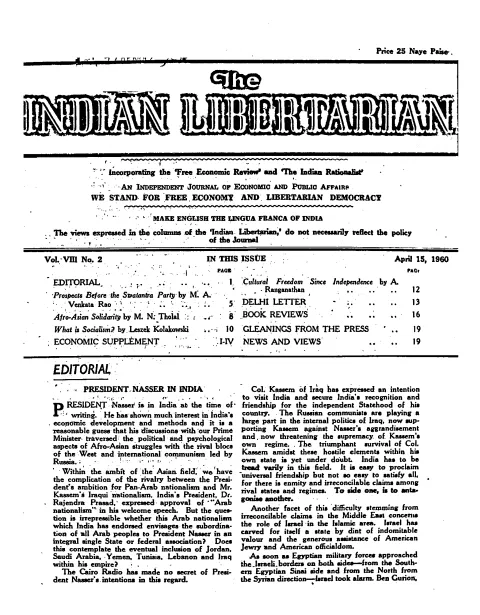
periodical issue
Indian Libertarian
An Independent Journal of Public Affairs
By MA Venkata Rao, M. N. Tholal, J. M. Lobo Prabhu
The Libertarian Publishers (Private) Ltd., First floor, Arya Bhuvan, Sandhurst Road West, Bombay 4. · Bombay · 1964
16 pages
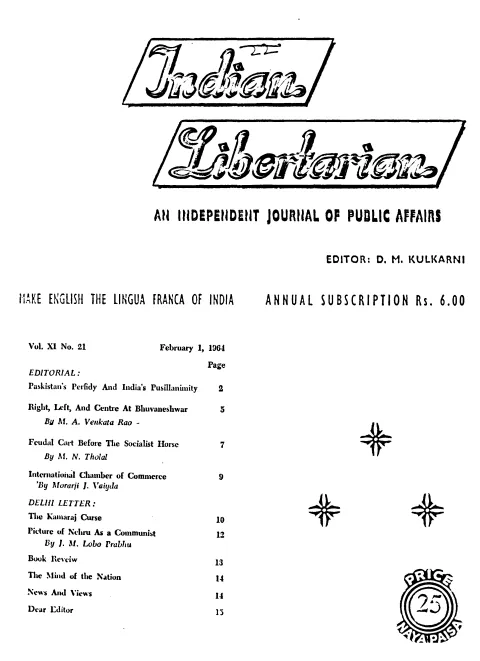
Indian Libertarian
Summary
The Indian Libertarian, Vol. XI No. 21 (1 February 1964), edited by D. M. Kulkarni for Libertarian Publishers Private Ltd., Bombay, is a sixteen-page fortnightly of public-affairs commentary written from a classical-liberal vantage. The issue opens with an editorial scolding the Government of India for its diplomatic complacency toward Pakistan after the Holy Relic disturbances in Kashmir and for indulging what it calls the religious fanaticism of an Arab-summit bloc led by Nasser; a sardonic side-piece urges Nehru to enjoy his “well-earned rest” and stop directing affairs from his sick-bed. The body of the issue carries argumentative pieces by M. A. Venkata Rao on the ideological coordinates of the Congress at Bhubaneswar, M. N. Tholal on the contradiction of grafting Soviet-style socialist planning onto a still-feudal Indian society, a James Kent continuation defending property as a precondition of liberty, Morarji J. Vaiyda’s institutional sketch of the International Chamber of Commerce and India’s place in it, and the Delhi Letter on the “Kamaraj Curse” — the Kamaraj Plan’s effect on Congress organisation and succession politics. J. M. Lobo Prabhu’s lead polemic reads Nehru as a Communist by conduct if not by label, and the issue closes with a John Chamberlain book review of “The Sickness of Socialised Medicine,” a Mind of the Nation column on the changing history of socialism, a News & Views round-up, and a Dear Editor section featuring Henry Meulen of “The Individualist” and notes on Chagla, Swaran Singh and Asoka Mehta.
Key points
-
The unsigned editorial accuses the Indian government of confusing non-violence with timidity in its response to renewed Pakistani assertiveness on Kashmir following the Hazratbal Holy Relic disturbances.
-
A second editorial strand, “Religious Fanaticism of Arab Nations,” attacks the Cairo Arab summit of Nasser, Tito, Nehru, Sukarno, and Ben Bella for taking sides against Israel under cover of non-alignment.
-
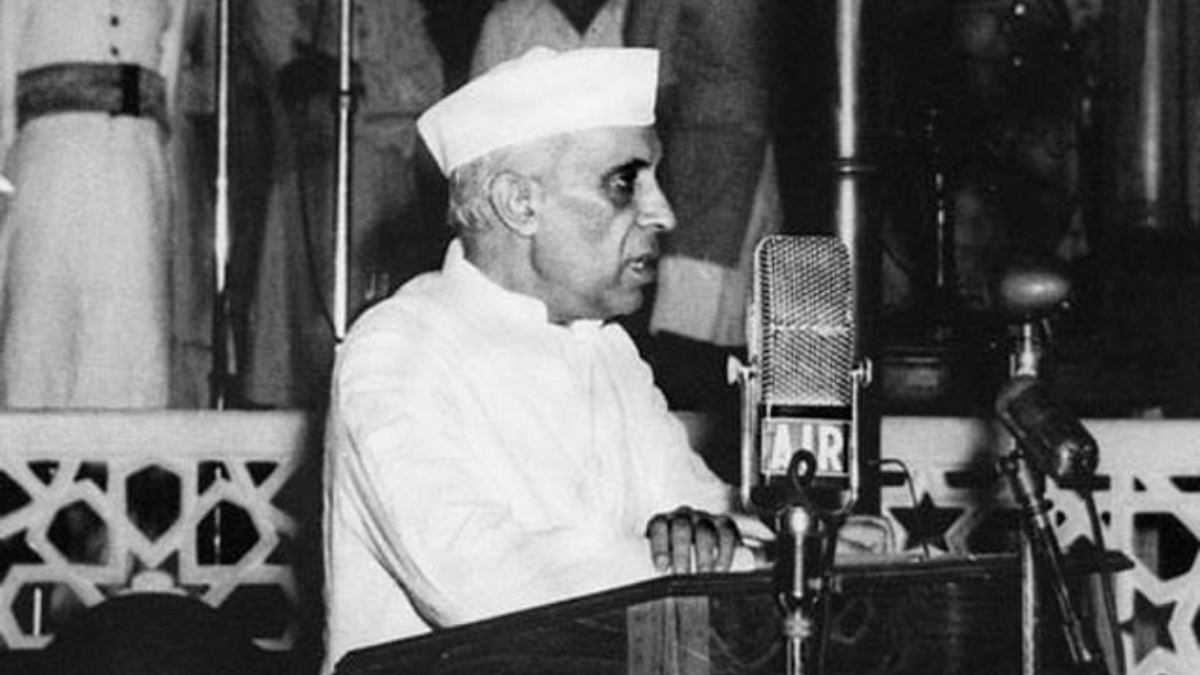
A closing editorial item, “Let Mr. Nehru Enjoy His Well-Earned Rest,” suggests the Prime Minister’s continued direction of government affairs from convalescence is itself a national risk.
-
M. A. Venkata Rao reads the Bhubaneswar Congress session as the party’s first open admission that Indian economic performance had fallen short of its promises.
-
Venkata Rao traces India’s doctrine of inevitable socialism to Hegel’s dialectic and Marx’s appropriation of it, arguing that Indian planning treats state ownership as scientifically certain rather than historically chosen.
-
M. N. Tholal argues that India is harnessing a socialist horse to a feudal cart, since the Soviet planning model assumes an industrial base and a disciplined wage-earning population that Indian conditions do not supply.
-
Tholal draws on Khrushchev’s remarks about peaceful coexistence to argue the Soviet model is itself mellowing, and treats property rights as the missing institutional anchor for genuine Indian reform.
-
Morarji J. Vaiyda, President of the Indian Council of Foreign Trade, describes the International Chamber of Commerce’s seven specialised commissions covering banking, transport, restrictive business practices, distribution, advertising, taxation, and arbitration.
-
Vaiyda stresses the ICC’s role at GATT, the UN Commission on International Commodity Trade, and UNCTAD as the chief organised voice of private enterprise in multilateral economic forums.
Essays
Paskistan’s Perfidy And India’s Pusillanimity
The unsigned editorial argues that Pakistan’s renewed assertiveness on Kashmir — following the disappearance and reappearance of the Holy Relic at Hazratbal and the subsequent communal disturbances — has been met by an Indian Government that confuses non-violence with timidity. The piece accuses New Delhi of trying to placate the United Nations and Afro-Asian opinion instead of telling Pakistan plainly that Kashmir is settled. A second strand, “Religious Fanaticism of Arab Nations,” attacks the Cairo Arab summit (Nasser, Tito, Nehru, Sukarno, Ben Bella) for taking sides against Israel under the cover of non-alignment, and a closing flourish, “Let Mr. Nehru Enjoy His Well-Earned Rest,” suggests the Prime Minister’s continuing direction of affairs from convalescence is itself a national risk.
- Frames Indian policy on Pakistan as pusillanimous non-violence rather than principled restraint.
- Reads the Hazratbal Holy Relic incident and Kashmir agitation as evidence that Pakistan exploits Indian softness.
- Brands the Cairo Arab-summit bloc as religiously fanatical and faults Indian alignment with it against Israel.
- Urges Nehru to take real rest and stop running the Government from his sick-bed.
Right, Left, And Centre At Bhuvaneshwar
By MA Venkata Rao
M. A. Venkata Rao reads the Bhubaneswar session of the Congress as the moment when the party at last admitted in its own resolutions that the Indian economy had not been performing as promised, and uses the occasion to set out the ideological coordinates of “right, left, and centre” within Congress. He traces the contemporary doctrine of inevitable socialism back to Hegel’s dialectic and Marx’s appropriation of it, and argues that the dialectical method, when imported into Indian planning, has produced an ideology that treats state ownership as scientifically certain rather than historically chosen. The essay closes by warning that the Congress drift toward state planning has neither a sound economic rationale nor a clear philosophical defence in Indian conditions.
- Bhubaneswar resolutions are read as Congress’s first open admission that economic performance has fallen short.
- Locates Indian socialism intellectually in Hegel’s dialectic and Marx’s adaptation of it.
- Distinguishes right, left and centre tendencies inside Congress rather than between Congress and its opponents.
- Warns that dialectical inevitability is being mistaken for economic argument.
Feudal Cart Before The Socialist Horse
By M. N. Tholal
M. N. Tholal argues that India is trying to harness a socialist horse to a feudal cart: the Soviet model of collectivised, planned development assumes a developed industrial base and a disciplined wage-earning population, neither of which Indian conditions actually supply. Drawing on Khrushchev’s own remarks about peaceful coexistence and on the recent record of Chinese and Pakistani conduct, Tholal contends that copying Communist methods without their pre-conditions delivers neither the productivity gains of capitalism nor the egalitarian discipline of socialism. The essay culminates in a defence of property rights as the social precondition of any genuine economic reform.
- Indian planning grafts Soviet-style socialism onto a society that is still organisationally feudal.
- Khrushchev’s own talk of peaceful coexistence is used to argue that the Soviet model itself is mellowing.
- Co-operative farming is treated as a slogan without the agrarian preconditions it requires.
- Property rights are framed as the missing institutional anchor for any workable Indian reform.
International Chamber of Commerce
By Morarji J. Vaiyda
Morarji J. Vaiyda, President of the Indian Council of Foreign Trade, offers an institutional sketch of the International Chamber of Commerce and its network of national committees, including India’s. He describes the ICC’s seven specialised commissions — on banking, transport, restrictive business practices, distribution, advertising, taxation and arbitration — and stresses the Chamber’s role at GATT, at the UN Commission on International Commodity Trade and at UNCTAD as the chief organised voice of private enterprise in multilateral economic forums. The essay treats the ICC as a model for what an organised Indian commercial community can become if it learns to speak through credible institutional channels.
- Maps the ICC’s seven specialised commissions and how they intersect with multilateral economic governance.
- Identifies GATT, the UN commodity trade commission and UNCTAD as the main bodies where the ICC is consulted.
- Casts the Indian National Committee as the bridge between domestic business and world commercial diplomacy.
- Implicitly argues that organised private enterprise needs disciplined institutional representation, not just lobbying.
DELHI LETTER: The Kamaraj Curse
By From Our Correspondent
The Delhi Letter argues that the Kamaraj Plan has functioned less as organisational renewal than as a curse on the Congress: senior ministers were pushed out to make space for party work, but the resulting succession scrum has left the leadership question — Nehru’s eventual successor — more unsettled, not less. The piece reads the recent by-election defeats in U.P., Morarji Desai’s relegation, Lal Bahadur Shastri’s return to Cabinet, and the Patnaik–Bidhan Roy manoeuvring as symptoms of a party where ideological direction is being decided by office politics rather than principle.
- The Kamaraj Plan is portrayed as having disorganised rather than rejuvenated the Congress.
- U.P. by-election defeats are read as a verdict on the party’s drift.
- Lal Bahadur Shastri’s return and Morarji Desai’s eclipse signal that succession will be decided by faction, not by policy.
- Asoka Mehta’s defence of the U.P.S.C. (state public sector) is treated as ideologically symptomatic.
Picture of Nehru As a Communist
By J. M. Lobo Prabhu
J. M. Lobo Prabhu, taking off from Sitaram Goel’s recent book defending V. K. Krishna Menon, argues that the practical record of Indian foreign and economic policy under Nehru — non-alignment that tilts against the Anglo-American bloc, growing state ownership, deep economic engagement with Communist states, and rhetorical solidarity with the Soviet position — produces a picture of Nehru as a Communist in conduct if not in label. The essay reads recent gestures toward Pakistan and the handling of the Kashmir question as further evidence and treats the public sector’s expansion as the domestic counterpart of that foreign orientation.
- Reads Nehru’s foreign policy as systematically tilted toward the Communist bloc beneath the language of non-alignment.
- Treats expanding state ownership and the public sector as the domestic face of that orientation.
- Uses Sitaram Goel’s defence of Krishna Menon as a point of entry rather than the target of polemic.
- Argues the picture cannot be explained away by tactical considerations or diplomatic balance.
Book Reveiw
By John Chamberlain
The Book Review notice covers John Chamberlain’s “The Sickness of Socialised Medicine,” using the British National Health Service experience under Aneurin Bevan to argue that state monopolies in healthcare degrade both supply and the doctor–patient relationship. The reviewer commends Chamberlain’s framing as a warning to Indian planners who think a state-run medical system would solve access and equity problems and would not produce the rationing, queueing and quality decline visible in Britain.
- Treats the British NHS under Aneurin Bevan as the cautionary case study.
- Argues that socialised medicine degrades both supply and the clinical relationship.
- Reads the book as a warning to Indian planners considering state-run healthcare.
The Mind of the Nation
The Mind of the Nation column, signed “Faqirjee,” surveys the changing history of socialism, observing that Marx’s expected proletarian revolution has not materialised in industrial societies, while Tito’s Yugoslavia and other ostensibly socialist regimes have quietly imported the price mechanism and elements of private property back into their economies. The columnist takes this as evidence that socialism in practice is moving steadily away from its doctrinal foundations and toward the very market disciplines its founders set out to overthrow.
- Reads Marx’s failed prediction of proletarian revolution as the central anomaly of twentieth-century socialism.
- Cites Tito’s Yugoslavia as the prototype of socialism quietly returning to market mechanisms.
- Treats the trajectory of socialism in office as a confirmation of liberal economic intuitions.
News And Views
The News & Views section bundles short notices on a reported new Soviet base in Cuba, food-production shortfalls flagged by Union Food and Agriculture Minister Swaran Singh against the Second Plan target, Education Minister M. C. Chagla’s defence of English at Jadavpur University against any sudden change-over to regional languages, and Planning Commission Deputy Chairman Asoka Mehta’s claim before the Commission Club that South-East Asian economies that adopted radical policies have not moved forward. Each item is presented as supporting the issue’s larger sceptical reading of Indian planning and language policy.
- Reports that food production is still at second-plan levels despite a 23 per cent target.
- Records Chagla’s argument that English must stay as the medium of higher education.
- Carries Asoka Mehta’s admission that some radical South-East Asian economies have sagged.
- Headlines a reported new Soviet base in Cuba as a Cold War alert.
Dear Editor
The Dear Editor section carries a single signed letter from Henry Meulen, editor of “The Individualist” (London), responding to Professor Lawande’s earlier piece on heavy industries and state enterprise. Meulen disputes Lawande’s premise that heavy industry necessarily exceeds private capital’s reach, arguing that Western experience shows private capitalists have repeatedly financed heavy industry where the political climate allows them to keep the profit, and that the chief obstacle to such private investment in under-developed countries is not capital scarcity but the uncertainty manufactured by governments themselves.
- Meulen rejects the premise that heavy industry is intrinsically beyond private investment.
- Argues that political uncertainty, not capital shortage, blocks private investment in under-developed countries.
- Frames the exchange as a transnational liberal correspondence between The Individualist and The Indian Libertarian.
Generated by the v1.5 extraction pipeline. Awaiting editorial review.
Metadata and summary are AI-extracted from the source PDF and reviewed for editorial accuracy. The original work is available via the Read PDF tab above (where present); paragraph-level citation inside the PDF is deferred to a future engagement.