edited volume · anthology
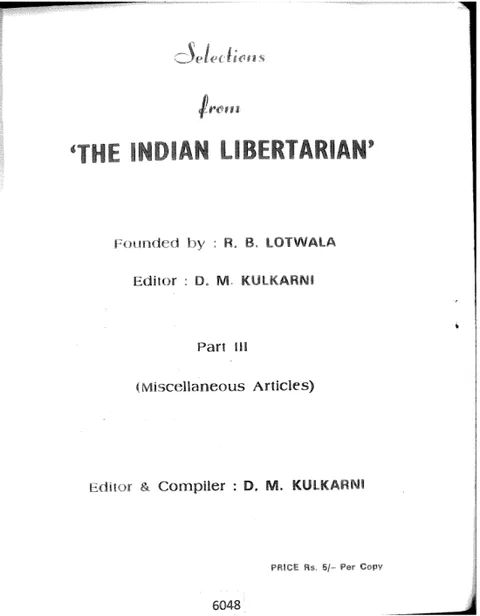
Selections from 'The Indian Libertarian'
Part II, 1971 to 1981
Founded by: R. B. Lotwala; Editor & Compiler: D. M. Kulkarni · Bombay · 1981
52 pages
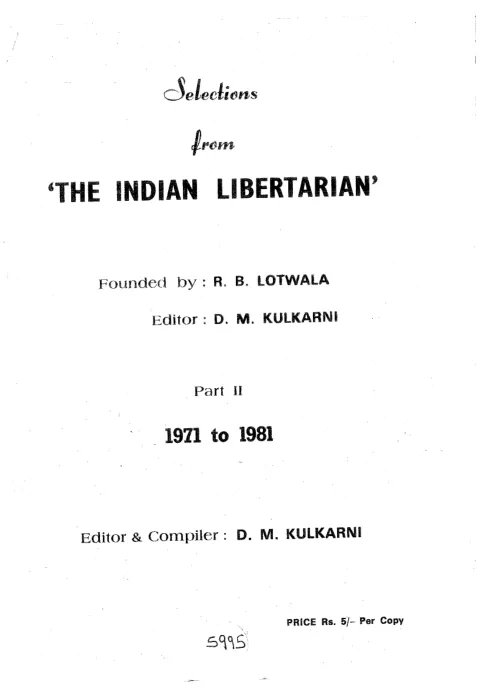
Selections from ‘The Indian Libertarian’
Summary
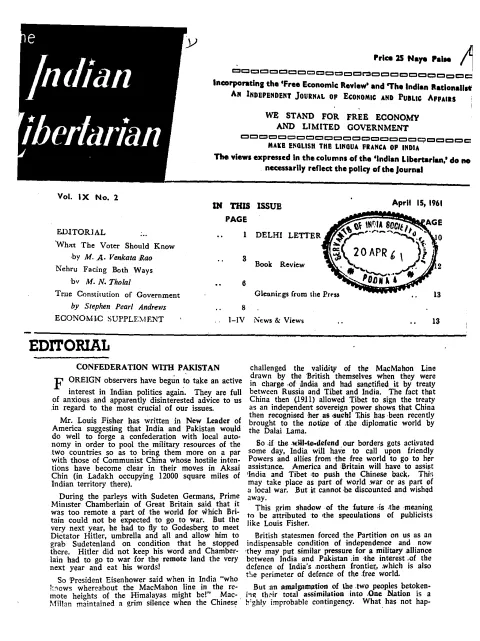
This is Part II of ‘Selections from The Indian Libertarian’, a thematic anthology compiled by editor D. M. Kulkarni of articles drawn from the Bombay journal founded by R. B. Lotwala, covering the period 1971 to 1981. The opening section is a memorial to Lotwala (d. 12 March 1971), a Bombay flour-mill magnate and press baron who bankrolled radical, rationalist and libertarian causes in early-twentieth-century India and patronised M. N. Roy. The rest of the volume groups reprinted articles by subject — Libertarianism, Economics, Democratic Politics, Foreign Policy, Language and Rationalism — presenting the journal’s classical-liberal and Georgist ‘single tax’ positions, its rationalist and secular-humanist commitments, and its sharp criticism of socialism, casteism and Congress politics. In the rendered pages the anthology argues, through a review of Tibor Machan’s ‘The Libertarian Alternative’ and articles on Henry George’s single tax, that liberty rests on property rights and a strictly limited state.
Key points
-
Part II of ‘Selections from The Indian Libertarian,’ compiled by editor D. M. Kulkarni, opens with a life-sketch memorial to founder R. B. Lotwala, who died 12 March 1971 at Deolali aged ninety-five.
-
Lotwala, a Bombay flour-mill industrialist who founded the Hindustan Press and The Hindustan daily, is presented as the financial backer who sustained M. N. Roy’s propagation of communist doctrine in India from 1919 to 1929.
-
A companion piece, ‘R. B. Lotwala the Rationalist,’ traces his libertarianism to Bakunin and Kropotkin and criticises the ‘double life’ of educated Indians who privately reject but publicly observe superstition, singling out Nehru as an example.
-
A review of Tibor R. Machan’s thirty-seven essay anthology The Libertarian Alternative summarises its core doctrine that every person owns his own life and labour and that property rights are the foundation of all other rights.
-
The review names libertarian writers including Mises, Hazlitt, Friedman, Rothbard and Hospers, and argues government should answer ‘no’ to minimum wages, price-fixing and managing the money supply.
-
Two further articles set out Henry George’s single-tax proposal to fund government from a tax on land value, reflecting Lotwala’s own late-life interest in land-value taxation as a remedy for poverty.
-
A closing piece contrasts Japan’s postwar economic prosperity with India’s stagnation, arguing that Japan’s success vindicates market-oriented development over state planning as a lesson for Indian policy.
Essays
R. B. Lotwala: The Prophet of Human Freedom — A Life-Sketch
D. M. Kulkarni’s life-sketch, ‘Shri R. B. Lotwala: The Prophet of Human Freedom’, commemorates Ranchhoddas Bhavan Lotwala (d. 12 March 1971 at Deolali, aged 95). Born into an orthodox Lohana family of Bombay, Lotwala built a fortune from a roller flour mill and founded the Hindustan Press and ‘The Hindustan’ daily. The sketch presents him as the silent, dynamic patron behind India’s radical, rationalist and libertarian movements, and the financial backer who sustained M. N. Roy’s communist work in India.
- Lotwala (d. 12 March 1971, aged 95) was a Bombay flour-mill industrialist and press baron.
- He founded the Hindustan Press and ‘The Hindustan’ daily (1915, renamed ‘Hindustan Praja-Mitra’ 1926).
- He financed M. N. Roy’s propagation of communist doctrine in India, 1919-1929.
- He was associated with Vithalbhai Patel, M.P.T. Acharya and S. A. Dange.
R. B. Lotwala the Rationalist
‘R. B. Lotwala the Rationalist’ (signed ‘I. L., May 1975’) portrays Lotwala as a self-made rationalist who built a library of Marxian literature, embraced the libertarianism of Bakunin and Kropotkin, and combined intellectual rigour with a private practice of rejecting religious superstition. It contrasts his consistency with what it calls the ‘schizophrenia’ of educated Indians who privately doubt yet publicly conform to superstition, and singles out Nehru as one who ‘sports his rationalism when the occasion suits him’ but otherwise runs with the orthodox crowd.
- Casts Lotwala as a consistent rationalist who lived his anti-superstition principles.
- Traces his libertarianism to Bakunin and Kropotkin and the anti-Marxist anarchist tradition.
- Criticises the ‘double life’ of highly educated Indians who privately reject but publicly observe superstition.
The Libertarian Alternative to Big Business, Big Government and Big Labour
‘The Libertarian Alternative to Big Business, Big Government and Big Labour’ reviews Tibor R. Machan’s anthology ‘The Libertarian Alternative’ (Nelson Hall, Chicago), a collection of 37 essays by exponents of libertarianism. It summarises the book’s core doctrine — that every person owns his own life and labour, that property rights are the basis of all other rights, and that government must be confined to protecting life, liberty and property — drawing especially on John Hospers’s essay ‘What Libertarian Is’.
- Reviews Tibor R. Machan’s 37-essay anthology ‘The Libertarian Alternative’.
- States property rights are the foundation of all other rights.
- Names libertarian writers including Mises, Hazlitt, Friedman, Rothbard and Hospers.
- Argues government should answer ‘no’ to minimum wages, price-fixing and managing the money supply.
”The Single Tax” System of Henry George
‘“The Single Tax” System of Henry George’ sets out the Georgist proposal to fund government from a single tax on the value of land, reflecting the founder Lotwala’s late-life interest in the single-tax alternative. Together with the companion piece ‘12 Reasons Why Georgist Reforms are Needed Now’, it presents land-value taxation as a remedy for poverty and economic injustice consistent with the journal’s libertarian outlook.
- Explains Henry George’s single tax on land values.
- Reflects Lotwala’s late interest in the ‘Single Tax Alternative’.
- Paired with an article giving 12 reasons Georgist reforms are needed now.
Economic prosperity of Japan and The Lessons it holds for India
‘Economic prosperity of Japan and The Lessons it holds for India’ contrasts Japan’s postwar economic success with India’s stagnation, drawing free-market lessons for Indian policy. In the rendered pages it argues that Japan’s prosperity vindicates market-oriented development over state planning.
- Holds up Japan’s postwar prosperity as a model for India.
- Draws free-market policy lessons against state planning.
Generated by the v1.5 extraction pipeline. Awaiting editorial review.
Metadata and summary are AI-extracted from the source PDF and reviewed for editorial accuracy. The original work is available via the Read PDF tab above (where present); paragraph-level citation inside the PDF is deferred to a future engagement.