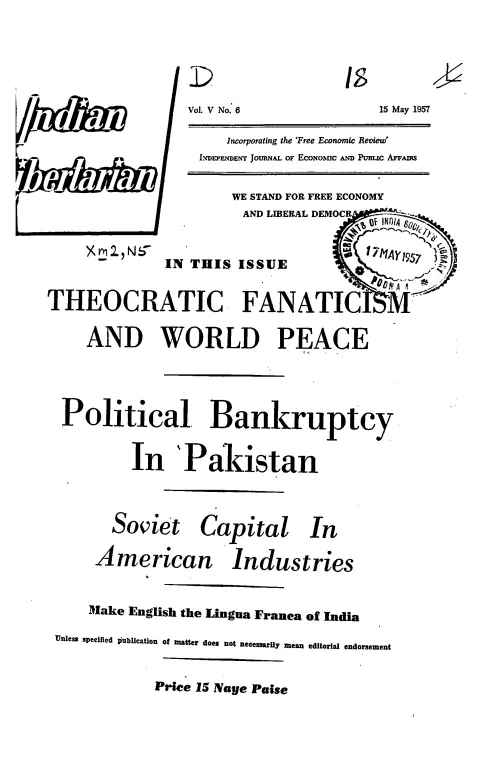
periodical issue
The Indian Libertarian
Independent Journal of Economic and Public Affairs
By MA Venkata Rao, J. K. Dhairyawan
The Indian Libertarian, Arya Bhuvan, Sandhurst Road, Bombay 4 · Bombay · 1957
20 pages
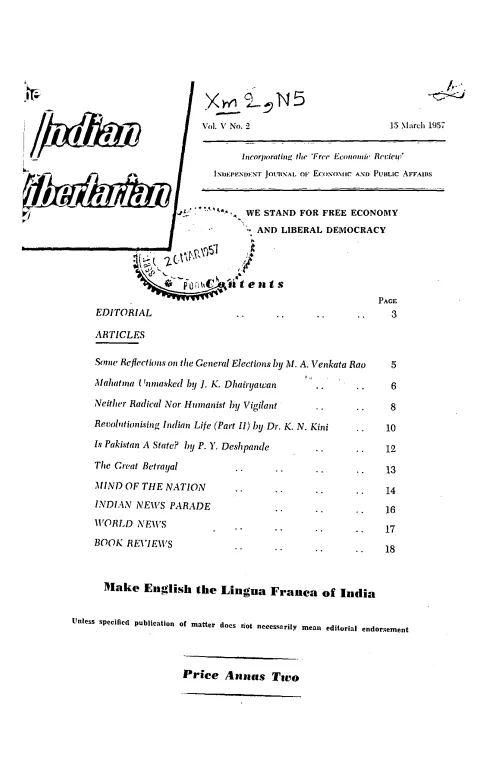
The Indian Libertarian
Summary
The Indian Libertarian, Vol. V No. 2 (15 March 1957), is an issue of the Bombay fortnightly ‘Independent Journal of Economic and Public Affairs’ edited by Kusum Lotwala, appearing under the banner ‘We Stand for Free Economy and Liberal Democracy.’ This issue is framed by the second Indian general elections of 1957: an unsigned editorial attacks Nehru’s foreign policy and his statements on Kashmir and Pakistan, while the lead article by M. A. Venkata Rao reflects on the election results and the prospects of opposition liberalism. Other contributions critique Gandhian thought (J. K. Dhairyawan), assess the Radical Humanist movement of M. N. Roy (‘Vigilant’), continue a series on social and religious reform (Dr. K. N. Kini), and debate Pakistan’s statehood and India’s policy toward it (P. Y. Deshpande). The issue closes with the recurring ‘The Great Betrayal’ commentary on the Cold War, a ‘Mind of the Nation’ press-digest section, news roundups, and book reviews.
Key points
-
Framed by India’s second general elections of 1957, the editorial attacks Nehru’s foreign policy and his statements on Kashmir and Pakistan.
-
M. A. Venkata Rao’s ‘Some Reflections on the General Elections’ argues Congress dominates through organisation, money and patronage rather than ideas, and distinguishes democratic ‘precept’ from actual ‘practice’ in Indian politics.
-
J. K. Dhairyawan’s ‘Mahatma Unmasked’ offers a critical reassessment of Gandhi, drawing on P. Chandra Ghosh’s work to argue his saintly reputation masks a record of political contradiction and failure.
-
Writing under the pseudonym ‘Vigilant’, a contributor uses the Kashmir question to test and find wanting the consistency of M. N. Roy’s Radical Humanist movement.
-
Dr. K. N. Kini’s serial ‘Revolutionising Indian Life’ (Part II) calls for rooting out superstition and reorienting worship away from idolatry, and links this cultural reform to a broader economic case against socialism.
-
P. Y. Deshpande’s ‘Is Pakistan A State?’ questions whether Pakistan meets the criteria of genuine statehood, citing its geographic division and dependence on foreign powers.
-
‘The Great Betrayal’ revisits Western dealings with the Soviet Union since the Second World War, commenting critically on Rockefeller-funded internationalism.
-
The ‘Mind of the Nation’ press digest foregrounds Nehru’s foreign policy and Kashmir ahead of United Nations discussions, and the issue closes with a review of Ludwig von Mises’s ‘Anti-Capitalist Mentality’.
Essays
Some Reflections on the General Elections
By MA Venkata Rao
M. A. Venkata Rao reflects on the 1957 general elections, reading the results as evidence that Indian democracy is maturing but remains dominated by the Congress and its patronage machinery. He weighs the performance of opposition candidates and parties, the financial and organisational obstacles that liberal and conservative forces face against the ruling party, and the gap between democratic precept and practice in Indian electoral life.
- Reads the 1957 general elections as a test of India’s young democratic institutions.
- Argues the Congress dominates through organisation, money and patronage rather than ideas.
- Notes the structural handicaps facing opposition and liberal candidates.
- Distinguishes democratic ‘precept’ from actual ‘practice’ in Indian politics.
Mahatma Unmasked
By J. K. Dhairyawan
J. K. Dhairyawan offers a critical reassessment of Gandhi, arguing that the Mahatma’s reputation for spirituality and saintliness obscures a record of political failure and contradiction. Drawing on a reading of P. Chandra Ghosh’s work, the essay challenges the conventional view of Gandhi’s leadership and his place in the freedom movement, questioning the substance behind the public image.
- Disputes the conventional image of Gandhi as a spiritual and political success.
- Engages P. Chandra Ghosh’s critical account of Gandhi.
- Argues Gandhi’s saintly reputation masks political contradictions.
Neither Radical Nor Humanist
By Vigilant
Writing under the pseudonym ‘Vigilant’, this essay critiques the Radical Humanist movement associated with M. N. Roy, arguing that it is ‘neither radical nor humanist.’ Framed around the Kashmir question and India’s claim to the state, the piece examines the movement’s positions and finds them wanting, using the Kashmir dispute as a test case for the consistency of radical and humanist principles.
- Attacks the Radical Humanist movement of M. N. Roy as failing its own labels.
- Uses the Kashmir question as a test of the movement’s principles.
- Questions the coherence of ‘radical’ and ‘humanist’ as applied to the movement.
Revolutionising Indian Life (Part II)
By Dr. K. N. Kini
Dr. K. N. Kini continues his series ‘Revolutionising Indian Life’ (Section II), attacking superstition and calling for the rationalisation of social and religious life. He argues that worship and ritual should be reoriented away from idols and toward enlightenment, that the clergy should help rather than hinder reform, and connects this cultural reform to the broader case against socialism and for spiritual and economic freedom.
- Continues a series calling for the rooting out of superstition in Indian life.
- Argues for reorienting worship away from idolatry toward enlightenment.
- Calls on the clergy to assist social reform.
- Links cultural reform to an economic and spiritual case against socialism.
Is Pakistan A State?
By P. Y. Deshpande
P. Y. Deshpande asks ‘Is Pakistan A State?’, examining whether Pakistan meets the criteria of genuine statehood given its geographic division, internal tensions, and dependence on foreign powers. He reviews Pakistan’s foreign policy and its conduct over Kashmir, and argues that India needs a clearer interpretation of Pakistan’s character to frame a realistic policy toward it.
- Questions whether Pakistan qualifies as a genuine, viable state.
- Points to geographic division and external dependence as weaknesses.
- Reviews Pakistan’s foreign policy and the Kashmir dispute.
- Calls for a clearer Indian interpretation of Pakistan to guide policy.
The Great Betrayal
‘The Great Betrayal’ is a Cold War commentary that revisits the Western powers’ dealings with the Soviet Union, tracing what the author regards as a record of concession and betrayal from the Second World War onward. It discusses Rockefeller-funded internationalism, the role of the United States, and the obligations of free nations in the global contest with communism.
- Frames Cold War history as a ‘betrayal’ by Western powers in their dealings with the USSR.
- Traces concessions from the Second World War onward.
- Comments critically on Rockefeller-funded internationalism and U.S. policy.
Mind of the Nation
‘The Mind Of The Nation’ is a digest of opinion from the contemporary Indian press, assembling extracts and editorial commentary on the political questions of the moment. In this issue it foregrounds Nehru’s foreign policy, the ‘No Votes’ debate around the election, Kashmir on the eve of the U.N. discussions, and the state of the nation after the general elections.
- Assembles and comments on extracts from the Indian press.
- Highlights Nehru’s foreign policy and the post-election political mood.
- Touches on Kashmir ahead of U.N. discussions.
Book Reviews
The ‘Book Reviews’ section opens with a review of ‘Anti-Capitalist Mentality’ by Ludwig von Mises, published by the Libertarian Publishers and translated by Fred C. Clark. The reviewer engages Mises’s argument that hostility to capitalism springs from psychological resentment rather than reasoned economic analysis.
- Reviews Ludwig von Mises’s ‘The Anti-Capitalist Mentality’.
- Notes the Libertarian Publishers edition and Fred C. Clark’s role.
- Engages Mises’s thesis that anti-capitalism is rooted in resentment.
Generated by the v1.5 extraction pipeline. Awaiting editorial review.
Metadata and summary are AI-extracted from the source PDF and reviewed for editorial accuracy. The original work is available via the Read PDF tab above (where present); paragraph-level citation inside the PDF is deferred to a future engagement.