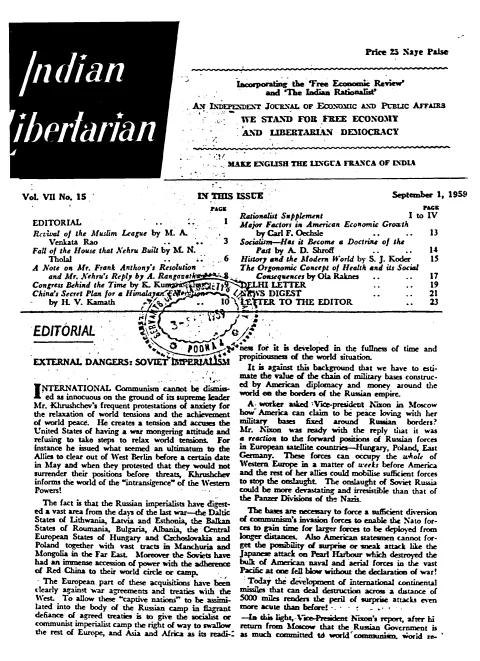
periodical issue
The Indian Libertarian
Independent Journal of Economic and Public Affairs
By MA Venkata Rao, M. N. Tholal, A Ranganathan
The Indian Libertarian, Published by E. D. Lotwala for the Libertarian Publishers (Private) Ltd. · Bombay · 1959
32 pages
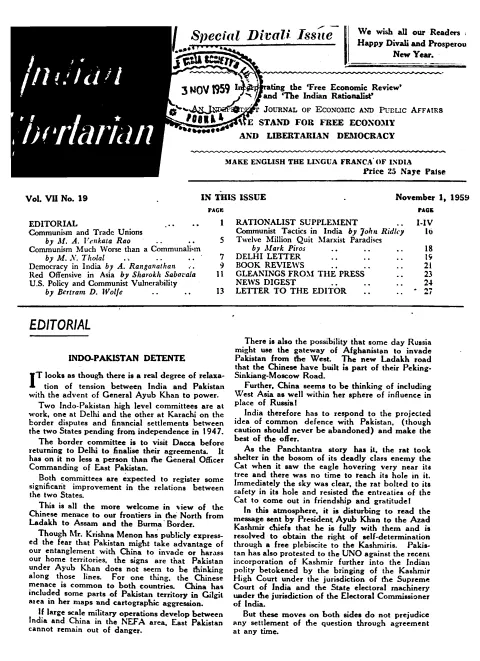
The Indian Libertarian
Summary
This November 1, 1959 ‘Special Divali Issue’ of The Indian Libertarian (Vol. VII No. 19), a Bombay fortnightly edited by Miss Kusum Lotwala for Libertarian Publishers, gathers an unsigned editorial and a cluster of essays unified by a single preoccupation in the rendered pages: the threat that communism poses to India’s economy, polity, and trade-union freedom, set against the contemporary backdrop of Chinese border incursions and Indo-Pakistan relations under Ayub Khan. The editorial weighs an ‘Indo-Pakistan detente’ alongside the Chinese menace in Ladakh, NEFA and Tibet, while the bylined articles—M. A. Venkata Rao on trade unions, M. N. Tholal contrasting communism with communalism, A. Ranganathan on parliamentary democracy, Sharokh Sabavala on China’s ‘Red Offensive in Asia’, and Bertram D. Wolfe on communist vulnerability—argue from a classical-liberal, anti-collectivist standpoint. A separately paginated ‘Rationalist Supplement’ (pp. I–IV) carries pieces on the Catholic church, rationalism, and the origin of priesthood. Coverage here is drawn from the rendered front portion of the issue.
Key points
-
M. A. Venkata Rao contrasts workers’ rights under free societies, where they may organise, strike, and change employers, with communist states, where unions become “tools of state” serving the regime.
-
Venkata Rao cites Lenin’s formula casting the trade union as “a school of administration, a school of management, a school of communism,” rather than a defender of workers’ interests.
-
He notes that Soviet and Eastern-bloc trade-union charters make strikes offences under common law, converting unions into “transmission belts” for Communist High Command orders.
-
M. N. Tholal argues communism is more dangerous than the communalism Indian opinion usually fears most, since it claims a monopoly of office and denies minorities any equal right to rule.
-
Tholal cites the Soviet succession from Lenin through Stalin to Khrushchev as proof that communism’s monopoly on power makes internecine conflict and dictatorship structurally unavoidable.
-
Tholal criticises Nehru’s foreign policy for resting on flawed assumptions about communism and for failing to expose its true nature, reviewing the Andhra split inside the Praja Socialist Party.
-
A. Ranganathan attacks Indian politicians who romanticise a “mythical institution of the soil,” defending inherited British parliamentary democracy against nativist appeals to ancient village republics.
-
Ranganathan invokes Ambedkar’s critique of village life to rebut the idealisation of village republics, while faulting the Communist Party for treating Parliament as a mere stepping-stone to power.
-
Sharokh Sabavala, reporting on India for the Christian Science Monitor, surveys China’s “Red Offensive,” noting Chinese forces captured border posts over 1,000 miles apart in NEFA and Ladakh while Peking advanced cartographic claims to Nepal, Sikkim, Bhutan, and Assam.
Essays
Communism and Trade Unions
By MA Venkata Rao
Venkata Rao contrasts the position of workers under free societies with their condition under communism. In the free world, he argues, workers are full citizens with the right to organise, strike, and bargain as a last resort against employers; under a communist state they lose this primary protective function and become ‘tools of state’, their unions converted into ‘transmission belts’ for the orders of the Communist High Command. He marshals quotations from Soviet and Eastern-bloc trade-union charters and officials to show that strikes are forbidden as anti-state acts and that the union’s role is to raise labour productivity and enforce discipline rather than defend workers’ economic interests.
- In free societies workers may organise, strike, and change employers; the strike is a last-resort protection.
- Under communism unions lose their protective function and serve the state.
- Lenin’s formula casts the union as ‘a school of administration, a school of management, a school of communism’.
- Soviet/Eastern-bloc charters make strikes ‘part of common law’ offences and forbid them.
- Unions become ‘transmission belts’ for Communist High Command orders.
Communism Much Worse than a Communalism
By M. N. Tholal
Tholal argues that communism is far more dangerous than communalism, the evil Indian opinion usually fears most. Reviewing the Andhra split inside the Praja Socialist Party and Acharya Narendra Deva’s death, he contends that communism, by claiming for itself an exclusive monopoly of office and the ‘loaves and fishes’ of power while denying minorities any equal right to rule, makes internecine conflict and dictatorship inevitable—citing the Soviet succession from Lenin through Stalin to Khrushchev as proof. He criticises Nehru’s foreign policy for its uncritical assumptions and its failure to expose communism’s true nature.
- Communalism is the evil Indians fear, but communism is far worse.
- Communism claims a monopoly of office and denies minorities equal right to rule.
- This makes internecine war and dictatorship structurally unavoidable.
- The Soviet succession (Lenin-Stalin-Khrushchev) illustrates the pattern.
- Nehru’s foreign policy rests on flawed assumptions and fails to expose communism.
Democracy in India
By A Ranganathan
Ranganathan attacks Indian politicians who ‘hanker after a mythical institution of the soil’ and the Communist Party’s attitude of treating Parliament as a mere stepping-stone to power rather than valuing private-sector and individual rights. Opening with debates in the Constituent Assembly over whether India’s parliamentary forms were authentically Indian, he defends inherited British parliamentary democracy against romantic appeals to ancient village republics, invoking Ambedkar’s critique of village life. Only the opening of the essay is in the rendered pages.
- Critiques politicians who romanticise a ‘mythical institution of the soil’.
- Faults the Communist Party for treating Parliament merely as a stepping-stone to power.
- Defends inherited parliamentary democracy against nativist objections.
- Invokes Ambedkar against the idealisation of ancient village republics.
Red Offensive in Asia
By Sharokh Sabavala
Sabavala, who reports on India for the Christian Science Monitor, surveys China’s ‘Red Offensive’ across South Asia: communist guerrilla forces in North Vietnam, the Chinese incursion of over 1,000 miles into Indian territory in NEFA and Ladakh, and Peking’s cartographic claims to Nepal, Sikkim, Bhutan and Assam. He notes Nehru’s protests to Peking and warnings that an attack on Sikkim or Bhutan would be tantamount to aggression against India, set against the ‘big thaw’ in East-West relations after the Khrushchev-Eisenhower exchanges.
- Frames a Sino-neutralist ‘big freeze’ against the East-West ‘big thaw’.
- Chinese forces captured border posts over 1,000 miles apart in NEFA and Ladakh.
- Peking advances cartographic claims to Nepal, Sikkim, Bhutan and Assam.
- Nehru warns an attack on Sikkim or Bhutan equals aggression against India.
U.S. Policy and Communist Vulnerability
By Bertram D. Wolfe
Wolfe argues that communism, far from being invulnerable, has exploitable weaknesses, and that the West fails to attack them only because it does not understand its enemy. He traces the theoretical foundation of the movement to Marxism and the unfulfilled prophecies of the Communist Manifesto, contrasting Marx’s and Engels’s predictions of the worker’s growing immiseration with the actual rise in living standards in the West. Only the essay’s opening is in the rendered pages.
- Communism has real, exploitable vulnerabilities.
- The West neglects them through failure to understand the enemy.
- Locates the movement’s theoretical foundation in Marxism.
- Contrasts Manifesto prophecies of immiseration with rising Western living standards.
Generated by the v1.5 extraction pipeline. Awaiting editorial review.
Metadata and summary are AI-extracted from the source PDF and reviewed for editorial accuracy. The original work is available via the Read PDF tab above (where present); paragraph-level citation inside the PDF is deferred to a future engagement.