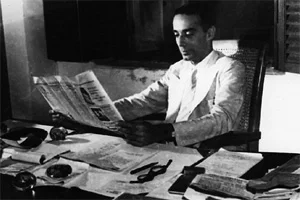
speech
The Retreat From Socialism
By BK Nehru
Published by: M & J Services, “Mohan Kunj”, Gr. Floor, 68, Jyotiba Phule Marg, Behind Gurudwara, Dadar, Bombay 400 014; Copyright: The Project for Economic Education · Bombay · 1990
12 pages
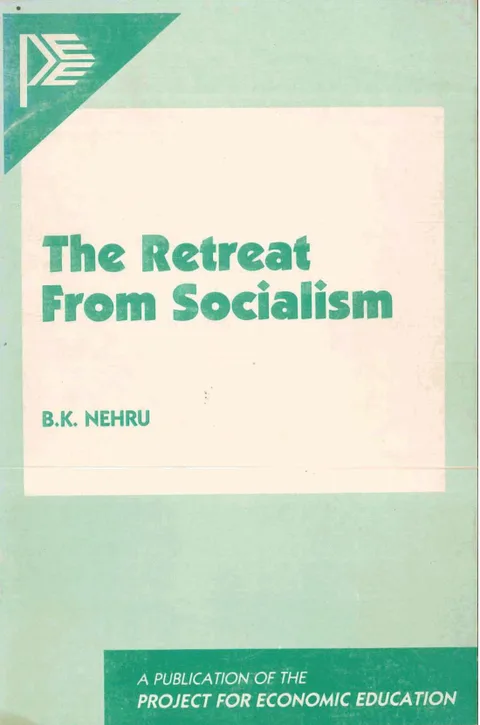
The Retreat From Socialism
By B.K. NEHRU
Summary
This booklet reproduces the Seventh C.D. Deshmukh Memorial Lecture, “The Retreat From Socialism,” delivered by B.K. Nehru at the India International Centre, Delhi on 14 January 1990. After an opening tribute to Sir Chintaman Deshmukh — under whom Nehru trained at the Reserve Bank of India and whose career as Finance Secretary, Governor of the RBI, and Union Finance Minister he recalls — Nehru turns to his central theme: the worldwide collapse of confidence in socialist economic organisation and what it implies for India.
Nehru traces the intellectual history of the socialist idea, from Adam Smith and the rise of the market through Marx and the Great October Revolution of 1917, and the subsequent spread of Communist and Fabian socialism. He argues that the system of comprehensive state ownership, central planning, and suppression of private enterprise — adopted in India under the influence of Fabian thinking — has failed on its own terms, producing inefficiency, shortages, and a vast apparatus of controls rather than the prosperity and equality it promised. He points to the reformist turns under Margaret Thatcher in Britain and Deng Xiaoping in China, and to the wider “retreat” across the socialist world, as evidence that the tide has turned against state command of the economy.
In the rendered pages Nehru presses the case for restructuring India’s economic policies — what he frames, borrowing Gorbachev’s term, as a kind of “perestroika” — toward markets, private enterprise, and a smaller, less controlling state, while remaining attentive to the social costs of transition. The text closes (printed pp. 14–15) by setting out the choice he sees facing India between continued statism and economic freedom. M.R. Masani contributes a short publisher’s foreword commending Nehru as “a good economist” and “a good man.”
Key points
-
The work is the text of the Seventh C.D. Deshmukh Memorial Lecture, delivered by B.K. Nehru at the India International Centre, Delhi, on 14 January 1990.
-
Nehru opens with an extended personal tribute to Sir Chintaman (C.D.) Deshmukh, recalling training under him at the Reserve Bank of India and Deshmukh’s career as RBI Governor and Union Finance Minister.
-
The lecture’s thesis is that socialism — state ownership, central planning, and the suppression of private enterprise — has failed worldwide and is in retreat.
-
Nehru sketches an intellectual lineage from Adam Smith through Marx, the 1917 Revolution, and the global spread of Communist and Fabian socialism that India absorbed.
-
He cites reform movements under Margaret Thatcher in Britain and Deng Xiaoping in China as signal instances of the worldwide turn away from state command.
-
He argues India’s controls-and-planning regime produced inefficiency and shortages rather than the prosperity and equality it promised.
-
Echoing Gorbachev’s “perestroika,” he calls for a restructuring of Indian economic policy toward markets, private enterprise, and a smaller state.
-
The booklet carries a publisher’s foreword by M.R. Masani and was issued by the Project for Economic Education with Friedrich Naumann Stiftung support.
Generated by the v1.5 extraction pipeline. Awaiting editorial review.
Metadata and summary are AI-extracted from the source PDF and reviewed for editorial accuracy. The original work is available via the Read PDF tab above (where present); paragraph-level citation inside the PDF is deferred to a future engagement.